
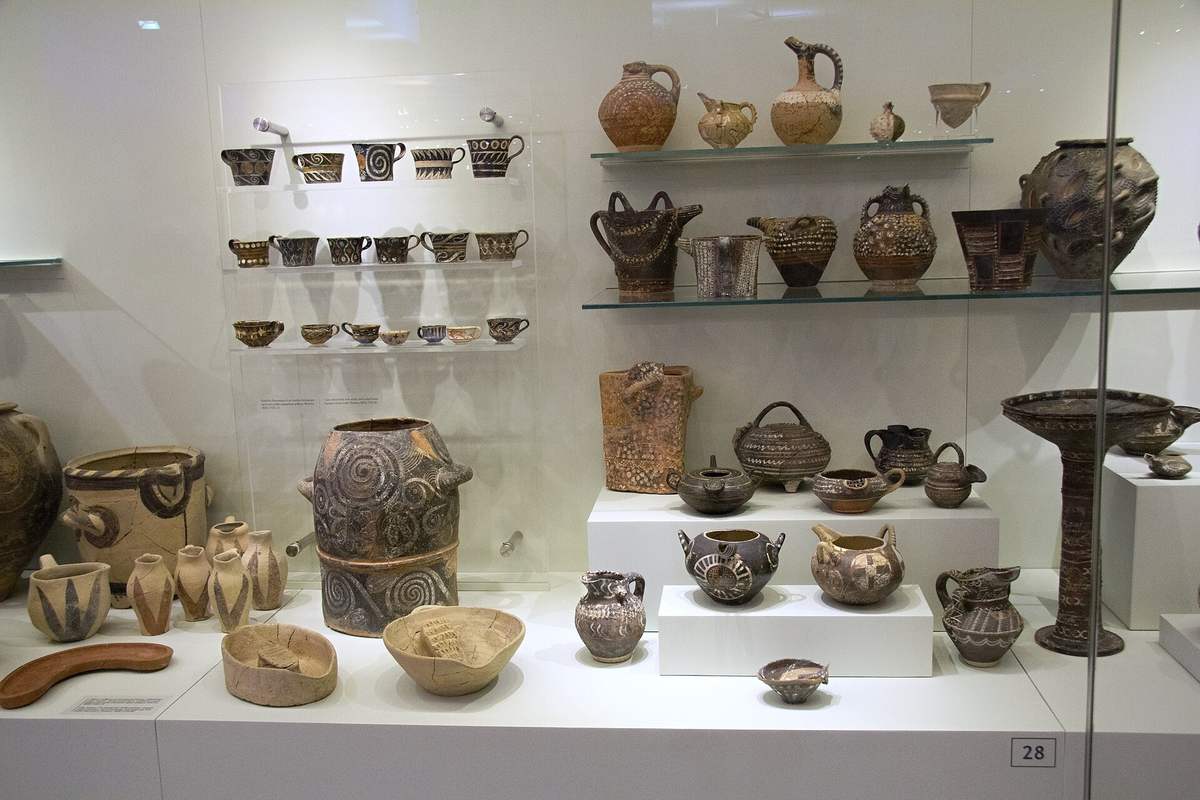
Kamares ware is a fine polychrome luxury pottery of the Old Palace period, the most accomplished Minoan palatial pottery of its time. It was painted in white, red and orange on a dark lustrous ground and prized across the Bronze Age Mediterranean. Plan tickets and tours through My Greece Tours.
The palace workshops that produced Kamares ware sat at the heart of Minoan Crete, alongside the great court of the Palace of Knossos. The sections below cover what Kamares ware is, where its name comes from, what it looks like, how it was made and used, its shapes and dating, and where you can see it today.
What is Kamares ware?
Kamares ware is a fine polychrome luxury pottery of the Old Palace, or Middle Minoan, period. It ranks as the finest Minoan palatial pottery of its time, distinguished by thin walls, a dark lustrous ground and bold decoration painted in white, red and orange.
Kamares ware defines the ceramic art of the Old Palace period on Crete, the era when the first great Minoan palaces rose at Knossos, Phaistos and Malia. Potters worked it as a luxury product rather than everyday kitchenware, reserving its finest cups and jars for palace use, ceremony and elite display. The pottery combines technical mastery with confident design: thin, evenly turned walls carry a dark, glossy slip across the whole surface, over which the painter laid bright abstract patterns. No earlier Aegean pottery matched its control of clay, slip and colour, which is why specialists rank Kamares ware as the high point of Minoan palatial ceramics.
Three features set Kamares ware apart from ordinary Bronze Age pots: very thin walls, a lustrous dark ground, and polychrome decoration in white plus warm red and orange. The clay body was refined and well fired, giving the finished vessel a hard, ringing quality. Forms include drinking cups, jugs, bridge-spouted jars and large storage vessels, each shaped to show the decoration to advantage.
The rise of Kamares ware went hand in hand with the rise of the palaces themselves. It was the first pottery to bring together the fast wheel, refined clay, a lustrous dark slip and bright polychrome paint in a single luxury product, and no earlier Cretan ware had combined all four. This makes the style a marker of a new kind of society, one with centralised workshops and an elite that valued and displayed fine craft. Reading a Kamares cup, then, is reading the moment Minoan Crete became a palace civilisation. Our guide to Minoan pottery covers the wider ceramic sequence, and the next section covers where the name Kamares ware comes from.
Where does the name Kamares ware come from?
Kamares ware takes its name from the Kamares Cave, a sacred cave high on the slopes of Mount Ida, also called Psiloritis, on Crete. Archaeologists first recovered this distinctive polychrome pottery from the cave, and the find site gave the whole style its lasting name.
The Kamares Cave opens high on the southern flank of Mount Ida, the tallest mountain in Crete, which Cretans also call Psiloritis. The cave served as a sacred site, a mountain sanctuary where worshippers left offerings, and among those offerings were fine painted vessels. When the polychrome pottery first came to scholarly attention from this cave, its name was attached to the entire class of decorated ware, regardless of where individual pieces were later excavated. Naming a pottery style after its first significant find spot is a long-standing archaeological convention.
The cave gave the ware its name, yet the pottery itself was not made there. Production happened in the palace workshops in the lowlands, and finished vessels travelled up to the mountain sanctuary as dedications. The Kamares Cave therefore links the pottery to Minoan religion and to the sacred-cave tradition of Crete. That a luxury palace product was carried to a remote mountain shrine shows how closely craft, wealth and worship were bound together in the Old Palace world.
The naming convention can mislead a first-time visitor. Kamares ware is found across Crete and beyond, at Knossos, Phaistos, Malia and abroad, not only at the cave that named it. The cave marks where the style was first recognised, not where it belongs. Keeping this in mind helps when reading museum labels, since a Kamares vessel on display may come from a palace workshop far from Mount Ida. Our guide to the Dikteon Cave covers another famous Cretan sacred cave, and the next section covers what Kamares ware looks like.
What does Kamares ware look like?
Kamares ware shows bold patterns in white, red and orange on a dark black or brown lustrous ground. The finest cups have very thin eggshell walls, and the decoration mixes abstract, spiralling, floral and marine motifs that flow around the curved surface of the vessel.
The visual signature of Kamares ware is colour against darkness. Painters covered the vessel with a dark, lustrous slip, black or rich brown, then laid bright designs over it in white, with accents of red and orange. This polychrome scheme reverses the usual dark-on-light pottery of the period and gives the ware its dramatic look. The motifs are dynamic rather than static: tight spirals, rosettes and stylised flowers, curving leaves, and marine shapes that seem to move around the rounded body of the pot. Each design was composed to fit the specific shape it decorated.
The most celebrated Kamares vessels are the eggshell cups, whose walls are turned so thin, as little as a millimetre, that they feel almost weightless and translucent at the rim. This extreme delicacy proves the skill of the palace potters and marks the cups as luxury objects, unfit for rough daily use. Larger jars and jugs carry bolder, broader patterns suited to their scale, filling the whole surface with rhythm and movement.
The designs balance freedom and control. A painter might set a single great spiral spinning across a cup, ring a jar with repeating rosettes, or scatter stylised petals and leaves so they seem to grow around the body. Curved and looping lines suit the rounded shapes, and the bright motifs stand out sharply against the dark ground. The result reads as lively and almost restless, a decoration in motion rather than a static pattern, which is part of what makes Kamares ware so recognisable. Our guide to the Palace of Phaistos covers one of the main centres where these vessels were made, and the next section covers how Kamares ware was made and used.
How was Kamares ware made and used?
Kamares ware was thrown on the fast potter’s wheel in palace workshops at Phaistos, Knossos and Malia, then slipped, painted and fired. Potters used the finest pieces for palace ceremony and elite drinking, while merchants exported others abroad as prized luxury goods.
The fast potter’s wheel made Kamares ware possible. Spinning the clay at speed let the palace potters draw the walls up thin and even, achieving the eggshell delicacy that defines the finest cups. Production concentrated in workshops attached to the great palaces, above all at Phaistos and Knossos, where skilled specialists worked under palace control. After throwing, the potter coated the vessel in a dark slip, painted the polychrome design freehand, and fired the piece in a kiln hot enough to harden the body and fix the lustrous surface. The whole process demanded coordinated craft expertise.
Kamares ware functioned as a luxury product for the palace elite. Fine cups and jugs served ceremonial drinking and dining, signalling status through their beauty and the skill they embodied. Beyond Crete, Kamares vessels travelled as valued exports, and archaeologists have recovered examples in Egypt and the Levant, firm evidence of Minoan trade reaching the eastern Mediterranean. These finds show that the ware was prized far from its island origin.
The polychrome scheme demanded careful control at every stage. The white, red and orange were applied as slips of different mineral content, and the single firing had to fix all of them along with the dark ground without any running or flaking. Getting the kiln temperature right was as important as the painting, since the colours and the lustrous surface depended on it. The presence of such demanding, coordinated craft points to full-time specialists working within the palace economy rather than to village potters. Our guide to Minoan trade covers these exchange networks, and the next section covers its shapes and dating.
What shapes and dates define Kamares ware?
Kamares ware takes the form of cups, beaked jugs, bridge-spouted jars, chalices, small boxes and large storage jars. It appeared in the earlier Middle Minoan period and remained in use for centuries, spanning the whole life of the first Cretan palaces.
The range of shapes matches the range of uses. Small eggshell cups and chalices served elite drinking, beaked jugs and bridge-spouted jars poured liquids at table and in ritual, and small boxes, or pyxides, held precious contents. At the other end of the scale stand the pithoi, large storage jars that could rise well above waist height, used to keep oil, wine and grain and sometimes marked with the Linear A script that recorded their contents. Each form gave the painter a different field for the polychrome design.
The dating ties Kamares ware to the age of the first palaces. The style emerged in the earlier Middle Minoan phase, developed through the Old Palace period, and continued in use until the palaces were destroyed and rebuilt, spanning roughly the twenty-first to the fifteenth centuries before the common era. The distinctive, well-dated ware lets archaeologists use Kamares vessels found abroad to synchronise the chronologies of Crete, Egypt and the Near East.
Within that span the ware developed rather than standing still. Early pieces tend toward simpler patterns, while the mature phase brings the boldest polychrome designs and the finest eggshell cups, the peak by which the whole style is judged. When the first palaces fell and were rebuilt, the polychrome dark-ground tradition gave way to the new dark-on-light marine and floral styles of the following age. Kamares ware therefore marks a clear, closed chapter in Minoan pottery, one whose beginning and end both help date the wider Bronze Age. Our guide to Minoan pottery sets it within the wider ceramic sequence, and the next section covers where you can see Kamares ware today.
Where can you see Kamares ware today?
You can see the finest Kamares ware in the Heraklion Archaeological Museum on Crete, which holds the richest collection of Minoan pottery. Its galleries display eggshell cups and polychrome jars from Phaistos and Knossos, the leading centres of Kamares production.
The Heraklion Archaeological Museum holds the world’s foremost collection of Minoan art, and its ceramics galleries gather the finest surviving Kamares ware. Visitors can study the eggshell cups at close range, see the dark grounds and bright white, red and orange motifs in person, and compare drinking cups with larger bridge-spouted jars and storage vessels. A large share of the displayed pieces come from Phaistos and Knossos, the palace centres that produced the ware, so the museum sets the pottery beside the wider Minoan world it belonged to.
The Phaistos museum material and the site itself add to the picture, since Phaistos was a leading centre of Kamares production. Seeing the pottery in Heraklion and then walking the courts of Phaistos or Knossos gives a full picture of Minoan palatial life, craft and ceremony. Standing before an eggshell cup, turned thinner than a modern coffee mug and painted with flowing spirals, brings home why the ware ranks as the peak of Minoan ceramics.
Looking closely rewards the visit. The dark ground still holds its lustre after thousands of years, the white, red and orange motifs remain crisp, and the thinness of the finest walls is clear even through the glass of a display case. Set beside the later marine and floral pottery in the same galleries, the polychrome Kamares vessels stand out at once, which makes the museum the best place to grasp what sets this ware apart. Our guide to the Heraklion Archaeological Museum covers the collection in detail. Plan your visit and tours through our Palace of Knossos guide.
Frequently Asked Questions
What period does Kamares ware belong to?
Kamares ware belongs to the Old Palace period of Minoan Crete, the era archaeologists also call the Middle Minoan period. This was the time when the first great palaces were built and flourished at Knossos, Phaistos and Malia, before they were destroyed and rebuilt. Kamares ware represents the ceramic high point of that age and is the finest Minoan palatial pottery of its time. The style developed alongside the rise of palace society, when centralised workshops, skilled specialists and the fast potter’s wheel together made fine luxury pottery possible.
Its dark grounds and bright polychrome patterns mark a distinct phase in the long Minoan ceramic sequence. Because the ware is so closely tied to this palatial era, archaeologists use Kamares pottery as a key marker for dating other Middle Minoan finds across Crete and beyond, including at sites in Egypt and the Levant where exported pieces appear.
Why is Kamares ware important to archaeologists?
Kamares ware is important because it demonstrates both the artistic peak and the trade reach of Old Palace Crete. As the finest palatial pottery of its time, it shows the technical mastery of Minoan potters, who threw eggshell-thin walls on the fast wheel and painted confident polychrome designs in white, red and orange on a dark lustrous ground. The ware also serves as direct evidence of Minoan trade: examples recovered in Egypt and the Levant prove that Cretan luxury goods reached the eastern Mediterranean during the Bronze Age.
The distinctive, well-dated style also gives archaeologists a dating tool. They use Kamares vessels found abroad to synchronise the chronologies of Crete, Egypt and the Near East. The pottery therefore matters on two fronts at once. It records the height of Minoan craft, and it maps the connections that linked the island to the wider ancient world through exchange and contact.
What is the difference between Kamares ware and other Minoan pottery?
Kamares ware differs from other Minoan pottery in its colour scheme, its delicacy and its status. Where most Bronze Age pottery used dark paint on a light clay surface, Kamares ware reverses the order, setting bright white, red and orange designs against a dark black or brown lustrous ground. Its finest cups have eggshell-thin walls turned on the fast potter’s wheel, a refinement rarely matched in everyday ware. It was a luxury product made in palace workshops at Phaistos, Knossos and Malia for ceremony, elite drinking and export, not a coarse household pot.
The decoration favours dynamic abstract, spiralling, floral and marine motifs that flow around the vessel. Later Minoan pottery, such as the marine and floral styles of the New Palace period, shifts toward dark-on-light schemes and naturalistic sea and plant imagery. Kamares ware thus stands out as the polychrome, dark-ground luxury pottery that defines the Old Palace period specifically.
What is Kamares eggshell ware?
Eggshell ware is the name given to the very finest Kamares vessels, whose walls are turned so thin that they recall the shell of an egg. The best of these cups have walls as slender as a millimetre, so they feel almost weightless and can appear translucent at the rim when held to the light. Producing such vessels demanded complete mastery of the fast potter’s wheel and of the firing, since walls this thin risk collapsing on the wheel or cracking in the kiln.
The eggshell cups carry the same polychrome decoration as the rest of the ware, with white, red and orange motifs on a dark ground, but at a scale that makes the painting exceptionally fine. Their fragility marks them as luxury objects for the palace elite rather than for daily use. They are among the most admired pieces in the Heraklion Archaeological Museum, where the delicacy of the Minoan potter’s craft can be studied at close range.