
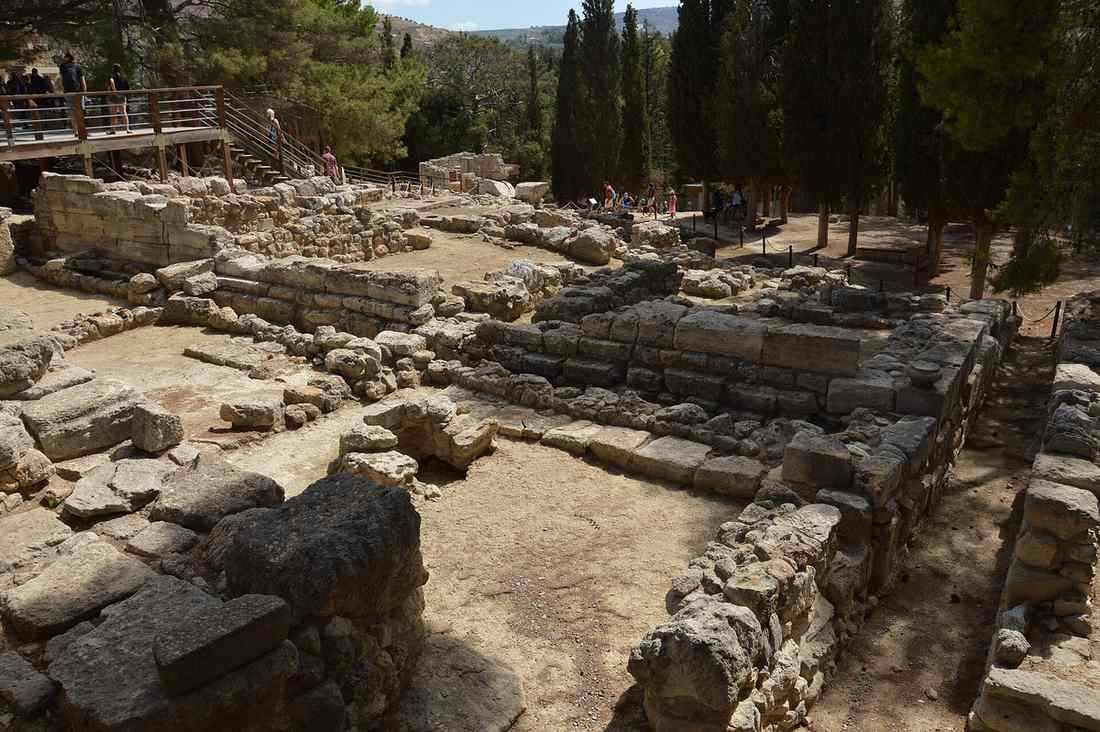
The Temple Tomb at Knossos is a two-storey rock-cut tomb and shrine south of the palace, combining burial and worship in one monument. Plan tickets and tours through My Greece Tours.
The Temple Tomb is one of the most unusual monuments connected with the Palace of Knossos. The sections below cover what it is and why it carries that name. They also cover who was buried there, what it looks like, when it was built, how it compares with other Minoan tombs and how to see it.
What is the Temple Tomb at Knossos?
The Temple Tomb at Knossos is an elaborate Minoan tomb and shrine built into the hillside a short way south of the palace.
The Temple Tomb is one of the most elaborate monuments associated with Knossos. It is an unusually grand Minoan tomb, set into the hillside a short distance south of the main palace. Sir Arthur Evans excavated it and gave it its evocative name. The monument stands out for its size, its careful construction and its union of two functions in one complex. It belongs to the world of the palace at its height. In that age the rulers of Knossos could build for the dead on the same ambitious scale they used for the living.
Unlike a simple grave, the Temple Tomb is a substantial two-storey structure, built partly cut into the rock and partly raised above it. On the lower level lies a rock-cut burial crypt. Above it stands an upper storey thought to have served as a shrine. In front are pillared halls, a courtyard and an entrance pavilion. This blending of a place of burial with a place of worship gives the monument its name and its special interest. It reflects the religious ideas of Minoan Knossos more clearly than any ordinary tomb could. Our guide to Minoan burial customs covers the wider funerary world, and the next section covers why it is called a temple tomb.
Why is it called the Temple Tomb?
It is called the Temple Tomb because it combines a tomb with a temple or shrine in one monument, a dual role Sir Arthur Evans captured in the name.
The monument is called the Temple Tomb because it seems to have combined a tomb and a temple within one structure. That double role is unusual and striking among Minoan buildings. Sir Arthur Evans, who excavated it, coined the name to capture this character, and the label has been used ever since. It signals at once that the building was a place of the dead and a place of active worship. It was far more than a plain chamber for a body.
On the lower level, cut into the rock, was the burial crypt. This was the actual tomb chamber where the dead were laid, its ceiling carried on a central pillar. Above it, on the upper storey reached by a staircase, was a room read as a shrine or chapel. Rites connected with the dead or with the gods could be carried out there, looking down toward the burial below. The courtyard and pillared hall in front completed the plan. Together they suggest a place where burial and ongoing ceremony were brought together, perhaps a cult of the dead or of ancestors. That deliberate joining of tomb and temple is what makes the monument so distinctive.
Who was buried in the Temple Tomb at Knossos?
The Temple Tomb was a high-status burial place, almost certainly for a ruler, a royal family member or the elite of Knossos, given its scale, fine construction and cost.
The Temple Tomb was the burial place of someone of the very highest rank. That person was almost certainly a ruler, a member of the royal family, or a leading figure of the elite of Knossos. Everything about the monument points to this. Its great size, its costly construction and its fine gypsum lining all argue for it. So do the two-storey design and the inclusion of a shrine, which reflect an investment far beyond an ordinary grave. Only the people who controlled the palace and its resources could command a tomb built to this standard.
The Minoans left no readable records naming individuals. Tombs were also robbed and reused over time. For both reasons the exact identity of the person buried in the Temple Tomb is unknown, and no name can be attached to it. What the monument tells us instead is the wealth and status the rulers of Knossos commanded even in death. It also shows the care they took to honour the most powerful dead. They gave them a tomb that was at the same time a place of worship. It is a window onto the Minoan elite. Our guide to the legend of King Minos covers the rulers of Knossos, and the next section covers what the tomb looks like.
What does the Temple Tomb look like?
The Temple Tomb is a two-storey complex set into the hillside, with an entrance pavilion, a paved courtyard and a pillared hall leading to the rock-cut burial crypt.
The Temple Tomb is a carefully planned complex, set against and into the hillside and approached from the north. At the front stood an entrance pavilion, or porch, opening onto a small paved courtyard. Beyond the courtyard lay an inner pillared hall whose roof was carried on columns. This sequence of spaces created a dignified, processional approach to the burial place. Mourners moved through a series of thresholds before they reached the crypt itself.
Beyond the hall, cut into the living rock, was the burial crypt. It was a square chamber whose ceiling rested on a single central pillar. Fine gypsum slabs lined its walls, marking it as a place of the highest importance. From the hall a staircase led up to the upper storey, the room read as a shrine, set directly above the crypt. The whole monument shows the same sophistication seen in the palace at Knossos. Here that skill was applied to a place of burial and worship. Traces of a blue ceiling and gypsum benches add to the sense of a room finished with palace-grade care. Our guide to the key features of Knossos covers Minoan architecture, and the next section covers when the tomb was built.
When was the Temple Tomb at Knossos built?
The Temple Tomb was built in the Neopalatial period, the great age of the second palace at Knossos, and was used and altered over several generations.
The Temple Tomb belongs to the Neopalatial period, the era of the second and grandest palace at Knossos. These are roughly the same centuries in which the throne room, the great frescoes and the main state rooms took their final form. This was the height of Minoan power and wealth on Crete, and the tomb reflects that prosperity in its scale and finish. Building a two-storey funerary shrine of dressed gypsum was a project only a thriving palace economy could support.
The monument was not a single frozen moment but a place used and altered over time. Evidence from the excavation suggests the crypt received burials across more than one generation. The structure was repaired and adapted before it eventually fell out of use. Like much of Knossos, it was then damaged in the disturbances that ended the palatial age. The Minoans dated nothing in writing that survives. So archaeologists place the Temple Tomb by its pottery, its building style and its relationship to the palace, rather than by any inscription. The next section compares it with other Minoan tombs.
How does the Temple Tomb compare with other Minoan tombs?
The Temple Tomb is far grander than ordinary Minoan graves and is closest in spirit to the great tholos and chamber tombs of the Cretan elite.
Most Minoan burials were modest. Ordinary people were laid in simple graves, in clay coffins called larnakes, in reused caves or in communal tombs, with few or plain grave goods. Against that background the Temple Tomb is exceptional. It was designed as a monument in its own right, with a formal approach, a pillared hall and a two-level plan. It was never just a hole cut for a body. In this it belongs with the small group of elite tombs that expressed rank through building rather than through the grave alone.
The closest comparisons are the great circular tholos tombs of southern Crete and the built chamber tombs of wealthy families. Those too served whole lineages over time and combined burial with ritual. What sets the Temple Tomb apart even among these is its explicit upper shrine. That shrine gives worship its own dedicated storey above the dead. A tholos gathers the ceremony around and outside the tomb. The Temple Tomb instead stacks tomb and temple vertically in one building. That vertical union of crypt and shrine is unmatched at Knossos and rare anywhere in the Minoan world. The next section covers how to see the tomb today.
What was found inside the Temple Tomb?
The Temple Tomb held burial remains, fragments of fine grave goods and gypsum fittings, though earlier robbing had removed much of its original contents.
The crypt of the Temple Tomb was not found intact and untouched. Like most rich tombs, it had been entered and robbed long before modern excavation. Even so, the digging recovered enough to confirm its funerary use. Fragments of human bone, remains of burials, and scattered pieces of once-fine objects were present in and around the chamber. The gypsum lining of the walls and the sockets for its fittings survived, showing how carefully the room had been finished.
Small finds pointed to the wealth once placed with the dead. Beads, fragments of stone and clay vessels, and traces of the kind of luxury goods buried with the Minoan elite came to light. The richest portable objects had gone, carried off by robbers or removed in antiquity when the tomb was reused. What remained was still enough to place the burials among the highest in Knossian society. The architecture, more than the surviving contents, now carries the clearest evidence of the status of those laid to rest here.
The Heraklion Archaeological Museum displays comparable grave goods from other elite Knossian tombs. These help fill out the picture of what the Temple Tomb once held. Gold jewellery, bronze weapons, seal stones and imported vessels were the kind of offerings placed with the Minoan elite. Seeing such objects makes the empty crypt easier to imagine as it first appeared, filled with the wealth of a ruling family. The next section covers how to see the tomb today.
Can you visit the Temple Tomb at Knossos?
The Temple Tomb lies a short distance south of the main Knossos site, and access can be limited, so it is less visited than the palace.
The Temple Tomb sits a short distance south of the main excavated palace at Knossos, away from the principal visitor route. Access to it can be restricted or variable, so it is far less visited than the palace itself. For this reason most visitors focus on the great palace and never see the Temple Tomb. They meet the world of the Minoan dead instead through the larnakes, sarcophagi and grave goods in the Heraklion Archaeological Museum.
Some visitors have a particular interest in Minoan funerary architecture and want to see the Temple Tomb. They can ask locally, or through a specialist guide, about whether and how it can be reached, as arrangements vary from season to season. Understanding the monument adds a great deal even if you only see it in plans and photographs. It sharpens the sense of Minoan ideas about death, status and the joining of tomb and shrine. It is a reminder that Knossos was a whole landscape of palace, town and tombs, not just the famous central building. Plan your visit and tours through our Palace of Knossos guide.
Frequently Asked Questions
What is the Temple Tomb at Knossos?
The Temple Tomb is one of the most elaborate monuments associated with Knossos. It is an unusually grand Minoan tomb, set into the hillside a short distance south of the main palace. Sir Arthur Evans excavated it and gave it its name, and it stands out for its size and careful construction. Unlike a simple grave, it is a substantial two-storey structure, built partly cut into the rock and partly raised above it. On the lower level lies a rock-cut burial crypt. Above it stands an upper storey thought to have served as a shrine, with pillared halls, a courtyard and an entrance pavilion in front.
Why is it called the Temple Tomb?
The monument is called the Temple Tomb because it appears to have combined a tomb and a temple within one structure, which is unusual and striking. Sir Arthur Evans, who excavated it, coined the name to capture this dual character. On the lower level, cut into the rock, was the burial crypt where the dead were laid, its ceiling carried on a central pillar and its walls lined with fine gypsum. Above it, on the upper storey reached by a staircase, was a room read as a shrine, where rites connected with the dead or with worship could be carried out.
Who was buried in the Temple Tomb?
The Temple Tomb was clearly the burial place of someone of the very highest rank. That person was almost certainly a ruler, a member of the royal family, or a leading figure of the elite of Knossos. Its great size, costly construction and fine gypsum lining all point to this, as do the two-storey design and the shrine. The Minoans left no readable records naming individuals, and tombs were often robbed and reused. For these reasons the exact identity of the person buried there is unknown, and no name can be attached to it.
How far is the Temple Tomb from the palace of Knossos?
The Temple Tomb lies a short distance south of the main palace at Knossos, on the far side of the valley from the central excavated buildings. It sits away from the principal visitor route through the palace, which is one reason so few travellers see it. The separation is deliberate in the Minoan world, where tombs and cemeteries were generally placed apart from the living quarters. Even so, the Temple Tomb stayed close enough to the palace to belong clearly to its elite rather than to an ordinary rural community.
Is the Temple Tomb the same as the Royal Tomb of Isopata?
No, the Temple Tomb and the Royal Tomb of Isopata are two different elite tombs in the Knossos area. Both were high-status Minoan burial places excavated in Evans’s era. The Royal Tomb of Isopata was a large built chamber tomb of a different plan, north of the palace. The Temple Tomb is the two-storey rock-cut monument with its distinctive upper shrine to the south. Together they show that Knossos had more than one grand burial place for its ruling families, each expressing rank and religious ideas in its own architectural form.
What is the upper shrine of the Temple Tomb?
The upper shrine is the room on the second storey of the Temple Tomb, set directly above the burial crypt and reached by an internal staircase. Evans interpreted it as a chapel where rites for the dead, or for the gods, were carried out. Stone horns of consecration, a common Minoan religious symbol, were associated with this level, reinforcing its sacred character. The shrine is what turns an already grand tomb into a true temple tomb. It gave worship a permanent home above the dead, so that ceremony could continue long after the burial itself.
Who was Sir Arthur Evans?
Sir Arthur Evans was the British archaeologist who excavated Knossos from the year nineteen hundred and revealed the Minoan civilisation to the modern world. He uncovered the palace, named the Minoans after the legendary King Minos, and carried out the famous reconstructions in concrete that make the site so vivid today. Evans also excavated the tombs around Knossos, including the Temple Tomb, which he named for its striking blend of burial and worship. His work remains the foundation of everything visitors see at Knossos, even where later scholars have questioned his interpretations.