
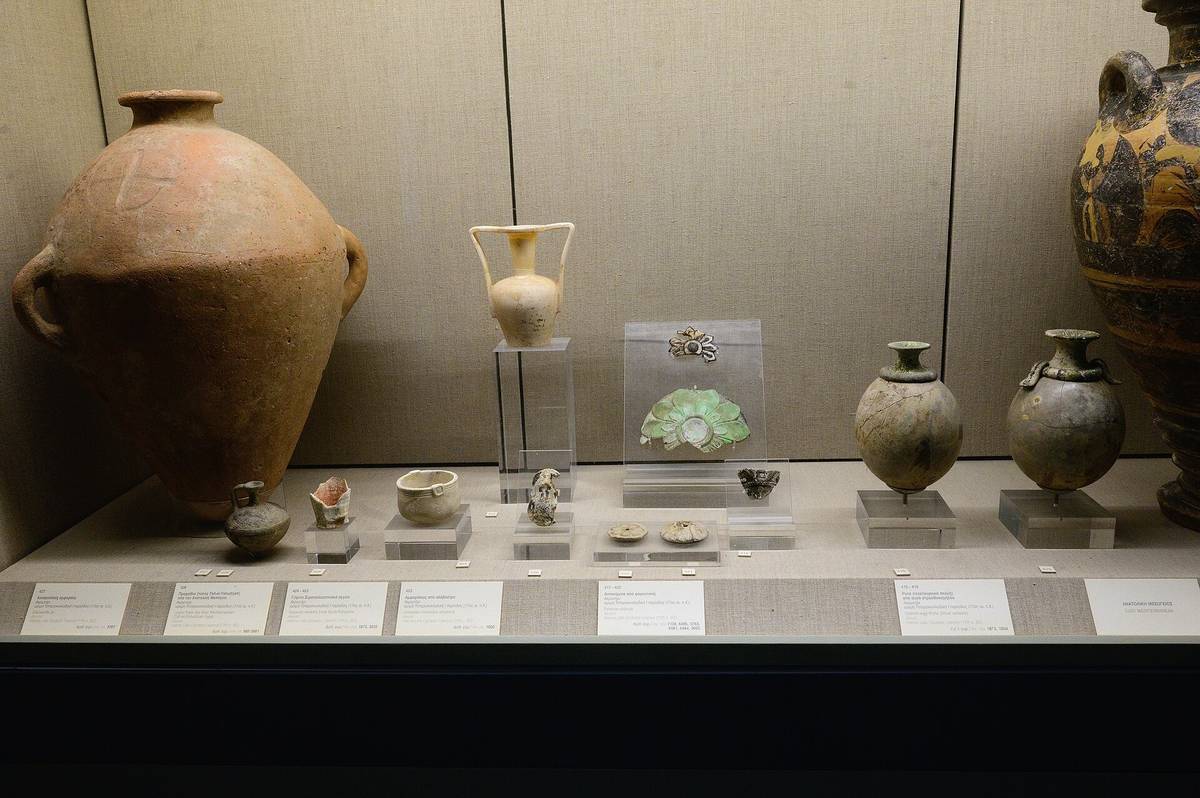
Minoan trade was the sea-based commerce that made the Minoans wealthy, exchanging oil, wine, pottery and crafts across the Bronze Age Mediterranean. Plan tickets and tours through My Greece Tours.
Trade was the engine of the wealth on display at the Palace of Knossos. The sections below cover the sea power behind Minoan trade, what the Minoans traded, who their partners were, how the palace ran the economy, the harbour towns and ships that carried the cargo, and how trade shaped the Minoan world.
What was Minoan trade based on?
Minoan trade was based on sea power. The Minoans ran a fleet that dominated the Aegean and carried Cretan cargo across the eastern Mediterranean, the first great maritime trading network centred on Europe.
The sea was the foundation of everything the Minoans built. Their fleet reached the Cyclades, the Greek mainland, Cyprus, the Levant and Egypt, moving Cretan goods outward and raw materials home. Thucydides preserved the memory of this dominance in the figure of King Minos, the first ruler said to command a navy and clear the waves of piracy. Scholars call this kind of sea-based supremacy a thalassocracy, or rule of the sea. The wealth generated by that command of the trade routes turned a single island into the leading economic power of the Bronze Age Aegean.
The Minoans trusted the sea instead of walls. Their palaces at Knossos, Phaistos, Malia and Zakros stood unfortified, an unusual choice in a Bronze Age world of ramparts and citadels. The ships themselves formed the outer defence of Crete, and safe trade routes protected the island better than any army. This outward-facing security let the Minoans invest surplus in art, architecture and craft rather than in fortification, and it gave their civilisation a distinctive, relatively peaceful character built on exchange rather than conquest.
Commerce filled the storerooms that made the palaces possible. The giant storage jars called pithoi at Knossos held surplus olive oil, wine and grain, the trading stock of the economy. That surplus paid for the frescoes, the jewellery and the sophisticated life of the Minoan elite. Our guide to the Minoan civilization at Knossos covers the culture that this wealth supported, and the next section covers what the Minoans actually traded.
What did the Minoans trade?
The Minoans exported fine pottery, olive oil, wine, textiles, wool, perfumed oils, purple dye and metalwork. They imported the raw materials Crete lacked, above all copper and tin for bronze, plus gold, silver, ivory and precious stones.
Cretan exports centred on the products of the land and the workshop. Kamares ware, thin-walled pottery painted in white, red and orange on a dark ground, travelled as a prestige export in the palatial period, and the later Marine-style vases carrying octopus and dolphin designs followed the same routes. Alongside the pots went olive oil and wine pressed from Cretan groves and vineyards, textiles and finished cloth, raw wool, and the perfumed and scented oils that Minoan workshops distilled from herbs. These were finished, high-value goods, and they carried Minoan taste across the Aegean and beyond.
Beyond food and fabric, the Minoans traded luxury craft and specialist raw goods of their own. Purple dye extracted from murex shells, cypress timber for shipbuilding and construction, dried herbs and currants, and fine metalwork in gold and bronze all moved outward from Cretan ports. Minoan seal-stones, jewellery and inlaid daggers reached mainland Greece and the islands, spreading a recognisable Cretan style. This mix of agricultural surplus and elite craftsmanship gave the Minoans a broad export base rather than a single commodity, which steadied the economy across changing markets.
Imports answered a hard geological fact: Crete had no metal ore of its own. Bronze demanded copper and tin, so the Minoans brought copper from Cyprus and tin from Anatolia and more distant sources far to the east. Gold and silver came in for jewellery and inlay, along with ivory from Syria, the Levant and Egypt for carving. The trade also carried lapis lazuli routed through Syria from Afghanistan, amethyst, carnelian, alabaster, and ostrich eggs and plumes from Egypt. Obsidian arrived from Melos and Yiali, and emery, an abrasive stone, came from Naxos.
These imports were not stray curiosities but the working inputs of Minoan industry and prestige. Copper and tin fed the bronzesmiths; ivory, gold and semi-precious stones supplied the jewellers and seal-cutters; obsidian and emery gave craftsmen sharp edges and grinding tools. The finished goods then re-entered the export stream, so raw material and craft skill compounded into value. Our guide to Minoan pottery covers a signature export in detail, and the next section covers the partners who received these goods.
Who did the Minoans trade with?
The Minoans traded with Egypt, the Levant, Cyprus, Anatolia, the Cyclades, mainland Greece and later the Mycenaeans. Egypt was the most important distant partner, recording Cretan visitors it called the Keftiu.
Egypt stands out as the best-documented partner. Egyptian officials of the New Kingdom painted tribute-bearers they called the Keftiu, men in Cretan kilts carrying Minoan vases and metal vessels, on the walls of tombs at Thebes belonging to figures such as Rekhmire and Menkheperreseneb. The exchange also ran in the other direction: Minoan-style frescoes with running spirals and leaping bulls have been excavated at Avaris, the site of Tell el-Dab’a in the Nile Delta, showing Cretan artists or Cretan taste working on Egyptian soil. This two-way flow of goods and imagery marks one of the deepest relationships in the Bronze Age Mediterranean.
Closer routes tied Crete into the Aegean and the Near East. The Minoans traded with the Levant and Canaan for ivory, metals and luxuries, and with Cyprus, the great source of copper for their bronze. Anatolia supplied tin and stood on the road to more distant eastern markets. Within the Aegean, the Cycladic islands passed on obsidian from Melos and emery from Naxos and hosted Minoan-influenced settlements, the clearest being Akrotiri on Thera, buried by the eruption. This network of shorter hops fed the longer voyages to Egypt and the Levant.
Mainland Greece drew steadily into the Cretan orbit before overtaking it. Minoan goods and styles reached Messenia, Lakonia and the Argolis, and Cretan craftsmanship shaped early Mycenaean art, seen in the inlaid daggers and gold work of the shaft graves at Mycenae. The rising Mycenaeans began as trading partners and cultural pupils of the Minoans, then grew into rivals who eventually took over the palace at Knossos itself. Our guide to Minoans vs Mycenaeans covers that shift in power, and the next section covers how the palace ran the trade.
What role did Knossos play in Minoan trade?
Knossos ran a redistribution economy. The palace collected agricultural surplus and craft goods, stored them in vast pithoi, recorded them on Linear A and Linear B tablets, and channelled them into internal supply and external trade.
The palace worked as the accounting and warehouse centre of its territory. Long magazines at Knossos held rows of pithoi, some taller than a standing person, filled with olive oil, wine and grain drawn in from the surrounding farms. This concentration of surplus was the palace’s capital: it fed craftsmen and officials, supplied the ceremonies of the court, and provided the goods that ships carried abroad. The scale of the storerooms shows an economy organised around collecting a share of production centrally, not around scattered private exchange.
Administration made that concentration possible. Minoan scribes used clay sealings and engraved seal-stones to control access to stores and to mark goods in transit, and they kept written accounts on tablets in the Linear A script, the palace bookkeeping of the era. After the Mycenaeans took control, the later Linear B tablets recorded the same kinds of information, listing quantities of oil, wine and grain, counts of livestock, and named personnel and their rations. These records let the palace track exactly what it held, what it owed and what it could trade.
The system followed a clear cycle of collect, store and redistribute. The palace drew in the surplus of its region, banked it in the magazines, then sent it out again, some to feed dependent workers and support the court, some loaded onto ships for export. In return came the copper, tin, gold and ivory that Crete could not produce, which flowed back through the same central store to the workshops. Our guide to the Knossos layout covers where the storerooms sat within the palace, and the next section covers the harbours and ships that moved the cargo.
How did Minoan ships and harbours carry the trade?
Minoan trade moved on oared galleys and single-sail ships out of harbour towns such as Kommos, Amnisos, Poros-Katsambas, Zakros, Gournia and Nirou Chani. The Akrotiri flotilla fresco shows the vessels in action.
Crete’s coast held a chain of dedicated harbour towns, each feeding the trade. Kommos on the south coast served Phaistos and the routes toward Egypt and the Levant. Amnisos and Poros-Katsambas acted as the harbours of Knossos on the north coast, receiving imports for the inland palace. Zakros in the far east faced directly toward the Levant and Egypt and yielded raw elephant tusks and copper ingots in its storerooms. Gournia and Nirou Chani added further coastal bases, so the network of ports ringed the island rather than depending on a single gateway.
The ships themselves came in two main forms. Oared galleys gave reliable speed and let crews row against wind and current, useful for the fixed timing of trading voyages and for hugging coastlines. Single-sail vessels used wind power for the longer open runs and carried bulkier cargoes of oil, wine and grain in jars. The famous flotilla fresco from Akrotiri on Thera paints a procession of these vessels between two towns, oars manned and cabins decked out, giving the clearest surviving picture of what a Minoan seagoing fleet looked like under way.
Cargo, harbour and ship worked as one system. Pithoi and smaller stirrup jars packed the holds with oil, wine and scented oils, while ingots of copper and blocks of raw ivory came the other way. The harbour towns held their own storerooms, transferring goods between the sea and the inland palaces along the roads of Crete. This maritime infrastructure, more than any army, was the real machinery of Minoan power. Our guide to the Palace of Knossos covers the destination that the harbours supplied, and the next section covers how all this trade shaped the wider Minoan world.
How did trade shape the Minoan world?
Trade generated the wealth that built the unfortified palaces, funded the frescoes and jewellery, and made the Minoans an outward-looking, relatively peaceful people. Its disruption after the Thera eruption opened the way for the Mycenaeans.
The riches of commerce paid for the whole visible splendour of Minoan civilisation. Income from dominating Aegean and Mediterranean trade built the grand palaces of Knossos, Phaistos, Malia and Zakros, filled their walls with brilliant frescoes, and supplied the gold jewellery, seal-stones and fine pottery that fill the museum cases today. Without the trading surplus banked in the storerooms, that concentration of art and architecture could not have existed. The palaces were, in the plainest sense, the built form of a trade balance running in Crete’s favour.
Trade also set the character of the culture. Reliance on ships and exchange rather than on armies and walls left the palaces unfortified and gave the Minoans an open, outward-looking temperament, carrying their styles and goods across the Aegean and stamping early Mycenaean art with Cretan taste. This spread of Minoan influence made Crete the leading cultural and economic power of the region during the palatial period. A people who chose commerce over conquest set a very different tone from the citadel-builders who came after them on the mainland.
That trading supremacy did not last. The eruption of the Thera volcano devastated Akrotiri and disrupted the sea routes, shipping and coastal sites on which Minoan commerce depended, and the shock weakened the palatial economy. Into that opening stepped the Mycenaeans, more warlike mainlanders who took control of Knossos and the Cretan trade networks and switched the accounts into their own Linear B. Our guide to the fall of Knossos covers that decline. Plan your own visit and tours through our Palace of Knossos guide.
Trade is the hidden foundation beneath everything a visitor admires at Knossos. The dazzling frescoes, the fine pottery, the gold jewellery and the sheer scale of the palace were all paid for by the wealth that flowed from command of the sea. A people who chose ships over fortifications built the first great trading power of Europe and grew rich and sophisticated on it. Walking past the great storage jars and through the storerooms brings the ruins to life as the working heart of a maritime economy, not merely a royal and ceremonial showpiece.
Frequently Asked Questions
What did the Minoans trade?
The Minoans exported the products of their land and workshops while importing the raw materials Crete lacked. Exports included fine Kamares ware and later Marine-style pottery, olive oil, wine, textiles and wool, perfumed and scented oils, purple dye, cypress timber, currants, herbs and fine metalwork. In return they imported copper from Cyprus and tin from Anatolia to make bronze, along with gold, silver, ivory from Syria and Egypt, lapis lazuli routed through Syria, amethyst, carnelian, alabaster and ostrich eggs, plus obsidian from Melos and emery from Naxos. The giant pithoi in the storerooms of Knossos held the surplus oil, wine and grain that underpinned this exchange and made the Minoans wealthy across the Bronze Age world.
Who did the Minoans trade with?
The Minoans traded across the Bronze Age eastern Mediterranean and Aegean. Their most important distant partner was Egypt, which painted Cretan tribute-bearers it called the Keftiu in the Theban tombs of officials such as Rekhmire, and hosted Minoan-style frescoes at Avaris in the Nile Delta. They also traded with the Levant and Canaan for ivory and luxuries, with Cyprus for copper, and with Anatolia for tin. Within the Aegean they linked to the Cycladic islands, including Akrotiri on Thera, and to mainland Greece in Messenia, Lakonia and the Argolis, where their craft shaped early Mycenaean art. The rising Mycenaeans began as trading partners and later took over the Cretan networks.
Why were the Minoans so wealthy?
The Minoans grew wealthy because they dominated sea trade across the Bronze Age Aegean and eastern Mediterranean. Operating a fleet of oared galleys and sailing ships, they built the first great maritime trading network centred on Europe, exporting prized pottery, olive oil, wine, textiles, perfumed oils, purple dye and fine crafts, and importing copper, tin, gold, ivory and precious stones. This commerce generated the riches that paid for the grand palaces, the frescoes and pottery, the jewellery and the sophisticated life of the elite. Their reliance on the sea rather than warfare left the palaces unfortified and the culture relatively peaceful, and it made Crete the leading economic and cultural power of the early Aegean.
What was a thalassocracy in the Minoan world?
A thalassocracy means rule of the sea, a power whose strength rests on maritime dominance rather than a large land army. The historian Thucydides described King Minos as the first ruler to command a navy, control the islands and clear the Aegean of piracy, and later writers used his name for the whole Minoan sea power. The idea fits the archaeological record well: unfortified palaces, harbour towns ringing Crete, Minoan goods and frescoes reaching Egypt and the Levant, and a fleet shown in the Akrotiri flotilla fresco. The Minoans secured Crete through control of the trade routes, so their prosperity and their defence both flowed from the same command of the sea.
How did the palace of Knossos manage trade goods?
Knossos managed trade through a redistribution economy centred on storage and record-keeping. The palace drew in agricultural surplus and craft products from its territory and banked them in long magazines filled with pithoi of olive oil, wine and grain. Scribes used clay sealings and engraved seals to control goods and kept written accounts on Linear A tablets, replaced after the Mycenaean takeover by Linear B records listing oil, wine, grain, livestock and personnel. The palace then redistributed this surplus, some to feed dependent workers and the court, some loaded onto ships for export. Imported copper, tin, gold and ivory flowed back through the same central store to the workshops that turned them into finished goods.
Which harbour towns handled Minoan trade?
Minoan trade ran through a ring of harbour towns around Crete rather than a single port. Kommos on the south coast served Phaistos and the routes toward Egypt and the Levant. Amnisos and Poros-Katsambas acted as the harbours of Knossos on the north coast. Zakros in the far east faced the Levant and Egypt and preserved raw ivory and copper ingots in its storerooms. Gournia and Nirou Chani added further coastal bases with their own storage and workshop quarters. Ships of oared galleys and single-sail vessels, like those in the Akrotiri flotilla fresco, moved between these ports, transferring cargo between the sea and the inland palaces along the roads of Crete.