
Milos vs Symi pits a volcanic Cycladic island of colourful beaches against a tiny Dodecanese island of neoclassical harbour houses and culture. Plan island tours and tickets through My Greece Tours.
Choosing between the two is a common question in the Milos travel guide. The sections below compare the landscapes, the beaches, the vibe, the access and which island suits you best.
Milos vs Symi: which island is better?
Milos is the volcanic beach island, while Symi is the elegant harbour one. Choose Milos for colourful beaches, sea caves and dramatic scenery, or Symi for its famous neoclassical harbour, coastal hikes and a cultured, picturesque Dodecanese atmosphere.
The two islands suit very different travellers. Milos offers volcanic beaches and scenery. Symi offers a postcard harbour and culture. Each delivers a distinct holiday.
Milos is the beach and scenery choice. The volcanic coast gives colourful beaches and caves. Boat trips reach the hidden coves. It rewards beach lovers and explorers.
Symi is the elegant, cultured choice. The famous harbour spills colourful mansions to the sea. Coastal hikes and monasteries fill the days. It suits lovers of architecture and calm.
The decision comes down to your priorities. Pick Milos for dramatic beaches and boat trips. Pick Symi for its harbour and culture. The sections below compare each side across the things to do in Milos. The next section covers the landscapes.
The two islands belong to different groups and feel worlds apart. Milos sits in the western Cyclades, a volcanic island of coloured rock, white moonscapes and sea caves, with a strong, low-key Cycladic character. Symi is a tiny island in the Dodecanese, just north of Rhodes, famous above all for its picture-perfect harbour, where well-preserved neoclassical mansions in soft colours tumble down the hills to the water. The contrast is clear: Milos rewards travellers after dramatic geology and beaches, while Symi suits those after elegant architecture, culture and a postcard setting.
Access marks an early, telling difference. Milos has a small airport with summer flights from Athens, plus ferries on the western Cyclades line from Piraeus. Symi has no airport at all, so every visitor arrives by boat, usually from Rhodes, which keeps it quiet and unhurried. That extra step adds to Symi’s away-from-it-all charm, while Milos, better connected, draws a slightly wider crowd to its beaches and boat trips, though both stay calmer than the famous party islands of Greece.
How do the landscapes of Milos and Symi compare?
Milos is volcanic, with coloured cliffs, white moonscapes and sea caves spread across a large coast. Symi is small and rocky, its drama concentrated in the famous harbour and steep, hike-laced hills. Milos wins on coastal variety, Symi on its iconic harbour setting.
Milos is a volcanic spectacle. Old eruptions and hydrothermal water stained its coast. Beaches glow red, grey and snow-white. The geology drives the spectacle.
Symi crowns a rocky bowl. The harbour fills a steep amphitheatre. Coloured mansions climb the slopes. The setting is its signature.
The two differ in scale. Milos spreads drama along a wide coast. Symi concentrates beauty in its harbour. Each lands its scenery differently.
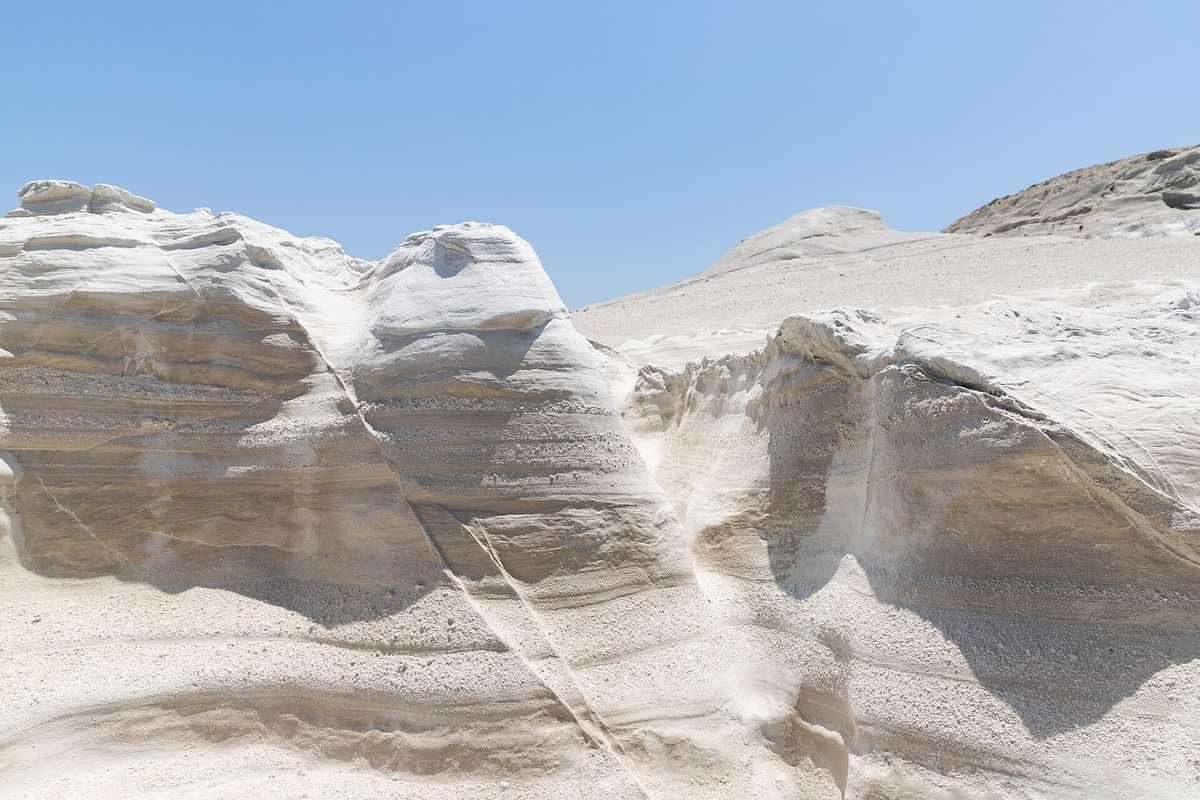
Both reward the explorer. Milos shows it in coloured coves and white rock. Symi shows it in harbour and hills. The moonscape of Sarakiniko beach headlines Milos. The next section covers the beaches.
The defining scene differs sharply between the two. Milos draws its drama from a long volcanic coast, where the white moonscape of Sarakiniko, the red cliffs of Paleochori and the sea caves of Kleftiko spread across the whole island. Symi packs its beauty into one unforgettable view: the harbour of Gialos, a steep amphitheatre of pastel neoclassical houses rising from the water, widely held to be among the prettiest in Greece. Milos is a coast to explore, while Symi is a single, perfect picture to admire.
Beyond the headline scenes, each island rewards the active visitor. Symi offers fabulous coastal hikes to remote coves, caves, castle ruins and monasteries, with many steps and trails that suit fit, energetic walkers. Milos answers with its own coastal paths, the climb to Prophet Elias and the trail past the catacombs to Klima, set among volcanic scenery. Both reward those who like to walk, but Symi leans toward stepped harbour-town strolls and clifftop paths, while Milos leans toward open, coloured volcanic coastline.
Light and stone give each island its character. Milos shows its drama in coloured volcanic rock, white moonscapes and sea caves spread along an open coast. Symi shows it in the warm pastel facades of its harbour mansions, glowing in the evening sun above the water. One island is sculpted by nature, the other by neoclassical builders. Both are intensely photogenic, but Milos rewards the camera with wild, natural forms across many beaches, while Symi rewards it with a single, perfect architectural scene rising from the harbour, framed by steep, hike-laced hills.
Which has better beaches, Milos or Symi?
Milos has far more and more dramatic beaches, with more than 70 vivid volcanic coves, sea caves and the lunar shelf of Sarakiniko. Symi has a handful of pretty pebbly beaches and bays reached on foot or by boat taxi.
Milos wins on number and drama. The island counts more than 70 coves. They range from white moonscapes to coloured cliffs. The the pick of the west accessible only from the water.
The signature beaches have no equal. Sarakiniko forms a bright moon-like terrace. Firiplaka and Paleochori paint their cliffs in red and grey. Kleftiko sits screened behind the sea.
Symi keeps its beaches few. Pebbly bays line the coast. Boat taxis reach the quieter coves. The harbour outshines the sand.
The choice depends on your taste. Milos rewards beach variety and boat trips. Symi suits a few pretty bays. The famous Kleftiko sea caves crown a Milos cruise. The next section covers the vibe.
Beaches are a clear win for Milos. The island builds its whole appeal around a volcanic coast of upward of 70 coves in a striking spread of hues and shapes, from the chalk-white moonscape of Sarakiniko to the ochre cliffs of Paleochori and the cavernous inlets of Kleftiko, a good share reachable only by boat. The beaches are wild and natural, rewarding travellers who chase variety, colour and a sense of discovery across the whole island.
Symi is not really a beach island in the same way. Its coast offers a handful of pretty, mostly pebbly beaches and bays, such as Agios Nikolaos and Nanou, several reached on foot, by boat taxi or by the small boats that ferry swimmers from the harbour. They make pleasant spots for a dip, but they play a supporting role to the architecture and the harbour. For a beach-focused trip, Milos is the far stronger choice, while Symi rewards those drawn to its town and setting.
How do the vibe and culture of Milos and Symi compare?
Symi is cultured and picturesque, with a film festival, live music and a refined harbour-town feel, reached only by boat. Milos is relaxed and scenery-led, with beaches, boat trips and tavernas. Symi suits architecture and culture lovers, Milos suits beach lovers and explorers.
Symi leans cultured and elegant. A summer film festival draws visitors. Live music and theatre fill the calendar. The harbour sets a refined tone.
The island stays quiet and walkable. Boats are the only way in. The pace feels unhurried. The architecture defines the days.
Milos leans relaxed and scenic. Beaches and boat trips fill the days. Tavernas and sunsets shape the evenings. The volcanic coast is the draw.
The two suit different trips. Symi suits culture and a postcard town. Milos suits beaches and scenery. Compare the wider Milos vs Rhodes guide. The next section covers the verdict.
The atmosphere reflects each island’s strengths. Symi is a cultured, picturesque retreat, drawing visitors who come for the architecture, the harbour-town strolls and a summer calendar of events, including an international film festival, live music, book fairs and outdoor theatre across the high season. The pace is gentle and the mood refined, with dining and galleries rather than nightlife at the centre. It suits travellers who want beauty, culture and calm in equal measure.
Milos offers a more relaxed, scenery-led holiday rooted in nature. The focus falls on the beaches, the boat trip to Kleftiko, the colourful villages and the sunsets, with evenings spent in low-key tavernas and a few quiet bars. It suits beach lovers, couples and explorers after dramatic landscapes and an easy pace. The choice is clear: Symi rewards travellers drawn to architecture, culture and a famous harbour, while Milos rewards those after beaches, geology and an active, scenic trip.
The two islands suit different rhythms of travel. Symi rewards a slow, cultured stay, with mornings wandering the harbour lanes, afternoons on a boat taxi to a quiet cove, and evenings of dining and the summer arts calendar. Milos rewards an active, varied trip, with beach-hopping by car or quad, a full-day boat trip to Kleftiko, and relaxed taverna evenings. Neither chases nightlife, so both suit travellers after calm. The real divide is the focus, architecture and culture on Symi against beaches and volcanic scenery on Milos, two distinct ways to enjoy the Greek islands.
Should you choose Milos or Symi?
Choose Milos for colourful volcanic beaches, sea caves and dramatic scenery. Choose Symi for its famous neoclassical harbour, coastal hikes and a cultured, picturesque feel.
Pick Milos for beaches and scenery. The volcanic coves and sea caves are unmatched. The boat trips fill the days. It suits explorers and beach lovers.
Pick Symi for harbour and culture. The neoclassical town defines it. The hikes and festivals reward a slow visit. It suits culture seekers.
The two sit far apart. Milos lies in the western Cyclades. Symi rides the southeast Dodecanese near Rhodes. They do not pair on one trip.
Most travellers choose one as a focus. Milos pairs with the western Cyclades. Symi pairs with Rhodes and the Dodecanese. Compare the wider Milos vs Kos guide to plan your route.
How do dining and food compare on Milos and Symi?
Milos serves a compact, seafood-led island food scene of harbour tavernas and Cycladic cooking, while Symi is known for its tiny sweet Symi shrimp, fresh fish and Dodecanese dishes served around the harbour.
Milos concentrates its kitchens around Adamas and Pollonia, where tavernas grill the day’s catch and plate octopus, caper-leaf salads and Cycladic cheese pies. The volcanic soil grows capers and tomatoes that anchor the table, and dinner leans on the short distance between the boat and the plate.
Symi builds its table around the sea and its Dodecanese heritage. The island is famous for the tiny sweet Symi shrimp eaten shell and all, alongside fresh fish and dishes that carry an eastern Aegean accent. Tavernas ring the harbour of Gialos and climb to the upper town of Chorio, so dinner comes with a view over the neoclassical mansions.
The gap reflects setting more than skill. Milos rewards a traveller who wants relaxed island seafood within walking distance of the harbour. Symi rewards one who wants to eat beside one of the most photogenic ports in Greece, with the local shrimp as its signature.
Which has more to do beyond the beach, Milos or Symi?
Milos offers boat trips, hot springs, an ancient theatre and catacombs, while Symi offers its neoclassical harbour, the grand Panormitis monastery, coastal hikes and a summer festival of music and theatre.
Milos keeps its activities close to the coast. The boat trip to Kleftiko headlines the itinerary, the Roman theatre and the early Christian catacombs add culture, and the site of the Venus de Milo draws visitors to Tripiti. Kayaking, snorkelling and the thermal springs fill a beach-led week.
Symi centres on its architecture and its walks. The harbour of Gialos ranks among the prettiest in Greece, the Panormitis monastery draws pilgrims to the south of the island, and coastal paths link hidden coves, chapels and castle ruins. The Symi Festival brings music, film and theatre to the town through the summer, adding a cultural layer to the setting.
The two suit different curiosities. Milos rewards a traveller who wants coves, boat trips and a dose of ancient history. Symi rewards one who wants a postcard harbour, monasteries, coastal hikes and a cultured, unhurried Dodecanese pace.
How do access and getting around compare for Milos and Symi?
Milos has a small airport with flights from Athens plus ferries from Piraeus, while Symi has no airport and is reached by boat from Rhodes, which keeps it quiet and away from the crowds.
Milos sits in the western Cyclades, linked to Piraeus by ferry and to Athens by a short domestic flight into its small airport. The island stays compact, so a rental car or scooter reaches the coves within short drives, and boat trips cover the caves that roads cannot.
Symi lies in the Dodecanese just north of Rhodes and has no airport, so every visitor arrives by boat, usually the catamaran or ferry from Rhodes. The island is small, and the steep town is walked rather than driven, while boat taxis link the harbour to coves that the road network does not reach.
The practical takeaway favours different planners. Milos suits a traveller who wants a direct sail or flight from Athens. Symi suits one who flies into Rhodes first and hops across by boat for a quiet, harbour-focused Dodecanese escape.
Is Milos or Symi cheaper for a holiday?
Both sit in the mid-range, with Symi’s costs shaped by the Rhodes connection and its boutique harbour rooms, while Milos carries Cycladic premiums in peak summer for accommodation, boat trips and the ferry out.
Milos prices track the wider Cyclades, where summer demand lifts the cost of rooms, ferry tickets and popular boat trips. Spring and autumn ease the rates, yet July and August place the island in the mid-to-upper tier, with the ferry or flight adding to the spend.
Symi keeps a boutique profile, since the harbour’s restored mansions house characterful rooms that price for their setting, and reaching the island means a flight to Rhodes plus a boat. Day-trippers from Rhodes keep the harbour busy, yet an overnight stay in the quiet town can run comparably to a Cycladic night once the setting is factored in.
The value verdict follows the trip style. Symi suits a traveller happy to pay for a photogenic harbour reached via Rhodes. Milos costs more to reach directly for a dramatic volcanic coast, and the premium buys beaches and boat trips rather than harbour scenery.
Frequently Asked Questions
Is Milos or Symi better?
Milos is the volcanic beach island, while Symi is the elegant harbour one. Choose Milos for its colourful volcanic beaches like Sarakiniko, sea caves, boat trips and dramatic scenery across more than 70 coves. Choose Symi for its world-famous neoclassical harbour, where pastel mansions tumble to the sea, plus coastal hikes, monasteries and a cultured summer calendar. Milos wins on beach variety and geology, while Symi wins on architecture, atmosphere and its picture-perfect setting. The right choice depends on whether you favour dramatic beaches and the sea or an elegant, cultured harbour town.
Which has better beaches, Milos or Symi?
Milos has far better beaches, with more than 70 vivid volcanic coves, sea caves and the chalk-white Sarakiniko, a good share reached only by boat. Symi has just a handful of pretty, mostly pebbly beaches and bays, such as Agios Nikolaos and Nanou, several reached on foot or by boat taxi from the harbour. Milos wins clearly on number, colour, drama and variety, building its whole appeal around the coast, while on Symi the beaches play a supporting role to the architecture and harbour. For a beach holiday, Milos is by far the stronger choice.
Can you visit both Milos and Symi?
Visiting both Milos and Symi on one trip is difficult, as they sit far apart in different island groups, Milos in the western Cyclades and Symi in the southeastern Dodecanese near Rhodes, with no quick or direct ferry between them. Symi has no airport, so it is reached by boat from Rhodes, while Milos is reached from Athens. Pairing them means a long, multi-leg journey. Most travellers therefore choose one island as the focus, combining Milos with its western Cyclades neighbours like Sifnos, and Symi with Rhodes and the Dodecanese islands.
Is Milos or Symi better for families?
Both suit families, in different ways. Milos works for a beach-led island week, with sheltered coves for swimming, a boat trip as the highlight and short drives between beaches. Symi suits families who enjoy a calm harbour base, boat taxis to coves and the novelty of a car-free town, though its steep steps and reliance on boats ask a little more of younger children. A family after easy beach days will lean to Milos, while one drawn to a picturesque harbour and boat rides will enjoy Symi.
How many days do you need for Milos versus Symi?
Milos rewards four to six days, enough to reach the main coves, take a boat trip to Kleftiko and settle into the island rhythm from one base. Symi suits three to five days, enough to enjoy the harbour, ride the boat taxis to the coves and visit the Panormitis monastery. Both work as a focused island stay, though Symi often pairs with two or three days on Rhodes given the boat connection, while Milos links into a western-Cyclades hopping route.