
An Ancient Olympia day trip from Athens reaches the sacred sanctuary where the Olympic Games were born, with the Temple of Zeus, the original stadium and a superb archaeological museum. Make the long journey effortless with a guided tour or tickets from My Greece Tours, the cradle of the Olympics.
This bucket-list excursion is a major option in the Athens travel guide. The sections below cover whether it is worth it, the birthplace of the Olympics, the ruins and temples, the ancient stadium, the museum, how to get there, and tips for the day.
Is Ancient Olympia worth a day trip from Athens?
Yes, Ancient Olympia is one of the most important archaeological sites in the world and deeply rewarding, though the distance makes for a long day: it lies around 320 km west of Athens in the Peloponnese, roughly a 3.5 to 4 hour drive each way. As the birthplace of the Olympic Games, with the sanctuary of Zeus, the ancient stadium and a magnificent museum, it richly repays the journey, ideally as a guided tour, a long self-drive day, or an overnight trip.
For lovers of history and anyone moved by the legacy of the Olympic Games, Ancient Olympia is a genuinely unmissable site and a deeply rewarding, if long, day trip from Athens. Olympia lies in the western Peloponnese, around three hundred and twenty kilometres from Athens, a drive of roughly three and a half to four hours each way, so a same-day return is certainly possible but makes for a long and tiring outing with a great deal of travel. The reward, however, is one of the most significant and evocative archaeological sites on earth: this was the sacred sanctuary of Zeus and the birthplace of the Olympic Games, held here every four years for over a thousand years in antiquity, and the site preserves the temples, the treasuries, the training grounds and, above all, the original ancient stadium where the games were run, alongside a world-class museum.
Because of the distance, the trip is best done either as an organised full-day tour that handles the long drive, as a determined early-start self-drive day, or, ideally, as an overnight stay that allows a more relaxed visit. For its profound historical importance, Olympia is well worth the effort. It is hallowed ground for sport and civilisation. Its fame rests on the games born here.
Why is Olympia the birthplace of the Olympics?
Olympia gave birth to the Olympic Games because it was here, at the sanctuary of Zeus, that the ancient Olympics were held every four years from 776 BC for over a millennium. Athletes from across the Greek world competed in running, wrestling, boxing, chariot racing and more, in honour of Zeus, during a sacred truce. The games shaped Greek culture and inspired the modern Olympics, revived in 1896, making Olympia a place of immense significance.
The towering significance of Olympia flows from its role as the cradle of the Olympic Games, one of the most enduring institutions of the ancient world and the direct inspiration for the modern Olympics. It was here, at the great sanctuary dedicated to Zeus, king of the gods, that the ancient Olympic Games were founded, traditionally dated to 776 BC, and then held every four years for nearly twelve centuries, drawing athletes and spectators from across the entire Greek world and beyond. During the games, a sacred truce was declared throughout the warring Greek city-states so that competitors and visitors could travel safely to Olympia, where athletes competed in events including foot races, wrestling, boxing, the pentathlon and the thrilling and dangerous chariot races, all in honour of Zeus, with victors crowned with simple olive wreaths and celebrated as heroes.
The games were far more than sport, being a religious festival and a powerful expression of shared Greek identity and culture that profoundly shaped the ancient world. Their memory inspired the revival of the modern Olympic Games in Athens in 1896, and the Olympic flame is still lit here today before each modern games. This unbroken thread of history makes Olympia extraordinarily resonant. The ruins bring that history to life. The sanctuary is rich with monuments.
What are the ruins and temples at Olympia?
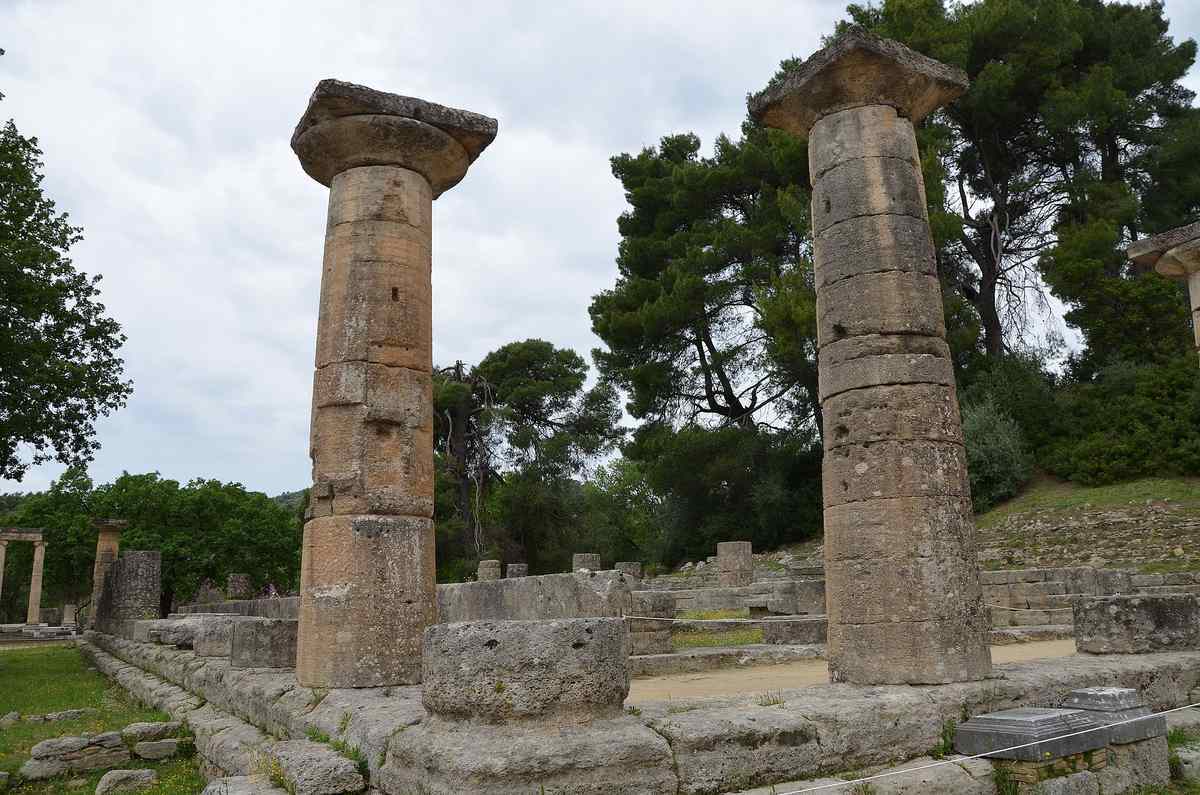
The archaeological site of Olympia spreads through a green, tree-shaded valley and contains the remains of the great sanctuary. Highlights include the ruins of the magnificent Temple of Zeus, which once housed the colossal gold-and-ivory statue of Zeus, one of the Seven Wonders; the older Temple of Hera, where the Olympic flame is lit; the workshop of the sculptor Pheidias; the training grounds, the gymnasium and palaestra; and rows of treasuries and altars.
Wandering the archaeological site of Olympia is a beautiful and atmospheric experience, for the extensive ruins are set in a lush, green and tranquil valley shaded by trees and threaded by rivers, a far cry from the bare hilltop sites elsewhere. At the heart of the sanctuary stood the magnificent Temple of Zeus, a vast Doric temple whose toppled columns and massive stone drums still convey its scale, and which once housed the colossal seated statue of Zeus made of gold and ivory by the sculptor Pheidias, a work so awe-inspiring it was counted among the Seven Wonders of the Ancient World. Nearby stands the older and better-preserved Temple of Hera, the Heraion, which is the spot where, to this day, the Olympic flame is kindled by the sun’s rays before each modern games.
The site also preserves the remains of the workshop of Pheidias where the great statue was made, the athletes’ training facilities including the gymnasium and the palaestra wrestling court, a row of treasuries built by various Greek cities, numerous altars, statue bases and monuments, and the council house. Exploring these ruins, you can trace the whole world of the ancient games and sanctuary. The setting is as memorable as the stones. One monument above all stirs the imagination.
What is the ancient stadium like?
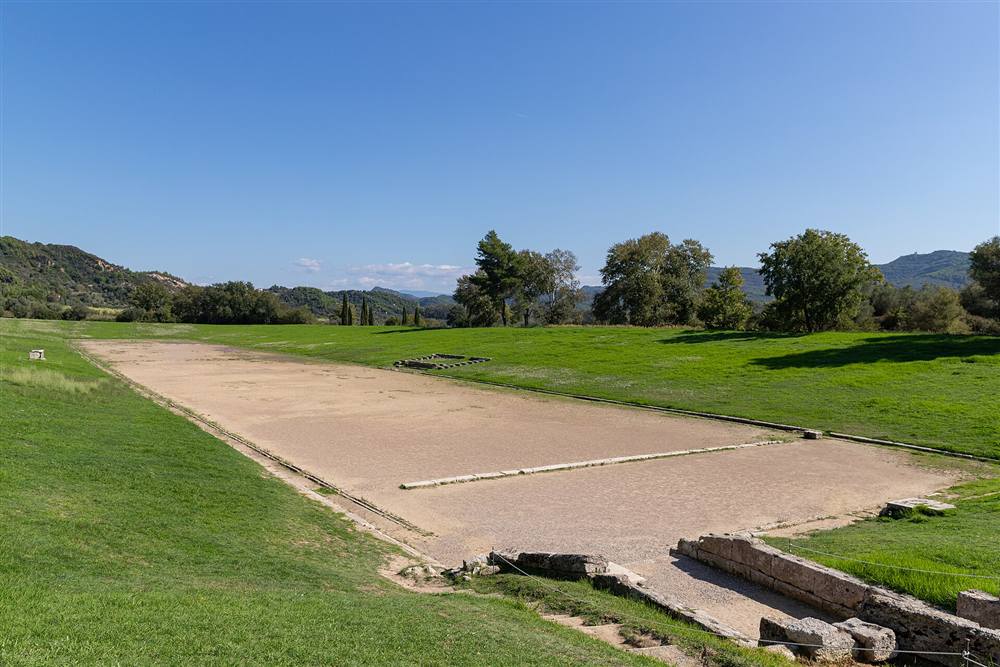
The ancient stadium of Olympia is the most evocative part of the site, the very ground where the Olympic foot races were run for over a thousand years. You enter through the original vaulted stone archway, the krypte, used by the athletes, onto a long grassy track flanked by earthen banks that seated up to 45,000 spectators, with the original stone start and finish lines still in place. Standing on the track, or racing along it, is a thrilling, unforgettable highlight.
If one part of Olympia captures the imagination above all others, it is the ancient stadium, the actual arena where the athletes of antiquity competed in the foot races that were the heart of the games, and reaching it is a moment of real magic. You approach the stadium through the krypte, the original vaulted stone tunnel or archway through which the competitors and judges once entered the arena, emerging onto a long, open running track of beaten earth and grass, around two hundred metres in length, flanked on either side by sloping grassy banks that once accommodated up to forty-five thousand spectators seated on the ground.
Remarkably, the original stone start and finish lines, the marble sills against which the runners braced their feet, are still in place at either end of the track, allowing you to stand exactly where ancient Olympic champions began their race. Many visitors cannot resist the thrill of sprinting, or at least walking, the length of the track themselves, a simple but deeply moving way to connect with the ancient athletes. The stadium’s simplicity and authenticity make it the emotional climax of any visit. It is sport’s most sacred ground. The treasures from the site fill a superb museum.
What is the Olympia museum like?
The Archaeological Museum of Olympia, beside the site, is one of the finest in Greece, displaying the treasures excavated from the sanctuary. Its highlights include the magnificent sculpted pediments and metopes from the Temple of Zeus, depicting myths and the labours of Heracles; the exquisite marble statue of Hermes by the master sculptor Praxiteles; the winged Nike of Paionios; and a wealth of bronzes, including helmets and votive offerings. The museum is essential for understanding the site.
A visit to Ancient Olympia is incomplete without the superb Archaeological Museum of Olympia, located right beside the archaeological site, which ranks among the finest museums in all of Greece and houses the priceless treasures unearthed from the sanctuary over generations of excavation. The undisputed highlights are the spectacular sculptures recovered from the great Temple of Zeus, above all its two sculpted pediments and the carved metopes, masterpieces of classical art depicting dramatic mythological scenes, including the famous Twelve Labours of Heracles, displayed so you can appreciate how the temple was once adorned. Pride of place goes to two other masterpieces: the exquisite marble statue of Hermes carrying the infant Dionysus, attributed to the great sculptor Praxiteles and famed as one of the finest surviving ancient statues, and the soaring, graceful figure of the winged Nike, or Victory, by the sculptor Paionios.
The museum is also rich in bronzes, including a remarkable collection of helmets, weapons, armour and votive offerings dedicated by athletes and cities, along with terracottas and models that bring the ancient site vividly to life. Allowing time for the museum greatly deepens an understanding of Olympia. The art alone justifies the journey. Reaching this distant treasure takes planning.
How do you get to Olympia, and what tips help?
Olympia lies about 320 km west of Athens, a 3.5 to 4 hour drive via the highway through the Peloponnese, with no direct train. The easiest ways to visit are a guided full-day tour from Athens, which handles the long drive, a self-drive day with a very early start, or an overnight trip. KTEL buses also run from the Kifissos terminal, taking around 4.5 hours. Wear comfortable shoes, bring water and a hat, and allow several hours for the site and museum.
Reaching Ancient Olympia from Athens requires commitment given the distance, and choosing the right method is key to a successful trip. Olympia lies roughly three hundred and twenty kilometres west of Athens in the Peloponnese, reached by a drive of about three and a half to four hours along the national highway that crosses the Corinth Canal and runs through the Peloponnese, and importantly there is no direct train service. For most visitors, the easiest and least tiring option is an organised full-day tour from Athens, which takes care of the long drive, the logistics and a guide, though it makes for a very long day; alternatively, a self-drive trip in a hire car offers flexibility but demands a very early start to allow enough time at the site, while KTEL intercity buses also serve Olympia from the Kifissos terminal in Athens, taking around four and a half hours.
Given the effort, many travellers prefer to make it an overnight trip, often combined with other Peloponnese sights, for a more relaxed pace. On arrival, wear comfortable shoes for the spread-out site, bring water, sun protection and a hat as there is little shade in summer, and allow at least a couple of hours for the ruins and stadium plus more for the excellent museum. With good planning, Olympia is unforgettable. The wider routes appear in the day trips from Athens guide. The questions below cover the points visitors ask most.
How long does an Ancient Olympia day trip from Athens take, hour by hour?
An Ancient Olympia day trip from Athens runs twelve to fourteen hours door to door. Coaches leave central Athens between 06:30 and 07:30, stop at the Corinth Canal around 08:00, reach Olympia near 11:00, and return to Athens between 19:30 and 21:00.
The drive takes three and a half hours each way without stops and about four hours with them. That leaves three to four hours on the ground for the site, the stadium and the museum.
The early start is fixed. A later departure reaches the site in the midday sun and returns to Athens late at night. For this reason every Ancient Olympia day trip from Athens leaves at dawn.
The route follows the A8 motorway to the Corinth Canal, then the A7 through Tripoli and west through the Arcadian mountains to Pyrgos and Olympia. The mountain section between Tripoli and Pyrgos climbs and turns for about forty minutes. Travellers prone to motion sickness take a seat at the front.
The return leg is the tiring part. Four hours of motorway follow a full day on foot, and hotel drop-offs in Athens run past 21:00. Winter hours at the site close in the afternoon, which shortens the winter version of the day.
Is an Ancient Olympia day trip from Athens better than an overnight stay?
An Ancient Olympia day trip from Athens suits a traveller with one free day who wants Olympia above all. An overnight stay suits everyone else: it gives the site at opening time, in cool morning light, and adds Delphi, Nafplio or Patras.
The trade is simple. Seven hours in a vehicle buy three hours at the site. Visitors who care about the ancient Games accept that trade. Visitors who dislike long coach days take the two-day tour.
The two-day tour reaches Olympia in the late afternoon and stays in the village. It enters the site at opening the next morning, hours before the day coaches from Athens arrive.
Cruise passengers skip the drive entirely. Ships call at Katakolo, a short road transfer from the site, and this is how the largest share of visitors reach Olympia.
What is worth stopping for on the road to Olympia?
The road to Olympia passes the Corinth Canal at the Isthmus, the Arcadian hill towns and, on longer versions of the trip, the Temple of Apollo at Bassae, Ancient Messene and Nemea. Kourouta beach, west of Olympia, suits a swim before the drive back.
The Corinth Canal stop is standard on every coach. It lasts about twenty minutes at the bridge over the 6.4 km cut through the Isthmus.
Bassae lies an hour’s drive into the Arcadian mountains. Its fifth-century BC temple is attributed to Iktinos, an architect of the Parthenon, and it stands under a protective tent. No single-day tour includes it.
Ancient Messene is the strongest add-on for a two-day trip. It is a complete Hellenistic city with walls, a stadium and a theatre, about an hour and a half south of Olympia.
Kourouta is the practical stop on a private tour in summer. Tavernas sit on the sand, and an hour in the Ionian Sea breaks up the return journey.
When is the best time of year for an Ancient Olympia day trip from Athens?
The best months for an Ancient Olympia day trip from Athens are April to early June and mid-September to October. Spring brings mild days and wildflowers across the site. July and August reach 36 to 40 degrees in the Alfeios valley.
Olympia sits inland in a river basin and holds the heat. Pines and plane trees shade part of the site, which gives more cover than Mycenae or Ancient Corinth. The stadium and the open ground around it still have no shade at midday.
Autumn brings the olive harvest and a warm sea on the nearby coast. Winter brings rain from November to March. The site stays open in the rain, though the paths between the ruins turn muddy.
The Olympic flame is lit at the Temple of Hera before each Summer and Winter Games. The site closes to visitors for the ceremony and its rehearsal, so check the date before booking a spring trip in an Olympic year.
Is an Ancient Olympia day trip from Athens suitable for children?
The site suits children; the drive is harder. Seven hours in a coach tires children under ten. Once there, the stadium, the starting line and the story of the Games hold the attention of any child over eight.
The race is the part families remember. Guides line children up on the original stone start line and let them run the length of the stadium, just as the ancient athletes did.
A private car changes the day for a family. It stops when needed, and children sleep in comfort rather than upright in a coach seat.
The museum is compact, and the great pediment sculptures anchor a short visit. Families with young children who want a shorter day choose Ancient Corinth or the Argolid instead, since both return to Athens by late afternoon.
Is a guided tour worth it on an Ancient Olympia day trip from Athens?
A licensed guide adds the most at Olympia of any Greek site, because almost nothing stands above waist height except the columns of the Temple of Hera. On an Ancient Olympia day trip from Athens, the guide turns a field of foundations into a working sanctuary.
Only state-licensed guides are allowed to explain the monuments inside the site. Audio-guide tours replace the guide with an app and a driver.
An audio guide from the museum desk covers the main buildings. It suits a visitor who has read about the Games in advance.
Group size matters as much as the licence. A guide with fifteen people at the stadium works well; the same guide with forty-five does not. Private guides at Olympia work in English, German, French, Italian and Russian. The private format is covered on our Athens private tour page.
How does Olympia compare with Delphi and the Argolid?
Olympia takes seven hours of driving for one sanctuary and the strongest museum of the three. Delphi takes about three hours of driving for a mountain setting. The Argolid takes about four hours for Mycenae, Epidaurus and Nafplio.
On a single free day, Delphi or the Argolid win on time. On a week in Greece with three free days, Olympia earns its place, because the Olympic Games are the story visitors already know.
The museums split the choice. The Olympia pediments and the Hermes of Praxiteles form a stronger collection than Delphi’s. Delphi holds the bronze Charioteer, the most famous bronze statue in Greece.
The settings are opposite. Delphi hangs on a cliff above a gorge of olive trees. Olympia lies flat in a green, wooded river valley. Travellers who want all three take a three-day loop by car through the Peloponnese and Delphi.
Who does an Ancient Olympia day trip from Athens suit?
An Ancient Olympia day trip from Athens suits travellers with a strong interest in the Olympic Games or classical sculpture, second-time visitors to Greece who have seen Delphi, sports clubs and school groups, and drivers heading on to the west coast.
The sports connection is the strongest draw. Athletes, coaches and clubs treat the stadium as a pilgrimage, and running the stadium is the point of their visit.
Classical specialists come for the Temple of Zeus pediments, the largest surviving sculpture group from a Greek temple outside the Parthenon marbles.
Drivers heading to Kalamata, Messenia or the Patras ferry stop at Olympia on the way, which removes the return leg to Athens.
How do you book an Ancient Olympia day trip from Athens?
Book an Ancient Olympia day trip from Athens five to ten days ahead from April to October, and two or three days ahead in winter. Name the hotel for the early pickup, and confirm whether the site ticket and lunch are included. Free cancellation up to 24 hours before is standard.
Departures are fewer than for Delphi or the Argolid. Outside high season, a shared coach runs three or four days a week rather than daily.
Confirm the vehicle. A 16-seat minibus handles the mountain section better than a 50-seat coach and reaches the site sooner.
Private bookings need a week’s notice in July and August. A fourteen-hour day takes a driver out of rotation, and the pool of licensed drivers is small. Pickup starts from 06:15 for central hotels, and the coach does not wait.
What is the modern village of Archaia Olympia like?
Archaia Olympia is a small village of one main street beside the archaeological site, with tavernas, small hotels and souvenir shops, five minutes on foot from the entrance gate.
The village exists for the site. Everything on the main street, Praxitelous Kondyli, serves visitors.
The food is local to Ilia: pork from the hills, wild greens, feta, pine honey and sweet red wine from the region. Lunch on a day tour takes place here after the site visit.
The Museum of the History of the Olympic Games in Antiquity stands at the top of the village. It is part of the combined ticket, it stays quiet when the coach groups crowd the main museum, and it explains the events of the Games in detail.
An overnight in the village buys the site at opening time. Day visitors see the village only at lunch.
How do the tours handle food, stops and comfort?
Tours make two rest stops on the way out, at motorway service areas near Corinth and Tripoli, serve lunch in the village between 14:00 and 15:00, and make one stop on the way back. Coaches carry air conditioning and a toilet.
Each service-area stop lasts fifteen to twenty minutes, with coffee, a bakery counter and clean facilities.
Lunch comes after the site, not before it. A full meal at midday followed by three hours on foot in the heat tires any group.
Included lunches are a set menu of a starter, a main course and water. Travellers with dietary needs state them at booking.
The coach stays parked at the site for the whole visit. Bags, hats and water stay on board between the site and the museum. Travellers who need more frequent stops book a private car, where the day runs to their own rhythm. More options sit on our Olympia page.
Frequently Asked Questions
How far is Ancient Olympia from Athens?
Ancient Olympia lies about 320 kilometres west of Athens in the Peloponnese, roughly a 3.5 to 4 hour drive each way via the national highway. There is no direct train, so you reach it by car, KTEL bus from the Kifissos terminal (around 4.5 hours), or an organised tour. The distance makes for a long day, so many visitors prefer an overnight trip.
Is a day trip to Olympia from Athens worth it?
Yes, Ancient Olympia is one of the world’s most important archaeological sites and richly rewards a visit as the birthplace of the Olympic Games, with the Temple of Zeus, the ancient stadium and a superb museum. The long drive of 3.5 to 4 hours each way makes for a tiring day, however, so it is best done as a guided tour, an early self-drive, or ideally an overnight trip.
What can you see at Ancient Olympia?
Ancient Olympia preserves the ruins of the great sanctuary of Zeus, including the toppled Temple of Zeus, the Temple of Hera where the Olympic flame is lit, the athletes’ training grounds, and the original ancient stadium with its stone start lines where the Olympic races were run. The excellent museum displays the Temple of Zeus sculptures and the famous Hermes of Praxiteles.