
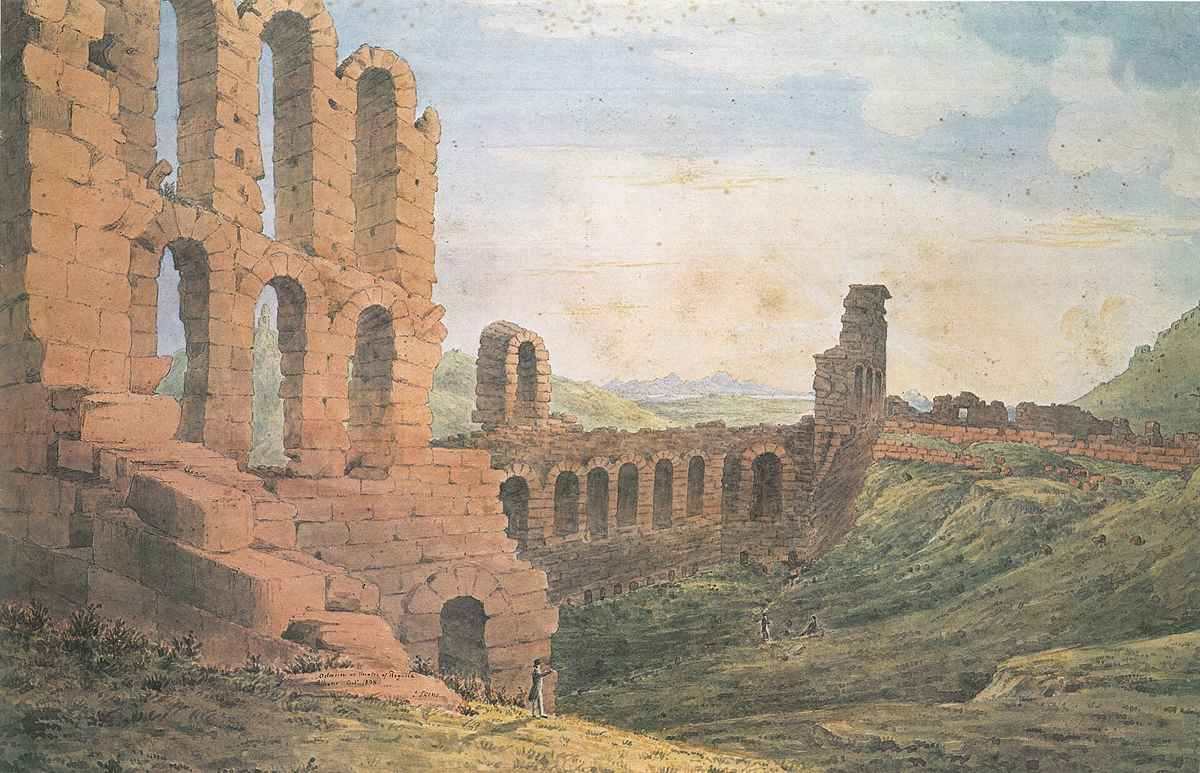
Carved into the southern slope of the Acropolis, the Odeon of Herodes Atticus is the magnificent Roman theatre built in 161 AD and still staging summer concerts and the Athens Epidaurus Festival beneath the floodlit Parthenon. See it on skip-the-line Acropolis tickets and tours from My Greece Tours.
This living ancient monument is a highlight of the Athens travel guide. The sections below cover what it is, its history, the architecture, the famous performances, how to see it by day, attending a concert, and how to get there.
What is the Odeon of Herodes Atticus?
The Herodeion is a stone Roman theatre on the south slope of the Acropolis in Athens, erected in 161 AD by the wealthy magnate Herodes Atticus to honour his wife. Restored in the 1950s, this semi-circular theatre seats around 5,000 and is the celebrated venue of the annual Athens Epidaurus Festival, hosting concerts, opera and theatre on summer nights beneath the Acropolis.
One of the most evocative ancient monuments in Athens, and unusual in that it remains in active use nearly two thousand years after it was built, is the Odeon of Herodes Atticus, a grand Roman theatre nestled dramatically into the steep southern flank of the Acropolis rock. Known affectionately to Athenians simply as the Herodeion, it was completed in 161 AD and is a covered odeon, meaning it was originally designed as a roofed concert hall for musical performances, recitals and lectures, rather than an open-air drama theatre. The structure forms a steep semi-circle of stone seating facing a high, arched stage wall, and after a careful restoration in the 1950s it now accommodates an audience of around five thousand people.
Its great distinction today is its role as the leading stage of the Athens Epidaurus Festival, the city’s flagship cultural event, which each summer fills the ancient theatre with concerts, opera, ballet and classical drama performed under the open sky and the floodlit Parthenon above. Few experiences in Athens are as memorable as a night here. The theatre owes its existence to one extraordinary benefactor. Its origin story is a tale of grief and wealth.
What is the history of the Odeon?
The Odeon was built in 161 AD by Herodes Atticus, an immensely wealthy Greek aristocrat, sophist and Roman senator, to honour his late wife, the Roman noblewoman Aspasia Annia Regilla, who had died around 160 AD. Used for musical performances in antiquity, it was destroyed by the Heruli invasion in 267 AD and lay in ruins for centuries until its restoration and reopening for performances in the 1950s.
The history of the Odeon is bound up with the life of one of the richest and most cultivated men of the Roman Empire, Herodes Atticus, a Greek aristocrat from a fabulously wealthy Athenian family who served as a Roman senator and consul and was renowned as a sophist, teacher of rhetoric and great public benefactor. When his beloved Roman wife, Aspasia Annia Regilla, died around 160 AD, the grief-stricken Herodes commissioned this superb theatre in her memory, completing it in 161 AD as a lavish gift to the city of Athens, one of several monuments he funded across Greece. In its Roman heyday the roofed odeon hosted musical contests, recitals and performances for Athenian audiences.
Its glory was short-lived, however, for little more than a century later, in 267 AD, the theatre was destroyed during the devastating invasion of the Heruli, a Germanic people who sacked Athens, and thereafter it fell into ruin, its cedar roof gone and its walls crumbling. For the better part of seventeen centuries the Odeon stood as a romantic ruin on the Acropolis slope, until a major restoration in the 1950s rebuilt the seating and the stage, allowing it to reopen as a performance venue and begin its remarkable second life. This long history adds depth to every visit. Its architecture reveals Roman grandeur.
What does the architecture of the Odeon look like?
The Odeon is a classic Roman theatre with a steep semi-circular cavea of marble seating in 33 rows, originally holding around 5,000 spectators, facing a flat orchestra and a towering three-storey stone stage wall, the scaenae frons, that rises to about 28 metres. Originally it was roofed with cedar of Lebanon timber. The arched facade and restored marble seating make it a striking sight from the Acropolis above.
Architecturally, the Odeon of Herodes Atticus is a fine and well-preserved example of Roman theatre design, combining Greek and Roman elements in a dramatic setting. Its most prominent feature is the steeply raked semi-circular bank of seating, the cavea, carved into and built against the natural slope of the Acropolis, originally comprising around thirty-three rows of marble seats that could hold approximately five thousand spectators, all with an excellent view down to the performance area. At the foot of the seating lies the flat, paved semi-circular orchestra where performers stand, and behind it rises the theatre’s most imposing element: the great stage wall, or scaenae frons, a towering three-storey facade of stone reaching about twenty-eight metres in height, pierced by arched openings and once richly decorated, which formed the backdrop to performances and gave the building its monumental presence.
In Roman times the whole auditorium was covered by a roof of expensive cedar of Lebanon timber, marking it out as a luxurious covered concert hall. Today the gleaming restored marble seating set against the weathered ancient stone of the stage wall makes the Odeon one of the most photogenic sights in Athens, especially when viewed from the Acropolis path above. The design serves performance superbly. Across the centuries great artists have graced its stage.
What famous performances have taken place here?
Since its restoration, the Odeon has hosted an extraordinary roll-call of world-famous artists. The legendary soprano Maria Callas sang here, and the stage has welcomed Luciano Pavarotti, Frank Sinatra, Sting, Elton John, the Bolshoi Ballet and many more. As the main venue of the Athens Epidaurus Festival since, it stages classical concerts, opera, ballet and ancient Greek drama every summer for audiences from around the world.
Part of the magic of the Odeon is the sense of standing where some of the greatest performers of the modern era have appeared, for since its reopening the theatre has become one of the most prestigious stages in the world. The Greek soprano Maria Callas, perhaps the most famous opera singer of the twentieth century, performed here, lending the venue a special place in the city’s cultural heart, and the list of international stars who have since graced its ancient stage reads like a who’s who of music and dance, including the tenor Luciano Pavarotti, Frank Sinatra, Sting, Elton John, Andrea Bocelli, Yanni and companies such as the Bolshoi Ballet.
The engine of this artistic life is the Athens Epidaurus Festival, the great annual arts festival of which the Odeon has been the centrepiece since, running each year roughly from June to early October and presenting a rich programme of symphony concerts, opera, ballet, contemporary dance, popular music and, fittingly, performances of the ancient Greek tragedies and comedies that were born in this very city. To watch a performance here, with the music rising into the warm night and the illuminated Parthenon looming above, is a profoundly atmospheric experience. The festival keeps the ancient stone alive. Even by day, the theatre rewards a visit.
How do you see the Odeon by day?
The interior of the Odeon is not open to walk inside except for ticketed performances, but by day you can admire it superbly from above. Access to view it is included in the standard Acropolis ticket, and the path around the Acropolis slope passes directly above the theatre, giving a magnificent overhead view of the seating and stage wall. The pedestrian Dionysiou Areopagitou street below also offers fine views of its arched facade.
Many visitors wonder whether they can wander inside the Odeon during the day, and it is important to know that, in order to protect the monument, the interior is normally closed to the public except for those holding tickets to an evening performance. This does not diminish a daytime visit, however, because the theatre is best appreciated from above, and viewing it is included in the general admission ticket to the Acropolis and its slopes. As you walk the path that climbs around the south slope of the Acropolis toward the entrance of the citadel, you pass directly above the Odeon, where a railing offers a spectacular bird’s-eye view straight down into the semi-circle of marble seating and across to the great arched stage wall, perfect for photographs.
From this vantage the scale and elegance of the Roman theatre are wonderfully clear. Down below, the broad pedestrian promenade of Dionysiou Areopagitou street, which runs along the foot of the Acropolis, gives a fine ground-level view of the towering arcaded facade of the stage building. Combining the Odeon with the Theatre of Dionysus nearby and the Acropolis itself makes for a rich morning of ancient theatre history. It is woven into the wider south slope explored in the Theatre of Dionysus guide. Attending a summer concert is the ultimate experience.
How do you attend a concert at the Odeon?
To attend a performance, book tickets to an Athens Epidaurus Festival event, which run from June to early October; tickets are sold through the festival’s official website and box offices and sell out for popular shows. Arrive early, bring a cushion as the marble seats are hard, and wear flat shoes, as a strict no-heels policy protects the ancient stone. Performances usually begin around 9pm after dark.
For most visitors, the dream is to actually attend a performance at the Odeon, and with a little planning this is entirely achievable during the summer season. Events take place as part of the Athens Epidaurus Festival, which runs each year from around June to early October, so if your visit falls in those months it is well worth checking the programme. Tickets are sold through the festival’s official channels, including its website and box offices, and they cover a wide range of prices depending on the seating tier and the event, from affordable upper rows to premium seats near the stage; popular concerts and big-name artists sell out, so booking ahead is wise.
On the night, a few practical tips greatly improve the experience: arrive early to find your seat and soak up the atmosphere, bring or rent a cushion as the ancient marble seats are hard and there are no backrests, and wear comfortable flat shoes, since the theatre enforces a strict no-heels policy to protect the historic stone, particularly in the upper tiers. Performances typically begin around nine in the evening once darkness falls, allowing the floodlit Acropolis to form an unforgettable backdrop. Dress for a mild night that can cool later. Reaching the theatre is simple and central.
How do you get to the Odeon of Herodes Atticus?
The Odeon stands on the south slope of the Acropolis, on the pedestrian Dionysiou Areopagitou street in the Makrigianni district. The nearest metro station is Acropoli on line 2, the red line, a 5-minute walk away. From there the traffic-free promenade leads straight to the theatre, also close to the Acropolis Museum. For performances, the entrance is on Dionysiou Areopagitou street itself.
Getting to the Odeon is easy, as it sits in the very heart of historic Athens at the foot of the Acropolis, well served by public transport and pedestrian streets. The theatre lies on the south slope of the Acropolis hill, fronting the lovely traffic-free promenade of Dionysiou Areopagitou street in the Makrigianni neighbourhood, just below the citadel. The most convenient way to arrive is by metro: the Acropoli station on line 2, the red line, is only about a five-minute walk away, and from its exit the broad pedestrianised avenue leads directly to the monument, passing close to the superb Acropolis Museum, which makes an ideal pairing.
The whole area is car-free and made for strolling, so most visitors reach the Odeon comfortably on foot as part of exploring the Acropolis and its surroundings. For those attending an evening festival performance, the entrance gate is located directly on Dionysiou Areopagitou street, and arriving by metro is strongly advised given the lack of parking nearby. With such a central and accessible location, the Odeon is simple to include in any Athens itinerary. The metro network is detailed in the Athens metro guide. The questions below cover the points visitors ask most.
Frequently Asked Questions
Can you go inside the Odeon of Herodes Atticus?
The interior of the Odeon is not open for visitors to walk inside, except for those holding tickets to a performance during the summer Athens Epidaurus Festival. By day, however, you can admire it superbly from the Acropolis slope path directly above, a view included in the standard Acropolis ticket, and from the pedestrian street below.
Is the Odeon still used for performances?
Yes, the Odeon of Herodes Atticus is very much in use. Since it has served as the principal stage of the Athens Epidaurus Festival, hosting concerts, opera, ballet and ancient Greek drama every summer from around June to early October, with performances beneath the floodlit Acropolis. World stars from Maria Callas to Pavarotti and Sting have played here.
How old is the Odeon of Herodes Atticus?
This Roman theatre was built in 161 AD, making it over 1,800 years old. It was constructed by the wealthy Greek aristocrat Herodes Atticus in memory of his wife Regilla. Destroyed in the Heruli invasion of 267 AD, it lay in ruins until a restoration in the 1950s returned it to use as a performance venue.