
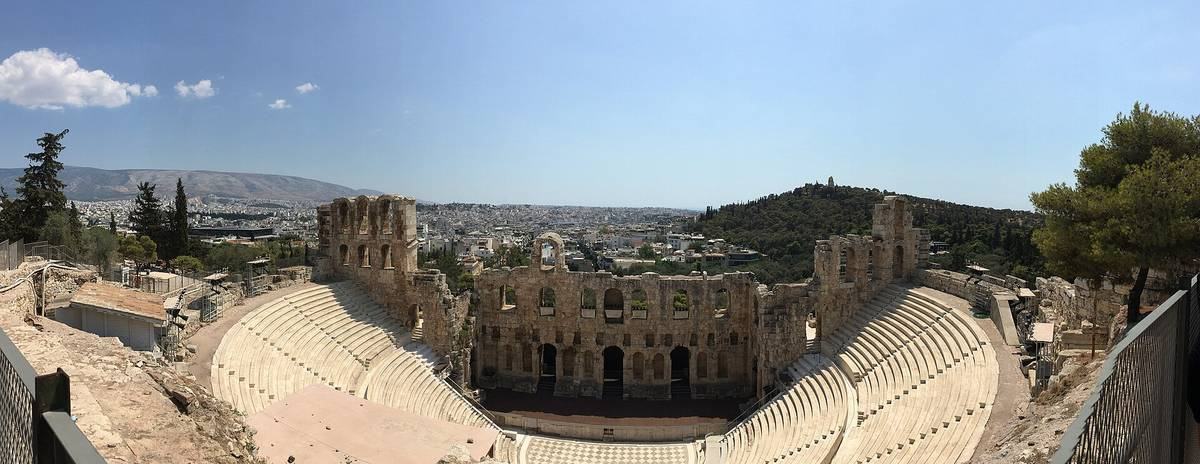
On the south slope of the Acropolis, the Theatre of Dionysus stands as the world’s first theatre and the very birthplace of drama, where the tragedies of Sophocles, Euripides and Aeschylus were first performed. Explore it on skip-the-line Acropolis tickets and tours from My Greece Tours, the cradle of Western theatre.
This foundational ancient site is a treasure of the Athens travel guide. The sections below cover what it is, its place as the birthplace of drama, the City Dionysia festival, what survives to see, its history, visiting tips, and how to get there.
What is the Theatre of Dionysus?
Set into the south slope of the Acropolis in Athens, the Theatre of Dionysus is an ancient open-air theatre regarded as the world’s first and the birthplace of drama. Dedicated to Dionysus, god of wine and theatre, it began as a 6th-century BC orchestra terrace and grew into a stone theatre holding up to 17,000 spectators, where Greek tragedy and comedy were born.
Among all the monuments clustered on the slopes of the Acropolis, none has had a greater influence on world culture than the Theatre of Dionysus, the ancient open-air theatre built into a natural hollow on the southern flank of the sacred rock and revered as the oldest theatre in the world and the place where the very art of drama was born. It formed part of the sanctuary of Dionysus Eleuthereus, the god of wine, fertility and theatrical performance, in whose honour the dramatic festivals were held, and from these religious celebrations the traditions of tragedy and comedy emerged. Beginning in the sixth century BC as a simple circular dancing floor, or orchestra, with wooden seating set against the hillside, the theatre was progressively enlarged and rebuilt in stone over the following centuries until, at its greatest extent, it could seat a vast audience numbering perhaps as many as seventeen thousand spectators.
Here, at the foot of the Acropolis, the greatest playwrights of antiquity premiered works that still form the foundation of Western literature and theatre. To stand among its ruins is to visit the birthplace of an art form. Its claim as the cradle of drama is its glory.
Why is it called the birthplace of drama?
The Theatre of Dionysus is the birthplace of drama because it was here, in the 5th century BC, that the masterpieces of Greek tragedy and comedy were first performed in dramatic competitions. The great tragedians Aeschylus, Sophocles and Euripides, and the comic playwright Aristophanes, premiered their plays on this stage. Drama itself evolved here from earlier choral rituals honouring Dionysus, founding Western theatre.
The Theatre of Dionysus earns its title as the cradle of theatre because it was on this very ground, during the golden age of Athens in the fifth century BC, that the dramatic arts as we know them were created and the foundational masterpieces of the Western stage first came to life. Drama itself is thought to have evolved here out of the choral songs and dances, the dithyrambs, performed in worship of Dionysus, when, according to tradition, a performer first stepped out from the chorus to speak as an individual character, giving birth to acting and dialogue. In the contests held here, the towering tragedians of classical Athens competed and premiered their immortal works: Aeschylus, the father of tragedy; Sophocles, author of Oedipus Rex and Antigone; and Euripides, creator of Medea and The Bacchae, while the brilliant comic playwright Aristophanes staged his biting satires such as The Clouds and Lysistrata.
These plays, written and performed for Athenian audiences in this theatre two and a half thousand years ago, established the forms of tragedy and comedy and continue to be studied and staged worldwide today. No site is more central to the history of theatre. The plays were the heart of a great religious festival.
What was the City Dionysia festival?
The City Dionysia was the great annual dramatic festival of ancient Athens, held each spring in the Theatre of Dionysus in honour of the god Dionysus. Introduced under the tyrant Pisistratus around 534 BC, it featured competitions in tragedy, comedy and choral song before huge audiences. Playwrights presented sets of plays judged for prizes, blending religious ritual, civic pride and dramatic art in a days-long celebration.
The dramatic life of the theatre revolved around the City Dionysia, the most important of the festivals of Dionysus and one of the great events of the Athenian civic and religious calendar, held each year in the early spring when the sailing season reopened and visitors flocked to the city. Traditionally said to have been established under the tyrant Pisistratus around 534 BC, the festival combined solemn religious ritual, including a grand procession bringing the statue of the god to the theatre and sacrifices in his honour, with several days of dramatic competitions that were the centrepiece of the celebration.
Playwrights selected to compete each presented a set of plays, typically three tragedies followed by a comic satyr play, performed before audiences of thousands, and a panel of judges awarded prizes to the best works and playwrights, making success here a matter of enormous prestige. The festival was also an expression of Athenian civic identity and democratic pride, attended by citizens, officials and foreign guests alike. Through these annual contests, generation after generation of dramatic masterpieces were created and performed. The festival fused worship, politics and art. Today the visible ruins let you picture these spectacles.
What can you see at the theatre today?
Today you can see the well-preserved stone remains of the theatre, including rows of marble seating curving up the Acropolis slope, the semi-circular orchestra where the chorus performed, and the front-row thrones of honour for priests and officials. The most striking is the ornate marble throne of the priest of Dionysus. Carved Roman-era reliefs on the stage front and the sanctuary remains complete the site.
While much of the theatre’s vast wooden and stone seating has been lost to time, what survives is evocative and rewarding to explore, giving a vivid sense of the great auditorium that once stood here. Climbing the south slope, you see the curving rows of weathered marble and stone seats that fanned up the hillside, the lower portions best preserved, framing the flat semi-circular orchestra, the performance space at the heart of the theatre where the chorus sang and danced. The single most remarkable surviving feature is the front row of grand marble seats of honour, the prohedria, reserved for dignitaries, among them the magnificently carved throne of the priest of Dionysus Eleuthereus, decorated with reliefs and inscribed with his title, which sat in the place of greatest privilege facing the stage.
Along the front of the later Roman stage building runs a frieze of sculpted reliefs depicting scenes from the myths of Dionysus, well worth examining closely. Around the theatre lie the remains of the sanctuary of Dionysus, including the foundations of its temples. Allowing twenty to thirty minutes lets you absorb these details and imagine the drama once staged here. The ruins reward a thoughtful eye. The theatre’s long history spans many centuries.
What is the history of the Theatre of Dionysus?
The theatre began as a simple 6th-century BC wooden structure and orchestra on the Acropolis slope. It was rebuilt grandly in stone in the 4th century BC under the statesman Lycurgus, reaching its peak capacity. The Romans later remodelled the stage, adding sculpted reliefs. After antiquity it fell into ruin and was rediscovered and excavated by archaeologists from the 1830s, revealing the ancient theatre seen today.
The Theatre of Dionysus evolved over many centuries, its successive rebuildings mirroring the changing fortunes of Athens itself. Its origins lie in the sixth century BC, when a simple performance space with a circular earthen orchestra and temporary wooden benches set against the hillside hosted the earliest dramatic contests of the City Dionysia. As drama flourished in the fifth century, the theatre was developed further, though it was in the later fourth century BC, under the Athenian statesman Lycurgus, that it was rebuilt magnificently in stone, given permanent marble seating and brought to its fullest grandeur and greatest capacity. In the Roman period the theatre was remodelled again, particularly the stage building, which received the carved frieze of Dionysian reliefs still visible today, and it continued in use for various spectacles.
After antiquity, however, the great theatre gradually fell into disuse and ruin, buried and forgotten beneath the slope for centuries. Its rediscovery came in the modern era, when archaeologists began systematic excavations from the 1830s onward, unearthing the seating, orchestra and sanctuary and revealing to the world the birthplace of drama. The monument we visit today is the fruit of that long history and careful excavation. Visiting it well takes a little planning.
How do you visit the Theatre of Dionysus?
This ancient theatre is on the south slope of the Acropolis and access is included in the standard Acropolis ticket, so no separate ticket is needed. It is best visited together with the Acropolis and the nearby Odeon of Herodes Atticus. Wear comfortable shoes, bring water and a hat in summer, and allow 20 to 30 minutes. The combined Acropolis ticket also covers other ancient sites.
Visiting the Theatre of Dionysus is straightforward and excellent value, since it forms part of the Acropolis archaeological site and requires no separate admission. Entry is covered by the standard ticket to the Acropolis and its slopes, and the combined multi-site ticket for the Acropolis also includes several other major ancient monuments around the city, offering good savings for those visiting many sites. The theatre lies on the south slope, on the way up to the Acropolis citadel, so the natural approach is to enter from the south slope and explore the theatre and the adjacent sanctuary of Dionysus before or after ascending to the Parthenon, ideally pairing it with the splendid Odeon of Herodes Atticus a short walk along the same slope.
As at all the open archaeological sites, a few sensible preparations help: wear comfortable, sturdy shoes for the uneven ground and marble, bring water and a sun hat in the hot summer months when there is little shade, and aim for early morning or late afternoon to avoid the worst heat and crowds. Allowing around twenty to thirty minutes lets you appreciate the seating, the throne and the reliefs. This rich site rewards an unhurried visit. The famous fortress nearby completes the experience in the Acropolis guide. The questions below cover the points visitors ask most.
Frequently Asked Questions
Is the Theatre of Dionysus the oldest theatre in the world?
Yes, the Theatre of Dionysus on the Acropolis slope in Athens is widely regarded as the world’s oldest theatre and the birthplace of drama. Beginning as a 6th-century BC performance space dedicated to the god Dionysus, it is where Greek tragedy and comedy were born and where the great playwrights Sophocles, Euripides, Aeschylus and Aristophanes premiered their works.
Do you need a separate ticket for the Theatre of Dionysus?
No separate ticket is needed for the Theatre of Dionysus. It lies within the Acropolis archaeological site on the south slope, so access is included in the standard Acropolis ticket. It is best visited together with the Acropolis citadel above and the nearby Odeon of Herodes Atticus along the same slope.
Which playwrights performed at the Theatre of Dionysus?
The greatest playwrights of ancient Greece premiered their works at the Theatre of Dionysus during the 5th century BC. The tragedians Aeschylus, Sophocles and Euripides staged masterpieces such as Oedipus Rex, Antigone and Medea here, while the comic playwright Aristophanes presented satires like Lysistrata, all performed in the dramatic competitions of the City Dionysia festival.