
A Thermopylae day trip from Athens reaches the legendary “Hot Gates”, where King Leonidas and his 300 Spartans made their heroic stand against Persia in 480 BC, with the Leonidas monument, Kolonos hill and a battle museum. Make it effortless with a guided tour or skip-the-line tickets from My Greece Tours, often paired with Delphi.
This legendary excursion is a powerful pilgrimage in the Athens travel guide. The sections below cover whether it is worth it, the battle, the monument, Kolonos hill, the museum, how to get there and the best way to do it.
Is Thermopylae worth a day trip from Athens?
Yes, for lovers of history and the legend of the 300. Thermopylae, the famous “Hot Gates”, is where King Leonidas and his 300 Spartans, with their Greek allies, made an immortal last stand against the immense Persian host of Xerxes in 480 BC. The battlefield, the dramatic Leonidas monument, the Kolonos hill of the final stand and a museum make a moving, legendary day trip, often combined with Delphi.
For anyone moved by one of history’s greatest stories of courage and sacrifice, a pilgrimage to Thermopylae is a deeply stirring excursion from the capital. This is the legendary site of the “Hot Gates”, the narrow coastal pass where, in 480 BC, the Spartan King Leonidas and his elite 300 warriors, alongside a small force of Greek allies, stood against the overwhelming might of the Persian Empire of Xerxes in one of the most famous battles ever fought, immortalised in countless retellings and the film “300”. Though the landscape has changed over the millennia as the sea has receded, the site preserves the spirit of the battle, with the imposing modern monument to Leonidas and the 300, the poignant Kolonos hill where the last defenders fell, the original thermal hot springs that gave the pass its name, and an excellent information centre and museum recounting the battle.
Lying on the route north toward Delphi and Meteora, Thermopylae is often combined with those great sites into a rich day or longer tour. For history enthusiasts, standing at this hallowed ground is unforgettable. It pairs naturally with the great oracle in the Delphi day trip guide. The battle itself is the heart of the story.
What happened at the Battle of Thermopylae?
In 480 BC the Persian ruler Xerxes invaded Greece with a vast army. An allied Greek force under the Spartan King Leonidas, with his 300 Spartans, blocked the narrow pass of Thermopylae. Hugely outnumbered, the Greeks repelled the Persians for three days until betrayed by a local who revealed a mountain path. Leonidas and his men perished to the last man, becoming legends.
Understanding the battle brings the quiet pass vividly to life and explains why it resonates so powerfully. In 480 BC the Persian ruler Xerxes led an enormous army, said by ancient sources to number in the hundreds of thousands, across the Hellespont to conquer Greece. To buy time and halt the advance, a small allied Greek force took up position at the narrow coastal pass of Thermopylae, the “Hot Gates”, where the mountains and the sea left only a slender passage; this force was commanded by the Spartan King Leonidas with his famous bodyguard of 300 Spartans, supported by several thousand other Greeks. Despite being vastly outnumbered, the Greeks used the bottleneck brilliantly, repelling wave after wave of Persian attacks for three days in fierce fighting.
The defence was finally undone when a local Greek named Ephialtes betrayed a hidden mountain path to the Persians, allowing them to encircle the defenders. Knowing the end was near, Leonidas dismissed most of the allies but stayed with his 300 Spartans and a few others, who fought to the last man in a sacrifice that bought Greece precious time and became the ultimate symbol of courage and duty. The story still inspires. The era is explored in the Marathon day trip guide. The great monument honours the fallen.
What is the Leonidas monument?
The Leonidas monument at Thermopylae is a striking modern memorial to King Leonidas and the 300 Spartans, erected beside the battlefield. It features a bronze statue of Leonidas, spear and shield raised, bearing the defiant inscription “Molon Labe” (“Come and take them”), his reply to the Persian demand to surrender their weapons. It is the central memorial and photo spot of the site.
The most prominent and stirring feature of the Thermopylae site is the modern monument dedicated to King Leonidas and his 300 Spartans, which serves as the focal point of any visit. Erected beside the main road across from the battlefield, the memorial is crowned by a powerful bronze statue of Leonidas himself, depicted as a warrior in his crested helmet, gripping his spear and shield in a pose of defiance and readiness for battle. Beneath the statue, the monument bears the famous Greek words “Molon Labe”, meaning “Come and take them”, the legendary reply Leonidas is said to have given when Xerxes demanded that the Greeks surrender their weapons, a phrase that has become an enduring symbol of resistance.
Marble plaques and reliefs around the base honour the various Greek contingents who fought and fell in the battle, including the Spartans and their Thespian and Theban allies. The monument is the iconic image of Thermopylae and the natural place to pause, reflect and take photographs, and a moving tribute to the heroism the site commemorates. Standing before it, the legend feels close. Across the road lies the hill of the last stand. The Kolonos hill is the most poignant spot.
What is Kolonos hill?
Kolonos hill is the low mound across the road from the Leonidas monument where the surviving Greek defenders made their final stand and were buried. A simple plaque on the hill bears the famous epitaph: “Stranger, tell the Spartans that here we lie, obedient to their laws.” Quiet and moving, it marks the exact spot where Leonidas and his men perished to the last man.
While the grand Leonidas monument draws the eye, the most genuinely moving place at Thermopylae is the modest, low hill of Kolonos, which lies just across the road and marks the very ground where the battle reached its tragic, heroic climax. It was here, on this small rise, that the last surviving Greek defenders, having been surrounded by the Persians, made their final stand, fighting to the death with spears, swords and finally hands and teeth, in defence of the body of their fallen King Leonidas. After the battle, the dead were buried on this spot, and the hill became a place of memory and pilgrimage in antiquity.
Today a simple stone plaque on the quiet hill records the famous ancient epitaph, attributed to the poet Simonides, in honour of the fallen Spartans, in the words attributed to Simonides: “Stranger, go tell the Spartans that here we lie, true to their laws.” Climbing the small mound and reading these words, in the silence of the spot where such courage and sacrifice unfolded, is the emotional heart of a visit to Thermopylae, far more affecting than the grand statue across the way. It is a place for quiet reflection. The nearby museum explains the full story. The information centre deepens the experience.
What is the Thermopylae museum?
The Thermopylae Historical Information Centre, near the Leonidas monument, opened and tells the story of the battle through digital displays, interactive screens and a three-dimensional video reconstruction. It helps visitors understand the events, tactics and significance of the 300’s stand, making the battlefield far more meaningful. It is well worth visiting alongside the monument and Kolonos hill.
To make full sense of the battlefield, which today looks like an unremarkable stretch of plain since the coastline has shifted far from the ancient pass, a visit to the modern museum is invaluable. The Thermopylae Historical Information Centre, run by the Municipality of Lamia and located right by the Leonidas monument, was inaugurated as a state-of-the-art interpretation centre dedicated to the battle. Inside, visitors can learn about the historical events through engaging digital “tables” and interactive screens that explain the build-up to the invasion, the course of the three-day battle, the tactics used in the narrow pass, the betrayal and the final stand, and the wider significance of the sacrifice for the survival of Greek civilisation.
A particular highlight is a three-dimensional video that vividly reconstructs the battle of Thermopylae, bringing the clash to life in a way that the open battlefield alone cannot. Visiting the centre before or after exploring the monument and Kolonos hill transforms the experience, turning a quiet roadside site into a comprehensible and powerful encounter with one of history’s most famous battles. It is highly recommended for the full picture. Reaching the site takes some planning. Getting there is part of the journey.
How do you get to Thermopylae, and what is the best way to visit?
Thermopylae is about 200 kilometres north-west of Athens, a roughly 2 to 2.5 hour drive on the A1 motorway toward Lamia. There is no easy direct public transport, so driving or an organised tour is best. Many full-day tours pair Thermopylae with Delphi, and it also lies on the route to Meteora, making it ideal to combine with those great sites for a richer day.
Reaching Thermopylae takes a little planning, as it lies a good distance north of the capital, but the journey is straightforward and the rewards considerable. By car, the site is around 200 kilometres north-west of Athens, a drive of roughly two to two and a half hours on the good A1 motorway heading toward Lamia and Thessaloniki, with the monument visible beside the road and parking available. Public transport is awkward and impractical for a focused day trip, as there is no convenient direct service to the site itself, so driving or, better still, an organised tour is strongly recommended. Because Thermopylae sits on the main route north and close to other great destinations, it is most often and most rewardingly combined with other sites: many full-day tours from Athens pair the battlefield with the magnificent ancient sanctuary of Delphi, sometimes adding the chic mountain town of Arachova, while Thermopylae also lies conveniently on the way to the spectacular monasteries of Meteora, making it a natural stop on a longer tour.
For history lovers, combining Thermopylae with Delphi or Meteora makes for an outstanding day or multi-day excursion. An early start is wise. The wider routes appear in the getting around Athens guide. The questions below cover the points visitors ask most.
Why does the Thermopylae pass look so wide today?
Silt from the Sperchios river has pushed the shoreline about 5 km east since 480 BC. During the battle, the sea reached the foot of the cliffs and the road was a track a few metres wide. That strip is now open plain.
The Leonidas bronze went up in 1955. It now stands in fields that were sea in the time of Leonidas. The motorway to Lamia runs across the same ground.
The Persians turned the Greek position by the Anopaia path. The track starts in the Asopos gorge and crosses Mount Kallidromo, which rises directly behind the battlefield.
Which hot springs and spas lie near Thermopylae?
Sulphur water at about 40 degrees flows into open pools a few hundred metres from the Leonidas monument, and bathers use them all year. The spa towns of Kamena Vourla and Loutra Ypatis lie within an hour of the pass on a Thermopylae day trip.
Kamena Vourla sits on the Euboean Gulf under the cliffs of Knimida. Its springs are mildly radioactive, and hydrotherapy buildings of the 1930s still stand on the front. A pebble shore faces northern Evia across a narrow strait.
Loutra Ypatis is the older spa, set in a park under the slopes of Mount Oiti. Its water is sulphurous. The spas stay open through the winter, when the pass stands empty.
What does Lamia add to a Thermopylae day trip?
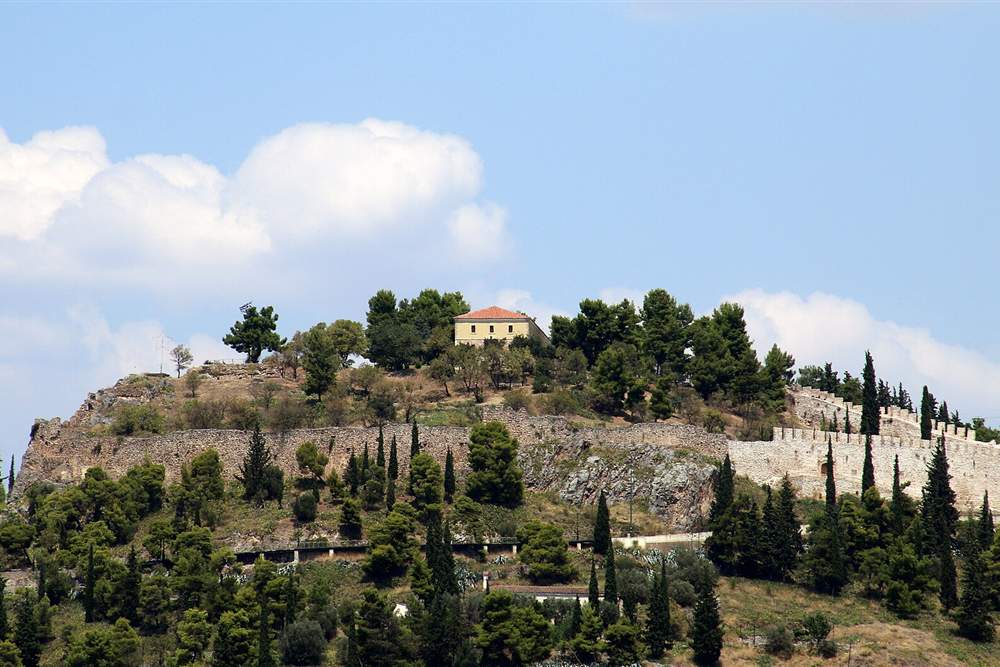
Lamia adds a castle on its acropolis with the archaeological museum inside, walls from five periods and three old-town squares. The city lies twenty minutes from Thermopylae, so a Thermopylae day trip takes it as a half-day extension.
The castle walls run from classical blocks through Byzantine and Catalan rebuilding. Ottoman barracks inside them now hold the museum. Its finds span the region, from Neolithic Phthiotic Thebes to the Hellenistic cities.
The Lamian War took its name from the town. After the death of Alexander in 323 BC, the Greek cities rose against Macedon and besieged Antipater in Lamia. They lost the war at Krannon a year later.
Homer placed Phthia, the home of Achilles and the Myrmidons, in the Sperchios valley below the town. The squares of Eleftherias, Parkou and Laou form the old centre. Trains on the main line stop at Lianokladi, just outside Lamia.
Lamia opens the way to the wider Central Greece tours, and the road north on the Meteora day trips from Athens passes the city.
What happened at the Gorgopotamos bridge?
On 25 November 1942, Greek resistance fighters and British saboteurs blew up the Gorgopotamos railway viaduct near Lamia. The attack was the most celebrated act of resistance during the occupation of Greece. The rebuilt bridge still carries trains.
Fighters of the two main resistance groups, ELAS and EDES, joined a British team for the operation. The viaduct carried the main railway between Thessaloniki and Athens, and its destruction cut the main north-south line of Greece.
A memorial stands beside the bridge. Walking routes follow the Gorgopotamos and Asopos gorges south of Lamia.
What links Mount Oiti to Herakles?
Myth places the funeral pyre of Herakles on Mount Oiti, where the hero burned himself to end his agony. The mountain rises to 2,152 m south-west of Lamia and forms a national park of fir forest and high plateaus.
Excavations on the upper slopes found a sanctuary of Herakles at the traditional pyre site. The plateaus sit at about 1,800 m, and endemic flowers bloom on them in spring. Marked paths climb from Ypati and Pavliani.
The mountain country continues west into Evrytania, where Karpenisi lies 80 km from Lamia.
Why are the Lichadonisia islets named after Lichas?
Myth says Herakles hurled his servant Lichas into the sea, and the Lichadonisia rose where he fell. The small green islets lie in the strait off northern Evia, twenty minutes by boat from Agios Georgios, in shallow turquoise water.
Lichas brought Herakles the poisoned robe that drove him to the pyre on Oiti. In his pain, the hero seized Lichas and threw him into the gulf.
The islets fill with swimmers and boats in August. A coastal day pairs them with Kamena Vourla. Two-day routes such as the Delphi and Meteora 2-day tour cross the region on the way north.
Frequently Asked Questions
How far is Thermopylae from Athens?
Thermopylae is about 200 kilometres north-west of Athens, roughly a 2 to 2.5 hour drive on the A1 motorway toward Lamia. There is no easy direct public transport, so a car or an organised tour is the best way to visit. It is often combined with Delphi, and lies on the route to Meteora.
What can you see at Thermopylae?
At Thermopylae you can see the battlefield of the 300 Spartans, the striking modern Leonidas monument with its “Molon Labe” inscription, the poignant Kolonos hill where the last defenders fell and are buried, the original hot springs, and the Thermopylae Historical Information Centre, which explains the battle with digital displays and a 3D video.
Can you combine Thermopylae with Delphi?
Yes, Thermopylae is very often combined with Delphi on a full-day tour from Athens, as it lies on the route north. Many tours visit the battlefield and monument of the 300 Spartans along with the great ancient sanctuary of Delphi, and Thermopylae is also a natural stop on a longer trip to Meteora.