
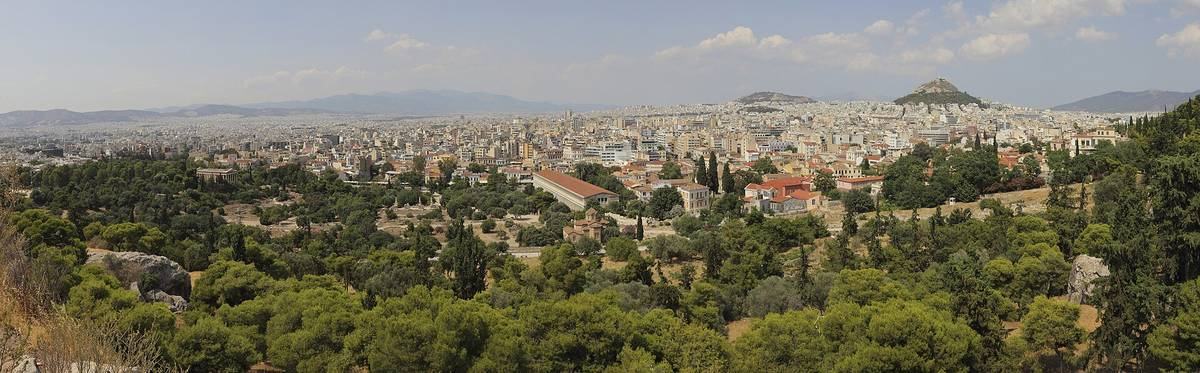
The Areopagus, or Mars Hill, in Athens is a rocky outcrop beside the Acropolis offering the closest free view of the Parthenon, famed as the ancient supreme court and the site of St Paul’s celebrated sermon. Pair a climb here with skip-the-line Acropolis tickets and guided tours from My Greece Tours for the full ancient-Athens experience.
This free, historic viewpoint is a must-see in the Athens travel guide. The sections below cover what it is, its history as a court, St Paul’s sermon, the views, climbing it, when to visit and how to get there.
What is the Areopagus in Athens?
The Areopagus, also called Mars Hill, is a bare rocky outcrop just below and north-west of the Acropolis in Athens. Its name means “Hill of Ares”, the Greek god of war. In ancient times it served as the meeting place of the Areopagus Council, the city’s supreme court, and today it is a free viewpoint offering the closest views of the Acropolis.
Rising directly beside the great rock of the Acropolis, the Areopagus is a low, bare hill of smooth, worn limestone that packs an extraordinary amount of history and a spectacular view into a small space. Its Greek name, Areios Pagos, means the “Hill of Ares”, after the god of war whom the Romans called Mars, which is why it is widely known in English as Mars Hill; according to myth, this was the very spot where the gods themselves put Ares on trial for the killing of a son of Poseidon. In the ancient city the hill served a serious civic purpose as the meeting place of the Areopagus Council, the venerable aristocratic body that acted as Athens’s supreme court for grave matters such as homicide and certain religious offences.
Today the hill is an open, unticketed site that anyone can climb at any time, and it has become one of the most popular free viewpoints in Athens, offering the closest and most dramatic view of the Acropolis and the Parthenon to be had from anywhere, along with sweeping panoramas over the Ancient Agora and the city. History and views combine to make it unmissable. It looks straight up to the citadel covered in the Acropolis history guide. Its role as a court runs deep.
What was the Areopagus Council?
The Areopagus Council was the ancient supreme court and governing body of Athens, named after the hill where it met. Composed of former senior magistrates, it dated back to the earliest days of the city and judged the most serious cases, especially murder, as well as overseeing religious and constitutional matters. Its powers were reduced as Athenian democracy developed, but it endured for centuries.
The Areopagus is far more than a viewpoint; it was one of the most important institutions of ancient Athens, a court and council so venerable that it gave its name to the hill itself. The Council of the Areopagus is thought to date back to the earliest, aristocratic period of the city, perhaps around the eighth century BC, long before the birth of democracy, and it was made up of former senior magistrates, the archons, who served for life. Meeting on the rocky hill, this council acted as the supreme court of Athens, trying the gravest cases, above all charges of deliberate murder, as well as cases of arson and certain religious crimes, and in its early days it wielded broad powers over the governance and morals of the city.
As Athenian democracy developed in the fifth century BC, reformers stripped the Areopagus of much of its wider political authority, transferring power to the popular assembly and the people’s courts, yet it retained its solemn role as the homicide court and a guardian of the laws for centuries afterward, even into Roman times. This deep legal history makes the bare rock a foundational site in the story of justice and law. The civic institutions it complemented are covered in the Ancient Agora guide. The hill is also sacred to Christians.
Why is the Areopagus important to St Paul?
The Areopagus is famous in Christian history as the place where the Apostle Paul delivered his celebrated sermon to the Athenians around 51 AD. As recorded in the Acts of the Apostles, Paul spoke about the altar “to an Unknown God” and introduced Christianity to the city’s philosophers. A bronze plaque on the hill commemorates the speech, making it a major pilgrimage site.
Beyond its ancient legal fame, the Areopagus holds a special place in Christian history, drawing pilgrims and visitors from around the world. According to the New Testament book of the Acts of the Apostles, it was here, around 51 AD, that the Apostle Paul delivered one of his most famous speeches, addressing the assembled Athenians, including Epicurean and Stoic philosophers, on this very hill. Noting that he had seen an altar in the city dedicated “to an Unknown God”, Paul used it as a starting point to introduce the Athenians to the Christian God, proclaiming the one they worshipped in ignorance, a sermon that sparked curiosity and scepticism in equal measure and won a few early converts.
This moment, when the new faith first engaged directly with the philosophical heart of the classical world, is regarded as a pivotal event in early Christianity. Today a bronze plaque set into the rock at the foot of the hill records the Greek text of Paul’s address, and the site has become an important place of pilgrimage for Christian visitors retracing the apostle’s steps. Standing where this famous encounter took place adds a profound dimension to the visit. The religious heritage links to the wider sacred sites of the city. The views, however, are the main draw for most.
What are the views from the Areopagus?
The Areopagus offers some of the best free views in Athens, including the closest panorama of the Acropolis and Parthenon you can get from anywhere, looking straight up at the citadel. It also overlooks the Ancient Agora, the Temple of Hephaestus, the sprawl of the city to the mountains, and Filopappos Hill, making it a favourite sunset spot.
For most visitors, the irresistible reason to climb the Areopagus is the view, which ranks among the very finest and most accessible in all of Athens. Because the hill sits immediately below and beside the Acropolis, it provides the closest and most dramatic vantage point on the sacred rock to be found anywhere, so that you look almost straight up at the towering walls, the Propylaea gateway and the Parthenon itself, a perspective impossible from more distant viewpoints. Turning the other way, the rock offers a magnificent panorama over the Ancient Agora directly below, with the beautifully preserved Temple of Hephaestus, across the rooftops of Plaka and Monastiraki, and out over the whole mountain-ringed sprawl of the Athenian metropolis to the distant peaks and, on a clear day, the sea.
The green hills of Filopappos and the Pnyx rise nearby. Best of all, this spectacular outlook is completely free and available at any hour, which makes the Areopagus one of the most popular spots in the city to watch the sunset, when the marble of the Acropolis glows golden above the gathering crowds. The combination of view and history is unbeatable. It rivals the panorama from the Filopappos Hill guide. Climbing it requires a little care.
How do you climb the Areopagus, and when should you visit?
You climb the Areopagus by worn marble steps cut into the rock or a modern metal staircase beside them, reaching the bare summit in a few minutes. The rock is very smooth and slippery, so wear sturdy, grippy shoes and take care. It is best visited early morning or at sunset for the light and cooler temperatures, and it is free and open at all hours.
Reaching the top of the Areopagus is quick and rewarding, but it calls for a little caution because of the nature of the rock. The hill rises just off the main path between the Acropolis entrance and the Ancient Agora, and you ascend it either by the original ancient steps carved directly into the marble, now extremely worn and polished, or by a modern metal staircase installed alongside them for easier and safer access; either way, the climb to the bare, open summit takes only a few minutes. The single most important thing to know is that the exposed limestone and the ancient marble steps are remarkably smooth and slippery, worn glassy by millions of feet over the centuries, so sturdy shoes with good grip are essential and you should tread carefully, especially when descending or if the surface is damp.
There are no railings on the open rock. As for timing, the Areopagus is at its best either early in the morning, when it is quiet and cool, or in the late afternoon and at sunset, when the light turns golden on the Acropolis and Athenians and visitors gather to watch the sun go down, though it can become crowded then. Being free and unticketed, it can be enjoyed at any hour. With care and good timing, it is a magical spot. The nearby routes are explained in the getting around Athens guide. The questions below cover the points visitors ask most.
What else is near the Areopagus?
The Areopagus sits at the heart of ancient Athens, surrounded by major sights. Directly above rises the Acropolis and its museum; just below spreads the Ancient Agora with the Temple of Hephaestus; nearby stand the green hills of Filopappos and the Pnyx, the old quarters of Plaka, Monastiraki and Thissio, and the Roman Agora. This makes it a natural stop on a walking route through the ancient city.
Part of what makes the Areopagus so easy and rewarding to visit is its position in the very midst of ancient Athens, ringed by an extraordinary concentration of monuments and neighbourhoods. Immediately above the rock looms the Acropolis itself, with its entrance and the modern Acropolis Museum just a short climb away, so the hill is almost always combined with a visit to the sacred citadel. Spread out directly below lies the Ancient Agora, the civic heart of classical Athens, where the beautifully preserved Temple of Hephaestus and the reconstructed Stoa of Attalos can be seen. A little further sit the wooded heights of Filopappos Hill and the Pnyx, birthplace of democracy, both offering more free views, while the charming old-town districts of Plaka, Monastiraki and Thissio, full of lanes, tavernas and shops, surround the archaeological zone.
The Roman Agora with its Tower of the Winds is also close by. Because everything is within an easy walk, the Areopagus fits naturally into a day exploring ancient Athens on foot. Its central setting is a large part of its appeal. The old town is profiled in the Plaka guide. The questions below cover the points visitors ask most.
Frequently Asked Questions
What is the Areopagus (Mars Hill) known for?
The Areopagus, or Mars Hill, is known as the rocky hill beside the Acropolis that served as the supreme court of ancient Athens, as the site of St Paul’s famous sermon to the Athenians around 51 AD, and today as a free viewpoint offering the closest views of the Acropolis and Parthenon and spectacular sunsets.
Is the Areopagus free to visit?
Yes, the Areopagus is completely free to visit, with no ticket or entry fee, and it is open at all hours. You climb the worn marble steps or a modern staircase to the bare summit for the closest free views of the Acropolis. The rock is very slippery, so wear sturdy shoes and take care.
How do you get to Mars Hill in Athens?
Mars Hill, the Areopagus, sits just below the entrance to the Acropolis, between the Acropolis and the Ancient Agora. The nearest metro stations are Monastiraki on lines 1 and 3 and Acropoli on line 2, both a short walk away. It is easily combined with a visit to the Acropolis and the Agora.