
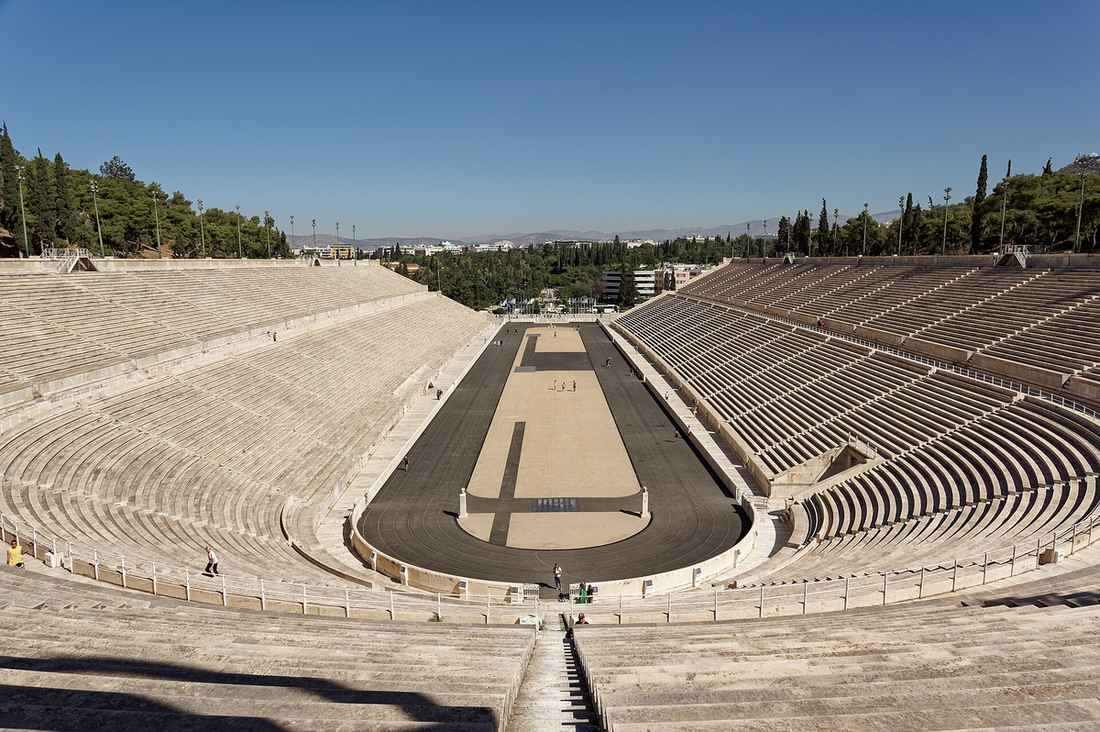
The Panathenaic Stadium, known as Kallimarmaro, is the world’s only stadium built entirely of marble and the host of the first modern Olympics, held in 1896. Visit this Olympic landmark and run its ancient track with skip-the-line tickets and guided tours from My Greece Tours for a richer experience. Plan the whole trip with Greece Tours.
The Panathenaic Stadium is a unique landmark in the Athens travel guide. The sections below cover its history, what to see, how to visit and tips in full.
What is the Panathenaic Stadium?
An ancient stadium in central Athens, the Panathenaic Stadium, also called Kallimarmaro meaning “beautiful marble”, is the world’s only stadium built entirely of marble. Originally built for the ancient Panathenaic Games and rebuilt in marble by Herodes Atticus, it was restored to host the first modern Olympics, held in 1896 and seats around 50,000.
One of the most remarkable monuments in Athens, the Panathenaic Stadium is a horseshoe-shaped ancient stadium set in a small valley in the heart of the city, just east of the National Garden. Its popular name, Kallimarmaro, means “beautiful marble”, and it earns the title as the world’s only stadium constructed entirely of marble, its gleaming white tiers of seating made of fine Pentelic marble, the same prized stone used for the Parthenon. The stadium has a history stretching back to antiquity, when it hosted the athletic contests of the ancient Panathenaic Games, and it was magnificently rebuilt in marble in the Roman era.
Centuries later, beautifully restored, it became the stage for one of the most significant moments in modern sporting history, hosting the very first modern Olympic Games in 1896, and it remains deeply connected to the Olympic movement. With a capacity of around 50,000, it is still used for events and ceremonies today. For its beauty, uniqueness and Olympic legacy, the stadium is a must-see, set out alongside the guide to things to do in Athens. Its long history is fascinating.
What is the history of the Panathenaic Stadium?
A stadium was first built on the site around 330 BC by the statesman Lykourgos for the Panathenaic Games, which dated back to about 566 BC. It was rebuilt entirely in Pentelic marble by the wealthy Roman-era Athenian Herodes Atticus by 144 AD, seating 50,000. Abandoned after antiquity, it was excavated in 1869 and rebuilt for the 1896 Olympics.
The Panathenaic Stadium has a history spanning nearly 2,500 years, tied to two great ages of athletics. The ancient Panathenaic Games, held in honour of the goddess Athena, began around 566 BC, and a permanent stadium was built on this site around 330 BC by the Athenian statesman Lykourgos to host the running and athletic contests. Its most magnificent transformation came in the Roman period: by 144 AD, the immensely wealthy Athenian benefactor Herodes Atticus, who also built the famous odeon below the Acropolis, rebuilt the stadium entirely in fine Pentelic marble, giving it grand tiered seating for around 50,000 spectators. With the spread of Christianity in the 4th century AD, the games ended and the stadium was abandoned, its marble gradually quarried away over the centuries.
It was rediscovered and excavated in 1869, and hosted the revived Zappas Olympics in 1870. Then, for the first modern Olympic Games of 1896, the stadium was completely rebuilt in marble on its ancient foundations, a vast project funded by the benefactor George Averoff and designed by the architects Anastasios Metaxas and Ernst Ziller. This rich history is part of its appeal, set out alongside the guide to ancient Athens history. Its Olympic role is its greatest fame.
Why is the Panathenaic Stadium important to the Olympics?
The Panathenaic Stadium hosted the first modern Olympics, held in 1896, staging the opening and closing ceremonies and four of the nine sports. It remains an Olympic icon: the Olympic flame is handed over to host nations here before each Games, and the marathon traditionally finishes in the stadium, cementing its place at the heart of the Olympic movement.
The Panathenaic Stadium holds a uniquely important place in the history of the modern Olympic Games. When the Olympics were revived in the modern era, Athens, the home of the ancient games, was chosen to host the first modern Olympics, held in 1896, and the restored marble stadium was the centrepiece venue. It staged the spectacular opening and closing ceremonies and hosted four of the nine sports contested at those inaugural games, before crowds of tens of thousands. The connection endures powerfully today: the stadium remains a sacred site of the Olympic movement, and it is here that the Olympic flame, lit at ancient Olympia, is ceremonially handed over to the organisers of each host nation before every modern Olympic Games, both summer and winter.
The stadium also famously served as the finish line for the marathon at the 1896 games and again at the Athens Olympics, and the classic Athens Marathon still finishes within its marble tiers each year. This living Olympic legacy makes a visit deeply meaningful, set out alongside the guide to Greek heritage sites. There is plenty to see and do on a visit.
What can you see and do at the Panathenaic Stadium?
At the Panathenaic Stadium you can walk onto the track and run a lap like an Olympian, climb the marble tiers for panoramic views, sit in the royal marble thrones, follow the included audio guide, and visit the small exhibition of Olympic torches and posters from every modern Games in the tunnel beneath the stands. Children especially love it.
A visit to the Panathenaic Stadium is interactive and memorable, offering more than just admiring it from outside. The highlight for many is stepping onto the running track itself and running, or walking, a lap around it, channelling your inner Olympian on the very ground where the first modern champions competed, a thrill especially for children. You can climb the steep marble tiers of seating for sweeping panoramic views over the stadium, the Acropolis and the city, and sit in the special marble thrones, the seats of honour once reserved for dignitaries and royalty.
Entry includes an informative audio guide, available in many languages, which brings the stadium’s long history to life as you explore. A fascinating small museum or exhibition runs through the vaulted tunnel beneath the stands, displaying the Olympic torches and official posters from every modern Olympic Games, summer and winter, a wonderful overview of Olympic history. The stadium is also a superb spot for photographs of the gleaming marble against the sky. With these experiences, it is a rewarding, hands-on visit, set out alongside the guide to Athens with kids. Visiting is easy.
How do you visit the Panathenaic Stadium?
The Panathenaic Stadium is in central Athens near the National Garden and Temple of Olympian Zeus, a short walk from Syntagma or Acropoli metro. It is open daily, with an entrance fee that includes an audio guide. Allow around 45 minutes to an hour, visit early or late to avoid the heat, and combine it with nearby central sights.
Visiting the Panathenaic Stadium is straightforward and fits easily into a day exploring central Athens. The stadium is centrally located on Vassileos Konstantinou Avenue, just south-east of the National Garden and close to the Temple of Olympian Zeus, Zappeion and the Acropolis, so it is within walking distance of the main central sights and reachable on foot from the Syntagma or Acropoli metro stations, or by bus and tram. It is open to visitors daily, generally from the morning until early evening, with hours shorter in winter, and charges a modest entrance fee that conveniently includes the multilingual audio guide. Allow around 45 minutes to an hour to walk the track, climb the tiers, see the Olympic exhibition and take photographs at a relaxed pace.
As the marble stands are exposed and reflect the sun, it is best to visit early in the morning or later in the afternoon to avoid the midday heat in summer, and to wear comfortable shoes for the steps. The stadium combines perfectly with the Temple of Olympian Zeus, the National Garden and Plaka nearby. With these tips, it is an easy, rewarding stop, set out alongside the guides to the Temple of Olympian Zeus and getting around Athens. The questions below cover the points visitors ask most.
What were the ancient Panathenaic Games?
The Panathenaic Games were a major ancient Athenian festival held every four years from about 566 BC in honour of the goddess Athena. They featured athletic contests, chariot races, music and poetry competitions, and a grand procession, with victors awarded amphorae of sacred olive oil. The Panathenaic Stadium was built to host the athletic events.
To understand the Panathenaic Stadium, it helps to know the ancient festival that gave it its name and purpose. The Panathenaic Games, or Panathenaia, were the greatest religious and athletic festival of ancient Athens, held in honour of the city’s patron goddess, Athena. Established around 566 BC, the games were celebrated every four years in a grander form known as the Great Panathenaia, with a smaller version held annually, and they were among the most important events in the Athenian calendar, drawing competitors and spectators from across the Greek world. The festival combined a magnificent religious procession, the Panathenaic Procession depicted on the Parthenon frieze, which carried a new robe to the statue of Athena on the Acropolis, with a wide programme of competitions.
These included athletic contests such as running, wrestling, boxing and the pentathlon, thrilling chariot and horse races, and musical, poetic and rhapsodic competitions. Victors were awarded distinctive large amphorae filled with sacred olive oil from Athena’s groves, a valuable and prestigious prize. The stadium was built to stage the athletic events of these games, linking it directly to this ancient tradition. This heritage enriches a visit, set out alongside the guide to Greek heritage sites. The questions below cover the points visitors ask most.
Frequently Asked Questions
What is the Panathenaic Stadium famous for?
The Panathenaic Stadium, known as Kallimarmaro, is famous as the world’s only stadium built entirely of marble, and as the host of the first modern Olympics, held in 1896. It also stages the ceremonial handover of the Olympic flame to each host nation and is the traditional finish of the Athens Marathon.
Can you run on the track at the Panathenaic Stadium?
Yes, visitors can step onto the track and run or walk a lap around the Panathenaic Stadium, a popular and memorable experience, especially for children. You can also climb the marble tiers for panoramic views, sit in the marble thrones, and explore the exhibition of Olympic torches beneath the stands.
How much time do you need at the Panathenaic Stadium?
You need around 45 minutes to an hour at the Panathenaic Stadium to run the track, climb the marble tiers, follow the included audio guide, see the Olympic exhibition and take photographs at a relaxed pace. It combines well with the nearby Temple of Olympian Zeus, the National Garden and Plaka.