
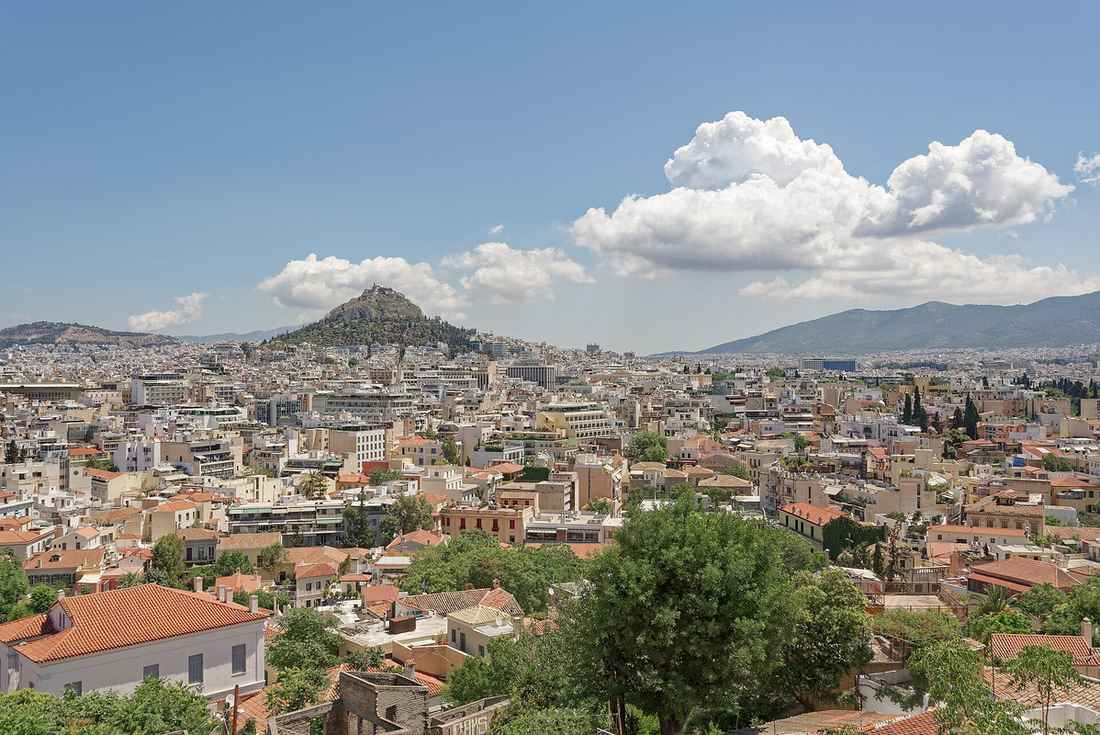
Lycabettus Hill is the highest point in the city at 277 metres, offering breathtaking panoramic views of the Acropolis, the city and the sea, best of all at sunset. Reach the top by funicular or on foot, then enjoy the view with the help of guided tours from My Greece Tours for the perfect Athens day. Plan the whole trip with Greece Tours.
Lycabettus Hill offers the best views in the Athens travel guide. The sections below cover the views, how to get to the top, the sunset and tips in full.
What is Lycabettus Hill?
Lycabettus Hill is the highest point in the city, rising 277 metres above the city in the Kolonaki area. Its summit, reached by funicular or on foot, offers spectacular 360-degree panoramic views over Athens, the Acropolis and the Aegean Sea, and is crowned by the whitewashed chapel of St George, a café and an open-air theatre. It is famous for its sunsets.
Lycabettus Hill, or Mount Lycabettus, is the highest point in the city and one of the city’s most rewarding viewpoints, a steep, pine-clad limestone hill that rises dramatically above the rooftops to a height of 277 metres. Located in the chic central district of Kolonaki, north-east of the Acropolis, its conical summit towers over the city and is visible from much of Athens. From the top, visitors are treated to breathtaking, unobstructed 360-degree panoramic views that take in the whole sprawl of Athens, the Acropolis and the Parthenon on their rock, the surrounding mountains, and the Aegean Sea glinting in the distance, a reminder that Athens sits by the coast.
The summit is crowned by the small, picturesque whitewashed chapel of St George (Agios Georgios), alongside a café and restaurant and an open-air theatre that hosts concerts in summer. Lycabettus is especially famous as a place to watch the sunset and the city lights come on. For the finest views in Athens, it is unmissable, set out alongside the guide to things to do in Athens. Reaching the top is easy.
How do you get to the top of Lycabettus Hill?
You can reach the top of Lycabettus Hill by the funicular cable railway, which climbs through a tunnel in about 3 minutes from the Kolonaki side, or by walking up a paved switchback path in around 20 to 30 minutes. The funicular runs daily roughly 9am to past midnight, costing about 10 euros one way or 13 round trip. Walking is free.
There are two main ways to reach the summit of Lycabettus Hill, each with its own appeal. The easiest is the funicular, a cliff railway, or teleferik, that climbs steeply up through a 210-metre tunnel inside the hill, whisking you to the top in about three minutes. The funicular station is on the south side of the hill, at the intersection of Ploutarchou and Aristippou streets in Kolonaki, a short walk from the Evangelismos metro station on Line 3; it runs daily, roughly from 9am until past midnight, departing at least every 30 minutes, and costs around 10 euros one way or 13 euros for a round trip.
The trade-off is that the funicular runs through an enclosed tunnel, so you see nothing of the view as you ascend or descend. The alternative is to walk, following a paved path with switchbacks that winds up through the pines from the surrounding Kolonaki neighbourhood, a moderately strenuous climb of around 20 to 30 minutes. Walking is free, gives good views and exercise along the way, and is quieter, though it is hot work in summer. Many visitors ride up and walk down, or vice versa. Either way, the summit rewards you, set out alongside the guide to getting around Athens. The sunset is the magic hour.
Why is the Lycabettus sunset so popular?
The Lycabettus sunset is popular because, from the highest point in the city, you watch the sun sink over the city and the Aegean Sea while the Acropolis, the Panathenaic Stadium, the Temple of Olympian Zeus and the Ancient Agora are lit up below. The golden light, the panoramic view and the city lights coming on make it one of the most magical experiences in Athens.
Lycabettus Hill is renowned as one of the best places in Athens to watch the sunset, and timing your visit for the early evening is the classic way to experience it. From the summit, the highest viewpoint in the city, you enjoy an uninterrupted, sweeping panorama, and as the sun sinks toward the horizon it bathes Athens in warm, golden light, with the Aegean Sea and the mountains framing the view. As dusk falls, the city’s great monuments below begin to glow as their floodlights come on, the Acropolis and Parthenon, the Temple of Olympian Zeus, the marble Panathenaic Stadium and the Ancient Agora, turning the cityscape into a sparkling spectacle.
The sight of the floodlit Acropolis from above, with the sea beyond and the lights of Athens spreading out in every direction, is unforgettable and deeply romantic, perfect for couples and photographers. Because it is so popular, the summit gets busy at sunset, so arrive a little before to find a good spot at the viewing platform by the chapel or at the café terrace. The Lycabettus sunset is a highlight of any visit, set out alongside the guide to the best time to visit. There is more at the summit.
What can you see and do at the summit?
At the summit of Lycabettus you can visit the charming whitewashed chapel of St George, enjoy the panoramic viewing platform, relax at the café or restaurant with a drink and a view, and in summer catch a concert at the open-air Lycabettus Theatre. The combination of views, the chapel and refreshments makes the top a lovely place to linger.
The summit of Lycabettus Hill is more than just a viewpoint, offering a few charming things to see and do that make it worth lingering at the top. Crowning the peak is the pretty little chapel of St George, Agios Georgios, a whitewashed Greek Orthodox church that all are welcome to enter, its simple beauty and hilltop setting making it a serene spot; nearby a small bell tower and terraces add to the charm. The main viewing platform in front of the chapel provides the sprawling, postcard-perfect panoramas of Athens stretching to the coast, ideal for photographs. To relax and soak up the view, there is a café open during the day and evening serving drinks and snacks, and a more upmarket restaurant, both with spectacular vistas, making the summit a wonderful place to enjoy a coffee, a cocktail or a meal above the city.
In summer, the open-air Lycabettus Theatre, set in a former quarry on the hill, hosts concerts and cultural events under the stars. With its views, chapel, refreshments and atmosphere, the top of Lycabettus invites you to stay a while, set out alongside the guide to Athens nightlife. A few tips help your visit.
What tips help for visiting Lycabettus Hill?
Visit Lycabettus for sunset, arriving a little early to beat the crowds and secure a good viewing spot. Take the funicular up to save energy in the heat, or walk for free with views, wearing sturdy shoes and bringing water. Combine it with the chic Kolonaki neighbourhood below, and bring a light layer, as the summit can be breezy.
A few practical tips help you make the most of a visit to Lycabettus Hill. The single best tip is to time your visit for sunset and the early evening, when the views and the floodlit monuments are at their most magical, but arrive a little before the sun goes down to claim a good spot, as the summit gets crowded at this prime hour. To reach the top, consider taking the funicular up, especially in the heat of summer or if you prefer to save your energy, and perhaps walking down, or vice versa; if you walk, wear sturdy, comfortable shoes for the steep path and bring plenty of water.
The hill rises from the elegant Kolonaki district, full of chic boutiques, cafes and restaurants, so combine your visit with a stroll, coffee or meal there before or after. Bring a light jacket or layer, as the exposed summit can be noticeably breezy and cools after sunset. A camera is essential for the panoramas. While the views are spectacular at any time of day, including a clear morning, the sunset and evening are the most rewarding. With these tips, Lycabettus is a highlight, set out alongside the guide to a first-timer’s itinerary. The questions below cover the points visitors ask most.
What is the best time of day to visit Lycabettus Hill?
The best time to visit Lycabettus Hill is late afternoon into sunset and early evening, when the light is golden, the heat eases, and the floodlit monuments and city lights come on. A clear morning also offers crisp, crowd-free views, while midday is hot and hazy. Sunset is the most popular and magical, so arrive a little early.
Choosing the right time of day greatly enhances a visit to Lycabettus Hill, the highest viewpoint in Athens. The most rewarding and popular time is the late afternoon into sunset and the early evening: as the sun lowers, the harsh daytime glare softens into warm, golden light that flatters the city and the Acropolis, the temperatures become more comfortable after the heat of the day, and, best of all, as dusk falls the great monuments below light up, the floodlit Acropolis, the Temple of Olympian Zeus and the Panathenaic Stadium, while the lights of Athens spread out to the dark line of the sea, a magical, romantic spectacle. Because sunset is so popular, the summit gets busy then, so arrive a little before the sun goes down to secure a good spot at the viewing platform or café terrace.
A clear morning is the other good option, offering crisp, clear views with the fewest people and pleasant temperatures, ideal for photography of the city and the surrounding mountains. The least flattering time is the middle of a hot summer day, when the sun is harsh, the air can be hazy and the climb is tiring. Whenever you go, a clear day is essential for the views, set out alongside the guide to the best time to visit Athens. The questions below cover the points visitors ask most.
Frequently Asked Questions
What is Lycabettus Hill known for?
Lycabettus Hill is known as the highest point in the city, at 277 metres, famous for its breathtaking 360-degree panoramic views of the Acropolis, the city and the Aegean Sea, especially at sunset. Its summit is crowned by the whitewashed chapel of St George, a café and restaurant, and an open-air theatre that hosts summer concerts.
How do you get to the top of Lycabettus Hill?
You can reach the top of Lycabettus Hill by the funicular cable railway, which climbs through a tunnel in about 3 minutes from the Kolonaki side for around 10 euros one way, or by walking up a paved switchback path in around 20 to 30 minutes for free. Many visitors ride up and walk down for the views.
Is Lycabettus Hill worth visiting at sunset?
Yes, Lycabettus Hill is well worth visiting at sunset, as from the highest point in the city you watch the sun sink over the city and sea while the floodlit Acropolis, Temple of Olympian Zeus and other monuments glow below. Arrive a little early to beat the crowds and secure a good viewing spot for the magical spectacle.