
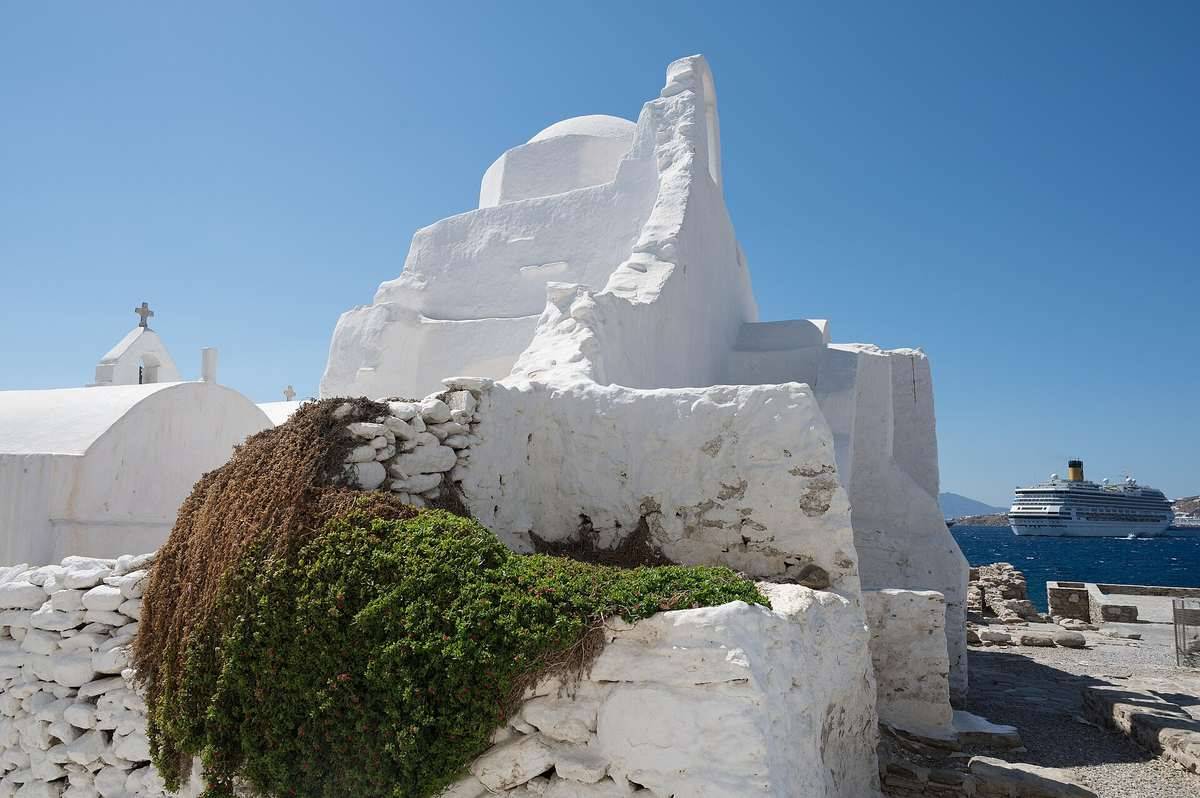
Panagia Paraportiani in Mykonos is a striking whitewashed complex of five churches merged into one sculptural form, built between 1425 and the 17th century in the old Kastro quarter, and is one of Greece’s most photographed monuments. This guide covers its history, unique architecture, where it is and how to visit.
Panagia Paraportiani is the most famous monument in the Mykonos travel guide, complementing the Mykonos Town guide. The sections below cover it in full.
What is Panagia Paraportiani?
Panagia Paraportiani is the most famous church and monument in Mykonos, a brilliant-white complex of five small churches merged into one sculptural structure in the old Kastro quarter of Mykonos Town. Built between 1425 and the 17th century, it is a masterpiece of Cycladic architecture, a national monument and one of Greece’s most photographed sights.
Panagia Paraportiani, meaning Our Lady of the Side Gate, is the most famous and beloved monument in Mykonos and one of the most recognisable churches in all of Greece. Standing in the historic Kastro neighbourhood at the edge of Mykonos Town, overlooking the sea, it is not a single church but a remarkable complex of five separate churches fused together into one flowing, sculptural, brilliant-white structure with soft, rounded, asymmetrical forms. Its striking, almost abstract shape, sculpted by centuries of whitewashing, makes it a masterpiece of Cycladic architecture and an icon of the island, classified as a national monument. It is among the most photographed sights in Greece, drawing huge numbers of visitors, especially at sunset when the white walls glow golden. More than a tourist attraction, it is a working piece of the island’s religious and historical heritage. For its beauty, history and unique form, Panagia Paraportiani is a must-see in Mykonos, set out alongside the guide to photography spots. Its history spans centuries.
What is the history of Panagia Paraportiani?
Panagia Paraportiani was built over around 200 years, with construction starting in 1425 and finishing in the 17th century. Its name means Our Lady of the Side Gate, as it stood by the side gate of the medieval Kastro fortress, built in 1207 by the Gisi family. The five churches were added gradually over the centuries.
The history of Panagia Paraportiani stretches across several centuries, which explains its layered, organic form. Construction started in 1425 and carried on into the 17th century, so it took around 200 years to build, with the five constituent churches added gradually over time rather than all at once. Its name, Our Lady of the Side Gate, comes from its location beside the side entrance, or paraporti, of the entrance to the medieval Kastro, the fortified castle quarter that once protected the town. That castle was constructed in 1207 by the Gisi family, the Venetian lords who controlled Mykonos at the time, and though the fortress was destroyed in the 16th century and its remains absorbed by later buildings as Chora expanded, the church endured beside where its gate stood. This long, piecemeal construction over two centuries, tied to the island’s medieval and Venetian past, gives the monument its deep historical significance and its distinctive merged shape, set out alongside the guide to Mykonos history. The architecture is its most striking feature.
What makes the architecture of Panagia Paraportiani unique?
Panagia Paraportiani is unique because it is five churches merged into one: four at ground level form the base, with a fifth domed church built on top of them. Centuries of whitewashing have softened it into a smooth, sculptural, asymmetrical white form, seen as a definitive piece of Cycladic architecture and unlike any ordinary church.
The architecture of Panagia Paraportiani is what makes it so extraordinary and instantly recognisable. Rather than a single building, it consists of five distinct churches ingeniously joined together: four churches at ground level, dedicated to Saints Anargyroi, Saint Anastasia, Saint Sozon and Saint Eustathios, form the base, and upon them, as their crowning element, sits a fifth, domed church. Built gradually over two centuries, the structure grew organically rather than to a single plan, and generations of the traditional lime whitewashing have rounded and smoothed its surfaces into flowing, sculptural, almost melting forms with soft curves, irregular angles and a beautiful asymmetry. The result is a dazzling white, abstract, almost otherworldly shape that looks more like a sculpture than a conventional church, glowing especially beautifully in the low light of sunset. It is regarded as a perfect, definitive example of Cycladic architecture, capturing the whitewashed island aesthetic at its most artistic. This unique, merged, sculptural form is why it captivates visitors and photographers, set out alongside the guide to Little Venice. Visiting is easy and free.
Where is Panagia Paraportiani and how do you visit?
Panagia Paraportiani is in the Kastro quarter at the edge of Mykonos Town, near Little Venice, a short walk from the centre. It is free to admire and photograph from outside, and best visited at sunset or in the soft morning light. The interior has limited opening, so most visitors appreciate its sculptural exterior and sea-edge setting.
Visiting Panagia Paraportiani is easy, as it sits right in the heart of Mykonos Town and is free to see. You will find it in the historic Kastro neighbourhood, the old castle quarter on the western edge of the Chora, perched near the sea and just a short, well-signposted walk from the centre and close to the Little Venice waterfront, so it is easy to combine with exploring the old town. There is no entrance fee to admire and photograph the monument from outside, and indeed its sculptural white exterior and its setting against the blue sea are the main draw, so most visitors enjoy it from the outside; the interior of the churches has only limited and irregular opening for services, so do not count on going in. The best times to visit are at sunset, when the white walls glow golden and the light is magical, drawing crowds for the spectacle, or in the quiet early morning for peaceful photos without the throng. Wear comfortable shoes for the old town’s cobblestones, and combine your visit with Little Venice and the windmills nearby. It is an unmissable, free highlight of any Mykonos trip, set out alongside the guides to a walking tour and things to do. The questions below cover the points travellers ask most.
Why is Panagia Paraportiani so famous and photographed?
Panagia Paraportiani is so famous because of its extraordinary, unique sculptural form: five whitewashed churches merged into one flowing, asymmetrical white mass unlike any conventional church. Its beautiful Cycladic architecture, sea-edge setting, golden glow at sunset and status as a national monument make it one of Greece’s most photographed and beloved landmarks.
Panagia Paraportiani’s fame and its status as one of Greece’s most photographed monuments come down to its truly unique appearance and setting. Unlike any ordinary church, it is a cluster of five separate churches fused over centuries into a single, flowing, sculptural mass of brilliant white, with soft rounded curves, irregular angles and a striking asymmetry created by generations of lime whitewashing. The result looks more like an abstract sculpture than a building, captivating visitors and photographers and making it instantly recognisable as a symbol of Mykonos and of Cycladic architecture itself. Its location adds to the appeal: it stands in the atmospheric old Kastro quarter right at the edge of the town, with the blue Aegean as a backdrop and the romantic Little Venice nearby, a perfect photogenic setting. The light transforms it through the day, and it is especially magical at sunset, when the white walls glow warm gold and crowds gather to watch and photograph. As a designated national monument with centuries of history, it carries cultural weight as well as beauty. This combination of unique form, stunning setting, beautiful light and heritage is why it draws so many admirers and cameras, set out alongside the guide to photography spots. There is more to see nearby.
What else can you see near Panagia Paraportiani?
Near Panagia Paraportiani you can explore the Kastro quarter, the romantic Little Venice waterfront, the iconic windmills, the Aegean Maritime and Folklore museums, and the maze of whitewashed old town lanes with their shops, churches and tavernas. All are within a short walk, so the church combines easily with a tour of Mykonos Town’s highlights.
Panagia Paraportiani sits in the heart of Mykonos Town’s most scenic area, so it combines beautifully with the surrounding sights in an easy walking tour. It stands in the historic Kastro, the old castle quarter, whose narrow lanes and sea-edge setting are atmospheric to wander. Just steps away is Little Venice, the romantic waterfront row of colourful houses with balconies over the sea, perfect for a drink, a meal and the sunset. The iconic windmills, the Kato Mili, stand on the low hill just above Little Venice, a two-minute walk on, offering the classic photo and sea views. Close by, the small Folklore Museum, housed in a sea-captain’s mansion near the church, and the Aegean Maritime Museum tell the island’s stories, while the whole maze of whitewashed old town lanes around them is full of boutiques, art galleries, tiny churches, cafes and tavernas to explore. Because everything is so close together and pedestrianised, you can easily see Panagia Paraportiani, the Kastro, Little Venice, the windmills and the museums in a single relaxed stroll through the Chora, ideally in the soft morning light or around sunset. This concentration of highlights makes the church a natural part of exploring the town, set out alongside the guides to Little Venice and Mykonos Town. The questions below cover the points travellers ask most.
Frequently Asked Questions
How old is Panagia Paraportiani?
Panagia Paraportiani is around six centuries old, with construction starting in 1425 and continuing until the 17th century, so it took about 200 years to complete as its five churches were added one by one. This long history, tied to the medieval Kastro and the Venetian Gisi family, gives it deep significance.
What is Panagia Paraportiani in Mykonos?
Panagia Paraportiani is the most famous church and monument in Mykonos, a brilliant-white complex of five small churches merged into one sculptural structure in the old Kastro quarter of Mykonos Town. Built between 1425 and the 17th century, it is a masterpiece of Cycladic architecture and one of Greece’s most photographed sights.
Why is Panagia Paraportiani made of five churches?
Panagia Paraportiani is five churches because it was built gradually over around 200 years, from 1425 to the 17th century, with churches added one by one. Four churches at ground level form the base, with a fifth domed church built on top, and centuries of whitewashing merged them into one smooth, sculptural white form.
Can you go inside Panagia Paraportiani?
Panagia Paraportiani’s interior has only limited and irregular opening, mainly for religious services, so most visitors admire and photograph its sculptural white exterior and sea-edge setting from outside, which is free. It is best visited at sunset, when the walls glow golden, or in the quiet early morning for peaceful photos.