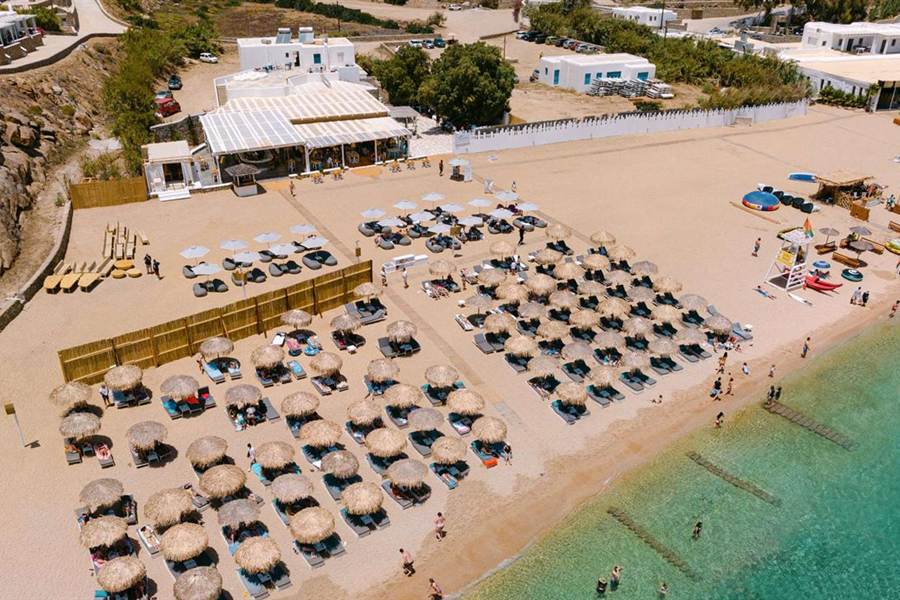
Greek law makes the beach at Mykonos beachfront resorts public: the strip runs no wider than 50 metres inland from the shore line, and a ban on buildings covers all of it. A resort advert that promises a “private beach” has no legal force, and the owner of a plot behind the strip must leave a free passage to the water.
Bathing water is rated in four classes, from excellent to poor, and a site rated poor for five seasons in a row gets a lasting bathing ban. Guests who have not yet picked an island will find the other Greek destinations we cover on the Greece Tours homepage.
What does the Greek coastal law call the shore, and how close to the sea can Mykonos beachfront resorts stand?
Greek law names two public strips along the coast. The shore, aigialos, is where waves reach at their highest usual run-up. The beach, paralia, lies behind it and is no wider than 50 metres. A ban on buildings covers both strips, so Mykonos beachfront resorts fall under it.
The law calls the shore an essential part of the natural environment. The State protects it and manages it as a public space. At the water’s edge, a guest of Mykonos beachfront resorts stands on aigialos, whoever owns the hotel behind the sand.
The beach, paralia, is the dry land that joins the shore. The law gives it two jobs. It guards the coast from erosion, and it links land with sea. The strip is measured inland from the shore line. The limit is national, so it applies to Mykonos beachfront resorts as it does to any Greek coast.
A data-journalism review reports that the law abolished the 30-metre minimum building distance from the shoreline in the beach definition. It kept the 50-metre maximum. The strip behind Mykonos beachfront resorts is therefore set on site. For the island behind these strips, read the Mykonos island guide.
Who draws the line? A committee formed at regional-unit level by the Finance Minister sets it. The head of the Cadastre Service chairs the committee. A surveyor or civil engineer, a Port Authority representative, a geologist and a planning official sit with the chair. The line marks the edge of the public strip in front of Mykonos beachfront resorts.
The committee inspects the site first. It weighs the type of terrain, the vegetation line, lawful buildings, zoning guidance and nearby public land. Where a town plan exists, the beach line cannot go beyond the approved street line. In a traditional settlement, it cannot go beyond the lawful building line.
A decision can be challenged by an appeal within 30 days. After that, an application goes to the Council of State. The final line goes onto the orthophoto maps of the Hellenic Cadastre and into the Government Gazette. The Finance Ministry posts it online, and interested parties are presumed to know it three months later.
- Building: the law bans buildings and structures on the shore and the beach, with exceptions that an older law lists. The ban reaches Mykonos beachfront resorts too.
- Plots: for two years after the Government Gazette prints a new line, nobody can build, improve or plant on the affected private land.
- Rights: an owner with older real rights applies to the Cadastre Service with a survey plan, and the head of the service can recognise those rights.
- Old shore: land that appears when the coastline moves seaward through natural deposits or lawful works. It lies between the new shore line and the former one, and it belongs to the private property of the State.
Can Mykonos beachfront resorts own the beach in front of them, and what does the public access rule mean for guests?
No. The shore and the beach are public property for common use, and the State protects and manages them. Mykonos beachfront resorts can hold a right to use a section for a set time. The public keeps a free, unobstructed passage to the sea.
Common use means the strip serves everyone. The law says its main job is free, unobstructed public access and the link between land and sea. The State can grant only the use of a part. A passer-by and a hotel guest stand on equal ground. For the sands themselves, one by one, read the beach-by-beach guide.
A resort plot can sit between a public road and the shore. In that case, the owner or the possessor must give free passage for safe, unobstructed access to the shore. That duty binds Mykonos beachfront resorts on such plots. A locked gate on that path defeats the rule.
The State grants simple use in two ways. One is an electronic auction, run by the Land Service on a national platform. The notice goes online and onto the municipality’s website at least 20 days before the auction. The law sets 31 March as the yearly deadline for these auctions.
The second way skips the auction. On request, an adjacent business gets simple use for 1 to 3 years if it operates lawfully beside the stretch. Main hotels qualify, and so do rented rooms, campsites and sports clubs. A road or square in between does not break adjacency, so Mykonos beachfront resorts behind a road can apply.
A holder must keep the passage free and the section clean daily, on the sand of Mykonos beachfront resorts too. A sign on site shows the coordinates, the decision number, the public’s rights and a QR code for complaints. Anyone who sees a fence or an extra row of items can report it there.
Without a concession, or beyond one, the Land Service orders movable items off the sand within 48 hours. The municipality gets notice at once. If the business does not comply, the municipality removes the items and charges the offender. An unlawful structure gets a demolition protocol with 30 days to clear it.
- Concession: a contract that grants the use of part of a shore and beach section for a set period. Simple use means a use that keeps the common-use status and leaves the natural form of the shore unchanged.
- Term and bids: an auction contract lasts between 1 and 3 years and is personal to the holder unless its terms say otherwise. If nobody bids, the auction repeats one week later. After a second empty round, the section is not granted for that year.
- Private beach: an advert for Mykonos beachfront resorts that says “private beach” is not a legal act. Only a decision of the Finance Ministry with the competent ministry can take a part out of common use. The law lists public security, health and protection of nature and culture as the grounds.
- On the sand: umbrellas, sunbeds and other movable items stay inside the granted section, and the holder restores the site when the grant ends. A main hotel with a concession can sub-grant part of it to a licensed third party for water-recreation vessels.
- Blocked access: obstructing access to the sea, the shore or the beach brings a fine from the Land Service, and a repeat doubles it. The rule binds Mykonos beachfront resorts as it binds any business.
What share of a beach can sunbeds cover, and how wide is the free strip beside the water for Mykonos beachfront resorts?
The Greek finance ministry sets three limits. At least 50 percent of a beach stays free. Umbrellas and sunbeds cover up to 60 percent of a conceded area. New concessions keep them 4 metres from the sea. The same limits bind Mykonos beachfront resorts that lease sand.
The first limit protects the public. The Ministry of National Economy and Finance says at least 50 percent of the beach must remain free. A second limit applies inside the leased part: umbrellas and sunbeds cover up to 60 percent of the leased area. The two figures use different bases, the whole beach and the leased area.
A single lease cannot exceed 500 square metres. Two leases sit at least 6 metres apart. A beach under 4 metres wide, or under 150 square metres in all, cannot be leased as a rule. A Greek legal study reported in the press names neighbouring hotels as the main exception.
The free strip beside the water is 4 metres for new leases. Sunbeds, umbrellas and tables cannot reach the waterline, says the same legal study. Earlier Greek press reports give 5 metres. At Mykonos beachfront resorts, that strip is the open sand between the sea and the first row of sunbeds.
The rules cover simple beach use only. Umbrellas, sunbeds, movable tables, changing rooms and showers are allowed on the sand. Permanent buildings and concrete bases are not. Noise stays under 50 decibels near homes and under 80 decibels elsewhere. A mobile kiosk covers no more than 15 square metres and stays at least 100 metres from hotels.
The lifeguard rule covers heavily used beaches. A Greek news report defines them as beaches with 300 or more swimmers. A second report counts 930 lifeguard posts that beach size and visitor traffic require. Coastal municipalities put lifeguard services out to bid. Families can read the family beach pages to plan around them.
Joint inspection teams check the leases. They include staff of the Ministry, the state property service, the municipality, the tax authority and the police. A free app, MyCoast, shows each concession on a satellite map with its terms. Mykonos beachfront resorts that lease sand display a sign with a MyCoast QR code. The rules sort beaches into three kinds:
- Organised: leased umbrellas and food and drink service, the kind of beach that Mykonos beachfront resorts lease. A Greek consumer group says an organised beach must still leave free space for other bathers.
- Natura: a lease is possible, but equipment covers no more than 30 percent of the leased area, so Mykonos beachfront resorts on a Natura shore work with that cap.
- High-protection, called untouched: umbrellas, sunbeds, tables, canteens, water sports and music are banned. The legal study reports that the count rose from 198 to 251.
What is the number of beaches on Mykonos, and how long is the coast that Mykonos beachfront resorts share?
The Greek National Tourism Organisation states that at least twenty-five beaches ring Mykonos. The Municipality of Mykonos and the Ministry of Culture both give the island 89 kilometres of coast. That coast is the shore on which Mykonos beachfront resorts stand.
The island that carries Mykonos beachfront resorts covers 85.5 square kilometres on Wikipedia. The municipality adds Delos, Rhenia and uninhabited islets, and covers 105.183 square kilometres. Delos covers 3.43 square kilometres. Rhenia covers 14 and has 43 kilometres of coast, says an Aegean islands information site. A strip 1 kilometre wide parts it from Delos.
The municipality’s island page gives a maximum length of about 14 kilometres and a width of 10. It calls the island mainly hilly, with no large flat surfaces near the coast. Bays cut deep into the land. The main bays are Chora, Panormos and Ornos. Mykonos beachfront resorts sit on that indented shore.
Wikipedia counts ten villages: Chora, Tourlos, Ano Mera, Kalafati, Ftelia, Ornos, Platis Gialos, Psarrou, Agios Stefanos and Agios Ioannis. It puts the main town, Chora, on the island’s west side. The Municipality of Mykonos is the only municipality in its regional unit of the South Aegean. The census counts 10,704 residents. The island lies 150 kilometres east of Athens.
The tourism organisation’s page puts beaches on every side of the island, the coast Mykonos beachfront resorts share. It places Ornos and Platis Gialos in the south, and Elia and Agrari in the east. It places Panormos, Mersini and Fokos in the north, and Agios Ioannis and Kapari in the west.
The Ministry of Culture says Elia, Kalo Livadi and Kalafatis keep their natural character. It calls Myrsini, Fokos, Merchia, Lia and Kavo Fragkia, in the northeast and southeast, almost untouched. The tourism organisation adds that the northern beaches are quieter and need a private vehicle or a motorcycle. Wikipedia notes that small boats sail to the beaches.
The former prefecture of the Cyclades covers 2,572 square kilometres. Naxos is the largest island, and Syros has the largest population. Mykonos beachfront resorts stand on 85.5 square kilometres, where Naxos has 429.8. Wikipedia lists these areas for other islands:
- Larger than Mykonos: Andros covers 380 square kilometres, Paros 195 and Tinos 194.
- Larger than Mykonos: Milos covers 151, Amorgos 141 and Kea 132.
- Larger than Mykonos: Ios covers 108 and Kythnos 99.4.
- Smaller than Mykonos: Syros covers 83.6, Santorini about 73, Anafi 40.4, Folegandros 32.2 and Donousa 13.8.
- Closest in size: Syros at 83.6 sits just below Mykonos, and Kythnos at 99.4 sits just above.
What is the sand of Mykonos made of, and how does the grain shape the water beside Mykonos beachfront resorts?
Mykonos is mostly granite, and granite breaks down into grains of quartz and feldspar. Geologists call a grain sand when it measures from one sixteenth of a millimetre to 2 mm. The same rule covers the shore at Mykonos beachfront resorts.
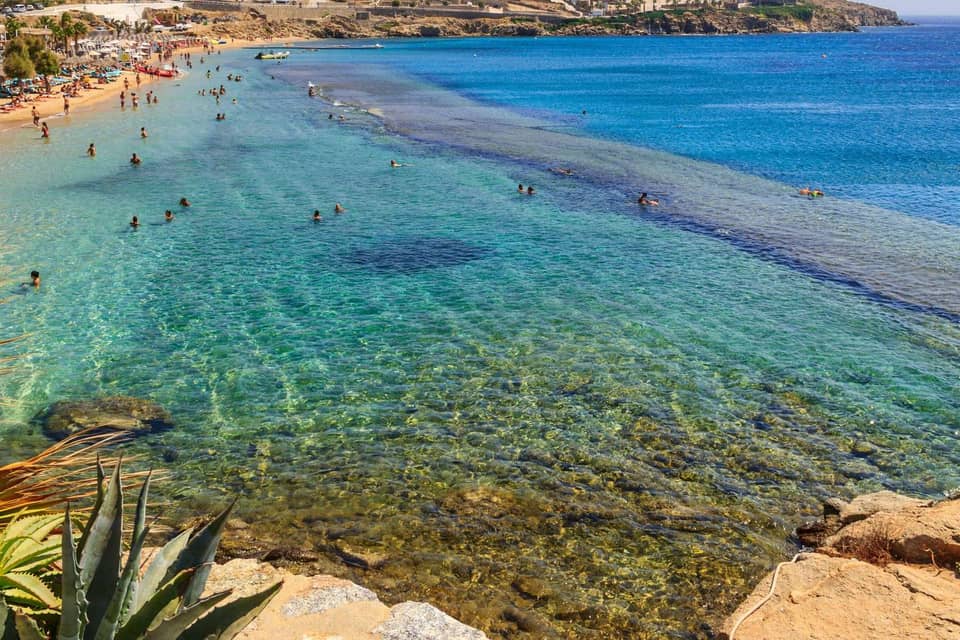
The coast of Mykonos, where Mykonos beachfront resorts stand, is cut in schist, gneiss and plutonic rock. A paper on the island group names monzogranite as the dominant rock. It is around 10 to 13 million years old. It intruded into marble, metapelite and metabasite of the Cycladic blueschist belt.
Granite is a coarse rock made of quartz, feldspar and mica. It is the commonest rock to form sand, and Mykonos beachfront resorts stand on a mostly granite island. Feldspar dissolves faster than quartz, so the rock falls apart into grains. Fresh grains are angular, and geologists call this coarse debris grus. Builders call it sharp sand.
Waves wear rock at the waterline over thousands of years. The loose grains pile up into the strip that Mykonos beachfront resorts face. Geologists sort those grains by size. One standard splits sand into three bands, and the United States scale uses five, from very fine to very coarse.
- Fine sand: 0.063 mm to 0.2 mm.
- Medium sand: 0.2 mm to 0.63 mm.
- Coarse sand: 0.63 mm to 2 mm.
- Gravel: from 2 mm up to 64 mm on the scale geologists use for sand.
- Silt: smaller than one sixteenth of a millimetre, down to 0.004 mm.
- Clay: finer than silt.
Silt feels like flour between the fingers, and sand feels gritty. That difference matters for the water above the sand at Mykonos beachfront resorts. Turbidity is a key test of water clarity and water quality. It measures the cloudiness that very small particles cause. Very small particles settle very slowly or not at all.
Rain runoff carries sediment from disturbed land into water. Mykonos has no rivers, only seasonal streams. Clarity has a standard test. A plain white disk 30 cm wide goes down on a line. The depth where it vanishes measures transparency. The first one was used in the Mediterranean Sea. A reading at Mykonos beachfront resorts uses the same white disk.
The composition of sand depends on the local rock sources. The shade of the shore at Mykonos beachfront resorts follows the rock. Sand rich in magnetite is dark to black. Albedo is the share of sunlight a surface reflects. A low albedo looks dark and takes in more sunlight. A high albedo looks bright and sends more of it back.
Does the tide change the shoreline in front of Mykonos beachfront resorts?
Only a little. In the central Aegean the maximum tidal range stays within 0.30 m. The mean range stays within 0.15 m. The waterline at Mykonos beachfront resorts moves with that small swing and with the weather.
Tidal range is the height gap between high tide and low tide. A coast counts as micro-tidal when the range is lower than 2 m. A paper on the Mykonos coast cites the Hellenic Navy Hydrographic Service for the 0.30 m figure. At Mykonos beachfront resorts the tide moves the water up and down by 30 cm or less.
The Mediterranean is among the seas with the smallest tidal ranges, next to the Baltic and the Caribbean. Its oscillation modes do not match any significant astronomical forcing period. Its largest tides therefore sit close to its narrow link with the Atlantic. The open-ocean range is about 1 m, against a mean of 11.7 m in the Bay of Fundy.
Spring tides bring the larger range at Mykonos beachfront resorts too, when the Moon and Sun line up. Neap tides bring the smallest, when their pulls meet at a right angle. Tide data is predictable because it follows astronomy. A float tide gauge of the Hellenic Navy Hydrographic Service sits at Syros, a neighbour of Mykonos in the Cyclades.
Other forces move the waterline too. The Poseidon monitoring system lists tides, air pressure, wind, water temperature and rainfall as causes of sea level change. Pressure and wind shift the waterline at Mykonos beachfront resorts on top of the tide.
- Air pressure: in open water the level rises by an estimated 10 mm for each millibar of pressure drop.
- Wind: it piles water up at the downwind shore and lowers it at the upwind shore.
- Storm: strong wind from one direction plus low air pressure can raise the range above the tide table.
- Seiche: a standing wave in a partly enclosed sea, set off by wind, a pressure change, earthquakes or tsunamis.
Weather effects are not calculable in advance. The tide therefore adds little to the width of the beach at Mykonos beachfront resorts. In exposed micro-tidal areas, the paper says, the top of the wave uprush is significantly greater than the tidal range. To see which months bring strong wind, read the weather month by month.
Beachrock is sand and gravel cemented at the waterline. The authors mapped it at 22 places, 15 of them on Mykonos. It records five old sea levels, from 4.80 m down to 0.80 m below the present mean. Since the Late Neolithic the sea has risen at an average of 0.76 mm a year.
Which sea hazards share the water in front of Mykonos beachfront resorts, and what do the public sources say about each?
Public sources name five animals that hurt swimmers in the Mediterranean. The stinger drifts in open water, the weever hides in sand, and urchins and a fireworm cling to rock. Mykonos beachfront resorts share that sea, and each animal has its own first-aid rule.
For Mykonos beachfront resorts, the jellyfish on the list is the mauve stinger, an animal of open water. Wikipedia gives the bell a width of 3 to 12 cm. Its colour runs from mauve and purple to pink, light brown and yellow. Eight long tentacles hang from the rim. Bell and tentacles both carry stinging cells.
A mauve stinger sting at Mykonos beachfront resorts means pain for 1 to 2 weeks, Wikipedia says. Local redness, swelling and a rash follow. A laboratory test on tentacles found that seawater stayed neutral, but vinegar made the stinging cells discharge. The authors suggest seawater. The test used tentacles, not swimmers.
The greater weever fish lives on muddy and sandy ground down to 150 m. By day it buries itself in fine sand and shows only its eyes and the tip of the dorsal fin. Venom glands sit at the base of the dorsal and gill-cover spines. Wikipedia lists the Aegean, the sea beside Mykonos beachfront resorts, among its seas.
A bather at Mykonos beachfront resorts gets stung by stepping on a buried fish. Wikipedia ties these cases to summer. The pain is intense and lasts hours to days. A Norwegian health portal advises water as hot as a person tolerates, 40 to 45 °C. It gives 30 to 45 minutes as the common time for the pain to ease.
The common sea urchin is up to 7 cm wide, with long, sharp purple spines. It lives on rock and seagrass meadows to 20 m. The black sea urchin is deep black and lives on rocky shores to 30 m. Both live on rock, so a guest of Mykonos beachfront resorts meets them where the shore turns rocky.
- Open water: the mauve stinger, from the surface down to 150 m.
- Sand and mud: the greater weever fish, buried by day.
- Rock: the common sea urchin and the black sea urchin.
- Rock, sand and Posidonia: the bearded fireworm, 15 cm long on average. Its stinging white bristles can penetrate skin, and adhesive tape helps remove them.
Urchin spines are calcium carbonate and break off in the skin. Tweezers lift out spines. Wikipedia lists hot-water soaks to ease the pain. The NHS lists breathing trouble, chest pain, fits and severe bleeding as reasons for emergency care. Scams and night-time risks of a stay at Mykonos beachfront resorts sit in the general safety guide for the island.
Why does seagrass wash up on the shore near Mykonos beachfront resorts, and does it mean the water is dirty?
Seagrass washes up because the plant sheds old leaves and gentle waves carry them ashore. The plant in these sources is Posidonia oceanica, which prefers clean water. A leaf bank near Mykonos beachfront resorts therefore points to a meadow offshore, not to dirty water.
Posidonia oceanica is a flowering plant, not an alga, and it grows only in the Mediterranean. Wikipedia gives its meadow depth as 1 to 35 metres. A Greek travel feature says people wrongly call it seaweed and that all European countries protect it. Mykonos beachfront resorts sit in the one sea where it grows.
The plant sheds old leaves in autumn, a journal paper states. The leaves gather in the surf zone and pile up on adjacent beaches as banks called banquettes. The paper puts their thickness at centimetres to metres. Gentle waves carry the floating leaves ashore, where they build up.
New banks form after energetic winter storms, with wave heights of about 2 to 3 metres, the paper says. It adds that banks rarely last before the next storm. A second paper records new banks in autumn and winter on one Catalan beach. For a stay at Mykonos beachfront resorts, the sources tie new banks to autumn and winter.
A Frontiers paper says banks play a critical role in coastal protection and sediment dynamics. Field and laboratory studies, it reports, show a drop in wave height. Other authors call the effect almost negligible. Removal with heavy machinery, the paper adds, contributes to beach erosion.
The paper reports that tourists see banks as a dirty part of the beach. Wikipedia says the plant grows in clean waters. It ties the depth where a meadow ends to the clarity of the water. A bank near Mykonos beachfront resorts is dead plant matter, not dirt.
- Habitat: wrack shelters animals, and invertebrates in it feed fish and birds.
- Nutrients: the leaves break down slowly, like compost, and return nutrients to the sea.
- Sand: Wikipedia says the plant produces a large part of the sediment in Mediterranean beach sand.
- Nursery: the meadows shelter more than 80 species of fish and crustaceans.
The smell of a bank near Mykonos beachfront resorts comes from rot. A science journal for young readers says wrack releases rotten-egg gas, called hydrogen sulfide, as it breaks down. Wikipedia adds that rising temperatures and damage from anchors threaten the meadows. The travel feature says about 80% of the marine grassland areas of Greece remain unmapped.
How is the bathing water at Mykonos beachfront resorts tested, and what do the classes excellent, good, sufficient and poor mean?
Greek authorities take water samples and count two faecal bacteria, E. coli and intestinal enterococci. Each site then ranks as excellent, good, sufficient or poor. A designated bathing water beside Mykonos beachfront resorts follows the same EU Bathing Water Directive as every other Greek site.
The European Environment Agency says the class depends on the level of faecal bacteria. The Greek registry names heavy bather numbers, tourism development and environmental interest as grounds for monitoring. Those grounds decide whether a beach beside Mykonos beachfront resorts joins the list. Coastal limits follow, in colony-forming units per 100 millilitres, with enterococci first and E. coli second.
- Excellent: 100 and 250, judged at the 95th percentile.
- Good: 200 and 500, judged at the 95th percentile.
- Sufficient: 185 and 500, judged at the 90th percentile.
- Poor: any result worse than the sufficient limits.
A percentile is a statistical limit, not one reading. The authority takes the log of every count and finds the mean and the standard deviation. The 95th percentile adds 1.65 deviations to the mean, and the 90th adds 1.282. The data spans four bathing seasons. Sufficient, good and excellent also need surveillance and early warning in place.
The registry describes a season of about five months, from June to October. The Minister of Environment and Energy sets the dates. A designated site beside Mykonos beachfront resorts gets one sample before the season, then one each month. The gap between two samples must not pass 30 days. Visual checks cover tar residues, glass, plastics, rubber and other waste.
Every designated site has a bathing water profile. It names the causes of pollution and rates the potential for cyanobacteria, macro-algae and phytoplankton growth. Significant construction works in or near the water force an update before the next season. That rule can reach a shoreline build beside Mykonos beachfront resorts. Excellent water needs a review only when its class changes.
The directive asks for a simple sign near each designated water. Beside Mykonos beachfront resorts, as elsewhere, that sign carries the class and any bathing ban. Results go online once analysis ends. The Greek registry adds a coast map with each beach’s sampling point. It counts about 1,700 beaches and more than 9,550 samples a year.
A poor class brings warning signs, a bathing ban or advice against bathing, and action on the causes of pollution. The measures are the same beside Mykonos beachfront resorts as anywhere else in the EU. Notices must give the reasons for any ban. Five poor years in a row bring a permanent ban or permanent advice against bathing.
What do the Blue Flag criteria demand, and which Mykonos beaches does the published list name?
The Blue Flag asks for clean water, clear information, tidy management and safety services at the beach. Its published Greek list holds no entry for Mykonos, so Mykonos beachfront resorts have no listed beach award to show.
The Blue Flag belongs to the Foundation for Environmental Education. It is a not-for-profit, non-governmental body of more than 100 organisations in 81 countries. The award began as a pilot in France, where eleven municipalities won it first. Awards run on an annual basis. Greece has one national operator, Hellenic Society for the Protection of Nature.
A beach is eligible when it is a designated bathing area. The applicant can be a municipality, a private hotel or a private beach operator. A flagged beach beside Mykonos beachfront resorts must admit people who are not clients of a hotel or beach club. Free access is preferred, and certain beaches charge a small, reasonable fee.
The criteria fall into four groups and split into imperative and guideline ones. A flag at Mykonos beachfront resorts needs every imperative criterion. Each beach needs an information board, and the criteria notes recommend about one every 500 metres on a long beach. It shows the water results, a code of conduct and a map that marks:
- lifeguards or lifesaving equipment and the patrolled area
- first aid equipment, toilets and drinking water
- the water sampling points
- rivers, inflows and storm water outlets
- nearby sensitive natural areas
A flag at Mykonos beachfront resorts needs the excellent class, judged at the 95th percentile for both bacteria. The sampling site sits where the concentration of bathers is highest. Extra samples cover streams and storm water outlets. The first sample falls within 30 days before the flag season. Results reach the board no later than one month after sampling.
The flag must fly during the flag season. A minor fault that cannot be fixed at once gets 10 days, with the flag withdrawn until it is fixed. A major fault withdraws the flag at once and for the rest of the season. A flagged beach beside Mykonos beachfront resorts faces control visits by the foundation, announced or unannounced.
The programme publishes the list by regional unit. It carries 624 Greek beaches, 17 marinas and 17 tourist boats. Thira lists 10 beaches and Naxos lists 3. Four Paros entries carry a withdrawn mark. A guest at Mykonos beachfront resorts can check any flag claim against that list. For the clubs themselves, read the beach club pages.
How strong is the sun at a Mykonos beachfront resort, and what does the UV index tell a guest?
The UV index measures how strongly sunlight burns skin. It is an open scale where 12 is twice as strong as 6. The World Health Organization says a guest at Mykonos beachfront resorts needs sun protection from an index of 3.
A guest at Mykonos beachfront resorts sees only the final number, but it comes from a calculation. Scientists score the sun’s UV with a standard curve that rates each wavelength by how much it burns skin. They divide the result by 25 milliwatts per square metre. The scale has no top end, so it is called open-ended.
Short wavelengths burn far harder. At equal strength, light at 305 nanometres burns about 22% as much as light at 295 nanometres. UVB, from 280 to 315 nanometres, is the main cause of sunburn. UVA, from 315 to 400, makes up over 95% of the UV at ground level. The index weights UVB and says little about UVA.
Five bands turn the number into advice for a guest at Mykonos beachfront resorts. The advice below fits an average adult with lightly tanned skin.
- 0 to 2, low: wear sunglasses on a bright day, and cover up if you burn easily.
- 3 to 5, moderate: stay in the shade near midday, and wear a wide-brimmed hat, protective clothing and UV-blocking sunglasses.
- 6 to 7, high: cut the time in the sun between 10:00 and 16:00.
- 8 to 10, very high: keep sun exposure minimal between 10:00 and 16:00, because bare skin and eyes burn quickly.
- 11 and above, extreme: try to avoid the sun between 10:00 and 16:00, because bare skin and eyes burn in minutes.
The same health body names what moves the index. A higher sun, a spot nearer the equator and a higher altitude all raise it. Less ozone raises it too. Cloud lowers it, yet the reading can stay high under cloud. Water, sand and fresh snow add reflected UV, and a guest at Mykonos beachfront resorts stands between sand and sea.
Mykonos lies at 37.46 degrees north. At solar noon the sun stands 75.6 degrees high on 1 July and 70.8 degrees on 31 July. Greek summer time runs at UTC+3, so solar noon falls at 13:22 and 13:25 on those dates. The daily maximum at Mykonos beachfront resorts sits in the four hours around it.
The sun protection factor (SPF) is the fraction of burning rays that reach the skin. SPF 15 lets one fifteenth through. EU labels stop at SPF 50+. The UVA seal needs UVA protection of at least one third of the SPF. A guest at Mykonos beachfront resorts reapplies it as the label directs and after a swim.
What does the Douglas sea scale say about swimming days at Mykonos beachfront resorts?
The Douglas sea scale grades the sea from degree 0 (no waves) to degree 9 (waves above 14 metres). Degrees 0 to 2 mean calm or smooth water, with waves up to 0.5 metres. That is a flat sea for a swim at Mykonos beachfront resorts.
A British naval officer devised the scale to judge how rough the sea is for ships. He later became Hydrographer of the Royal Navy. The scale has two codes, one for the sea and one for the swell. Both run from 0 to 9. The list below gives the sea code for the water at Mykonos beachfront resorts.
- Degree 0, calm (glassy): no waves.
- Degree 1, calm (rippled): 0 to 0.10 metres.
- Degree 2, smooth: 0.10 to 0.50 metres.
- Degree 3, slight: 0.50 to 1.25 metres.
- Degree 4, moderate: 1.25 to 2.50 metres.
- Degree 5, rough: 2.50 to 4 metres.
- Degree 6, very rough: 4 to 6 metres.
- Degree 7, high: 6 to 9 metres.
- Degree 8, very high: 9 to 14 metres.
- Degree 9, phenomenal: above 14 metres.
A flat sea sits in degrees 0 to 2. Degree 0 has no waves. Degree 1 has ripples up to 0.10 metres. Degree 2 has waves up to 0.50 metres. A wave on an exact boundary counts in the lower degree, says the World Meteorological Organization. So a 0.50 metre sea at Mykonos beachfront resorts is still smooth.
The Hellenic National Meteorological Service does not use degrees in its Aegean bulletin. A guest at Mykonos beachfront resorts reads a wave height instead. It gives the total significant wave height, and adds that the maximum wave reaches up to twice that. The bulletin names whole sea areas, such as the Central Aegean and the Southwest Aegean.
Three things set wave height: wind speed, how long the wind blows and the fetch. The fetch is the open water the wind crosses in one direction. Significant wave height is the average of the highest third of the waves. A guest at Mykonos beachfront resorts who wants to ride the waves finds the options in the watersports guide.
Lifeguard flags turn the sea state into a decision for a guest at Mykonos beachfront resorts. A red-and-yellow flag at the shore marks the swimming area. A medium-hazard flag means experienced swimmers only. A high-hazard flag means swimming is discouraged or banned. In Greek beach guides, the red flag forbids entering the water.
Greek beach guides add three more colours that a guest at Mykonos beachfront resorts can meet. Green marks calm water. Yellow marks waves up to 1.5 metres, and children and weaker swimmers stay out. Orange marks wind and waves that run toward open sea, and it bans air mattresses and other inflatables.
Which building rules shape the size and the look of Mykonos beachfront resorts?
Planning law sets how big a building can be, and island rules keep the white look. Mykonos beachfront resorts need a building permit. New tourist building outside planning zones on Mykonos was suspended until the island’s Special Urban Plan is approved.
A building permit is required for any building works, so it covers the work on Mykonos beachfront resorts too. An authorised engineer logs in to the Technical Chamber of Greece with personal codes. The engineer files the application and enters the studies. The service lists 10 to 18 documents, depending on the project.
Checks run within three working days of the filing. The permit number then goes online, and construction can begin. The municipal City Planning Agency issues permits for Mykonos beachfront resorts, unless other rules apply. Within three days of issue, the agency checks the required contributions and deductions and audits the project budget. A permit is valid for 4 years.
The Ministry of Environment and Energy suspended new permits on land outside planning zones on Mykonos and Santorini. They covered new tourist accommodation, a group that includes Mykonos beachfront resorts, plus special tourist facilities and other tourism businesses. The suspension was to last until each island’s Special Urban Plan is approved. A report on the planned rules gives plot minimums.
- Primary residences: a minimum plot of 4 stremmas, unchanged.
- Holiday homes: 6 to 8 stremmas.
- Tourism development on Mykonos: up to 30 stremmas, subject to revision.
- One stremma is 1,000 square metres.
A draft special spatial plan for tourism, a joint ministerial decision, groups islands of 20 to 250 square kilometres. Mykonos is one example. New tourist accommodation on those islands is capped at 100 beds, so the draft reaches Mykonos beachfront resorts. It also bars building in a strip along the coastline, a ban set out in the shore rules.
An ordinance of the Cyclades administration under the military regime banned multiple hues on house facades. It named white the dominating colour, and whitening stayed mandatory after the regime fell. A decree for Folegandros requires white water-based paint or limewash. A decree for Kythnos makes white the dominant colour of a painted facade.
Chora holds three layers of protection. It is a declared archaeological zone, a traditional settlement and a village of state-protected significance. A decree for Chora allows restaurants and snack bars but bans fast-food outlets. One approval there carried the condition that all terms for traditional settlements must be upheld.
The look of Mykonos is cubic stone-built homes coated in white limewash, with newer buildings in steel-reinforced concrete. Limewash protects the walls from deterioration. Cycladic walls have a thickness of 60 to 80 cm. Plot and zone decide where Mykonos beachfront resorts can stand. For the parts of the island with luxury hotels, read about the luxury hotel areas.
Where does the fresh water of Mykonos beachfront resorts come from on a dry island?
Mykonos beachfront resorts stand on an island with no rivers. Its water comes from seawater treated by reverse osmosis, two dams and wells that draw on an aquifer. Rain adds little, because the National Observatory of Athens classes the climate as hot semi-arid.
The rainfall table for Mykonos comes from the same observatory. Winter carries the rain. July and August are the two driest months, and the twelve months add up to 312.1 mm. A July stay at Mykonos beachfront resorts falls in the driest month of the table.
- January: 66.1 mm.
- February: 58.0 mm.
- December: 55.0 mm.
- June: 3.6 mm.
- July: 0.1 mm.
- August: 1.3 mm.
No river crosses the island that holds Mykonos beachfront resorts. A university thesis on its water system names two dams built of roller-compacted concrete. The same thesis lists drilling wells and pumping works that draw water from an aquifer. It adds desalination plants. It opens on the water shortage that hits the Cyclades, especially in summer.
The island makes its water by reverse osmosis of seawater, for residents and visitors. Desalination is the artificial process that turns salt water into fresh water. Pressure pushes the seawater through a semi-permeable membrane. That pressure must beat the natural osmotic pressure of seawater, around 27 bar.
Seawater systems need 2.9 to 5.5 kWh of power for each cubic metre of water. Pretreatment of the feed water is a necessity for any such system. The recovery ratio is about 20 percent for small seawater systems and 40 to 50 percent for larger ones. A hydrologist counts over 150 desalination plants in Greece, up from around 80.
A Greek newspaper puts daily water use on Mykonos at 1,600 to 2,000 cubic metres in winter. In summer it jumps to 10,000 to 18,000 cubic metres, up to nine times higher. A water professor in the same report puts basic-accommodation guests at about 450 litres a day. Luxury hotel use can reach 1,000 litres per person daily.
The island has room for about 50,000 visitors per night. Wikipedia puts the yearly visitor total at 1.5 million or more. The census counts 10,704 inhabitants. Mykonos beachfront resorts sit in the Cyclades, where tourism has caused problems with erosion, pollution and water shortages.
Roofs once carried part of the load. A university essay on Aegean roofing says the flat roofs of Mykonos formed cisterns that collected water. A Greek newspaper report links new island lodging to swimming basins of every size where water has long been scarce. It calls water carried by tanker truck or ship an essential stopgap.
Which waste and plastic rules apply on the sand in front of Mykonos beachfront resorts?
The EU Single-Use Plastics Directive bars cups and food and beverage containers of expanded polystyrene from the market. The cleanliness regulation of the Municipality of Mykonos names beaches in its scope. Both rules reach the beach that fronts Mykonos beachfront resorts.
The Commission says the directive targets 10 single-use plastic items found in the largest numbers on Europe’s beaches. It adds that single-use plastic items account for half of all marine litter on European beaches. The law applies on every EU shore, including the shore of Mykonos beachfront resorts. The Commission names these 10 items:
- cotton bud sticks
- cutlery, plates, straws and stirrers
- balloons and sticks for balloons
- food containers, cups for beverages and beverage containers
- cigarette butts, plastic bags, packets and wrappers
- wet wipes and sanitary items
The ban applies where sustainable alternatives are easily available and affordable. It covers cotton bud sticks, cutlery, plates, straws, stirrers and sticks for balloons. It also covers cups and food and beverage containers made of expanded polystyrene, and every product made of oxo-degradable plastic. Greece is an EU Member State, so suppliers cannot sell those products to Mykonos beachfront resorts.
Butts sit on the list, and the directive does not ban them. It sets awareness-raising, design and labelling requirements, and producer responsibility schemes instead. Wikipedia calls the butt the litter found in the largest numbers in the world. It estimates 4.5 trillion filters become litter each year. A butt left on the sand of Mykonos beachfront resorts joins that count.
The municipal cleanliness regulation lists beaches next to squares, streets and sidewalks. It bans lit cigarettes in waste bins, because lit butts can cause a fire in the bin. Dumping waste outside the bins is prohibited. Pet owners must carry special bags and collect the waste of their animals. Those rules reach the sand of Mykonos beachfront resorts too.
The same regulation runs a recycling programme, and cartons go in the special blue bins. Greece also charges a levy on single-use plastic bags. A study found supermarket shoppers used 80.3% fewer plastic bags after the levy began. Total use fell from about 1.8 billion bags to 350 million, or from 167 to 33 bags per person.
Beach clean-ups are run by civic organisations, the military or volunteers. They collect by hand or with beach-cleaning machines. Wikipedia reports that 80 percent of marine debris is plastic. The Municipality of Mykonos welcomed funding for a recovery and recycling facility. It processes recyclables, organics and residuals with energy recovery. Syros and Paros get sister facilities.
Whom does a guest of Mykonos beachfront resorts call when something goes wrong on the shore?
Dial 112 first. It connects straight to police, ambulance and fire brigade. A guest of Mykonos beachfront resorts can also reach the Hellenic Coast Guard on 108. Use 108 for a boat in trouble or a spill in the water.
Greece keeps its national numbers beside 112. The EU’s Your Europe portal says 112 is free of charge from fixed and mobile phones. It adds that only 112 reaches the emergency services in all EU countries. Wikipedia adds that a GSM-compatible handset dials 112 even when locked. The numbers Wikipedia gives for Greece, and so for Mykonos beachfront resorts, are:
- 112: the common emergency number in nearly all member states of the EU
- 100: the police
- 108: the Hellenic Coast Guard
- 166: the ambulance service
- 199: the fire service
The Hellenic Coast Guard handles search and rescue with the Hellenic Air Force and the Hellenic Navy. Its tasks include law enforcement at sea, in ports and in coastal areas. It also runs port operations, without the port pilots service. It responds to marine pollution incidents. It sits under the Ministry of Shipping and Island Policy of Greece.
A seaside resort facility collects its certificate from the relevant Port Authority of the Coast Guard. Teams from the General Policing Office and the Marine Environment Protection Office inspect safety and anti-pollution measures on site. The facility needs the means, equipment and training to handle pollution incidents. For Mykonos beachfront resorts, that office is the Port Authority of Mykonos.
EKAB, the National Centre of Emergency Help, coordinates air flights with the Ministry of Health. Air Force aircraft and helicopters are available around the clock. A Greek government plan for island health care lists Mykonos among the island health centres on call. For a guest of Mykonos beachfront resorts, the chain starts with a call to 166 or 112.
A study counted 4,169 patients moved by air and sea from the Cyclades islands to Syros over six years. Of them, 92.3% were admitted to Syros General Hospital. The records place 60.1% of transfers in summertime and 44.7% between 12:00 and 18:00. Private-owned boats were the main medical transport providers and took longer on average than state-owned means.
On the call, say what happened and name the beach. The free-of-charge Advanced Mobile Location service, deployed in Greece, sends the caller’s location to the emergency centre. A spoken place name still helps a dispatcher. Guests of Mykonos beachfront resorts who move by sea can use the water taxi guide. It shows where to catch the boat.
Which Natura sites and protected species touch the shore near Mykonos beachfront resorts?
One Natura site is named for Mykonos: the islets of Rineia, Chtapodia and Tragonisi and the sea around them. It protects seabirds. Monk seals and sea turtles live in the Cyclades, so Mykonos beachfront resorts share the Aegean with three protected groups.
Natura is a network of nature protection areas across the EU, on land and at sea. It rests on two laws: the Birds Directive and the Habitats Directive. Birds get Special Protection Areas, which each member state designates itself. Other species and habitats get Special Areas of Conservation, which the Commission confirms from national lists.
In Greece, the Natural Environment and Climate Change Agency runs a Central Aegean unit. It looks after 41 Natura areas: 16 for birds, 23 for habitats and 2 for both. The unit’s tasks include monitoring species and habitat types and drafting an annual report on its areas. Its list names one Mykonos site, with the code GR4220027.
Mykonos beachfront resorts and the protected islets sit in the same island group, the Cyclades. Rineia lies just west of Delos, so the Delos archaeological island stands beside the protected islets. Delos also carries a UNESCO World Heritage listing, and that label is separate from Natura.
The Key Biodiversity Area record for the islets gives 169.35 square kilometres, marine and terrestrial. It lists 99.91 percent of that area as protected. A protected area begins and ends at a mapped line. The official title ends with the words for the sea area. So the line takes in water as well as rock.
- Seabirds. BirdLife names three breeding seabirds that qualify the islets as an Important Bird Area. The Yelkouan shearwater has 100 to 250 pairs, Scopoli’s shearwater 150 to 250 and Audouin’s gull 13 to 21. Wikipedia says the Yelkouan shearwater nests in burrows that adults visit only at night, to avoid large gulls. Wikipedia says Scopoli’s shearwater leaves the Mediterranean for the Atlantic at the end of October and returns in late February.
- Monk seals. Wikipedia counts 250 to 300 animals in Greece, with the largest group on Gyaros in the northern Cyclades. It calls the seals shy and sensitive to disturbance, and says they use sea caves to give birth. The Hellenic Coast Guard forbids approaching or fishing close to Gyaros. Adults average 2.4 metres in length.
- Sea turtles. ARCHELON is the Sea Turtle Protection Society of Greece. It logged the first green turtle nest in the Cyclades, at Apollonas on Naxos. It also records loggerhead nests found on any suitable beach in the southern Aegean, south of 39 degrees north. Wikipedia says the loggerhead nesting season runs from late spring to August. The IUCN rates the species Vulnerable.
Wikipedia says Natura sites include farmed land, woodland, urban areas and more natural ground. The European Commission says the network includes strictly protected nature reserves too. So a Natura label alone does not tell guests of Mykonos beachfront resorts how strict a site is.
What else do guests ask before they book Mykonos beachfront resorts?
Where can a guest of Mykonos beachfront resorts look up the exact line of a protected area?
The network’s online viewer lets a guest of Mykonos beachfront resorts explore every site. Wikipedia says it gives access to every standard data form. Each form is the legal reference for the species and habitats of one site. It settles what a label protects.
Whom does a guest at Mykonos beachfront resorts tell about a turtle track on the sand at night?
ARCHELON takes reports from the public through an online registration form for nesting turtles, tracks and hatchlings. Its website also lists a 24-hour sea turtle phone line. Every confirmed sighting in its sporadic-nesting study came with photographs, so a photo of the track helps.
Does night lighting along the shore of Mykonos beachfront resorts matter to wildlife such as turtles?
ARCHELON says light pollution is a common threat to all sea turtle species. Turtles come ashore to nest at night. On Naxos, artificial light disoriented green turtle hatchlings, and a group there guided them safely to the sea. The nest hatched in September.
Does resort building threaten the seabirds that breed on the islets near Mykonos beachfront resorts?
Wikipedia names holiday resort development near breeding sites as one threat to the Yelkouan shearwater. It names rats and cats as others. The bird breeds on islands and coastal cliffs in the eastern and central Mediterranean. Wikipedia lists it as Vulnerable.
How close is the island of Delos to the coast where Mykonos beachfront resorts stand?
Wikipedia puts Delos only 2 km from Mykonos and calls it the meeting ground of the Delian League. Its highest point, Mount Kynthos, rises 112 metres and carries a sanctuary of Zeus. The Delos article places the island close to the centre of the Cyclades.
In which sea and island group do guests of Mykonos beachfront resorts spend their stay?
Mykonos is part of the Cyclades, lying between Tinos, Syros, Paros and Naxos, says Wikipedia. It lies in the Aegean Sea, 150 km east of Athens. The Cyclades take their name from the circle the islands form around Delos.