
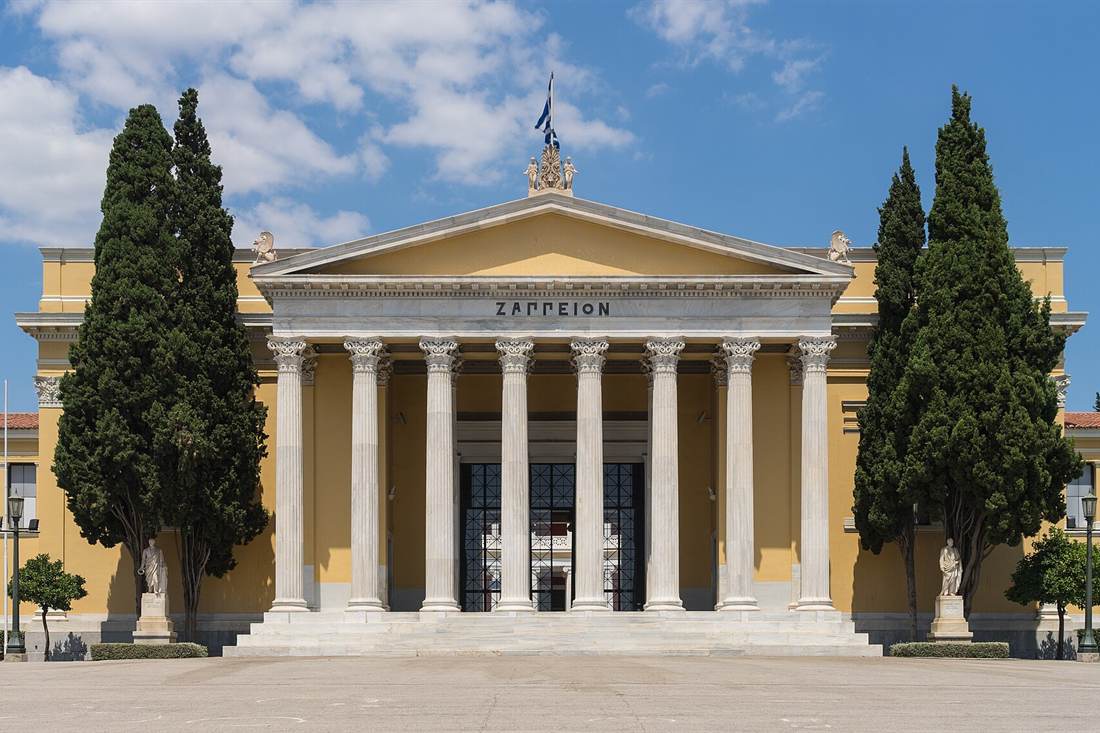
Athens free sightseeing starts with six Neoclassical landmarks whose facades face the pavement, from the Parliament on Syntagma Square to the three Trilogy buildings on Panepistimiou Street. Looking costs nothing. Going in follows a different rule at each door, because the Parliament admits booked groups only and the Old Parliament House now holds a museum.
The same walk reaches old churches such as Kapnikarea on Ermou Street, the squares between Syntagma and Monastiraki, and the First Cemetery. Anyone who has not yet picked between the capital and the islands can read about each area on the Greece Tours homepage.
What does Athens free sightseeing include, and what asks a ticket?
Athens free sightseeing means landmarks you see from the street or enter at no entry fee. Neoclassical public buildings, squares, churches, a cemetery and memorials fit. A museum inside a building, or a booked tour, changes the rule for that building.
Athens free sightseeing comes in two kinds. The first is the view from the pavement: a facade, a statue or a square needs no pass. The second is the inside of a public building, and there the rule changes from door to door.
The Hellenic Parliament shows the split. According to the Wikipedia article on Syntagma Square, the building is not open to the public. The Parliament’s own visitor page offers English-language guided tours to groups, free of charge. A tour lasts 1 hour 30 minutes, and a booking is needed at least 15 days ahead.
The Old Parliament House on Stadiou Street shows the other case. You see its facade, and the bronze statue of Theodoros Kolokotronis in front of it, from the pavement. The National Historical Museum fills the inside, and the museum’s visitor page lists a ticket for its permanent exhibition.
Four kinds of landmark make up Athens free sightseeing in the centre, and each has one stated fact:
- Neoclassical buildings: the Old Royal Palace, built for King Otto, now holds the Hellenic Parliament.
- Squares and monuments: Syntagma Square means Constitution Square, and King Otto granted the constitution after the uprising of 3 September.
- Churches: the Byzantine church of Panagia Kapnikarea stands in a small square on Ermou Street, and Wikipedia calls it one of the oldest churches in Athens.
- Cemeteries and memorials: the First Cemetery of Athens lies behind the Temple of Olympian Zeus, and a monument to the Unknown Soldier stands on the west side of the Old Royal Palace.
Everything sits in the centre of Athens, in the triangle between Syntagma, Omonoia and Monastiraki. Stadiou Street links Syntagma Square with Omonoia Square, and Panepistimiou Street runs about 1.2 km between the same two squares. Ermou Street joins Syntagma with Monastiraki, and its eastern pedestrian zone is about 700 m long.
Line 2 of the metro runs under Panepistimiou Street, with Panepistimio station on it. Syntagma station joins lines 2 and 3. Athens free sightseeing in the triangle starts at a metro exit and continues on foot.
Which Neoclassical landmarks does Athens free sightseeing cover?
Six Neoclassical landmarks fit Athens free sightseeing from the street. Three stand on Panepistimiou Street, and one stands on Stadiou Street. The Parliament faces Syntagma Square, and the Presidential Mansion opens on Herodou Atticou Street. Each has a named architect.
The Old Royal Palace holds the Hellenic Parliament and faces Syntagma Square. King Otto commissioned the Bavarian architect Friedrich von Gärtner, and work began in eighteen thirty-six. Gärtner drew 247 designs for this one building. The builders used marble from Penteli and stone from Hymettus and Lycabettus.
Wikipedia describes the main chamber of the Parliament as amphitheatrical, panelled in purple and white marble. The official group tour shows the Assembly Hall. From Syntagma Square, the facade is the free part of the Parliament.
Three buildings on Panepistimiou Street form the Athenian Neoclassical Trilogy. They are the Academy, the University main building and the National Library. Athens free sightseeing along this street means looking at all three from the pavement.
The Danish architect Theophil Hansen designed the Academy of Athens in eighteen fifty-nine. The foundation stone was laid on 2 August of that year, and the building was finished in eighteen eighty-five.
The sculptor Leonidas Drosis carved the main pediment, which shows the birth of Athena. He also made the figures of Athena and Apollo on the flanking pillars. Wikipedia lists seated marble figures of Plato and Socrates at the Academy as well.
The Danish architect Christian Hansen designed the University of Athens main building. Wikipedia describes its shape as an H. Work began in eighteen thirty-nine, and the last wings were done in eighteen sixty-four. Today the building serves as a ceremony hall and rectory. Athens free sightseeing here means the front wing, the Propylaea, seen from the street.
Theophil von Hansen also designed the National Library building, the Vallianeion Megaron. Three brothers from Kefalonia financed it, and the foundation stone was laid on 16 March eighteen eighty-eight. The library moved in 15 years later and still uses part of the building. Athens free sightseeing here is a look at the marble facade.
The Old Parliament House on Stadiou Street held the Parliament for 60 years. The French architect François Boulanger drew the first plans. The Greek architect Panagiotis Kalkos changed them after King Otto was deposed. The Republic was declared in this building on 25 March nineteen twenty-four.
The National Historical Museum fills the building today. The museum’s visitor page lists opening from Tuesday to Sunday. Athens free sightseeing at this address is the facade and the Kolokotronis statue. The statue moved to its present spot in nineteen fifty-four.
The Presidential Mansion is the official residence of the president of the Hellenic Republic. Ernst Ziller designed it for Constantine, the son of King George I, and building took six years. Its main entrance is on Herodou Atticou Street. It served as the New Royal Palace until the monarchy ended, so the street view is the whole visit.
A fire on Christmas Eve destroyed a large part of the Old Royal Palace. The royal family then used the Crown Prince Palace, as Wikipedia calls it, as a temporary home. Athens free sightseeing on Herodou Atticou Street therefore passes the building that replaced the first palace as the royal residence.
Which squares and monuments does Athens free sightseeing reach on foot?
Six squares and one war monument fit on a short walk. Syntagma, Omonia, Klafthmonos, Kotzia, Monastiraki and Kolonaki need no ticket. The Tomb of the Unknown Soldier sits beside the first one. Athens free sightseeing links them all on foot.
Syntagma Square carries the name of a promise. Wikipedia says the name honours the first Constitution of Greece, which Otto, the first king, had to grant. Soldiers under Dimitrios Kallergis gathered in front of the palace on 3 September, eighteen forty-three. The square was renamed to mark it.
Metro lines 2 and 3 stop at Syntagma. The same article calls the station one of the busiest transport hubs in the country. A day of Athens free sightseeing can start here and spread out on foot.
The Tomb of the Unknown Soldier stands on the square. A Wikipedia article states that Prime Minister Andreas Michalakopoulos unveiled it on 25 March, nineteen thirty-two. Emmanuel Lazaridis was the architect. The sculptor Fokion Rok shaped the central figure of a dead warrior lying on the ground.
The monument lists place names from the Balkan Wars, World War I, the Greco-Turkish War and World War II. It also carries lines from Thucydides, including one about an empty bier made up for the unidentified fallen. It stands in the open air, so this part of Athens free sightseeing needs no ticket.
Omonia Square dates to eighteen forty-six, Wikipedia states. It began as Palace Square, then became Othonos Square. In eighteen sixty-two it took its present name, because rival political leaders gave an oath of peace there. The Greek word for that oath is omonia.
Six main streets meet at Omonia: Panepistimiou, Stadiou, Athinas, Peiraios, Agiou Konstantinou and 3rd Septemvriou. The underground railway, built from nineteen twenty-five to nineteen thirty, made the square circular. The Athens Metro article names Omonia as one of five interchanges. That makes it an easy stop for Athens free sightseeing.
Klafthmonos Square was officially renamed National Reconciliation Square but keeps its popular name, Wikipedia says. The Ministry of the Interior stands beside it, and a tram stop carries its name. A stop for Athens free sightseeing here means looking at the square and the buildings around it.
Kotzia Square is the civic stop of Athens free sightseeing. It is named after Konstantinos Kotzias, a former mayor of Athens. It lies in front of the City Hall, designed by Panagis Kalkos. Wikipedia lists the City Hall and the National Bank of Greece Cultural Center as nineteenth-century neoclassical buildings on the square. Monastiraki Square lies to the south.
Monastiraki Square takes its name from the Pantanassa church inside it; the Greek name means little monastery. The station serves metro lines 1 and 3 and is an interchange. For the whole district, read our Monastiraki Athens page.
The Tzistarakis Mosque in Monastiraki was built in seventeen fifty-nine by the Ottoman governor of Athens, per Wikipedia. It has one main dome and three smaller domes. Today the Museum of Greek Folk Art uses the building as an annex. The dome seen from the square is the free part of this Athens free sightseeing stop.
Kolonaki adds a hillside square to Athens free sightseeing. The name comes from a two-metre column in Kolonaki Square, says the Wikipedia article on the district. It lies on the southern slopes of Mount Lycabettus, and line 3 stops at Evangelismos station. The Benaki Museum sits in a preserved neoclassical manor house here, as a separate visit from the square.
Which churches can you enter for Athens free sightseeing?
Six churches in the centre belong to Athens free sightseeing: five Orthodox churches and one Catholic cathedral. The Metropolitan Cathedral, the Little Metropolis, Kapnikarea, the Russian church and Agia Irini are Orthodox. Panepistimiou Street holds the Catholic one.
The Metropolitan Cathedral of Athens is the cathedral church of the Archbishopric of Athens and all of Greece. Construction began on Christmas Day, eighteen forty-two. It was dedicated to the Annunciation of the Mother of God in late spring, eighteen sixty-two. Theophil Hansen began the work, and three other architects continued it.
On the route of Athens free sightseeing, the cathedral is a three-aisled, domed basilica. It is 40 metres long, 20 wide and 24 high. Saint Philothei and Patriarch Gregory V are buried there, Wikipedia states.
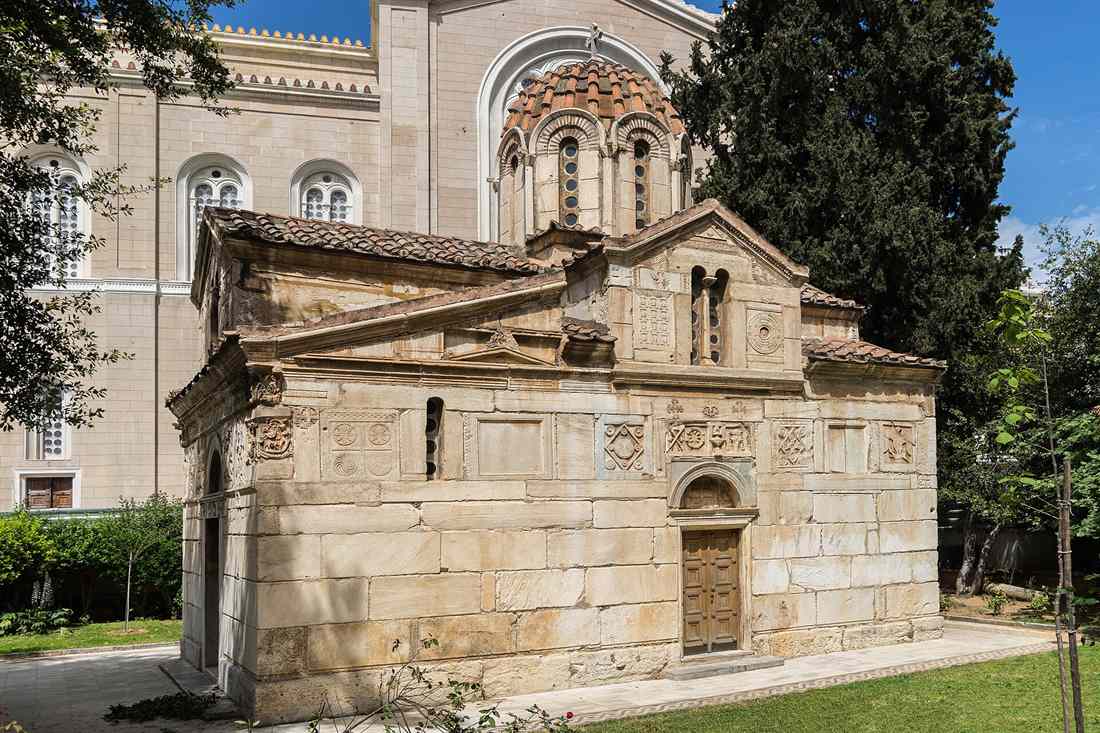
The Little Metropolis is a Byzantine church that measures 7.6 by 12.2 metres. Its walls are built exclusively of reused marble. Scholars date it anywhere between the ninth century and the thirteenth. It follows a cross-in-square plan under an octagonal dome. It was dedicated to the Panagia Gorgoepikoos, a name glossed as Who Grants Requests Quickly.
Kapnikarea is a Byzantine church from the eleventh century. It stands in the middle of the shopping area of Ermou Street. Ludwig I of Bavaria objected when Leo von Klenze marked it for removal, and he saved it. Its southern church is dedicated to the Presentation of Mary to the Temple.
Kapnikarea sits near the edge of Plaka. A walk through Plaka Athens links it with the other churches on this list.
The Russian church of Agios Nikodimos is a middle Byzantine cross-in-square building with a dome on an octagonal base. Wikipedia places the present structure in the eleventh century. Its original name was Soteira Lykodimou. A Greek Army major supervised its restoration, which ran from eighteen fifty to eighteen fifty-five.
The Catholic cathedral of Saint Dionysius the Areopagite stands at Panepistimiou 24. It is a neo-Renaissance basilica, 38 metres long, 24 wide and 15 high. Leo von Klenze drafted the plans, and Lysandros Kaftanzoglou modified them. The ceremonial inauguration took place on 4 August, eighteen sixty-five. Two popes have visited it.
Agia Irini stands on Aiolou Street. Kaftanzoglou designed the present church. Work began in eighteen forty-six, and the inauguration came in eighteen fifty. It is a Neoclassical basilica with Renaissance and Byzantine features. After the capital moved from Nafplio in eighteen thirty-two, it served as the official cathedral of Athens. It kept that role until the Metropolitan Cathedral was built.
The Catholic cathedral and Agia Irini date to the nineteenth century, while Kapnikarea and the Russian church are Byzantine. One walk of Athens free sightseeing covers both traditions.
Which cemeteries and memorials belong to Athens free sightseeing?
Athens free sightseeing reaches three burial and memorial stops. They are the First Cemetery of Athens, Phaleron War Cemetery and the National Resistance Memorial in Koukaki. The first is the official cemetery of the City of Athens, in the Mets district.
The First Cemetery of Athens opened in eighteen thirty-seven and was the first cemetery the city built, Wikipedia states. It stands behind the Temple of Olympian Zeus and the Panathinaiko Stadium. Its gates sit at the top of Anapafseos Street, a name that translates as Eternal Rest. Pine and cypress trees shade the paths.
The tombs are the sights of this stop. Wikipedia names the tomb of Heinrich Schliemann, designed by the architect Ernst Ziller. It also names the Sleeping Girl, a statue by the sculptor Yannoulis Chalepas of Tinos. A guidebook places the Sleeping Girl on the grave of an 18-year-old, close to the church of Saint Theodore.
The notable burials give the walk its names. Wikipedia lists the general Theodoros Kolokotronis, the poet Odysseas Elytis, the philanthropist Georgios Averoff and the actress Melina Mercouri. Athens free sightseeing here reads like a lesson in modern Greek history.
The grounds hold three churches. Saint Theodore is the main one, Saint Lazarus is smaller, and Saint Charles belongs to the Catholic community. A guidebook also lists the Mourning Angel, a sculpture by Ioannis Vitsaris, on a family tomb. The Municipality of Athens runs the site, and Wikipedia says it is declared a historical monument.
Phaleron War Cemetery lies a few kilometres south-east of Athens, on the coast road to Vouliagmeni. A history site counts 2,029 Commonwealth servicemen of the Second World War buried or commemorated there. Of the burials, 596 are unidentified. The Athens Memorial inside lists nearly 3,000 people with no known grave.
The coastal tram from Syntagma Square takes about 35 minutes. Get off at Pikrodafni, roughly 100 metres past the cemetery. This trip is the one part of Athens free sightseeing that leaves the centre.
The National Resistance Memorial stands in Perivolaki Ethnikis Antistasis Park in Koukaki. The Municipality of Athens installed the slate stele in nineteen eighty-eight. Engraved scenes show an execution, and the stele carries the date and the names of the victims. It remembers EPON resistance fighters whom German forces arrested and executed on the evening of 28 August during the Occupation.
The City of Athens also marks a communal grave in the Third Cemetery. It holds unidentified Occupation victims, under a modest marble cross. For more burial grounds and battle sites, read our guide to Athens historical sites.
How do you plan a day of Athens free sightseeing?
Plan the day as a loop around Syntagma Square, where metro Lines 2 and 3 meet. Panepistimio on Line 2 and Monastiraki on Line 3 each sit one stop from Syntagma. A day of Athens free sightseeing needs only two short rides.
The times below are a suggested order, not opening hours. The sources state the metro links and the walking minutes in the notes.
- 9:00 Syntagma Square. Wikipedia calls its station the busiest in the Athens transport system, and the Hellenic Parliament sits across Amalias Avenue.
- 9:30 Panepistimiou Street. Ride Line 2 one stop to Panepistimio. Wikipedia lists the University of Athens, the Academy of Athens and the National Library along this 1.2 km street.
- 10:30 Metropolitan Cathedral. A travel guide places it between Syntagma Square and Monastiraki Square.
- 11:15 Kapnikarea church. Wikipedia puts it on Ermou Street, at the edge of the Plaka district.
- 12:00 Monastiraki. This station joins Lines 1 and 3, and Line 3 returns to Syntagma in one stop.
- 13:00 Syntagma Square again, for a lunch break before the last stop.
- 14:00 First Cemetery of Athens. A guidebook names Leoforos Vouliagmenis as the closest tram stop.
Wikipedia calls Syntagma the centerpiece of the metro network and the northern end of the tram. The station also serves Ermou Street, the main shopping street of the historic centre. That makes it the natural base for Athens free sightseeing in the middle of the city.
Our Athens metro guide covers the lines and ticket types for these hops. Keep Phaleron War Cemetery and the Koukaki memorial for a second morning of Athens free sightseeing. Each sits away from this loop.
What do travellers ask about Athens free sightseeing?
Is the Hellenic Parliament free to enter?
The Parliament visitor page lists English guided tours for groups, each 1 hour 30 minutes and free of charge. Tours run Monday to Friday except August, and groups of up to 20 book by email 15 days ahead. Athens free sightseeing outside that booking means the street view.
Can you go inside the Metropolitan Cathedral?
A travel guide says the entrance is free for everyone and the church is open daily during the daytime. The walk from the Syntagma or Monastiraki station takes about 7 minutes. Athens free sightseeing reaches it without a detour.
Is the First Cemetery open every day?
A guidebook lists the hours as 8:00 to 20:00 and says the entrance is free for everyone. The Municipality of Athens runs the cemetery, so check its schedule before an Athens free sightseeing visit.
How long does a free sightseeing walk take?
A guidebook gives about 20 minutes on foot from Syntagma Square to the First Cemetery. Each stop in the plan is a short hop, so pick the stops to match the day.
Which free sights stay open on public holidays?
A history site says Phaleron War Cemetery is permanently open, including weekends and public holidays. A war museum page lists the National Resistance Memorial as accessible all 24 hours. Both suit Athens free sightseeing on a holiday.