
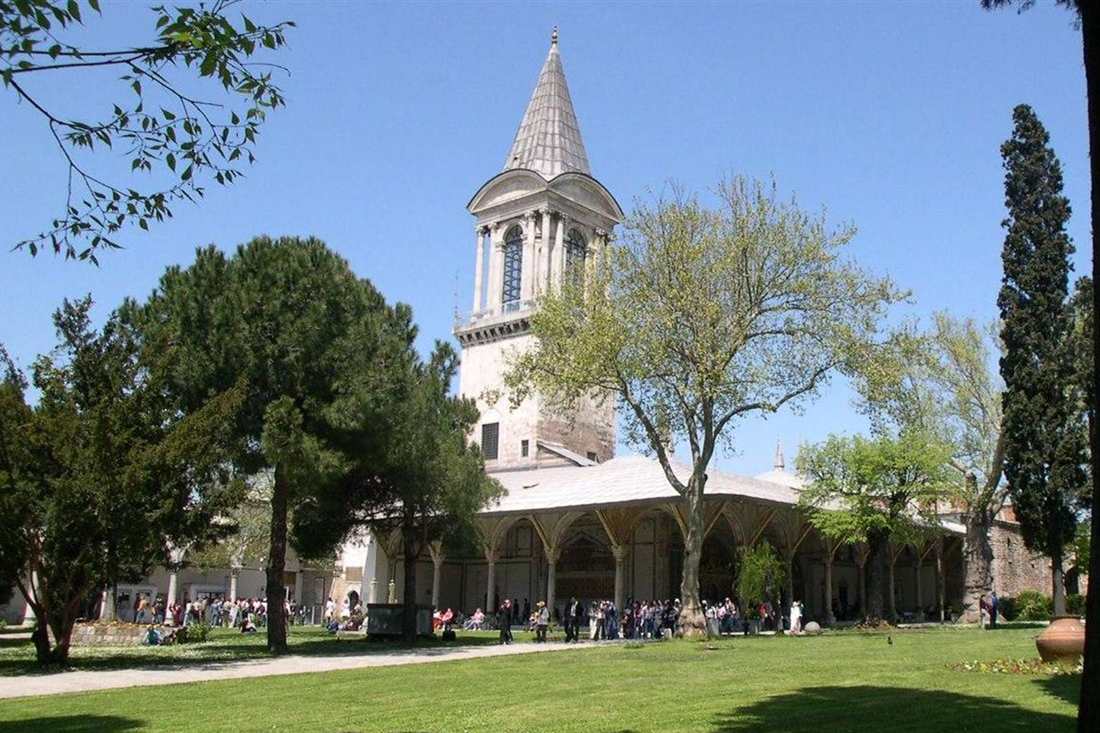
A Topkapi Palace tour lasts from 45 minutes to 3 hours across the listings read for this page, and it walks the courtyards of the former Ottoman palace in order. The Harem needs its own ticket, so check the highlights line before you book.
The museum’s opening hours and its closing day change, so the official page has the last word. For a longer trip around Turkey and Greece, the Greece Tours homepage shows the tours we run in each region.
What is a Topkapi Palace tour and what does it cover?
A Topkapi Palace tour is a walk through the former Ottoman palace in Istanbul. A guide or an audio guide leads it. The entry ticket is arranged before you arrive. It covers the courtyards, pavilions and exhibition rooms that are open to visitors.
The palace has had more than one name. Wikipedia says it began as the New Palace, to tell it apart from the Old Palace in Beyazit Square. Ottomans also called it the Palace of Felicity. Every Topkapi Palace tour you can book today visits that same walled site.
Wikipedia describes Topkapi Palace as a large museum and library in the east of the Fatih district of Istanbul. The Ministry of Culture and Tourism now runs it. The palace stands on Seraglio Point, a promontory above the Golden Horn, where the Bosphorus meets the Sea of Marmara.
It is not one big building. Wikipedia calls it a group of low buildings around courtyards, with pavilions and gardens. Mehmed II set the basic layout and put his private rooms on the highest point of the headland. Later sultans changed the palace but kept the plan in large part.
A Topkapi Palace tour walks that layout with a person or a recording that explains it. Wikipedia counts four courtyards, and the outer gardens surround all four. The part of the garden that faces the sea was once called the Fifth Palace.
The Fourth Courtyard was the innermost private sanctuary of the sultan and his family, says Wikipedia. The court also kept silence in the inner courtyards. Grilled windows and secret passageways gave the sultan and his family more privacy still.
Wikipedia says the complex has hundreds of rooms and chambers, but only the important ones are open to the public. The collection holds Ottoman clothing, weapons, armor, miniatures, religious relics and illuminated manuscripts. A Topkapi Palace tour follows a set route through that large site.
Why book a Topkapi Palace tour instead of walking in alone? Ticket sellers give three reasons. The first is skip-the-line entry past the ticket queue. The second is a licensed local guide who tells the stories behind the rooms. The third is the size of the site.
One seller’s guide says the large layout can feel confusing without a guide, and the rooms need historical context. The same page says an audio guide suits visitors who want to move slowly. They choose their own route and take photographs.
Seller pages list the following items in a Topkapi Palace tour:
- A live guide, or an audio guide that you carry yourself.
- An entry ticket booked ahead, with a way past the ticket queue.
- A route through the courts and pavilions that are open to visitors.
- A Harem visit, either included or sold as an option, depending on the listing.
- Free time on the grounds, which one seller page names as part of its tour.
Wikipedia adds that UNESCO recognises the palace as part of the Historic Areas of Istanbul. Our Istanbul tours page covers the other routes through the old city.
Which kinds of Topkapi Palace tour can you book?
Sellers list five kinds of Topkapi Palace tour. They are a small-group guided walk, a guided tour with the Harem, and a skip-the-line ticket with an audio guide. The last two are a private walk and a full-day Istanbul tour that adds the palace.
The sources do not agree on one list. A walking-tour company, a ticket platform and four GetYourGuide listings each sort their products in their own way. This section groups them by what each page says it includes.
The walking-tour company’s page describes a small group with a limit of 12 people, or a private walk. It says the tour runs every day, in English and German, and lasts 3 hours. It lists the Holy Relics, the Treasury sections and the outer terraced gardens.
The ticket platform sells a guided tour with a live guide, and you enter with the group. Its page says a 90-minute tour gives a lively overview. The guided part is in English only. The audio guide comes in 25 languages.
On that listing the Harem is an option that you select. The guide then takes you there after the palace tour, and you explore at your own pace. The page also says entry on this listing runs through the guide only.
A GetYourGuide listing for a complete tour gives a duration of 2.5 hours. It says priority entry covers the palace, the Harem and the church of Hagia Irene. The text offers English, German and Spanish guides. The language menu also shows Italian, Portuguese and French.
Two more GetYourGuide listings sell a guided tour with the Harem. One names a licensed guide and gives a duration of 20 minutes to 1.5 hours. Its language menu includes English, German, Chinese, French, Russian, Spanish and Arabic. The other gives 1.5 to 3 hours and puts the guided part at 1 hour 30 minutes.
The self-paced kind is the skip-the-line ticket with an audio guide. Its GetYourGuide listing says you skip the ticket line and explore at your own pace. The audio guide is optional and comes in 13 languages. The listing gives a duration of 45 minutes.
The private kind comes in two forms. The walking-tour company sells a private version of its palace and Harem walk. It also lists a private full-day tour for cruise passengers. That tour adds the palace to other old-city sights and the Grand Bazaar.
Four of the sources above include the Harem in the base tour. The ticket platform sells it as an option. So the first question for any Topkapi Palace tour is simple. Does the listing cover the Harem, or only the main palace?
The second question is time. A 45-minute ticket and a 3-hour guided walk are different days. The first leaves you alone with the audio. The second keeps you with a group and a guide. Pick the Topkapi Palace tour that matches the day you have.
The third question is language. Listings differ on the guide, and the audio guide has its own list. Read the language line on the page before you book. A guide in English only is a different product from a guide with a menu of languages.
Each kind also leaves things out. The walking-tour company lists transport to and from the meeting spot as not included. The ticket platform names three palace sections that were closed when this page was read. They are the Outer Treasury weapon collection, parts of the kitchen complex and the Petition Chamber.
Closures change, so ask the seller which rooms are open on your date. Every Topkapi Palace tour works inside the same museum, so a closed room is closed for every seller.
That is also why the list of kinds matters less than the list of inclusions. Compare the Harem, the guide, the length and the language on each page. Then choose the Topkapi Palace tour that fits your hours in Istanbul.
What does a Topkapi Palace tour show in the courtyards and the Divan?
The palace is a chain of courtyards, and a Topkapi Palace tour walks through them in order. The path runs from the Imperial Gate to the Gate of Salutation, Divan Square and the Gate of Felicity.
The First Courtyard was known as the Court of the Janissaries and as the Parade Court. Wikipedia says court officials and janissaries lined the path here in their finest clothes. The Imperial Mint, built in the eighteenth century, still stands in this courtyard.
On the way to the next gate, a Topkapi Palace tour passes the Fountain of the Executioner. Wikipedia says the executioner is said to have washed his hands and sword there. The same article adds that people disagree on whether the fountain served that purpose.
The Gate of Salutation is also called the Middle Gate, and a Topkapi Palace tour passes through it. It has two large pointed towers with eight sides. Every visitor had to dismount here, because only the sultan was allowed to ride through on horseback. An inscription dates the gate to at least the sixteenth century.
The Second Courtyard, or Divan Square, ran the business of the empire. Wikipedia lists the former hospital, bakery, stables and Janissary quarters around it, with the kitchens to the south. On a Topkapi Palace tour you also see Roman and Byzantine sarcophagi on display in front of the kitchens.
The kitchens now hold the Chinese porcelain, a collection of 10,700 pieces. Wikipedia ranks it among the finest porcelain collections in the world. The same article counts around 5,000 European pieces and a Japanese group made up mainly of Imari ware.
The Divan building is where the Grand Vizier and the council ministers met. At the Divan stop of a Topkapi Palace tour, you see three adjoining domed rooms. One was the council chamber. One housed the secretarial staff. The third, the Defterhane, held the records of the council.
Above the council hall is a window with a golden grill. Wikipedia says the sultan or the Valide sultan was able to follow the debate from it unseen. The Tower of Justice gave access to the window. It is the tallest structure in the palace and a landmark from the Bosphorus.
The Gate of Felicity closes the Second Courtyard and opens the Third. A Topkapi Palace tour sees the ceremonial side of the sultan here. He sat before this gate on festive days and at his accession, while officials paid homage standing. His funeral was also held in front of it.
Behind the gate stands the Audience Chamber, a square kiosk ringed by a colonnade of 22 columns. Its ceiling was painted ultramarine blue and studded with golden stars. The Enderun Library, shaped like a Greek cross, stands directly behind the chamber in the middle of the Third Courtyard.
- The Dormitory of the Expeditionary Force holds the Imperial Wardrobe Collection of around 2,500 garments.
- Its vault rests on 14 columns.
- The Conqueror’s Pavilion, home of the Imperial Treasury, lies next to it.
Sellers describe what the guide adds. One walking-tour company says its guide helps visitors filter myths from reality and stories from the official archives. Ask the seller which courtyards the visit covers, because the pages differ on what they list.
Is the Harem part of a Topkapi Palace tour?
Only when the listing says so. The Harem needs its own ticket, so a Topkapi Palace tour either adds that ticket or leaves the Harem out. Look for the word Harem in the highlights before you book it.
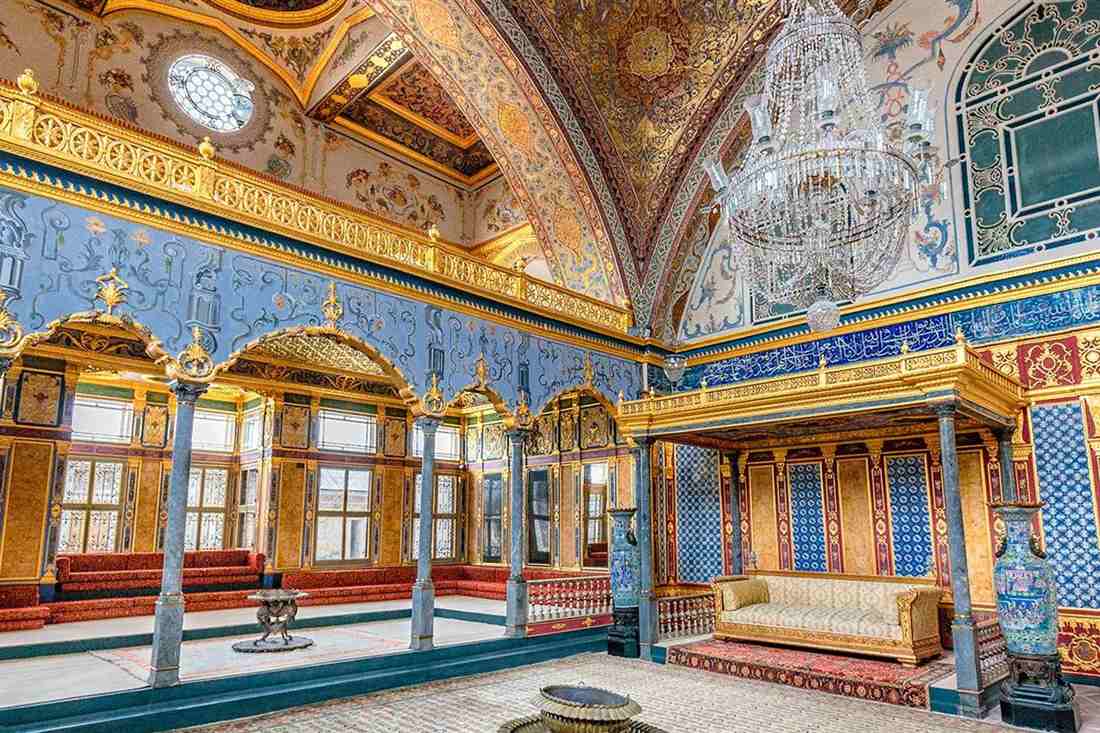
A Topkapi Palace tour that adds the Harem carries two admissions. One walking-tour company lists an admission ticket for the palace and another for the Harem. A Turkish museum portal agrees that the Harem needs a dedicated ticket. Its list also has one combined ticket that adds Hagia Irene to the palace and the Harem.
Four GetYourGuide listings checked for this article do not agree on the Harem. Two name the Harem in their highlights. One promises priority entry to the palace, the Harem and Hagia Irene. The other promises a Harem visit with an official guide. The other two name the Harem only in the listing name, and their highlights do not mention it.
Sources also disagree on the size of the Harem. Wikipedia says it contained more than 400 rooms. In the same section it calls the number undetermined and puts it above 100. The museum portal says the Harem has 300-odd rooms across six floors, and visitors can enter only one floor.
Wikipedia adds that only a small number of rooms are open to the public. The portal says the visitor route changes when rooms close for restoration. So the stops below can change, and a Topkapi Palace tour in the Harem shows a part of the whole.
The portal places the Harem entrance beneath the Tower of Justice, on the west side of the Second Courtyard. Wikipedia calls it the Gate of Carts. These sources describe the stops behind it in this order:
- The Domed Cupboard Room, a vestibule built under Murad III, where the Harem treasury worked.
- The Hall of the Ablution Fountain, an entrance hall guarded by the Harem eunuchs.
- The Courtyard of the Black Eunuchs, with their dormitories and the apartment of the Chief Harem Eunuch.
- The Passage of Concubines, where eunuchs set down the dishes they brought from the kitchens.
- The Courtyard of the Consorts and Concubines, the smallest courtyard of the Harem.
The Black Eunuchs’ quarters come first on a Topkapi Palace tour with the Harem. One walking-tour company says its group passes through the eunuchs’ sections before anything else. The museum portal says black eunuchs, sent as presents by the governor of Egypt, took control from the white eunuchs. It adds that up to 200 lived in the dormitories.
Wikipedia says the Chief Harem Eunuch ranked fourth in the official protocol. His apartment has a bath, living rooms and bedrooms. A school for the imperial princes stood upstairs in the same court. Its walls carry eighteenth-century tiles.
Next come the apartments of the Valide sultan, the Queen Mother. With the sultan’s apartments they form the largest section of the Harem. Wikipedia describes blue-and-white and yellow-and-green tiles with flower motifs. The museum portal adds murals from the nineteenth century in her salon.
The Imperial Hall of the Harem has the largest dome in the palace. Wikipedia says the sultan received his confidants, his mother and his children there. Weddings and the homage on religious festivals took place in the hall as well. Its gallery was kept for the consorts, headed by the Queen Mother.
The Privy Chamber of Murad III is the oldest surviving room in the Harem and keeps its original interior. Sinan designed it. A two-tiered fountain stands opposite the fireplace, and Wikipedia says the flowing water was meant to prevent eavesdropping.
The Twin Kiosk was the apartment of the crown prince. Princes lived there in seclusion, so people also called the apartments the kafes, which means cage. The Courtyard of the Favourites overlooks a large pool. Today visitors leave the Harem through the old Aviary Gate.
The Golden Path is the narrow axis of the Harem. Wikipedia says the name is believed to come from gold coins. The sultan threw them to the concubines on festive days. Scholars dispute this. Whether a Topkapi Palace tour includes the Harem is a listing question, not a palace rule. Choose one whose highlights name the Harem.
What do the Treasury and the pavilions add to a Topkapi Palace tour?
The Treasury adds jewelled thrones, weapons and gold objects inside the Conqueror’s Pavilion. The Fourth Court adds tiled kiosks and terraces above the water. One operator’s page lists the Treasury, the relics and the outer gardens as stops on its Topkapi Palace tour.
Wikipedia’s article on Topkapi Palace says the Conqueror’s Pavilion is one of the oldest buildings in the palace. It stands on a cliff, and its porch looks over the Sea of Marmara and the Bosphorus. The Treasury inside holds artworks, jewellery, heirlooms and money of the Ottoman dynasty. A Chief Treasurer ran it.
Wikipedia describes four rooms of displays. The first holds an armour of Sultan Mustafa III and the ebony throne of Murad IV. The second holds the walnut throne of Ahmed I. A jade bowl there was a gift of Czar Nicholas II. A Topkapi Palace tour that enters this room also meets the dagger from Jules Dassin’s heist film Topkapi.
The third room holds two solid gold candleholders. Each weighs 48 kg and carries 6,666 cut diamonds. Sultan Abdulmecid I gave them to the Kaaba in Mecca. The Muze Istanbul page calls the Spoonmaker’s Diamond a teardrop of 86 carats.
The fourth room holds a gold-plated throne in Indian style, a gift of the Persian ruler Nader Shah. A golden covering there holds the hand and forearm of John the Baptist. Ask whether your Topkapi Palace tour includes the Treasury.
Check the Treasury before you buy. The Muze Istanbul page carries a note that the Treasury was closed for restoration when its author last visited. Wikipedia lists the Treasury among the parts open to the public. Pick a Topkapi Palace tour that names the Treasury in its list of stops.
The Sacred Safekeeping Rooms hold relics of the Prophet Muhammad. Wikipedia lists a tooth, a hair of his beard and an autographed letter. It also lists the swords of the first four Caliphs. The Muze Istanbul page says Iznik tiles decorate the rooms. In palace days they opened once a year, on the fifteenth day of Ramazan.
Today a Topkapi Palace tour can enter the relic rooms, though the light is dim to protect the relics.
The pavilions of the Fourth Court stand on terraces beside the relic rooms. Wikipedia names the kiosks one by one.
- Circumcision Room: a summer kiosk that Sultan Ibrahim I added. Its facade carries tile panels that once decorated buildings of Suleiman I.
- Revan Kiosk: a small pavilion with a central dome and three apses. It served as a religious retreat of 40 days.
- Baghdad Kiosk: a facade of marble, porphyry and verd antique. The portico panelling follows the Cairene Mamluk style.
- Iftar Kiosk: a gilded roof in the form of a ridged cradle vault, the first of its kind in Ottoman architecture.
- Terrace Kiosk: the only wooden building in the innermost part of the palace. The sultan watched sport in the garden from here.
Wikipedia calls the Iftar Kiosk a magnet for photo opportunities, and it looks out on the Golden Horn. The Muze Istanbul page bans photography inside the museum halls. It gives no separate rule for the relic rooms, so a Topkapi Palace tour treats them as halls.
Not every pavilion is a kiosk. The Tower of the Head Tutor is the oldest building in the Fourth Court. Its walls are almost two metres thick. The court physician kept a chamber at the top, and a store of medicines stood below. A stone throne nearby carries an inscription: Murad IV threw an oak cudgel 120 metres, says Wikipedia.
Hagia Irene stands in the First Courtyard, outside the inner gates. Wikipedia calls it the oldest known church structure in Istanbul. It never became a mosque, because the Janissaries used it as an arsenal. Today it is a museum and a concert hall. Its dome is 15 metres wide and 35 metres high, with twenty windows.
The apse of Hagia Irene keeps a synthronon, a semicircle of seats for the clergy. It has six tiers, and Wikipedia calls it the only one in the city that survives from the Byzantine era. A cross in mosaic runs round the base of the apse dome. Ask whether the Topkapi Palace tour you book goes inside.
Hagia Irene has its own entry on the Muze Istanbul page. One GetYourGuide listing bundles all three sites in a 2.5-hour route. Another listing names the palace alone. Read the list of stops before you pick a Topkapi Palace tour.
How long does a Topkapi Palace tour take and when is the palace open?
Listings give 45 minutes to 3 hours for a Topkapi Palace tour, depending on the product. The palace museum opens at 09:00 and closes at 18:00. The Muze Istanbul page names Tuesday as its closing day.
Four GetYourGuide listings were checked for this page. An entry ticket with an optional audio guide lists 45 minutes. A guided tour with the Harem lists 1.5 to 3 hours. A guided tour with the Harem and Hagia Irene lists 2.5 hours. A fourth lists 20 minutes to 1.5 hours, a range too wide to plan around.
- Entry with audio guide: 45 minutes in one listing.
- Guided, without the Harem: 1.5 hours on a ticket seller’s page.
- Guided, with the Harem: 1.5 to 3 hours in one listing, 3 hours with one operator.
- Guided, with the Harem and Hagia Irene: 2.5 hours in one listing.
The same ticket seller lists a guided Hagia Sophia and Topkapi Palace tour at 2 hours. One small-group operator lists 3 hours with the Harem. Its tours start at 09:00 and at 13:30 every day except Tuesdays. The operator says the palace takes hours to enjoy properly.
The sources differ because the products differ. An entry ticket sets no pace, and a guide sets one. A listing that adds the Harem or Hagia Irene adds time. Ask the seller which stops a Topkapi Palace tour covers before you compare lengths.
The Muze Istanbul page gives the same opening hours for both seasons. The summer period runs from 1 April to 1 October, and the winter period from 1 October to 1 April. In both, the museum opens at 09:00 and closes at 18:00. The box office closes at 17:30 in summer and at 17:00 in winter.
The hours change, so read the Muze Istanbul page before you buy. Tuesday is the closing day on that page. Wikipedia’s article on Hagia Irene also says that museum is open every day except Tuesday. Check the date of your Topkapi Palace tour against that closing day. The palace is shut that day.
The Muze Istanbul page also lists night sessions with limited places. They run on Saturdays between 9 PM and 11 PM local time, for up to 300 visitors. The page gives a phone line for reservations. It does not say whether a guided tour runs at night.
No page checked gives a list of busy or quiet hours for the palace. None gives a shade count or a weather rule for the courts. Wikipedia says the terrain is hilly and the palace stands on one of the highest points near the sea. It describes courtyards, gardens and terraces.
A Hagia Sophia ticket seller’s guide says the palace deserves half a day on its own. It calls a Hagia Sophia and Topkapi Palace pairing realistic only across a full day, not a single morning. The small-group operator suggests a morning tour and the afternoon for the grounds. A morning Topkapi Palace tour leaves that afternoon free.
How do you reach the gate and join a Topkapi Palace tour?
Take the T1 tram to Gülhane or Sultanahmet, then walk to the Imperial Gate. A Turkish museum page puts that walk at five minutes. Guided groups gather outside the palace first. Each seller names its own meeting spot before a Topkapi Palace tour begins.
Wikipedia describes the T1 as the tram line from Kabataş to Bağcılar through Eminönü. Metro Istanbul runs it, and the line is 19.3 kilometres long. In its list of stops, Gülhane follows Sirkeci, and Sultanahmet follows Gülhane. The museum page measures its walking times from those two stops.
The same Turkish museum page gives five minutes for the walk from either stop. It lists 600 metres from Gülhane and 700 metres from Sultanahmet. The Sultanahmet route leads to the Imperial Gate, which opens into the First Courtyard.
Gülhane Park lies next to the palace, says Wikipedia, and was once part of the palace’s outer garden. The south entrance of the park has one of the palace’s larger gates. None of the pages checked gives a walking time through the park for a group.
The museum page lists the address as Babı Hümayun Street, number one, in the Sultanahmet quarter of Fatih. It also says the palace has no parking facility. The sources therefore describe arrival for a Topkapi Palace tour by tram and on foot.
Sellers name different meeting spots. One ticket seller’s page sets the meeting point at the Fountain of Sultan Ahmed III. The guide holds a white flag. The page puts the Imperial Gate one minute from there.
A walking-tour seller meets at a small food kiosk beside the Hippodrome in Sultanahmet Square, across from the German Fountain. The page says the meeting point has toilets and Turkish delicacies for sale. This Topkapi Palace tour starts there, not at the gate.
A third seller starts at the Imperial Gate itself. Its page says you show your ticket there and meet your guide. It places the gate just across from Hagia Sophia.
The GetYourGuide listings for this palace carry no meeting point in their widget frames. Check your booking confirmation for it. All four listings show a skip-the-line label.
Sellers give these rules for the start of the visit:
- Arrive 15 minutes early: both sellers ask for it.
- Expect timed entry: one seller says tickets expire within 5 to 10 minutes.
- Do not be late: the same seller says nobody can join once the tour has begun.
- Show a mobile QR code: one seller’s group enters with it at the entrance.
- Do not smoke: the museum page bans smoking, including e-cigarettes, across the whole premises.
A ticket seller’s page says every visitor on its Topkapi Palace tour goes through a security check before entering. The museum page places scanners and a military guard area at the Imperial Gate. It warns that the queue can be long. Wikipedia adds that armed guards of the Turkish military protect the complex.
On a walk-in visit, the main ticket office stands in the First Courtyard. It sits just before the gate to the Second Courtyard. The museum page adds that card-only kiosks sit beside the booths. A skip-the-ticket-line product replaces that stop with entry beside the tour group.
One ticket seller’s page says the palace administration sells a combined gate ticket. It covers the palace, the Harem and Hagia Irene. It is entry only and depends on the office queue. The museum page says combined tickets are valid for one day from the date of purchase.
An audio-guide ticket works without a guide. A GetYourGuide listing for a skip-the-line entry ticket calls the audio guide optional and lets you explore at your own pace. A guided Topkapi Palace tour replaces the device with a person who leads the walk.
Sources differ on access. The museum page says disabled access is possible, but wheelchairs are not provided and cobblestone slopes can cause problems. A ticket seller’s page calls the palace partly accessible and names uneven ground.
A walking-tour seller says its Topkapi Palace tour is not suitable for wheelchair users or people with reduced mobility. A single listing in that set carries a wheelchair-accessible tag. Ask your seller which of these statements covers your booking.
No page checked gives a rule for bags, cloakrooms or dress. None names stairs in the Harem. Ask your seller about those before the visit.
What do travellers ask about a Topkapi Palace tour?
Travellers ask six things first: the Harem, the closing day, photos, children, booking ahead and refunds. Where the pages checked disagree, the answer says so. Where no page gives a rule, the answer says that instead.
Does a Topkapi Palace tour include the Harem?
Three of the four GetYourGuide listings checked name the Harem in their titles. The fourth, an audio-guide ticket, names only the palace. A Turkish museum page adds that a Museum Pass Istanbul card already covers the Harem.
Is a Topkapi Palace tour open on Tuesdays?
No. A Turkish museum page says the palace is closed on Tuesdays. Wikipedia says Hagia Irene, in the First Courtyard, also opens every day except Tuesday. The same museum page says Dolmabahçe and Beylerbeyi palaces close on Mondays instead.
Can you take photos on a Topkapi Palace tour?
Pages differ. One ticket seller allows photography except in sections with precious objects. The Turkish museum page says photography is not allowed inside the museum halls. A third seller says photography is restricted inside certain rooms.
Is a Topkapi Palace tour suitable for children?
One ticket seller says children show valid passports at the museum entrance so staff can check their age. The Turkish museum page says children under six enter free. No page checked gives a rule for pushchairs.
Do you need to book a Topkapi Palace tour ahead?
The Turkish museum page says the national palaces website does not sell online tickets for this palace. Walk-ins buy at the office, and the page advises arriving early in busy seasons. One GetYourGuide listing asks for a booking at least five minutes ahead.
Is a Topkapi Palace tour refundable?
Each of the four GetYourGuide listings checked shows a free-cancellation label, but the frames give no cut-off time. One ticket seller’s page sets the free change or cancellation window at up to 24 hours before the start.