
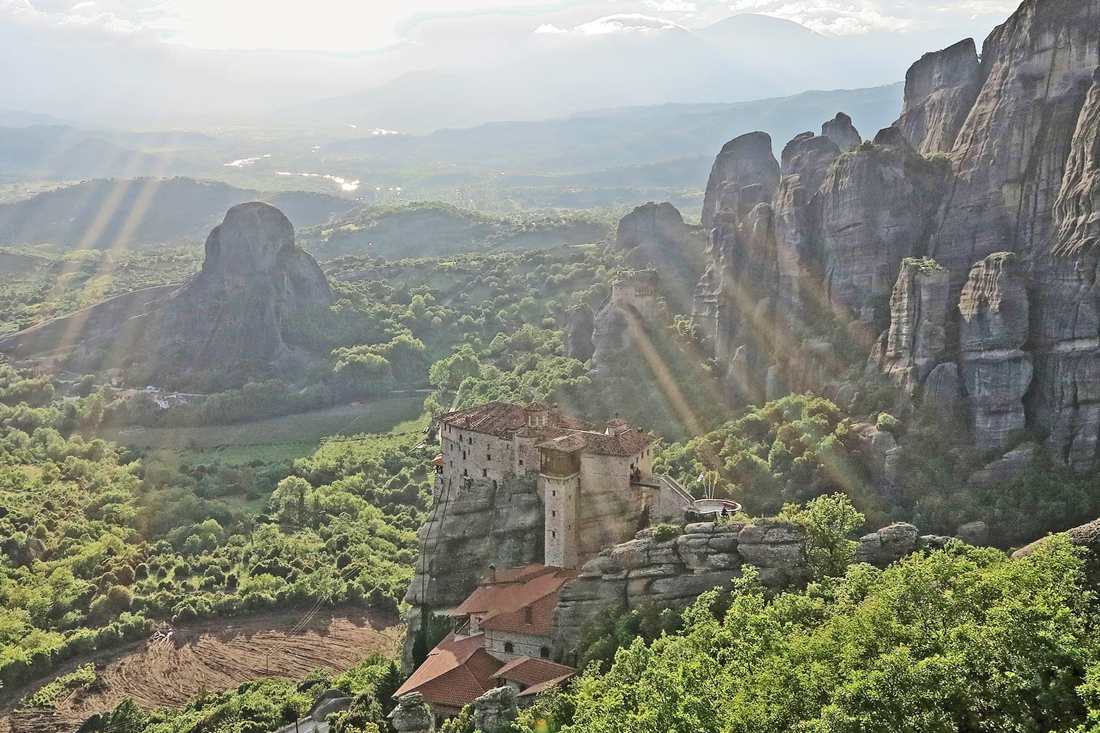
The Meteora Easter celebrations begin on Lazarus Saturday and end on Easter Tuesday, says To Vima, so a stay covers more than Holy Week. Greece Is points to the Last Supper services on Thursday and the epitaph processions on Friday. Wikipedia counts 8,573 people in Kalambaka, the town below the rocks, and 1,023 in Kastraki, the village beside them.
Holy Week rooms fill up fast, the Visit Meteora blog says, so book a base in one of those two places first. Once the base is booked, pick your next stop from the Greek islands and mainland towns that the Greece Tours homepage links to.
What are the Meteora Easter celebrations?
Holy Week and Easter, kept in the Orthodox way around the rock monasteries of Thessaly, form the Meteora Easter celebrations. The international edition of To Vima describes a municipal programme. It opens on the weekend of Lazarus Saturday and closes on Easter Tuesday.
Wikipedia places Meteora in Thessaly, in northwestern Greece, between Kalabaka and the village of Kastraki. It adds that locals see the monasteries as ranking second only to Mount Athos. For the rocks and the monasteries, start with our Meteora travel guide.
Easter is the greatest feast of the church year for Eastern Christians. Wikipedia’s Great Lent article says the 40 days of fasting prepare them for it. Its Easter article gives Great and Holy Pascha as the Eastern name for the feast. Its Eastern Orthodox Church article lists Greece among the countries where that church is the primary confession.
To Vima reports an action plan to make the municipality of Meteora the “capital of Greek Orthodox Easter”. The article puts the Meteora Easter celebrations at the heart of the area’s appeal as a religious tourism destination. It says the municipality offers visitors an experience that blends deep spirituality with local heritage and cultural expression.
Greece Is also writes about the Meteora Easter celebrations. Its article “5 Reasons to Spend Easter in Meteora” opens with the solemn atmosphere of the monasteries. It calls attending the Easter services there a singular experience. It says the scenery and the plain monastic life deepen the concentration of those who attend.
These are the parts of the Meteora Easter celebrations that the two articles point visitors to:
- Lazarus Saturday: To Vima says the town programme opens on this weekend.
- Holy Thursday: Greece Is recommends the Last Supper services.
- Good Friday: Greece Is names the epitaph processions.
- Holy Saturday night: To Vima names the Resurrection service.
- Easter Sunday: To Vima adds the Vespers of Love.
- After Easter: To Vima names the Paschalogiorta, communal celebrations held in the days after Easter.
Both pieces promote the Meteora Easter celebrations, so they leave gaps. Neither gives a visitor count or a service timetable. To Vima names villages for its customs: Theopetra, Gavros and Kastraki.
How is the date of Orthodox Easter set, and what is Holy Week?
Orthodox Easter is the first Sunday following the Paschal full moon, counted from 21 March on the Julian calendar. Holy Week is the week before it. The Orthodox Church calls it Great and Holy Week, or Passion Week.
Easter is a moveable feast, so the dates of the Meteora Easter celebrations change from one year to the next. Wikipedia’s Date of Easter article explains the split. Catholic and Protestant churches follow the Gregorian calendar. Eastern Orthodox churches follow the Julian one, and the Finnish Orthodox Church is the one exception.
The rule behind the Meteora Easter celebrations dates to the First Council of Nicaea in the year 325, Wikipedia says. The Easter article also links the feast to Jewish Passover, by its name Pascha and by its origin.
That article lists the gaps between the two dates: the same day, or one, four or five weeks later. It names no other gap until at least the 25th century. A visitor to the Meteora Easter celebrations needs the Orthodox date, not the Western one.
The same article adds that Julian lunar tables run five days behind the Gregorian ones. That puts the Orthodox Paschal full moon five days later than the astronomical one.
Wikipedia’s Holy Week article says the Orthodox day starts at sunset. So Vespers is the last service of each day in Holy Week, not the first. Parish services also move earlier than the canonical time, so that more of the faithful can attend.
Matins of Great Monday, for example, takes place on Sunday evening. A parish service for one day can therefore start on the evening before.
The article sets out these eight days for the Orthodox Church, from Palm Sunday to Easter Sunday:
- Palm Sunday: a transition day outside Holy Week itself, counted as one of the Great Feasts of the Lord.
- Holy Monday: the Bridegroom services begin, with an icon of Christ the Bridegroom in the centre of the church.
- Holy Tuesday: the Hymn of Kassiani is sung toward the end of the evening Bridegroom service.
- Holy Wednesday: a service of anointing, called Holy Unction, is held in the evening, in Greek Orthodox churches in particular.
- Holy Thursday: the Divine Liturgy of the Last Supper is held in the morning.
- Holy Friday: the Royal Hours are served in the morning.
- Holy Saturday: the First Resurrection liturgy, Proti Anastasi, turns the mood from mourning to joy.
- Easter Sunday: Agape Vespers is held in the afternoon.
Lent comes first, and it is the run-up to the Meteora Easter celebrations. Wikipedia says Great Lent begins on Clean Monday, seven weeks before Pascha, and runs for 40 continuous days. Its weeks start on Monday and end on Sunday, building toward Pascha, the greatest Sunday of all.
In the Orthodox Church those 40 days end on the Friday before Palm Sunday. Lazarus Saturday and Palm Sunday lighten the fast, and fish eggs are allowed on Lazarus Saturday. Fasting continues through Holy Week and ends only after the Paschal Vigil.
What happens on Holy Thursday in the Meteora Easter celebrations?
Holy Thursday, Megali Pempti in Greek, recalls the Last Supper and the betrayal of Christ. The Visit Meteora blog lists it first among four key days of the Meteora Easter celebrations. The Twelve Gospels reading closes it at night.
The blog says Good Thursday and Holy Thursday are one day with two names. It explains that “Maundy” comes from the Latin word mandatum, meaning commandment. That is the commandment to love one another, which Jesus gave at the Last Supper.
The blog advises planning the Meteora Easter celebrations between Holy Thursday and Easter Sunday. It adds that the evening services draw both locals and pilgrims, and that seating is limited. Its advice is to arrive early.
The blog calls Holy Week in Meteora a pilgrimage of the soul. It adds that Holy Week is not a tourist show but a living tradition of deep faith.
Wikipedia’s Meteora article calls the monasteries there Eastern Orthodox. Its Maundy Thursday article sets out the Eastern Orthodox day in four steps.
- The main service is Vespers joined to the Liturgy of St. Basil the Great. Its Gospel reading is a composite, taken mainly from Matthew, with the Washing of the Feet added from John.
- In the evening the church hangings and vestments change to black or another dark colour. Wikipedia says this marks the beginning of the Passion.
- The service of the Twelve Passion Gospels follows. Its readings present Christ’s last instructions to his disciples, the prophecy of the Cross and his new commandment.
- In Greek tradition a procession comes after the fifth gospel. A large cross with the body of Christ is carried through the church. The lights go out, the bells toll slowly and the faithful prostrate themselves.
The Greece Is article points visitors to the Last Supper and Holy Passion services at Varlaam Monastery on Maundy Thursday.
Red eggs belong to the same day. Wikipedia says Greek women dye the eggs with onion skins and vinegar on Thursday, the day of Communion. It calls them kokkina avga. The greecetravel.com Easter page says the red stands for the blood of Christ.
Dark red eggs are a tradition in Greece, not only in the Meteora Easter celebrations. Wikipedia adds that the hard shell stands for the sealed Tomb of Christ. It also records an older Greek custom. The first red egg went to the home’s iconostasis, where icons are displayed, to ward off evil.
Eastern Christian legend, Wikipedia says, has Mary Magdalene carry cooked eggs to the tomb of Jesus. The eggs in her basket turned bright red when she saw the risen Christ.
What is the Good Friday Epitaphios procession at Meteora?
The Epitaphios is an embroidered cloth icon of the dead Christ, laid on a flower-decked bier called a kouvouklion. The Meteora Easter celebrations include its Good Friday procession, a funeral procession for Christ carried through local streets.
Wikipedia says the Greek word Epitaphios means “upon the tomb”. The cloth shows Christ after he was taken down from the cross. The scene can include his mother and other mourners.
On Good Friday morning the bier is decorated with spring flowers, mainly white, red and purple, until they cover it. The kouvouklion stands for the Tomb of Christ and is made of wood. Wikipedia also mentions petals, rosewater and candles at the tomb.
Wikipedia’s Good Friday article gives the order of the night service, called the Lamentation at the Tomb.
- The service is the Matins of Holy and Great Saturday, held on Friday night. Much of it takes place around the tomb in the centre of the nave.
- Clergy chant the Lamentations, 185 tercets in three parts, between the verses of Psalm 118. Everyone holds a lit candle.
- In the third part, young girls of the parish place flowers on the Epitaphios. The priest sprinkles it with rosewater.
- Near the end of Matins, a procession carries the Epitaphios out. The bells ring a funeral toll and the Trisagion is sung.
- People who cannot attend the service come out to balconies and sidewalks as it passes, holding lit candles.
- Back at the church, certain parishes hold the Epitaphios above the door. Everyone bows down under it to go in, which Wikipedia says stands for entering the death and resurrection of Christ.
Wikipedia describes towns with more than one parish where the processions meet at a square. There they sing one shared Trisagion before each parish goes on its way.
The Visit Meteora blog lists Holy Friday, Megali Paraskevi, with evening Epitaphios processions in the Meteora Easter celebrations. It says each monastery and village has its own.
The Greece Is article names the two largest monasteries, Megalo Meteoro and Varlaam. In the Meteora Easter celebrations, it adds, epitaph processions and Easter vigils draw more people there. It describes the other monasteries as having sparse crowds.
The To Vima article on the Meteora Easter celebrations names a Kastraki procession of sacred icons and holy relics. It does not name an Epitaphios.
The Aegean Outdoors guide to Greek Easter names the flower-covered Epitaphios parades of Good Friday. It says the Meteora Easter celebrations connect visitors to a monastic tradition that has endured for centuries.
Two of the three pieces on the Meteora Easter celebrations name an Epitaphios procession. The To Vima article does not. Our Meteora cultural experiences page covers services and chant in general. This section keeps to the Epitaphios.
What happens at the Holy Saturday midnight service of the Meteora Easter celebrations?
In the Meteora Easter celebrations, the midnight service begins in the dark. Every light in the church goes out, except one flame on the altar table. At midnight the priest lights his candle from that flame, and the people light theirs. Then the bells ring and the Easter greeting is spoken.
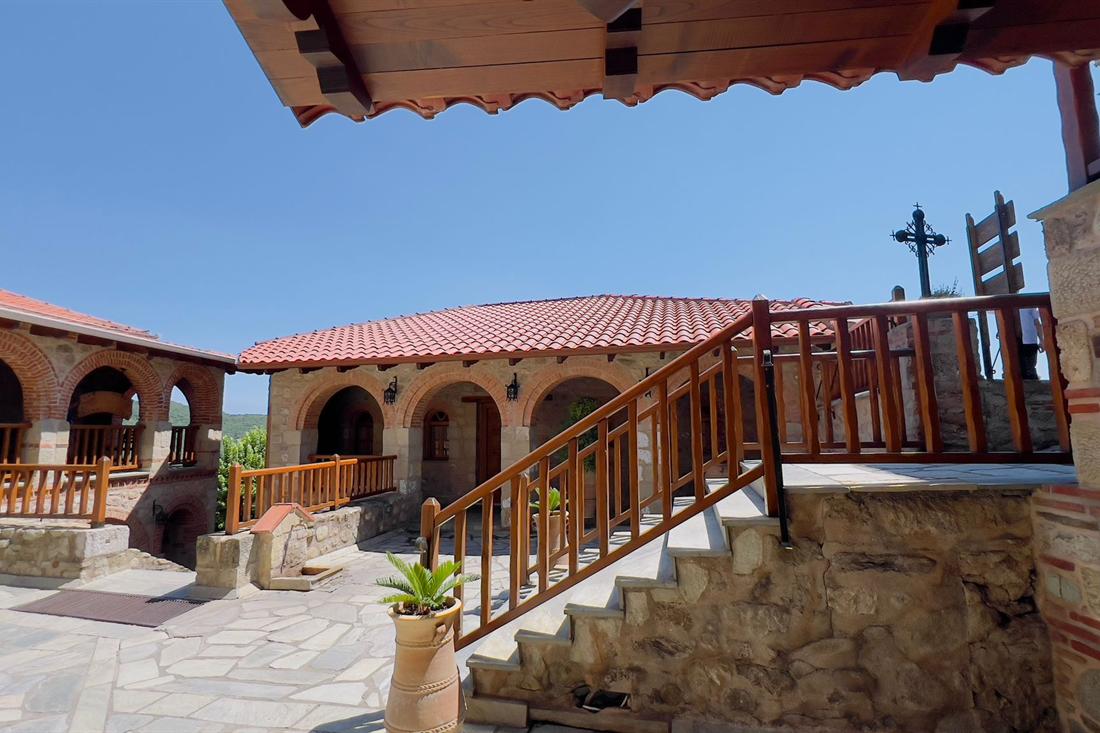
Wikipedia’s Easter Vigil article describes the Orthodox order of this night. It covers Orthodox practice in general, not the Meteora Easter celebrations alone.
Earlier in the day comes the First Resurrection service. Wikipedia’s Holy Saturday article says Greek clergy strew laurel leaves and flower petals over the church then. The Paschal greeting waits until after midnight.
- Before midnight the Midnight Office is sung. The epitaphios, the shroud that shows Christ, is carried to the altar table.
- All lights go out except the flame on the altar table. The people wait in silence and darkness.
- At the time for Matins, in practice at the stroke of midnight, the priest lights his candle from that flame. He invites the people to receive the light.
- The people light their candles from his flame. They hold them through the whole liturgy.
- The priest leads the people out of the church. They walk three times around it while the bells ring without a pause.
- At the front doors they sing the Paschal hymn. They say “Christ is risen” and “Truly He is risen” to each other for the first time.
- They go back in for Matins, where everything is sung and nothing is read.
Wikipedia gives the end of the liturgy as 3:00 or 4:00 a.m. in the Orthodox order. The Visit Meteora blog lists the midnight Anastasi service as a tradition visitors can witness in the Meteora Easter celebrations.
To Vima reports that the municipality promotes the Meteora Easter celebrations. The article names the “Lighting of the Fanos” in Theopetra. It calls the ritual a symbol of the Resurrection that lights the Meteora sky on Holy Saturday night. It also mentions the Resurrection service set against the rock formations.
The Greece Is article adds a note on crowds at the Meteora Easter celebrations. It says epitaph processions and Easter vigils are more popular at the two largest monasteries. These are the Great Meteoron and Varlaam. The other monasteries have sparse crowds, it says, and that adds to the experience.
The Visit Meteora blog says the priest proclaims “Christos Anesti” and candles light up the night. Its note tells visitors to arrive early. The blog says these services draw locals and pilgrims, and seating is limited.
The Visit Greece page on the Meteora Easter celebrations says the Resurrection service begins at 9 pm. It runs an hour and a half past the cry of “Christ is Risen”. That time is for people who stay to the end.
What do families eat and do on Easter Sunday during the Meteora Easter celebrations?
Greek Easter food starts with magiritsa soup and red eggs, which break the Lenten fast after the midnight liturgy. Roast lamb and sweet bread follow. The Visit Greece page adds that Kalambaka courtyards fill with the smell of roasting meat.
Wikipedia’s articles on Greek Easter food describe Greek Orthodox custom in general. They do not tie these dishes to the Meteora Easter celebrations alone.
- Magiritsa. Wikipedia says this Greek soup of lamb offal is eaten right after the midnight liturgy. It names Thessaly, the region of Meteora, as a place where it is served as a fricassee instead of a soup.
- Spit-roasted lamb. Wikipedia says souvla in Greece means a whole lamb roasted on a spit for Easter and other major holidays.
- Kokoretsi. Wikipedia says this dish of lamb or goat intestines wrapped around seasoned offal is served for Orthodox Easter. It is an appetiser while the lamb roasts.
- Tsoureki. Wikipedia says the Greek Easter loaf, lampropsomo, is a braided bread with whole dyed eggs pressed into the dough.
- Koulourakia. Wikipedia’s Easter food article says these butter pastries, a traditional Greek dessert, are made around Easter to be eaten after Holy Saturday.
- Paspaliares and basiordi. The Visit Greece page lists these cornmeal pies and this pork cooked in its own fat among the Easter Day delicacies in Kalambaka.
Wikipedia’s Easter egg article says that in Greek Orthodox tradition, people crack red eggs together when they exchange Easter greetings. It adds that the person whose egg does not break is believed to have good luck ahead. A second article, on egg tapping, gives the Greek name, tsougrisma, and says it means to clink together.
Restaurants for the Meteora Easter celebrations are a separate question. The guide on where to eat in Meteora answers it.
A Kalambaka hotel’s Easter page sets out its own meals for the Meteora Easter celebrations. It lists a Resurrection dinner on Holy Saturday night. It also lists an Easter Sunday lunch of local specialities. The Greece Is article names no Easter Sunday event, and its one dated Easter custom falls on Easter Monday.
Wikipedia says the Orthodox order has no liturgy on Sunday morning, because the vigil already celebrated the feast. On Sunday afternoon comes the Paschal Vespers, where the Gospel is chanted in more than one language.
Wikipedia notes that one name for it is Vespers of Love. To Vima lists the Vespers of Love among the defining moments of Holy Week and Easter in Meteora.
The sources disagree on the festivities. To Vima describes the Paschalogiorta as communal celebrations in the days after Easter. The Visit Greece page places the paschalogiorta on Easter Day, with revelry and dancing. Both pieces describe shared festivities, not church services.
What do travel writers report about the Meteora Easter celebrations?
Six pages agree that the Holy Week services at the monasteries are the draw. Each page then adds its own extra, from a town programme to bike rides and truffle hunts. Together they show what a visitor gets from the Meteora Easter celebrations.
The writers do not share one aim. The hotel page sells meals and rooms. The Visit Meteora blog mentions its own tours. To Vima reports a municipal plan. Keep that in mind as you read each reason.
- To Vima reports an action plan to position the municipality as the “capital of Greek Orthodox Easter”. It adds a local custom, the Farewell of Lazarus in Gavros, which it says has roots in antiquity.
- Greece Is gives five reasons, from monastery services to biking, climbing and hiking, truffle hunting and an Easter Monday gathering at Aghios Georgios near Kastraki.
- The Visit Meteora blog stresses evening liturgies in dim chapels, with incense and Byzantine hymns.
- The hotel page calls Easter there “a profoundly spiritual experience”. It promises monastery services, festive meals and views of the rocks.
- Aegean Outdoors adds hiking. It names the trail from Kastraki to the Grand Meteoron as a popular one and says hikers see the festivities from unique vantage points.
- The Visit Greece page says Meteora offers thousands of visitors a chance to experience the Passion and Resurrection. It calls the Holy Week services “almost mystical”.
To Vima quotes the municipality’s mayor, who spoke to the Athens-Macedonian News Agency. The article gives no visitor numbers for the Meteora Easter celebrations. It says the programme blends spirituality with local heritage and culture. Read it as a statement of intent.
Two Greece Is reasons for the Meteora Easter celebrations tie directly to the Easter dates. On Easter Monday, climbers scale the Stylos rock near Kastraki. They leave handkerchiefs as offerings and take down last year’s. Those go to the crowd as charms.
The second is a truffle hunt. A museum of natural history and mushrooms in Meteora runs it, with trained dogs. A mushroom tasting and an outdoor truffle pasta follow the hunt.
On the Meteora Easter celebrations, all six pages name the services. Four of them also name six working monasteries: Greece Is, the Visit Greece page, the hotel and Aegean Outdoors. The extras differ from page to page.
The pages even disagree on size. Greece Is counts 170 rock pillars. The Visit Greece page counts 800 rock formations. Treat any figure as one writer’s count until a second page repeats it.
How do visitors plan a stay for the Meteora Easter celebrations?
Book a room early, then choose Kalambaka or Kastraki as your base. Next, fix the length of the stay. To Vima’s programme runs from Lazarus Saturday to Easter Tuesday, and no page sets a minimum.
Book first. The Visit Meteora blog says Holy Week rooms fill up fast. Aegean Outdoors links the rush to Greeks who travel inside their own country at Easter. Settle the room before you plan the days. Aegean Outdoors also tells readers to stay flexible, because Easter schedules and events can differ slightly by village or island.
Then count the days of the Meteora Easter celebrations. To Vima says the municipal programme runs from the weekend of Lazarus Saturday to Easter Tuesday. That is longer than the Holy Thursday to Easter Sunday window that the blog names.
Greece Is adds a season note for the Meteora Easter celebrations. It says you can climb or hike before the hot days of summer arrive. After that, Meteora no longer lends itself to outdoor activities.
Two places serve as bases for the Meteora Easter celebrations, and Wikipedia puts the rocks between them.
- Kalambaka: Wikipedia calls it a town and the seat of the municipality of Meteora, with 8,573 people in the town proper. It is also the seat of the Metropolis of Stagoi and Meteora. The blog calls it “central and convenient for transport connections”.
- Kastraki: Wikipedia calls it a village of 1,023 people. Its small valley opens into the massif on the southwest side. The blog describes “a more serene village feel” within walking distance of the monasteries.
Our guide on where to stay in Meteora sets the two bases side by side. A hotel page also names Elati, Pertouli and Plastiras Lake among the sights for the area.
Getting to the Meteora Easter celebrations starts with Kalambaka. Wikipedia names it as the northwestern end of the old Thessaly Railways. The Kalambaka line joins the Athens to Thessaloniki mainline at Palaiofarsalos.
The station article adds that no trains were serving Kalambaka when it was written. A rail-replacement bus linked Kalambaka and Palaiofarsalos instead, where onward trains are found. Check the current service before you plan around the train.
Gate times and Holy Week closures belong to the monasteries, and none of the six pages prints them. The Meteora monasteries opening hours page sets out how feast days and the Easter days change the weekly gate times. Check it before you fix a day for the Meteora Easter celebrations.
Which Meteora tours can you book around Easter?
Six GetYourGuide listings sell ordinary Meteora sightseeing from Athens, Thessaloniki and Kalabaka. A search of their summary and highlight lines for the words Easter, Holy Week and Orthodox found none. No listing is built around the Meteora Easter celebrations.
Start city and length set the six apart. A trip from Athens takes 14 hours, from Thessaloniki 11 hours and from Kalabaka 4 hours. Pick the one that fits your days around the Meteora Easter celebrations.
- The 9 AM Athens day trip lasts 14 hours. The bus leaves Athens at 9 AM. The listing puts the Meteora part at 4 hours or more with a live local guide. You step inside 3 monasteries, see all 6 and visit the hermit caves. A sunset stop and a Greek lunch follow, with about 10 dishes on the menu. It runs in 12 languages.
- The live-guide Athens day trip lasts 14 hours. The listing says you explore the monasteries and hermit caves, step inside 3 of them and stop in Kalambaka. The Greek lunch at a local restaurant is optional, and the title adds a seasonal sunset. It runs in 8 languages.
- The central-pickup Athens day trip lasts 14 hours. The title adds an audio guide. The listing describes a full-day bus trip to the rock formations and the UNESCO monasteries. Pickup comes from 4 central locations, and the trip runs in 8 languages.
- The Thessaloniki bus trip lasts 11 hours and carries a Bestseller label. The listing says you visit 2 of the 6 monasteries and have lunch in the village of Kastraki. A highlight line names the old rope-net system preserved at Varlaam. It runs in English only.
- The Kalabaka morning tour lasts 4 hours. The listing calls it a guided half-day tour of centuries-old monasteries with panoramic views. It shows pickup and a private option, in 8 languages.
- The Kalabaka sunset tour lasts 4 hours. The listing calls it a small group tour. It visits the monasteries, the Byzantine Church of the Virgin Mary and the caves, with a sunset viewpoint. It shows pickup and a private option, in 12 languages.
Five of the six list an optional audio guide. Only the Thessaloniki trip does not. English is on all six listings, and the Thessaloniki trip offers nothing else. Both the 9 AM and the live-guide Athens trips name a live guide. All six carry a free cancellation label.
Four show a private option: the 9 AM and live-guide Athens trips plus both Kalabaka tours. The Meteora private tour page on this site covers the private formats from Athens, Thessaloniki and Kalabaka.
Each listing opens a calendar of dates. Check the days of the Meteora Easter celebrations there. The listing text names no Holy Week schedule for the monasteries.
The monasteries set their own schedule. The Great Meteoron’s site says its schedule changes by decision of the monastery. The Maptrotting site says feast days override the weekly pattern and names the days around Easter.
The hours page on this site collects what the monasteries and travel sites publish. Read it before you pick a day for the Meteora Easter celebrations.
What do travellers ask about Meteora Easter celebrations?
Do the Meteora Easter celebrations fall on the same day as Western Easter?
Not always. Wikipedia’s Date of Easter article gives the split. Eastern churches celebrate one week after western churches about 44% of the time. They celebrate on the same day about 30% of the time.
What is Bright Week after the Meteora Easter celebrations?
Bright Week is the seven days from Easter up to Thomas Sunday, says Wikipedia. It is also called Pascha Week or Renewal Week. Ordinary fasting is suspended all week. The Holy Doors of the iconostasis stay open, the only time of the year this happens.
Is Easter Monday a public holiday in Greece?
Yes. Wikipedia calls Easter Monday an official public and non-working holiday in Greece, imposed by law. The Orthodox Church names it Bright Monday or Renewal Monday. People see it as a time for family and for returning from holiday travel.
Is Kalabaka the same town as Kalambaka?
Yes. Wikipedia lists Kalabaka, Kalambaka and Kalampaka as spellings of one Greek name. It says the name is of Turkish origin, means “powerful fortress” and dates from six or seven centuries ago.
Do the tour listings mention the Meteora Easter celebrations?
No. The Thessaloniki highlights name the 6 Holy Monasteries of Meteora, and the Kalabaka sunset tour adds a Byzantine church. None gives an Easter date, so the Meteora Easter celebrations are not part of what they sell.
How much notice do the Meteora tours need?
Each listing sets a minimum notice. It is 5 minutes for the central-pickup Athens trip and 30 minutes for the Thessaloniki trip. The other four need 9 to 10 hours. For a full-day plan, read one day in Meteora.