
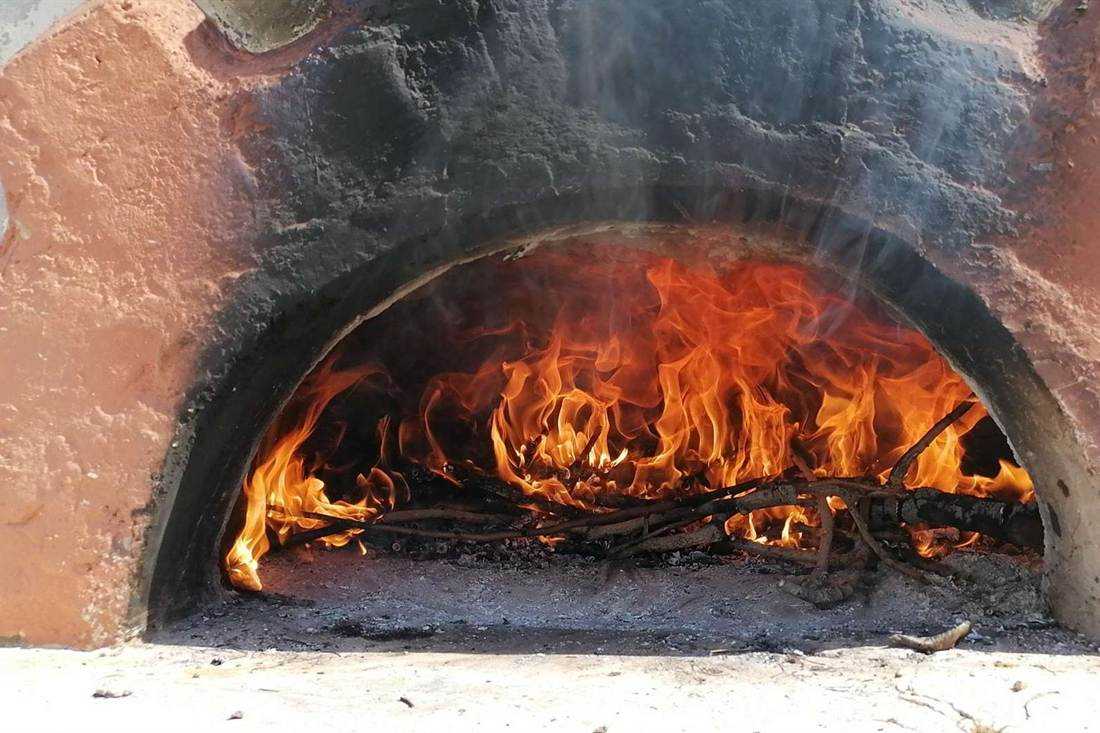
An Aegina cooking class is a private lesson in a local kitchen on the island of Aegina, where you prepare Greek pies, meat and bread in a wood-fired oven and then eat what you cooked. More trips from Athens and across the islands are listed on the Greece Tours homepage.
This page covers the Aegina cooking class you can book, the dishes in the lesson, how a wood-fired oven cooks, the Greek pies and dough behind them, how the private lesson runs, the other Aegina classes that fit the same day, and answers to common traveller questions.
What is an Aegina cooking class?
An Aegina cooking class is a hands-on lesson on the island where guests prepare dishes themselves. Afterwards they sit down together and eat the food they made.
A cooking class asks for participation. Guests handle the preparation with their own hands instead of watching a demonstration from the side.
One New York operator, League of Kitchens, sums up its format in three phrases. You cook together, eat together and learn together. Its students also share culture and stories along the way. That pattern is the core of any class, and an Aegina cooking class follows it on a Greek island.
Wikipedia defines a cooking school as an institution devoted to teaching the art and science of cooking and food preparation. Part of these schools train professional chefs, and the rest serve amateur enthusiasts. The article adds that amateur schools are often intertwined with culinary tourism, the practice of travelling to explore food.
Visitors who book an Aegina cooking class on holiday belong to that second group. They are guests, not trainee chefs. Wikipedia notes that programmes run from half a day up to years. A lesson of a few hours sits at the short end.
Aegina is one of the Saronic Islands, in the Saronic Gulf, 27 km from Athens, according to Wikipedia. Visit Greece, the national tourism site, calls it the largest island in the Argo-Saronic Gulf.
A lesson there trades the restaurant table for a kitchen. Guests make the food before they eat it. For a wider look at the island, read our guide to Aegina tours.
Which Aegina cooking class can you book?
The class on offer is GetYourGuide tour 1108961. Its title reads “Aegina: Cooking Lesson Using A Traditional Wood-Fired Oven.” It lasts three hours and suits a private group. The listing carries the “new activity” tag.
The listing places the activity in Aegina. Its title names the one feature that sets it apart: a traditional wood-fired oven. Anyone who searches for an Aegina cooking class can match that title word for word.
The booking is private. One group has the lesson to itself, so it is a single-party activity, not a shared table.
The listing states that guests cook in a private kitchen and then enjoy what they made with refreshments. It does not name the host, the village or the recipes, so this page leaves those details out.
The “new activity” tag is a label that GetYourGuide shows on recent listings. It marks this Aegina cooking class as a fresh addition to the platform.
Three hours is long enough for a real lesson and short enough to fit into one day on the island. It leaves room for another stop, such as the temple of Aphaia. Wikipedia lists that temple among the things Aegina is known for.
Why does the oven matter? The Oia Gefsis restaurant in Santorini calls the wood-fired oven one of the basic methods of cooking in Greece. It describes the method as a return to the roots of Greek cuisine. Its page adds that cooking in the oven continues today in homes and villages across Greece.
That background is general knowledge, not a description of the lesson. It explains why a class built around a wood-fired oven suits travellers who want a traditional Greek format. The oven is the star of this Aegina cooking class. The title makes it the first thing a guest reads.
Culinary tourism, in the words of Wikipedia, is the exploration of food as the purpose of tourism. A food lesson is one way to do that on a short trip. Among the lessons on the island, this Aegina cooking class is the one that centres on the oven.
What do you cook in an Aegina cooking class?
The listing for this Aegina cooking class names five foods: meat, spinach pie, cheese pie, bread and pizza. Guests prepare them in a private kitchen, then eat the results with refreshments. Each food below gets a plain definition from Wikipedia.
Meat is animal tissue, mostly muscle, that people eat as food. In an Aegina cooking class, meat is the first food named. Wikipedia adds that cooks prepare it by braising, broiling, frying, grilling and roasting. The listing names meat only, with no animal and no cut, so this page stays with the general definition.
Savory spinach pie is a pastry eaten throughout Greece, Bosnia and Herzegovina, and Turkey. Wikipedia gives it a Greek origin. The Aegina cooking class listing says spinach pie and nothing more, so no recipe is claimed here.
Cheese pie in an Aegina cooking class points to tiropita, and its Greek name translates as “cheese-pie”. Wikipedia describes it as a Greek pastry filled with a cheese-egg mixture.
Bread is one of the oldest prepared foods. Bread in an Aegina cooking class has a long past. The oldest evidence of bread-making is a 14,500-year-old Natufian site in the northeastern desert of Jordan. Wikipedia lists bread as both leavened and unleavened. It also says the ancient Greeks counted skill in the bakery arts as a sign of civilization.
Pizza is an Italian dish of flat, leavened wheat dough topped with tomato, cheese and other ingredients. Wikipedia says it is baked at a high temperature, traditionally in a wood-fired oven. A pizza made in an Aegina cooking class sits in that tradition. True Neapolitan pizza, it adds, requires a wood-burning masonry oven.
The Aegina cooking class ends at the table. The listing has guests enjoy their creations with refreshments after the cooking. It does not name the drinks, so this page names none.
How does a traditional wood-fired oven cook pies, meat and bread?
A wood-fired oven is a baking chamber of fireproof brick, stone or clay, heated by a wood fire. Its heavy walls soak up heat like a battery taking a charge, then release it slowly for hours. Wikipedia says such ovens once served any baking task.
The classic design is the direct-fired oven, where the fire burns inside the chamber. Wikipedia calls it the black oven or Roman oven. The name comes from the soot that the fire leaves on the dome. The design dates back to at least the Roman Republic.
An Aegina cooking class uses a wood-fired oven, so the old design matters. A modern gas or electric oven moves hot air around an insulated, lightweight box. Wikipedia says hot air cooks the food. So does radiant heat from the dense masonry. For bread and pizza, heat also passes from the hot floor bricks into the dough.
The oven also seals in the steam that cooking food gives off. Wikipedia says this steamy air gives a more flavorful, chewy crust and keeps other foods moist and tender. Radiant, conductive and convected heat together also speed up cooking.
Wikipedia’s Pizza oven article describes the shape. A wood-fired oven stands on a base of tuff and fire brick, covered by a circular cooking floor. A dome rises above the floor to minimize heat loss. How well it works depends on the skill of the person using it.
For pizza, the cook slides the dough in on a long paddle called a peel. The pizza then bakes directly on the hot bricks. Wikipedia notes that a pizza oven has been dome-shaped for centuries, which gives even heat.
People built masonry ovens long before writing existed. Wikipedia says true ovens of clay, brick or stone began to appear with grain farming and the baking of bread. Ancient Egyptian pictures show bakers laying dough on hot stones and covering it with heated clay pots.
Greece appears in that history, which suits an Aegina cooking class built around a wood-fired oven. Wikipedia says the cloche method dates back to ancient Egypt and Greece. A cloche is a preheated ceramic dome set over dough on a hot stone. Its Oven article also shows an ancient Greek portable oven dated to the 17th century BC.
What are spanakopita and tiropita, the Greek pies of an Aegina cooking class?
Spanakopita is a Greek savoury spinach pie, and tiropita is a Greek cheese pie. Both are baked in layers of filo pastry. The Aegina cooking class listing names spinach pie and cheese pie, so these are the two dishes worth understanding first.
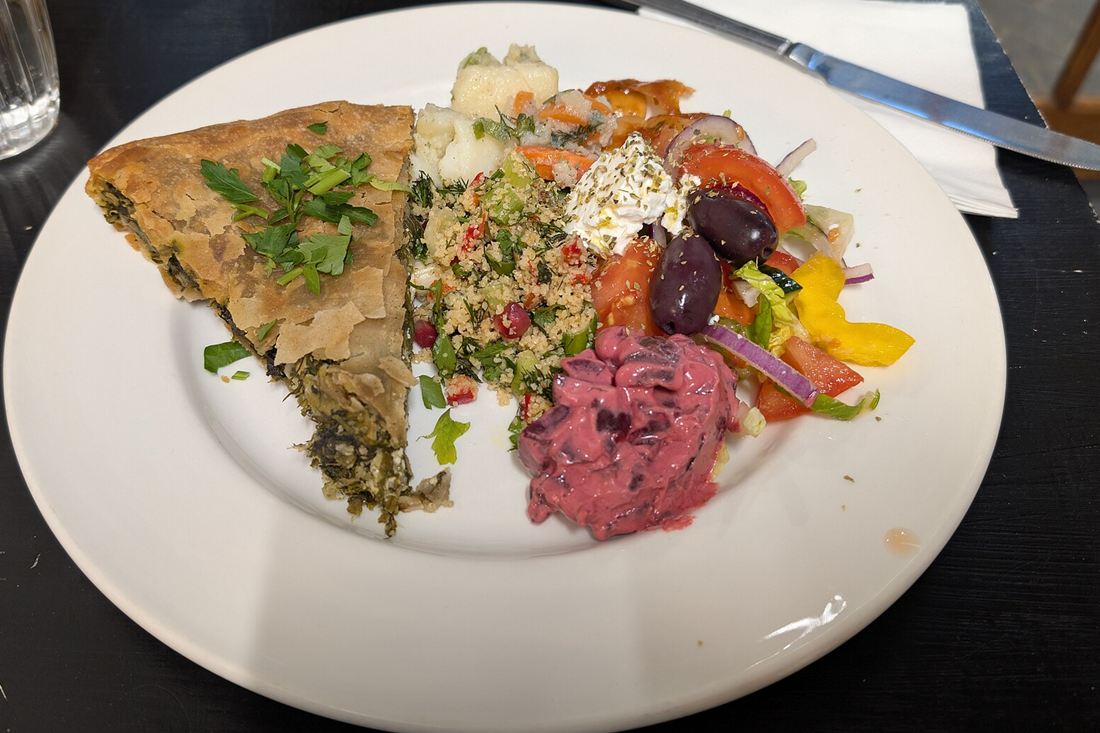
The name spanakopita joins the Greek words spanáki, meaning spinach, and píta, meaning pie. Its filling is made from chopped spinach, feta or another white cheese, and egg. The Aegina cooking class listing gives no recipe, so every pie fact below comes from general Greek cooking sources.
The traditional filling holds chopped spinach, feta, onions or scallions, egg and seasoning. Other white, salted cheeses such as kefalotiri can be mixed with the feta or replace it. Dill, mint and parsley add flavour. The Aegina cooking class listing names no cheese or herb, so these are general choices.
A spinach-and-cheese pie also carries the name spanakotiropita, especially in northern Greece. In southern Greece the word spanakopita covers the versions with cheese too. A version without cheese and eggs is eaten during religious fasts throughout Greece.
Tiropita, also written tyropita, means cheese pie in Greek. It is made with layers of buttered filo and filled with a cheese and egg mixture. The version made with kasseri cheese carries the name kasseropita. The name tells the cook that cheese, not spinach, leads the filling.
Tiropita comes as an individual free-form wrapped shape or as a larger pie that is cut into portions. Spanakopita is baked in a large pan and cut into servings, or rolled into individual triangles. Spanakopita goes to the table straight from the oven or at room temperature. The Aegina cooking class listing does not say which shape the lesson bakes.
Spanakopita appears in traditional Greek cookery books and on restaurant and hotel menus throughout Greece. People also eat it in Bosnia and Herzegovina and in Turkey, so the pie is known well beyond Greece.
The cheese pie in an Aegina cooking class has ancient roots. Scholars quoted on the tiropita page name plakous, an ancient Greek layered cheese cake, as an ancestor of tiropita. Cato the Elder recorded a Latin version, the placenta, as a sweet layered dish of cheese and honey.
What goes into Greek filo dough and pie fillings?
Filo is a very thin, unleavened pastry dough made from flour, water and oil. Cooks layer a stack of sheets, brush each with oil or butter, and bake the stack. The Greek word fýllo means leaf, a good picture of the paper-thin sheets.
Filo is also spelled phyllo, fillo or fila, and all four names describe the same dough. The word is borrowed from Greek. An Aegina cooking class that bakes pies works with exactly this dough, whatever spelling the recipe card uses.
The paper-thin form of modern filo was developed in the Ottoman Empire by the 15th century. It became the base for sweet and savoury pastries such as baklava and börek, with new shapes over the centuries.
In spanakopita, the filling is wrapped or layered in filo with butter or olive oil. Another recipe uses horiatiko, a village-style pastry with a thicker crust. The pie can also be made with puff pastry.
Pie is a baked dish with a pastry casing that holds a sweet or savoury filling. A pie can have a base and a top, a top only, or a base only. Shortcrust, puff pastry and filo are the pastries named for pies.
Feta is a Greek white cheese aged in brine, made from sheep’s milk or from sheep’s and goat’s milk. Its flavour is tangy and salty, from mild to sharp. Cooks use it in salads and in the filo dishes spanakopita and tyropita.
European Union rules limit the name feta to cheese made in the traditional way in mainland Greece and Lesbos Prefecture. It comes from sheep’s milk, or sheep’s milk with up to 30% goat’s milk from the same area. The island of Cephalonia also makes feta traditionally, but the protected definition leaves it out.
Tiropita needs filo, eggs and cheese, while spanakopita adds spinach and onions or scallions. These facts describe Greek pies in general, not the recipe of any Aegina cooking class.
How does a private Aegina cooking class run from pickup to table?
The GetYourGuide listing for this Aegina cooking class, tour 1108961, describes a three-hour private-group lesson with pickup available. Guests start with the cooking lesson and make the dishes in a kitchen kept for the group. They finish at the table with refreshments.
The listing gives the lesson in three beats. First you learn to cook. Next you prepare the dishes in a private kitchen. Last you enjoy what you made, with refreshments. It shows the order but no clock time for any beat, so no schedule is promised inside the three hours.
Pickup comes before the first beat of the Aegina cooking class. The listing carries the feature label “Pickup available” and names no pickup point, no village and no host. The booking page is where you read the arrangement for your own date and party.
Three hours is the length shown for the whole activity. The listing gives that length once, and it applies to the full lesson. It runs from the first lesson to the refreshments at the end. The listing does not say whether the ride from pickup counts inside those three hours. Ask before you plan your day around the Aegina cooking class.
The label “Private group” tells you the lesson runs for your own party. The listing shows this label next to the three-hour length and the pickup label. The abstract also calls the kitchen private. The lesson runs for your party alone. Nobody outside your group joins the table.
The abstract closes the Aegina cooking class with refreshments. The listing text reads “enjoy your creations with refreshments”. It names no drinks and no side dishes, so the closing course is the food your group prepared. The booking form offers two languages for the lesson, English and Greek.
Who suits an Aegina cooking class, and how do you book it?
Families, couples and friends suit a private-group Aegina cooking class, because the lesson runs for one party only. The booking form takes adults aged 18 to 99 and children aged 17 and younger. Each ticket type has a limit of 10.
Mixed cooking ability fits the Aegina cooking class format. The abstract opens with the words “Learn to cook” and sets no experience requirement. A first-time cook and a regular home cook sit in the same group and follow the same lesson.
The booking form lists two ticket types. Adult covers ages 18 to 99. Child covers ages 17 and younger. Each type accepts from 1 to 10 people. A family with children therefore books both types in one order, and a group of friends books adults only.
The listing states “Must book at least 3h in advance”. That cut-off is short. A booking made on the morning of the lesson works when a slot is open. The start time must be more than three hours away. Pick the date, the group size and the language on the booking form to see the open slots.
The listing marks the activity “Free cancellation”. The label carries no deadline, so read the cancellation terms shown for your chosen date before you pay. The terms on the booking page apply to your order, and the label is only the headline.
The listing also marks the activity “Wheelchair accessible”. It does not describe the kitchen layout, the entrance or the seating. A guest who uses a wheelchair checks those points with the operator on the booking page before the lesson day.
The lesson fits a day on the island as one fixed block of three hours. The rest of the day stays open for you to plan. The listing sets no timetable and no stop before or after the lesson.
Which other Aegina classes and tastings fit the same day as an Aegina cooking class?
Four other Aegina activities sit beside a three-hour lesson. They are a two-hour ceramics class, a two-hour Hippocras workshop, a 100-minute orchard tour and a three-hour wine tasting. Each listing states its own length.
A ceramics class with a local potter takes place in Aegina Town and lasts two hours. It can share a day with an Aegina cooking class. The listing covers pottery history, the pinching technique and decoration with colours. Pickup is available, and cancellation is free.
The Aegina pottery class page covers that session in full. Booked next to an Aegina cooking class, it adds a hands-on craft to the day and no second meal.
The Hippocras Ancient Greek Sangria Workshop runs for two hours in Aegina Town, for a small group. It pairs with an Aegina cooking class. The listing teaches two sangria-like drinks, a modern one and one from Ancient Greece. Cancellation is free.
This workshop adds a drink-making session to the day. The listing names no ingredients and no recipe, so it stays a separate topic from the lesson.
The Organic Pistachio Orchard Tour with Factory Visit lasts 100 minutes in Aegina Town, for a small group. It shares a day with an Aegina cooking class. The listing promises the history of Aegina pistachios, a close look at the trees and local pistachio snacks. Cancellation is free.
At 100 minutes, this is the shortest add-on here. It fits beside a three-hour lesson without crowding it. The tour covers pistachios, not cooking.
The Private Wine Tasting Experience takes place in Perdika and lasts three hours, for a private group. It can follow an Aegina cooking class. The listing offers three wines with artisanal cheeses and savoury meze. Pickup, wheelchair access and free cancellation are all listed.
The Aegina wine tasting page covers the tasting. Like the lesson, it is a private three-hour session with pickup and wheelchair access. It is a separate booking from an Aegina cooking class.
What role does bread play at a Greek table?
Wheat bread is ubiquitous in Greek cuisine, and barley is used too, notably for paximathia. The Aegina cooking class listing names bread among its dishes. Bread reaches the table as a loaf, a wrap, a rusk, a breakfast ring or a holiday loaf. Each type has its own job.
Traditional breads in Greek cuisine are leavened loaves, such as the round karvéli and the oblong frantzóla. The Greek Orthodox church community adds its own bread, called prosphora, to the country’s food traditions.
The listing names pies, so one word needs care. In Greece the word pita means pastry, as in spanakopita, the spinach pie. The flatbread that English speakers call pita is thicker and pocketless in Greek usage. It serves almost exclusively as a wrap for souvlaki or gyros.
That wrap is garnished with tzatziki sauce, tomatoes, onions and french fries. Pita bread in general can also scoop sauces or dips, such as hummus. Grilled pita bread appears beside skordalia, hummus, olives and roasted peppers in the Greek cuisine article.
Lagana is a Greek flatbread baked for Clean Monday, the first day of Great Lent. It is flat and oval, and pressed fingertips decorate its surface. Sesame seeds are a common topping. Leavened lagana is now more common than the unleavened original.
Paximathia is a hard bread, similar to a rusk, made with whole wheat, chickpea or barley flour. Greek bakeries sell it. It is served as a breakfast food with marmalade or cheese.
Greek farmers ate paximathia in their fields after soaking it in water and olive oil. It was baked in outdoor ovens about every ten to fifteen days. The bread was then sliced into thick wedges and returned to the oven to dry, which preserved it.
Paximadia was a staple food for the people of Crete. It forms the base of dakos, a Cretan food of soaked dried bread or barley rusk. The topping is chopped tomatoes, crumbled feta or mizithra cheese, dried oregano and splashes of olive oil.
A typical Greek breakfast lists rusks, bread, butter, honey and jam. It also names koulouri, a sesame bread ring and a type of simit. Skordopsomo is garlic bread made with sliced bread, olive oil, garlic, salt, pepper, oregano and basil.
Tsoureki is a sweet holiday bread made with flour, milk, butter, eggs and sugar. Greek Easter tsoureki carries dyed red eggs pressed into the dough. Christopsomo is a round Christmas loaf with a cross decoration.
Vasilopita is a Greek holiday loaf with a coin hidden inside for good luck. It is baked for St. Basil’s Day, which is New Year’s Day. Stafidopsomo is raisin bread, listed with the Greek sweets.
The abstract of the lesson names bread among the dishes prepared. A guest who knows these Greek breads reads the table better when the eating starts. After an Aegina cooking class, that knowledge makes the meal clearer.


What do travellers ask about an Aegina cooking class?
The Aegina cooking class is a three-hour private lesson built around a wood-fired oven. The listing offers pickup and marks the activity as wheelchair accessible. Guests prepare their dishes in a private kitchen and then eat them with refreshments.
The listing does not name the host, the kitchen or the village. It also gives no recipes, no ingredient list and no teaching steps. The answers below stay inside what the listing states.
Is the Aegina cooking class private or shared?
The Aegina cooking class is a private group activity. Your own party cooks together, with no strangers added to the table. The listing gives no maximum party size, so ask the operator through the booking page if your group is large.
How long is the lesson, and is pickup available?
The aegina cooking class lasts three hours, and pickup is available. The listing names no pickup points and no start times. Pick your date on the booking page and read the pickup details there before you plan the day.
How far ahead must I book, and can I cancel?
You must book at least three hours before the start. The listing offers free cancellation. It states no cancellation deadline in the summary, so check the cancellation terms at checkout. The activity is marked as new on the platform.
Is the Aegina cooking class wheelchair accessible?
Yes, the listing marks the Aegina cooking class as wheelchair accessible. It gives no detail on steps, floor surfaces or restrooms. If one feature matters to your group, confirm it with the operator before you pay.
What do guests cook and eat, and does the lesson teach recipes?
The listing says guests learn to cook traditional Greek pies or meat in a wood-fired oven. The overview lists meat, bread and pizza, plus two pies: spinach and cheese. Guests then eat their creations with refreshments. The listing does not say which of these dishes each session makes. It does not describe recipes or ingredients.
For general background only, Wikipedia calls spanakopita a Greek savory spinach pie. Its filling uses chopped spinach, egg and feta or another white cheese. Wikipedia describes tiropita as a pastry of buttered phyllo layers with a cheese and egg filling. The lesson page does not say it teaches either pie by those names.
Can a cooking lesson and another Aegina class fit into one day?
The listing does not promise that two bookings fit together. A two-hour Aegina ceramics class or the two-hour Hippocras workshop in Aegina Town brings the total to five hours. That is before any travel. Check both start times on the booking pages first.
The organic pistachio orchard tour takes 100 minutes, and the private wine tasting in Perdika takes three hours. A second three-hour session next to the lesson fills a large part of a day. Our Aegina food tour page covers the island’s food stops for a day without a lesson.
Pick one anchor activity per half day. Book the aegina cooking class for one half of the day. Keep the other half free for the ferry, the harbour walk or a swim.