
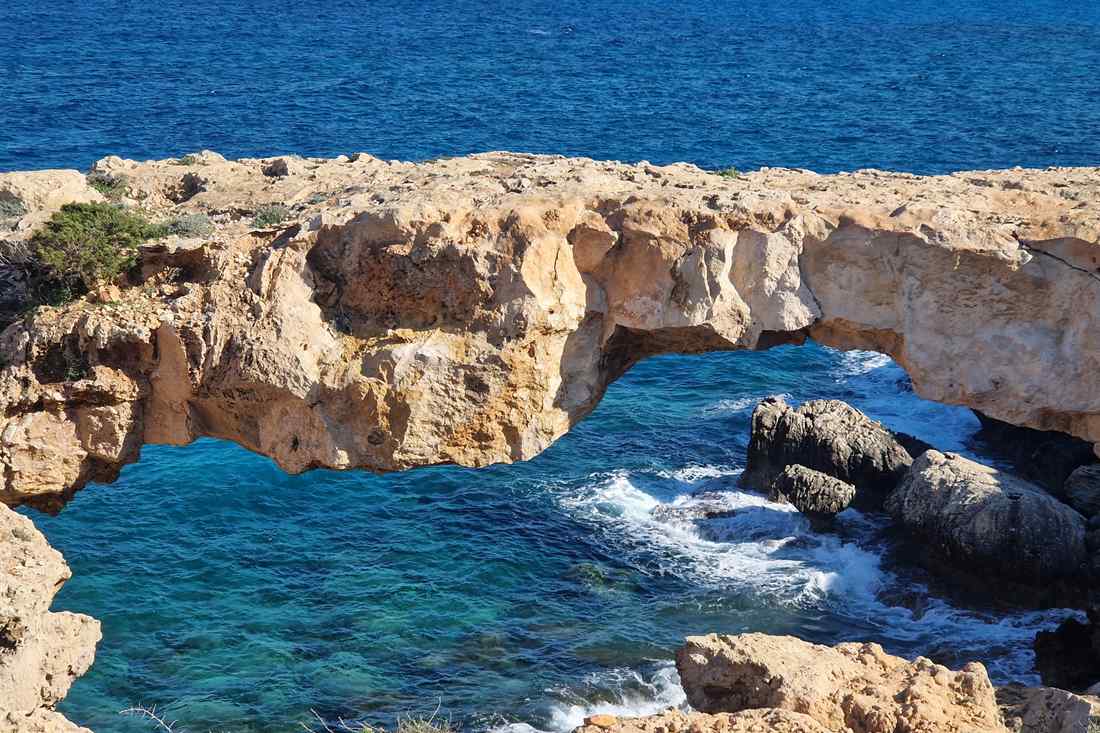
A Cape Greco tour walks, drives, paddles or sails through the national forest park between Ayia Napa and Protaras. It reaches nature trails, sea caves, rock arches and a cliff chapel. Find more trip ideas on Greece Tours.
The sections that follow cover the trails, the sights, the wildlife and the booking details for each Cape Greco tour format.
What is a Cape Greco tour?
A Cape Greco tour is a guided or self-led trip through Cape Greco National Forest Park. The park sits on the south-east coast of Cyprus, on the headland between Ayia Napa and Protaras. Trails, caves, bridges and bays make up the route.
Sources print the name in four ways: Cape Greco, Cavo Greco, Cape Greko and Kavo Gkreko. Wikipedia adds that the Italian form, Capo Greco, means Greek cape. GetYourGuide titles use Greco, Greko and Cavo Greco, so search for each one.
Each Cape Greco tour picks one way in. You walk the coast, ride in a jeep, paddle a kayak, sail on a boat or dive into the caves. The sections below follow the trails, the sights and the nature, then the tours.
Our Cyprus tours page compares the cape with the island’s other sights. This page stays inside the park and describes only what a Cape Greco tour reaches.
Which Cape Greco tour formats can you book?
Six Cape Greco tour formats run from the two resorts. Choose a hike, a caves tour, a sunset tour, a kayak trip, a dive or a cruise. Each format reaches a different part of the park.
- Hike: a guided walk from Protaras or Ayia Napa along the cliffs, with sea views and photo stops on a coastal path of 1.5 hours.
- Caves and bridge tour: the sea caves, the cliffs of Cape Greco, the Lovers Bridge, a swim and time on the shore of Konnos Bay.
- Private sunset tour: the Love Bridge, the sea caves, the Ayioi Anargiroi church and the Blue Lagoon, ending with a sunset from the cliff.
- Kayak trip: a private paddle to the sea caves, with snorkelling at Konnos Beach or in the Ayia Napa sea caves.
- Dive: a guided dive in the Cape Greco caves for certified divers.
- Cruise: a boat from Protaras that sails by the sea caves, the Blue Lagoon and Turtle Cove.
Love Larnaca lists hiking, fishing, snorkelling, kayaking and paddle boarding among the activities around the cape. The Viator grid below adds a caves jeep safari, two private trips listed under Larnaca and a Blue Lagoon cruise. Choose the format first, because it decides the pace of the day.


How long does a Cape Greco tour take, and how far ahead do you book?
A Cape Greco tour lasts from 2.5 hours for a dive to 7 hours for the full coastal day trip. Booking closes between 2 and 10 hours before the start, and three cruises close one hour ahead.
- 2.5 hours: the guided cave dive and the private sunset tour.
- 3 hours: the guided hike.
- 4 hours: the small-group tour from Larnaca.
- 4.5 hours: the caves and bridge tour with Konnos Bay.
- 5 hours: the private kayak and snorkel trip.
- 7 hours: the coastal day trip with the Blue Lagoon and Ayia Napa.
Each Cape Greco tour sets its own cut-off. The Larnaca tour and the day trip close two hours ahead. The hike closes at four hours and the caves tour at eight. The kayak, sunset and dive tours close at ten.
All seven carry free cancellation on GetYourGuide. The hike and the kayak trip run in English and Greek, and the others list English. The hike and the dive take small groups, while the kayak and sunset tours are private.
Cruises keep their own clock. The Protaras Blue Lagoon cruise lasts three hours and lists seven languages: English, French, German, Italian, Polish, Russian and Hungarian. The Medusa chill-out cruise lasts four hours, and the yacht tour from Protaras runs four to five hours.
Three cruises accept late bookings. The pirate cruise, the glass-bottom cruise and the Medusa cruise each close one hour before the start.
Where does a Cape Greco tour go inside the national forest park?
A Cape Greco tour covers a park of 385 hectares at the southern end of Famagusta Bay. The park has stood under protection for more than thirty years. It belongs to the European Union’s Natura network of protected sites.
The cape forms part of Ayia Napa Municipality and sits between the two resorts. DOM defines it by the southern coast of Famagusta Bay and the eastern coast of Ayia Napa Bay. The Cyprus Forestry Department, part of the Ministry of the Interior, manages the park. Our Ayia Napa tours page covers the resort side of the coast.
Wikipedia ranks the cape as the eastern limit of the land that the Cyprus government controls. De facto it is also the eastern limit of the European Union, if the outermost regions are left out. The Lighthouse Directory adds that the cape sits at the end of a long, slender peninsula.
A visitor centre anchors the park. The Environmental Information and Education Centre explains the protected area. Visit Famagusta advises starting your Cape Greco tour there.
The ground splits into four kinds of stop. The first is trails across the plateau. The second is caves under the cliffs. The third is a chapel beside a rock bridge. The fourth is the bays at Konnos and the Blue Lagoon. A full Cape Greco tour touches all four.
Which nature trails does a Cape Greco tour follow?
Visit Famagusta lists ten routes for a Cape Greco tour on foot, from 2 km to 8.5 km long. Each route has its own starting point and a difficulty grade of 1 or 2.
A linear route runs from one end to the other, so you need a ride back. A circular route returns to its start. Nine of the ten routes run 4.8 km or less. Only the Profitis Elias to Konnos path reaches 8.5 km.
Visit Famagusta calls the Aphrodite trail and the linear Sea Caves path well marked. Two routes carry grade 2, the Kavos loop and the circular Sea Caves walk. The other eight carry grade 1.
Trailheads sit at the visitor centre parking site, the Agioi Anargyroi church, an old quarry and Konnos beach. Another starts at the Sea Caves stop on the Ayia Napa to Cape Greko road. Two more start at the church of Panagia and the chapel of Profitis Elias.
The routes join each other. The linear path from the church to the Sea Caves links with the Konnos, Sea Caves and Kavos trails. A hiker can therefore chain two routes on one Cape Greco tour.
The next sections take the routes one by one.
What does the Aphrodite trail show on a Cape Greco tour?
The Aphrodite trail is the shortest start for a Cape Greco tour on foot. It is a 2 km loop from the visitor centre parking site and takes about an hour.
The goddess of love gives the trail its name. DOM places the route on the north-east coast of the cape. It passes the area where an ancient temple of Aphrodite stood, and only ruins remain today.
Travelfind says a 2 km trail in the park belongs to the E4 European long-distance path. That path runs from Gibraltar to Cyprus. The same page ties the trail to the Aphrodite Cultural Route.
Sources disagree on the time. Visit Famagusta gives one hour, while DOM gives 40 minutes. Plan an hour for this part of a Cape Greco tour.
What does the Kavos trail add to a Cape Greco tour?
The Kavos trail adds the peak of the cape to a Cape Greco tour. It is a 2.5 km loop from an old quarry and takes about 45 minutes. A vantage point at the top gives the view.
The loop starts at the old quarry parking area. You reach it from the main road between Ayia Napa and Cape Greko, near the cape itself. Signs along the way explain the area and its wildlife.
The vantage point at the peak looks far. According to the trail page, it reaches as far as the Stavrovouni Monastery. On a very clear day it shows the heights above Haifa in Israel.
Love Larnaca describes the walk to the peak as a path through pine trees. It gives views over the sea and the Ayia Napa coastline. The trail page calls the cliffs along the loop impressive and suitable for climbing. The day guide of Visit Famagusta lists Kavos Hill as a panoramic stop on a Cape Greco tour.
Which trail links Konnos Bay and the chapel on a Cape Greco tour?
The Konnoi to Agioi Anargyroi trail runs 4.8 km and takes about two hours. It starts at Konnos Beach or at the chapel, so a Cape Greco tour can walk it in either direction.
The chapel end is reachable by road. Visit Cyprus says you arrive from the main road between Protaras and Cape Greko, close to the cape. The beach end lies between Protaras and the cape.
The first two kilometres run parallel to the beach, beginning at Konnos Bay. They bring the walker to the Agioi Anargyroi church, which stands above a sea cave.
South of the church the path crosses low shrub and reaches Kamara tou Koraka, the natural arch. Beyond it the trail climbs a little, follows the coast through taller shrub and ends in a small pine forest.
Visit Cyprus gives GPS points for hikers with a phone. The start lies at about 34.98 N, 34.07 E, and the end lies at about 34.98 N, 34.08 E.
It also gives the heights. The start lies at 3 metres, the highest point at 28 metres and the end at 10 metres. The climb stays gentle.
What do the Sea Caves trails cover on a Cape Greco tour?
Two Sea Caves routes hug the coast for a Cape Greco tour on foot. A linear path of 4 km runs from the Agioi Anargyroi church to the caves in 1.5 hours. A circular route of 3.6 km starts at the caves.
The linear path crosses the Kamara tou Koraka bridge. Its trail page lists the area as suitable for diving. This is the Cape Greco tour path for hikers who want the caves.
The circular route starts at the Sea Caves stop on the road to Cape Greko. That stop lies 6 km east of Ayia Napa. The trail page warns that the walk is very steep and craggy at certain points.
Komoot hikers add a warning of their own. They call the Sea Caves a popular photo motif, even for wedding couples. They also ask for care when climbing the rocks.
Which other routes can a Cape Greco tour add?
Four more routes extend a Cape Greco tour. They reach the Cyclops Cave, two small chapels and the Profitis Elias chapel above Protaras. Distances run from 2.4 km to 8.5 km.
The Konnoi to Cyclops Cave loop starts at Konnos beach, between Protaras and the cape. It runs 2.4 km in 45 minutes along the coast to natural caves. The Cyclops cave heads the list. A kiosk operates on the beach.
Visit Famagusta tells the myth. A family of cyclops was shipwrecked on the island after a sea disturbance, and the large cave was their home.
The Panagia to Agioi Saranta path covers 2.5 km, and the Panagia to Agios Ioannis path covers 2.8 km. Both take 45 minutes. They start at the Church of Panagia, 300 metres off the road from the cape toward Protaras. The far ends lie on dirt roads reached from Protaras. Our Protaras tour page covers the resort end.
The longest route, Profitis Elias to Konnoi, runs 8.5 km in three hours. It leaves the Profitis Elias chapel in Protaras, reached from the Cape Greko to Paralimni road. It passes the two small chapels and ends at Konnos Beach. The trail page names the view from the first chapel as panoramic.
What are the sea caves on a Cape Greco tour?
The sea caves anchor a Cape Greco tour. They are hollows that wind and water carved into the limestone. They stretch from Ayia Napa to the tip of the cape.
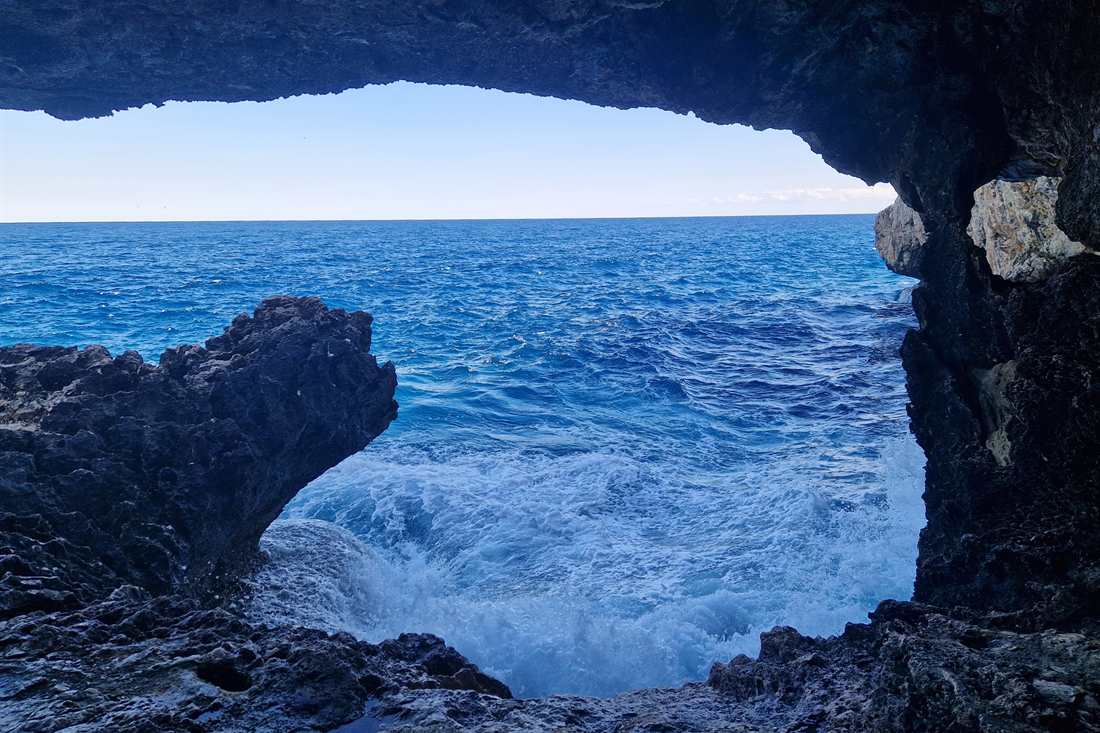
DOM says the caves formed over centuries as the sea and the wind wore the rock away. Caves with unusual shapes have earned names such as Shark, Cyclops, Pirates and Captains. Local legend says pirates and smugglers hid treasure and illegal goods in them.
The full scale of the caves shows from the sea, according to DOM, and tour boats gather there. Commercial.cy adds that the caves can be approached from the water. Low tide reveals places the cliffs hide. A walker sees the openings from the cliff path.
Love Ayia Napa lists the Palaces caves as a popular spot for cliff jumping. DOM places the jumps at the southern and northern parts of the cape. It adds that jumping suits experienced swimmers only.
A jeep is the dry way in. The Ayia Napa jeep safari page lists the jeep routes that stop at the caves. A kayak trip reaches the caves from the water, while a hike sees them from the cliff.
Which natural bridges does a Cape Greco tour pass?
A Cape Greco tour passes two rock arches. They are the Love Bridge and Kamara tou Koraka, which sits on the trails beside the chapel. Couples photograph both arches.
The Love Bridge is an arch of rock with one end in the sea. DOM measures it at 6 metres long and 1.5 metres wide. The gap between the arch and the water looks like a heart.
Local legend says that lovers who kiss in the middle and make a wish will see it come true. Couples come to propose and to take photos, and DOM says daredevils jump from the arch. Listings spell the name Lovers Bridge, Love Bridge and Bridge of Love.
Kamara tou Koraka is the second arch. Local lore says its name comes from the crows’ nests that once surrounded it. Visit Cyprus calls it an impressive geological formation. Commercial.cy calls it the Bridge of the Newlyweds. A Komoot hiker reports that the arch is locked, so admire it from the viewpoints during your Cape Greco tour.
What does the Agioi Anargyroi chapel add to a Cape Greco tour?
The Agioi Anargyroi chapel is the landmark of a Cape Greco tour. It is a small blue and white church built on a vertical rock above the sea. Weddings and wedding shoots take place there.
The church stands over a sea cave. Tradition says that Saint Kosmas and Saint Damianos lived there as ascetics. DOM adds that the two brothers lived in the early sixth century and treated patients without taking payment.
Steps lead down from the chapel to the water and the cave below. Visit Famagusta marks the spot beneath the church as a diving site. Komoot hikers praise the view of turquoise water from the chapel. They call it a popular place for wedding shoots, and DOM says couples hold weddings inside.
The chapel also anchors a loop. The Agioi Anargyroi circular trail covers 2.3 km in 45 minutes and starts at the church. It passes the Kamara tou Koraka arch and gives access to the sea caves. It connects to the linear path to the Sea Caves.
What does Konnos Bay add to a Cape Greco tour?
Konnos Bay adds a swim stop to a Cape Greco tour. The golden beach is 40 metres wide and over 200 metres long. It lies between Cape Greco and Protaras.
DOM lists the facilities: showers, changing cabins and playgrounds for children and for sport. Sunbeds and water sports gear are for rent, and cafes stand nearby. Blue flags fly over the beach.
The same guide says the calm sea and the safe seabed suit families with children. Komoot hikers praise the bay for snorkelling. They mention a small restaurant at the foot of the beach, with seats in the shade.
Love Ayia Napa calls Konnos Bay a secluded cove away from the main tourist track. Three trails start or end at the beach. A hiker on a Cape Greco tour can add a swim to any of them.
How did the sea shape the rock on a Cape Greco tour?
Geological uplift and erosion shaped the rock of a Cape Greco tour over millions of years. Wind and waves cut the limestone into cliffs, arches and sea caves.
Sancytours describes the coast as a place where the Mediterranean sculpted white limestone. The pale rock meets deep blue water, and the contrast defines the view on a Cape Greco tour.
Visit Famagusta adds that rugged rocks and limestone cliffs dominate the scene. Much of the shoreline is steep, with caves carved out by time and waves.
The old quarry on the Kavos trail shows the rock at close range. The trail page counts a large number of fossilized marine organisms there.
Which plants grow along a Cape Greco tour?
Visit Cyprus names six endemic plants on the Konnoi trail of a Cape Greco tour. They are Cyprus bosea, wild garlic, three-colour chamomile, Cyprus golden drop, Cyprus germander and valantia.
An endemic plant grows wild in one region only, and these six grow wild only on Cyprus. DOM counts over 400 plant species in the park. Sancytours describes the plateau as low shrubs, wild herbs and seasonal flowers. They cope with dry ground, salty air and strong sun.
Travelfind pictures the walk as a landscape of pines and cypresses. The Agioi Anargyroi circular trail runs through dense vegetation, mainly Phoenician juniper, and it has a picnic site.
The Konnoi trail changes its cover as it goes. The path starts in low shrub and climbs into high shrub. It ends in a small pine forest, and a Cape Greco tour on that route passes all three.
Which animals live along a Cape Greco tour?
Visit Cyprus lists foxes, hares and hedgehogs among the mammals met on a Cape Greco tour. The reptiles include the Cyprus viper, the Cyprus lizard, the Cyprus chameleon and the black whip snake.
Sancytours adds lizards, small mammals and insects that live among the rocks and the plants. The cliffs and the open sky also draw birds, which the next section covers.
DOM says the wildlife in the reserve poses no major threat to people. The same guide still advises walkers to watch their step on a Cape Greco tour.
Why do birdwatchers book a Cape Greco tour?
Birdwatchers book a Cape Greco tour because the cape is a migration bottleneck. BirdLife International lists it as an Important Bird Area, and large flights of raptors funnel over it.
Pallid harriers and red-footed falcons pass through, along with honey buzzards and common kestrels. Cyprus wheatears, Cyprus warblers and black francolins breed in the park, according to Wikipedia. Visit Cyprus adds kestrels and partridges to the list of birds.
Sancytours places the cape on routes that link Europe, Asia and Africa. DOM counts more than 80 bird species in the park. Visit Cyprus calls the park a resting point for migrants.
Illegal trapping threatens the birds, says Wikipedia, even inside a protected park.
What lies under the water on a Cape Greco tour?
A Cape Greco tour by water meets warm, clear sea. Travelfind gives sea temperatures from 16 degrees Celsius in winter to 28 degrees in summer. Visibility reaches 30 to 40 metres.
DOM puts the depth of the caves at no more than 12 to 14 metres. The guided dive in the Cape Greco caves is for certified divers. A second listing, a dive session of two hours, promises chances to see seahorses, turtles, rays and rare seals. Its booking closes 45 minutes before the start.
A boat shows the same coast without a wet suit. A Protaras cruise uses a glass-bottom boat and lists a diving show during the trip. Another cruise lists snorkelling with sea turtles. A pirate cruise sails in the morning or at sunset. Our Ayia Napa boat trip page compares the cruises that sail past the cape.
Commercial.cy describes the Blue Lagoon as a sheltered, turquoise bay on the other side of the cape. Boats anchor there in the season while visitors jump in for a swim on a Cape Greco tour by sea.
Can you walk or cycle a Cape Greco tour without a guide?
Yes. A Cape Greco tour can run without a guide. The park has marked walking trails and cycle paths. A self-guided Komoot route covers 10.8 km in 2 hours 57 minutes.
A Komoot hiker calls the stretch between the Sea Caves and the cape viewpoint the loneliest on the coast. Komoot rates the route moderate and asks for good fitness. It climbs about 160 metres in total and tops out at 70 metres. The paths are easy to reach, and the start lies right next to a parking lot.
The route links Konnos Beach, the chapel and the Kamara tou Koraka arch. It also links the summit of the cape and the Sea Caves. Of its 10.8 km, 8.26 km run on unpaved ground. Hiking paths make up 5.64 km, other paths 3.70 km and roads only 696 metres.
Cyclists have their own routes. Travelfind says the area keeps special trails for cycling. DOM suggests renting a bicycle or an ATV in the resort towns.
How do you reach the park on a Cape Greco tour?
The park lies 5 to 10 minutes by car from Ayia Napa, along the border with Protaras. A guided Cape Greco tour also picks guests up from their hotels in Ayia Napa, Protaras and Larnaca.
Ayia Napa lies about 12 km from Protaras, and the cape sits between them. Love Ayia Napa lists the ways in: car, local bus, taxi, bicycle or jeep safari. DOM names bus 101 from Ayia Napa and bus 102 from Protaras. The bus stop sits in the centre of the park.
Drivers find parking near the observation deck, and DOM says it takes all types of vehicle. The Lighthouse Directory places the lighthouse at the tip of the cape, about 8 km south-east of Ayia Napa.
Pickups vary by tour. The guided hike picks up from Protaras or Ayia Napa. The small-group tour from Larnaca includes hotel pickup and drop-off for a group of up to five guests. Pickup is also available on the caves and bridge tour and on the kayak trip. The private sunset tour and the day trip offer it too.
What do you wear and pack for a Cape Greco tour?
Wear lightweight sneakers or closed-toe sandals on a Cape Greco tour, and carry water, a hat and sunscreen. DOM tells visitors to leave high heels and rubber flip-flops behind.
DOM adds that clothes of natural fabric are comfortable on a Cape Greco tour. It suggests adhesive and elastic bandages in the backpack. The park has places to eat, but drinking water belongs in the bag.
The sea needs care too. DOM warns of sea urchins on the seabed, because contact with them hurts. The 7-hour day trip lists swimming, snorkelling and relaxing by the rocky shore, so pack swimwear for it.
Which season and time of day suit a Cape Greco tour?
March and April bring wildflowers to the cape. In summer, plan a Cape Greco tour for early morning or afternoon, when the heat drops. Autumn and winter allow walks at any hour.
DOM names March and April as the months when blooming wildflowers contrast with the emerald sea. Visit Famagusta says autumn and winter allow walks at all hours, because the weather suits nature walks.
Love Ayia Napa warns that the coastal path needs caution in the summer heat. On hot days, DOM advises choosing a cooler day or an evening visit.
Sunset has its own tours. The guided hike runs at sunset. The private tour ends with a sunset from the cliff. DOM says the observation deck at the highest point has benches for watching the sky.
What history sits behind a Cape Greco tour?
The cape holds a nineteenth-century lighthouse, a Neolithic settlement and an ancient shipwreck. Visit Famagusta lists all three in its guide for a Cape Greco tour.
The British built the lighthouse. Visit Famagusta calls it the second lighthouse in Cyprus, after the one at Paphos Castle. It guided ships for decades and served informally as an observatory for smugglers’ activities.
The Lighthouse Directory dates the tower to the nineteenth century. The round masonry tower is 15 metres tall and painted white. It is still active and shows one long white flash every 15 seconds.
Neolithic means New Stone Age. Archaeologists uncovered one of the oldest Neolithic settlements in Cyprus on the cape. Divers later found an ancient shipwreck off the coast, dated to the second century AD. The finds span the Neolithic age to the second century AD.
What did the radio station on Cape Greco broadcast?
A powerful mediumwave station of Radio Monte Carlo Middle East stood on the cape. It broadcast French and Arabic programmes to the Middle East and North Africa.
Mediumwave is the AM radio band. Trans World Radio used the site in the early morning and for a time late at night. It carried programmes in Arabic, Armenian and Persian.
The first transmitter ran at 600 kW on 1,233 kHz. A second transmitter later carried the Arabic programme of Radio Sawa, a station founded by the U.S. government. Its frequency moved from 981 to 990 kHz because of interference with ERT broadcasting from Athens.
Both services have ended, and both antennas have been demolished. Wikipedia says a nature reserve information centre was to take their place.
Where do photographers stop on a Cape Greco tour?
Photographers on a Cape Greco tour stop at the chapel and the rock arch. They also stop at the sea caves at sunset and at a lone tree in an open field.
Commercial.cy describes the tree as a solitary old tree in the middle of an open field, among low vegetation. Couples and newlyweds use it for natural, romantic photographs.
At sunset the limestone around the sea caves takes on warm evening light. The same guide mentions a bench that overlooks the cliffs and the sea. It marks a quiet place to stop after a walk.
One private tour builds photos into its title. The Ayia Napa sunset tour with photos and pickup visits the Love Bridge and the sea caves. It also stops at the church and the Blue Lagoon.
What do travellers ask about a Cape Greco tour?
Can children join a Cape Greco tour?
Booking forms for the caves and bridge tour, the day trip, the Larnaca tour and the dive list child tickets. The caves tour and the day trip also list infants. On the Protaras cruises, children aged two and younger join for free but must be added to the booking.
Which Cape Greco boat tour bars young guests?
The semi-private yacht tour from Protaras allows no one aged 17 or younger. It sails to the Blue Lagoon, Turtle Bay and the sea caves with an open bar.
Can you enter the Cape Greco lighthouse?
No. The Lighthouse Directory lists the site and the tower as closed, and all views come from the sea. A boat is the way to see it.
Which Cape Greco tour is wheelchair accessible?
GetYourGuide lists the Medusa 1 chill-out cruise as wheelchair accessible. The cruise lasts four hours. It sails the Protaras and Ayia Napa coast to the Blue Lagoon and the sea caves.
Does a Cape Greco tour show Famagusta?
A Protaras cruise lists the ghost town of Famagusta as a sight seen from a distance. A pirate cruise from Protaras names Famagusta among its sights. The others are Fig Tree Bay, Cape Greco and the Love Bridge.
Can you add yoga to a Cape Greco tour?
Yes. One GetYourGuide listing pairs a scenic hike on the nature trails with an outdoor yoga session and sunset views. It lasts three hours and carries the New activity label.