
A Tinos photoshoot turns a quiet Cycladic island into a set of backdrops, from carved dovecotes and marble lanes to a valley of giant granite boulders. Plan more island days and tours with Greece Tours.
Here you can compare the bookable sessions, the villages, Volax, the dovecotes, the churches, the light and weather, and the practical plan.
What is a Tinos photoshoot?
A Tinos photoshoot is a photo session on Tinos, the Cycladic island next to Mykonos, with a local photographer or with your own camera. Its marble villages, granite boulders at Volax, carved dovecotes and white chapels give a different backdrop at every stop.
Tinos lies in the Cyclades, close to Andros, Delos and Mykonos. It covers about 194 square kilometres, which makes it larger than its famous neighbour, and around 8,900 people live there.
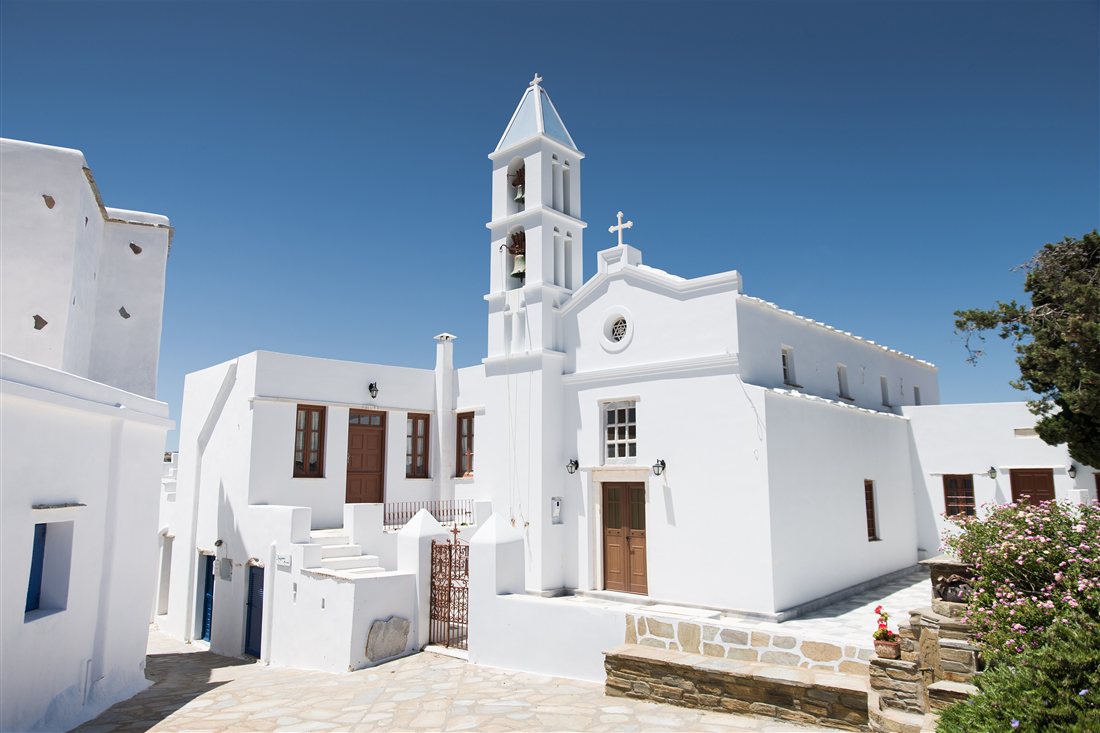
The island is a gallery of backdrops. Wikipedia counts the church of Panagia Evangelistria, about 80 windmills, around 1,000 decorated dovecotes, 50 living villages and the Venetian walls on the mountain of Exomvourgo. Marble from the island fills doorways, fountains and church towers.
Tinos is also an island of artists. Sculptors and painters such as Yannoulis Chalepas, Nikolaos Gysis and Nikiforos Lytras came from here, and the marble village of Pyrgos still trains carvers. A Tinos photoshoot draws on that same light and stone.
On a booked session, the photographer holds the camera while you pose. A self-planned day lets you pick the villages and frame the pictures yourself. Both work on Tinos, because the main sights lie within a short drive of each other. Our Tinos page covers the island beyond the camera.
Which Tinos photoshoot can you book?
Viator sells two sessions on the island: a private photo session with a local photographer in Tinos and a vacation photographer package. Airbnb also lists photo services for Tinos from photographers who work across the Cyclades.
The first Viator listing offers a private photo session with a Tinos-based photographer. A private session means only your party is in front of the camera, whether you travel as a couple, a family or a group of friends.
The second listing is “Vacation Photographer in Tinos”. It suits travellers who want a record of the trip itself, from walks in the villages to an evening on the waterfront. Check the length of each Tinos photoshoot and the meeting point on Viator before you book.
Airbnb lists photography services for Tinos alongside its other experiences. The platform says it reviews each photographer on their portfolio and asks for at least 2 years of photography work. Its Tinos page shows photographers from nearby Mykonos, who cover couples, families and editorial-style shoots.
Weddings form a separate market. Couples who marry on the island book a full-day photographer rather than a short session, and our Tinos weddings page covers that side of the island.
A self-planned Tinos photoshoot costs only the drive. Bring your own camera or phone, rent a car or use the island buses, and follow the route of villages and viewpoints set out below.

Which villages suit a Tinos photoshoot?
Pyrgos offers marble doorways, fountains and a shaded square. Kardiani climbs a green slope above the sea, with a fountain of carved frogs. Isternia has a marble church courtyard facing the bay, and Ktikados has arched lanes and marble window frames.
Pyrgos is the marble village. Marble appears everywhere: in the streets, on door frames and fountains, on churches and even in the cemetery. Its square, with a marble fountain and cafés under a giant plane tree, makes a natural first stop for a Tinos photoshoot. Our Pyrgos Tinos page covers the village in detail.
The lanes of Pyrgos add colour. Travel.gr describes courtyards full of flowers and a wealth of marble details, from lintels and window frames to carved reliefs. The same village holds a museum of marble crafts and the family home of the sculptor Yannoulis Halepas.
Kardiani is built like an amphitheatre on the slopes of Mount Pateles, wrapped in greenery with a wide view of the sea. Its marble fountains, vaulted arcades and Catholic and Orthodox churches frame portraits well, and the sunset from the central square is the highlight of the village.
Isternia is the village of the marble carvers. Its grand church of Agia Paraskevi has a marble courtyard with a view over the sea and the bay of Isternia. A Tinos photoshoot here pairs white marble with deep blue water.
Travel.gr counts Ktikados among the loveliest villages of the island, with cobbled lanes under arches, marble latticed windows and fountains where locals still wash carpets. The view of Tripotamos from the western road, with Exomvourgo behind, is a classic postcard, but the road has nowhere safe to stop.
Can you hold a Tinos photoshoot among the Volax boulders?
Yes. Volax sits on a plateau scattered with thousands of round granite boulders, a number of them as big as houses, which travel.gr compares to an outdoor geological museum. The small white village stands out among them, 6 km from Tinos town.
The boulders fill a triangular plateau of 23 square kilometres. Local stories call them the remains of an ancient seabed or of meteorites, but geologists explain them as granite shaped by spheroidal weathering. Either way, they make a striking frame for a Tinos photoshoot.
The village sits at about 284 metres. Its houses rise above and between the rocks, following the rules of Cycladic building. Basket weavers still work in Volax, and a small folklore museum and a 380-seat outdoor theatre complete the village.
A short walk adds more scenes. A 2 km trail links Volax with the tiny village of Agapi through a field of giant boulders. Routinely Nomadic calls Agapi photogenic too, and the loop takes about 1.5 to 2 hours, including time in both villages.
A second boulder field lies nearby. From Falatados, a route leads through Kakovolo, where round granite rocks frame threshing floors, small churches, animal stalls and vineyards. Our Volax Tinos page covers the village and its customs.
Where are the dovecotes for a Tinos photoshoot?
About 600 dovecotes stand across Tinos, with a cluster at Tarampados, a 17th-century village near the town. Others rise in Potamia, Steni, Falatados and the valley of Tripotamos. Their stone lace of triangles, diamonds and suns makes a unique backdrop.
The dovecotes are the island’s signature. The first record of them dates from 1726, and travel.gr believes the Venetians brought the idea to the island. Builders used slate, stone and lime, and every tower carries its own pattern of cut-out shapes.
The pattern has a name, lithokentimata, or stone embroidery. Triangles, rhombuses and suns repeat across the walls. A Tinos photoshoot beside a dovecote uses that pattern as a frame.
The towers had a purpose. Islanders raised pigeons for their droppings, which fertilised the fields, and for squab meat. Single dovecotes stand along the island’s routes, so they appear on almost any drive.
Tarampados holds a whole complex of dovecotes. The small village dates from the 17th century. Our Tinos dovecotes page covers the towers and their history.
Respect private land. Dovecotes stand in fields and gardens, so shoot from the road or the path unless the owner invites you in.
Which churches and landmarks suit a Tinos photoshoot?
The marble esplanade of Panagia Evangelistria, the castle rock of Exomvourgo, the island’s windmills and the white chapels by the sea all suit a Tinos photoshoot. Each church has its own dress code and rules for cameras.
Panagia Evangelistria is the landmark of the island. The neoclassical church stands above the town on a wide esplanade of white marble. Inside, the icon of the Virgin Mary is covered in gems, and visitors must wear long trousers or skirts and cover their shoulders.
Respect the pilgrims. Devout pilgrims cross the 800 metres from the harbour to the church on their hands and knees. Ask before you photograph worshippers, and keep the camera down during services.
Exomvourgo rises to 640 metres with a jagged, almost alpine shape. The ruins of the Venetian castle of Saint Helen crown the rock, which was once the highest castle in the Aegean. A 10-minute climb from the Catholic monastery of the Sacred Heart reaches the top, with wide views over the nearby islands.
Windmills and chapels fill the rest of the frame. Tinos has about 80 windmills, and travel.gr counts up to 600 chapels, a large share of them private, scattered across the hills. Their white walls stand out against dry-stone terraces and the sea.
Panormos adds a harbour scene. The small port lies about 3.5 km from Pyrgos, with fishing boats along the quay, and across the water stands the islet of Planitis with its lighthouse, first lit in 1886. A Tinos photoshoot can end there with the boats at golden hour.
When are the light and weather right for a Tinos photoshoot?
Plan for early morning or the hour before sunset, when the light is soft on white walls. From late spring to mid-September the meltemi wind blows from the north, strongest in the afternoon. Avoid 15 August, when the island fills with pilgrims.
Wind shapes the plan. The meltemi, the dry north wind of the Aegean, blows on Tinos from late spring to about mid-September. It is at its strongest in the afternoon and dies down at night in a typical day, though it can last for days without a break.
For calm portraits, shoot in the morning or choose sheltered lanes inside the villages, where walls block the gusts.
Evening light suits Kardiani. Travel.gr promises a glorious sunset from its central square, so a Tinos photoshoot that ends there catches the last light over the sea.
Dates matter too. On 15 August, the feast of the Dormition, thousands of pilgrims fill Tinos for the great procession, and rooms are hard to find. Book a photoshoot on another week unless the pilgrimage itself is the subject.
The off season has its own appeal. Travel.gr notes that Tinos suits exploration beyond summer, when the villages are quieter.
How do you plan a Tinos photoshoot?
Reach Tinos by ferry from Piraeus, Rafina, Andros, Syros or Mykonos, which lies 35 minutes away. Base yourself in Tinos town, then drive or take the island buses to Volax, Pyrgos and Kardiani. Group the spots by area to save time.
Ferries arrive at the main port in Tinos town. The island has three ports, including one for fast passenger boats, and a heliport about 2 km from town near Agios Fokas beach.
Regular buses link Tinos town with the villages, but a car gives more freedom for a Tinos photoshoot. Volax lies 6 km from the town, and Pyrgos lies 24 km away, near the northern coast.
Plan the route by area. One morning can cover Panagia Evangelistria, Volax and the dovecotes of Tarampados. An afternoon can cover Pyrgos, Panormos and the marble villages of the west, with Kardiani at sunset.
Agree the details with your photographer before the day. Ask how long the session lasts, the number of edited photos you receive, and where to meet. A clear plan turns a Tinos photoshoot into a relaxed day rather than a rush.
What do travellers ask about a Tinos photoshoot?
Can you book a private Tinos photoshoot?
Yes. Viator sells a private session with a Tinos-based photographer.
Which backdrop is unique to Tinos?
The granite boulders of Volax, which cover a plateau of 23 square kilometres around the village.
Can you take photos inside Panagia Evangelistria?
Ask the church staff first, dress modestly, and keep the camera away from worshippers during services.
When is the wind strongest on Tinos?
The meltemi blows from late spring to mid-September and is strongest in the afternoon.