
A Corinth food tour pairs olive oil, farm cooking and local wine with the ruins and coast of Corinthia. Plan more days in the Peloponnese with Greece Tours.
Read on for the bookable trips, the produce on the plate, the start points, the seasons and the questions travellers ask.
What is a Corinth food tour?
A Corinth food tour joins local tastings or a meal with a visit in the Corinth area. On these trips, guests taste olive oil, cook Greek dishes or share a picnic by the sea. Other trips add time at the ruins of the ancient city.
Corinth is a city in the Peloponnese in Greece. It is the capital of the Corinthia regional unit. Corinthia lies in the north-eastern part of the Peloponnese peninsula. The city sits near the Isthmus of Corinth, the narrow land bridge that joins the Peloponnese to mainland Greece. Each Corinth food tour below takes place in the Corinth area.
The ancient city was a city-state on the isthmus, roughly halfway between Athens and Sparta. With 90,000 people in 400 BC, it was one of the largest cities of Greece. The Romans demolished it in 146 BC. A Corinth food tour that visits Ancient Corinth adds this history to the meal.
Christians know Corinth from two letters by Paul the Apostle in the New Testament. The Acts of the Apostles also names Corinth on his missionary travels. One Corinth food tour pairs traditional local food with this story of Paul.
Which Corinth food tour can you book?
Six Corinth food tour options run from a 2-hour tasting to a 6-hour private day. They cover an olive oil pairing, a farmhouse cooking class, a seaside picnic and three sightseeing trips with food. Three of the six offer pickup.
The list below sets out each Corinth food tour by length, group type, pickup and start point. Four of the six are private group trips, and two are wheelchair accessible.
- Olive oil tasting and food pairing on a family farm: 2 hours, small group.
- Traditional food with a private tour of Ancient Corinth: 6 hours, private group, pickup available.
- Cooking class in a farmhouse with unlimited wine: 2.5 hours, wheelchair accessible.
- Picnic by the sea in Corinth: 2 hours, private group.
- From Loutraki, Ancient Corinth, the canal and olive oil: 5 hours, private group, pickup available, start point Loutraki.
- From Athens, Corinth and olive oil tasting: 6 hours, private group, pickup available, wheelchair accessible, start point Athens.
Four more trips can join your Corinth food tour shortlist. One is “Biblical Ancient Corinth: St. Paul’s Journey including Lunch”. Another is “Olive Oil taste Private Tour from Athens or Nafplio includes: Corinth, Perachora”. The last two are “Corinth Winery Tour and Organic Fine Wine Tastings” and “Wine Tasting Tour Ancient Nemea – Argos”.
Already in Corinth? Choose a 2-hour or 2.5-hour Corinth food tour for a tasting, a class or a picnic. For a full day, choose one of the 5-hour or 6-hour trips with sightseeing.
With no car, pick a Corinth food tour that offers pickup at your hotel or the port.
How does the olive oil tasting and food pairing on a Corinth food tour work?
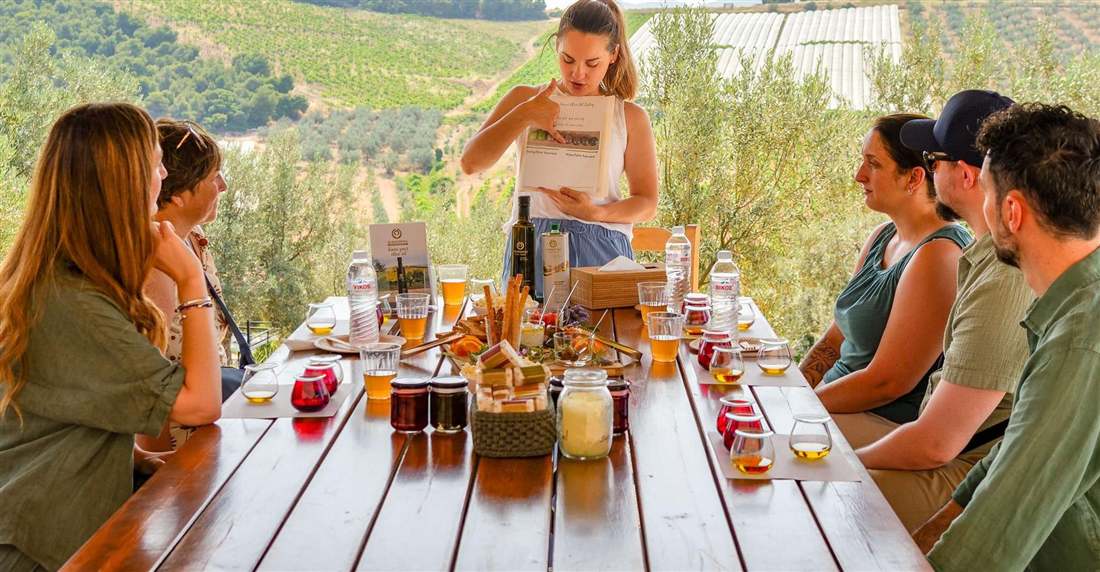
The olive oil tasting and food pairing on this Corinth food tour is a guided session on a family farm. It lasts 2 hours in a Greek olive grove. You taste the oil with an award-winning producer and sommelier.
The booking listing names this Corinth food tour as a guided tour for a small group. The tasting is held in English. The steps below come only from that listing. For the oil itself, read our Corinth olive oil tasting page.
- You visit a family farm in Corinth.
- The guided tasting takes place in a Greek olive grove.
- You taste olive oil with an award-winning producer and sommelier.
- You discover the aromas and flavours of the olive oil.
- You try food pairings that change how you taste olive oil.
Olive oil is the one product the listing names for tasting. The food arrives as pairings with that oil. The listing does not name the dishes on this Corinth food tour, so this page names none either.
The tasting covers three things named in the listing: aromas, flavours and food pairings. The listing says the pairings change how you taste olive oil. At 2 hours, this Corinth food tour is one third the length of the Ancient Corinth tour below.
How does the Ancient Corinth tour with traditional food work?
The Ancient Corinth tour with traditional food is a private Corinth food tour that lasts 6 hours. You explore the ancient city, see the Temple of Apollo and visit the Bema. The listing pairs the visit with traditional local food.
The tour runs for a private group, so only your own party takes part. Pickup is available, and the tour is held in English. The listing gives Kechries as the location and marks this Corinth food tour as a new activity.
The listing names four parts of the day on this Corinth food tour:
- Traditional local food, offered as a food option.
- The ancient city of Corinth.
- The Temple of Apollo.
- The Bema, where Apostle Paul is said to have stood trial.
The Temple of Apollo is one of the two sights the listing names. It was built in the early third quarter of the 6th century BC. The Bema is the other named sight.
The Bema links this Corinth food tour to the New Testament. Gallio presided over the trial of the Apostle Paul in Corinth in AD 51/52. Gallio was the brother of Seneca and served as proconsul of Achaia.
Paul first visited the city in AD 49 or 50, while Gallio held that post. He lived in Corinth for eighteen months, as the Acts of the Apostles records. Standing at the Bema on a Corinth food tour puts you at the spot that tradition links to his trial.
What happens at the farmhouse cooking day on a Corinth food tour?
The farmhouse cooking day on a Corinth food tour is a 2.5-hour cooking class in a farmhouse at Ancient Corinth. Guests learn to make traditional Greek dishes from fresh ingredients. They then eat the meal with unlimited local wine.
The booking card lists this Corinth food tour under Acrocorinth, the rock above the ancient city. The class is wheelchair accessible, and the card marks it as a new activity. One booking takes up to 15 people. Places are open to adults, youths aged 10 to 17 and children aged 9 and younger.
The card names these steps for the Corinth food tour day:
- Join the cooking class at the farmhouse.
- Work with fresh, farm-to-table ingredients.
- Make traditional Greek dishes by hand.
- Eat the meal with local wines under the Ancient Corinth sky.
Greek cuisine leans on oregano, mint, garlic, onion, dill, cumin and bay laurel leaves more than other Mediterranean cuisines. The card does not name the dishes for this Corinth food tour. It names handmade food, fresh ingredients and a meal with local wines as the core of the class.
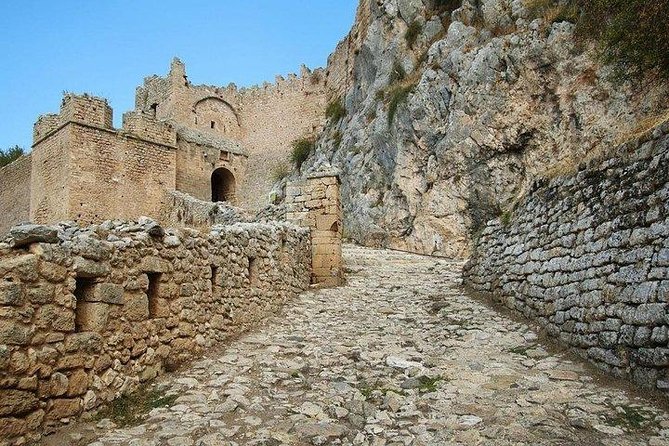
Acrocorinth means “Upper Corinth”, and it is a monolithic rock overlooking the ancient city. Its fortress commanded the Isthmus of Corinth. That role made it a last line of defence for southern Greece. You can add an Ancient Corinth tour to see the ruins below the rock before the Corinth food tour.
Three circuit walls defended the hill, and a temple to Aphrodite stood on its highest peak. People lived on the rock without a break from archaic times until the early 19th century. Today it ranks among the key medieval castle sites in Greece.
What is the seaside picnic on a Corinth food tour?
The seaside picnic on a Corinth food tour is a 2-hour private outing at a seaside spot in Corinth. Guests relax on linen blankets, taste authentic Greek bites and sip wine. They watch the sun dip into the sea.
The booking card title reads “Romantic picnic in Corinth by the sea”. It describes a curated picnic that awaits you at the spot. This Corinth food tour runs as a private group, so only your own party takes part. The card also tags it as a small group.
The card title points to couples. One booking for this Corinth food tour takes up to 6 people. Places are open to adults and to children aged 17 and younger.
Corinth town lies on the Gulf of Corinth, an inlet of the Ionian Sea. The gulf separates the Peloponnese from western mainland Greece. Loutraki, Kiato and Xylokastro also sit on its Corinthia shore. A seaside Corinth food tour in town looks out over this gulf.
In the Middle Ages, the gulf was known as the Gulf of Lepanto. Lepanto is the Italian form of Naupactus. The gulf is bounded in the east by the Isthmus of Corinth.
Fin whales and dolphins are known to enter the gulf at times. The card sets the Corinth food tour picnic right by the sea, so watch the water.
Which Corinthian foods do you taste on a Corinth food tour?
A Corinth food tour introduces the crops of Corinthia, a regional unit in the north-eastern Peloponnese. Its eastern coastlands are farmlands where olives, grapes, tomatoes and vegetables are cultivated. The port of Corinth exports local produce, mainly citrus fruits and grapes.
Agriculture is one of the main sources of income in Corinthia. Goods and services, manufacturing and tourism complete that list. Outside the eastern coastlands, the rest of Corinthia is mountainous. A Corinth food tour shows one side of this farming economy.
The crops behind a Corinth food tour also anchor the wider Greek kitchen. Wheat, olive oil and wine form the base of Greek cooking. Olive oil is its ancient, defining element, and the olives themselves are widely eaten. Fruit trees and citrus trees such as lemon, orange and bitter orange supply the nectar for Greek honey.
Greek cuisine lists these dishes and products made from the same crops. Each one helps a Corinth food tour guest match a crop to a Greek dish:
- Horiatiki salad: the village salad, built on tomatoes and olives with feta on top.
- Dolmades: stuffed grape leaves.
- Fasolakia: green beans simmered in olive oil, one of the ladera dishes.
- Portokalopita: orange cake with syrup.
- Moustokouloura: grape must cookies.
Why are currants named after Corinth on a Corinth food tour?
Currants are named after Corinth, the Greek harbour that was once their primary source of export. The name “raisins of Corinth” was recorded in the 15th century and gradually changed to currant. A Corinth food tour takes place in that harbour’s home region.
Zante currants are raisins of Black Corinth, a small, sweet, seedless grape cultivar of Vitis vinifera. They are not related to black, red or white currants, which are berries of Ribes shrubs. The fresh berries are very small, round and reddish black, with thin skin. For a Corinth food tour guest, a currant is a dried grape, not a berry.
The English name comes from the Anglo-French phrase “raisins de Corinthe”, meaning grapes of Corinth. In the 14th century, the raisins sold in the English market under the label Reysyns de Corauntz. The word Zante comes from the Ionian island of Zakynthos. That island was once the major producer and exporter.
The Zante currant is one of the oldest known raisins. Pliny the Elder made the first written record of the grape in the first century AD. He described a tiny, juicy, thin-skinned grape with small bunches. A millennium later, Venetian merchants traded the raisins with Greek producers from Ionian coasts.
By the 17th century, the currant trade shifted towards the Ionian islands, particularly Zakynthos. That shift gave the raisin its second name, Zante currant. A Corinth food tour explores the mainland region behind the older name.
Greece is still the primary producer of Zante currants, with about 80% of world production. California, South Africa and Australia also grow them. British cuisine has used currants as a key ingredient for centuries. They arrived from the Mediterranean as sweet luxury goods long before cane sugar became widely available.
How does Nemea wine fit a Corinth food tour?
Nemea wine fits a Corinth food tour because the Nemea zone lies in Corinthia, about 30 kilometres from Corinth. Its red wines come from the native Agiorgitiko grape. No red wine appellation in southern Greece outranks it.
Nemea holds protected status as an AOC wine zone. The zone lies next to the modern town of Nemea. The town sits at about 300 metres, in a plain basin ringed by mountains. Ancient Nemea lies in a smaller basin to the east, at about 360 metres. A Corinth food tour that heads inland to Nemea crosses this vineyard country.
Nemea ranks as the biggest vineyard in the Balkans. The town of Nemea serves as the hub for small villages that circle it. Its grape, Agiorgitiko, also grows across the Peloponnese, in Attica and in Macedonia. The name Agiorgitiko means St George’s grape. A Corinth food tour meets the grape in Nemea, where growers have traditionally planted it.
In Nemea, Agiorgitiko goes only into red wine, in dry and sweet styles. The wine shows a deep ruby colour, red fruit aromas and a sweet, spicy note. It tastes fruity, with notes of plum. The region’s Agiorgitiko wine carries the nickname Blood of Hercules. A Corinth food tour with a Nemea stop pours this red.
For a full day among the cellars, see our Corinth wine tasting page, which covers the wineries in depth.


Which sights pair with a Corinth food tour?
Three sights pair with a Corinth food tour. They are the Temple of Apollo at Ancient Corinth, the Acrocorinth citadel and the Corinth Canal. Each one adds a history stop between the wine and food tastings.
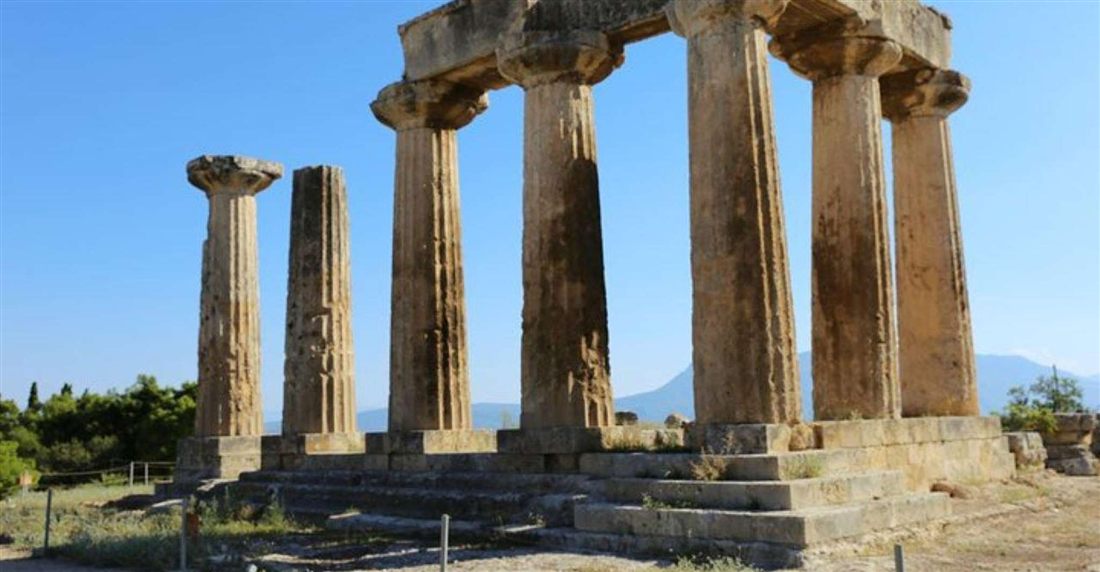
Ancient Corinth holds the temple, and Acrocorinth rises above the old city. The canal adds a modern sight to a Corinth food tour. Each sight below carries one or two facts to plan around.
- Temple of Apollo: Builders raised this Doric temple at Ancient Corinth in the mid-6th century BC. Of its 38 columns, 7 still stand.
- Acrocorinth: the fortified rock above the ruins, which the farmhouse cooking card lists as its location.
- Corinth Canal: The canal runs 6.4 kilometres, with a width of 24.6 metres at the waterline. It joins the Gulf of Corinth, on the Ionian Sea, with the Saronic Gulf, on the Aegean Sea.
The Temple of Apollo has been one of the only visible features of the site since antiquity. Builders set it on the ruins of an earlier temple. Excavations at Ancient Corinth have focused on the area around it. A Corinth food tour can stop here before or after a tasting.
The canal splits the Peloponnese from the rest of mainland Greece. Workers dug it 8 metres deep and finished it in the late 19th century, after eleven years of work. The channel narrows to 21.3 metres wide at the bottom. See our Corinth Canal tours page to add the canal to a Corinth food tour.
Where does a Corinth food tour start?
A Corinth food tour starts in the town of Corinth, the spa town of Loutraki or Athens, which lies about 78 kilometres to the east. A toll motorway and the Proastiakos suburban railway link the two cities.
The town of Corinth is the capital of the Corinthia regional unit in the Peloponnese. It stands on the coast of the Gulf of Corinth. The ruins of Ancient Corinth lie three kilometres south-west of the modern town. Guests who stay in the town start a Corinth food tour nearest to the ancient site.
Loutraki is a seaside resort town on the Gulf of Corinth. It lies 8 kilometres north-east of Corinth, and Athens is 81 kilometres to its east. The town is known for its natural springs and therapeutic spas. Its name comes from the Greek word loutro, which means bath. Loutraki sits north-west of the Corinth Canal, outside the Peloponnese.
One Corinth food tour starts in Loutraki. Its booking card lists a private trip of 5 hours, with pickup available. The day includes a guided visit to Ancient Corinth, the canal and an olive oil tasting at a local cooperative. The card files the trip under Kechries, a village in the municipality of Corinth.
Athens is the third start point for a Corinth food tour. The A8 toll motorway links Athens with Corinth and runs on to Patras. Proastiakos suburban trains serve the Corinth station at Examilia. Intercity buses also run between Corinth and Athens via the Isthmos station, south-east of the city centre.
How does a Corinth food tour from Athens work?
A Corinth food tour from Athens is a private day trip of 6 hours, with pickup available. It links the ancient city of Corinth and the canal with an olive oil mill. Guests learn how extra virgin olive oil is made.
The booking card for this Corinth food tour names four parts of the day:
- Pickup in Athens.
- A visit to the ancient city of Corinth.
- A stop at the Corinth Canal.
- An olive oil mill visit and an olive oil tasting.
The card also lists skip-the-line entry and wheelchair access. Skip-the-line entry means guests avoid the ticket queue. Wheelchair users can therefore join this Corinth food tour from Athens. The private format means the group travels without other guests.
The Athens trip runs one hour longer than the 5-hour tour from Loutraki. The card for this Corinth food tour gives no driving time from Athens. The suburban train needs about 55 minutes between Athens and Corinth. That line runs from Piraeus through central Athens to Kiato. Corinth station sits 5 minutes by car from the city centre.
Guests who want the waterway alone can compare this trip with our Corinth Canal day trip from Athens. Both trips start from the capital. A Corinth food tour from Athens adds the olive oil mill and its tasting to the canal stop.
When is the season for a Corinth food tour?
A Corinth food tour runs all year, as two of the four booking calendars list dates in all twelve months. Summers in Corinth are hot and dry. Autumn brings the grape and olive harvests, and winters are cool and rainy.
Corinth has a hot-summer Mediterranean climate, according to the nearby weather station at Velo. July is the hottest month, with an average of 28.7 °C. January is the coldest month, with an average of 9.1 °C. A Corinth food tour in July means farm visits in the full heat of summer.
Corinth receives about 463 mm of rain a year. Its average yearly temperature is 18.1 °C. In the Mediterranean climate zone of Greece, summer weather is mainly sunny and dry. Any summer rain falls as showers or thunderstorms. Winter brings the wet months, and snow melts fast when it falls.
Harvest time shapes the farm year. In the Mediterranean region, olives are harvested in the autumn, from October onwards. In the Northern Hemisphere, the main wine grape harvest runs from late August to early October. A Corinth food tour in early October falls inside both harvest windows.
The booking cards show where the open dates fall. Three of the four card calendars list open dates in every season, winter included. The fourth card lists open dates in October and November only. Every month of the year has at least one open Corinth food tour on these calendars.
Which kit and clothes suit a Corinth food tour?
Wear closed walking shoes and a sun hat on a Corinth food tour, and carry water and sun cream. Add a light layer for spring and autumn evenings, plus a bag for farm products. Send any dietary needs to the operator in advance.
A Corinth food tour mixes farm visits with walks across ancient ground. Farm tracks and old stone paths are uneven, with loose stones and dust underfoot. Pack the kit below for a full day outdoors.
- Closed walking shoes with a firm grip for uneven, stony ground
- A sun hat with a wide brim for time in open fields
- A refillable bottle of water for each person
- Sun cream, put on before you set out and again at midday
- A light layer, such as a thin jumper, for spring and autumn evenings
- A rain jacket for winter dates, when Corinth gets its rain
- A tote bag or cool bag for farm products you take home
In the summer months, drink water before you feel thirsty. Keep the hat on between stops in the open air. On a winter Corinth food tour, the rain jacket and a warm layer matter more than sun cream.
The four booking cards list no extra items to bring, and they state no dietary options. Food sits at the centre of every Corinth food tour, so dietary needs matter. Send any allergy, vegetarian, vegan or gluten-free need to the operator through the booking page. Do this before the day, so the operator has time to plan.
How do you book a Corinth food tour?
You book a Corinth food tour online through its booking card. Pick a date and the number of guests, then check the booking cut-off and the cancellation terms. Save the confirmation, note the meeting point and send any dietary needs.
- Open the booking card for the Corinth food tour you want.
- Pick a date, then enter the number of guests in each age group.
- Check the booking cut-off, which the card shows in hours.
- Read the cancellation terms before you pay.
- Save the confirmation and note the meeting point it gives.
- Message the operator with any dietary needs.
Five of the six cards say you must book at least 10 hours in advance. One card allows bookings up to 6 hours before the start. Cancellation terms do not differ, as all six cards list free cancellation. That makes the cut-off the main difference when you compare one Corinth food tour card with another.
The cut-off counts back from the start time. With a 10-hour cut-off, a morning start needs a booking by the night before. Late plans suit the card with the 6-hour cut-off.
None of the six cards lists dietary details. Message the operator through the booking page once your booking is confirmed. Name any allergies, vegetarian or vegan needs and foods you avoid.
One booking covers one outing only. If you also plan a Nemea day trip from Corinth, book it on its own card. Keep both confirmations in one place.
What do travellers ask about a Corinth food tour?
Can children join a Corinth food tour?
Yes, every Corinth food tour card accepts guests under 18. Three cards split guests by age. One sets the child band at 12 and younger. One counts anyone aged 17 and younger as a child. One adds a youth band for ages 10 to 17. The other three cards use one category for ages 99 and younger.
Which languages do Corinth food tour guides speak?
Five of the six cards list English as a guide language. Two of those five also list Greek. One card states no language. For that Corinth food tour, ask the operator through the booking page before you pay. Where a card offers both languages, pick one when you book. English and Greek are the only languages the cards name.
Can you cancel a Corinth food tour?
Yes, free cancellation appears on every card. No card states the cancellation deadline in hours before the start. Check the cancellation terms, shown on the booking page, before you pay. If the deadline is unclear, ask the operator through the booking page. Note the deadline in your calendar once you know it.
Is a Corinth food tour wheelchair accessible?
Two of the six cards state that the tour is wheelchair accessible. The other four cards say nothing about wheelchair access. Silence on a card is not a promise either way. Before you book one of those four, ask the operator through the booking page. Describe your access needs so the operator can answer in full.