
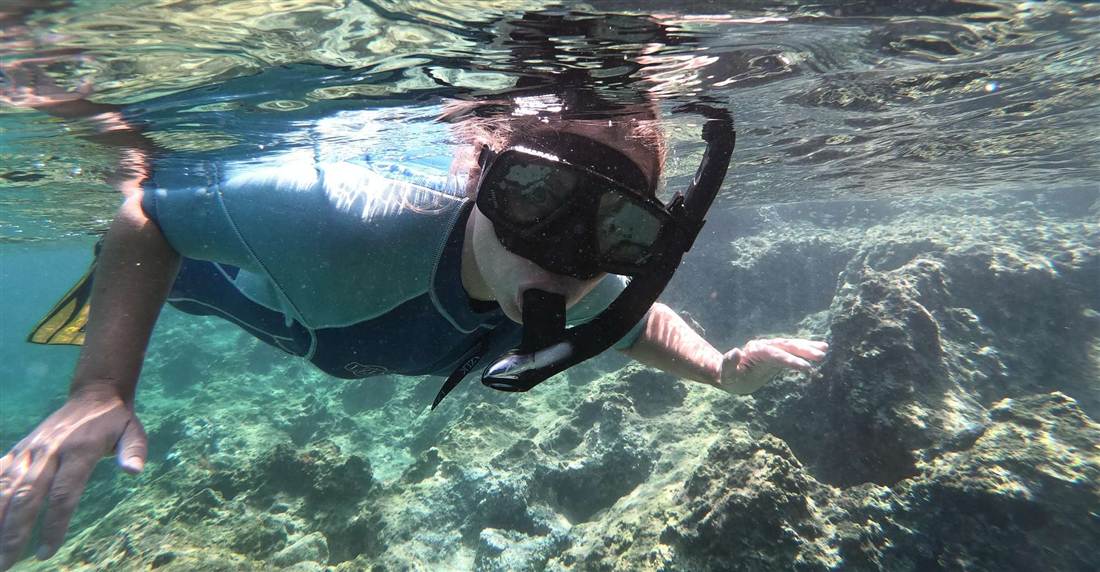
Sounion snorkeling takes you into the Aegean below the Temple of Poseidon, over rocky reefs at the southern tip of Attica. For more sea days, browse Greece Tours.
This page sets out the trips you can book, the spots, the sea life, the kit, the safety rules, the season and how to book.
What is Sounion snorkeling?
Sounion snorkeling is swimming face-down with a mask, snorkel and fins along the rocky coast of Cape Sounion. The cape sits at the southern tip of Attica. You breathe through the tube and watch the seabed below the Temple of Poseidon.
Cape Sounion is the promontory at the far south of the Attica peninsula, in Lavreotiki municipality, East Attica. The remains of the Temple of Poseidon stand on its headland, with the Aegean Sea on three sides. Sounion snorkeling takes you into that sea, along the foot of the cape.
Snorkeling means floating face-down at the surface while you breathe air through a shaped tube called a snorkel. A diving mask lets you see underwater, and swimfins push you along with little effort. You need none of the heavy gear or training that scuba diving asks for.
Here, the snorkel swim is part of a bigger plan. You join a shore swim, a coasteering session, a kayak day or a boat trip. Each format puts you in the water off the cape. Each one also gives the swim a different share of the day.
Which Sounion snorkeling trip can you book?
You can book four Sounion snorkeling trips on GetYourGuide. The list covers a shore snorkel with underwater photos and a coasteering adventure. It also covers a guided kayak day with lunch and a semi-private sunset tour with a swim.
Here is what each GetYourGuide card states about length, group, pickup and extras for its Sounion snorkeling day.
- Athenian Riviera: Shore Snorkeling with Underwater Photos: 3.5 hours in a small group, with underwater photos of your swim.
- Athens: Sounio Coasteering Adventure with Snorkeling: 3 hours of coasteering and snorkeling on the Sounio coast.
- From Athens: Cape Sounion Guided Kayaking Tour with Lunch: 3 to 8 hours. Pickup is available, and a guide and lunch come with the day. It is a GetYourGuide Original run by a certified partner.
- Semi-Private Cape Sounion Sunset Tour with Dinner Stop: 5 hours in a small group. Pickup is available, and the route adds a swim stop and a dinner stop.
Viator also lists a Private Cruise to Poseidon Temple at Sounio Cape with Snorkeling.
Pick by what you want from the day. Shore snorkeling suits you if the mask and fins are the main goal. Coasteering suits strong swimmers who want rock action before the snorkel. A kayak day trades swim time for paddling and a lunch.
The sunset tour is a sightseeing trip with one swim, not a full Sounion snorkeling session. Choose it if the evening view matters more than time in the water. The private cruise on Viator suits a group that wants a boat to itself.
How does the shore Sounion snorkeling and photo tour work?
The shore Sounion snorkeling and photo tour is a guided 3.5-hour swim that starts from the rocky coast, with no boat. A guide leads a small group over rocky underwater landscapes, and guests take home professional underwater photos of the swim.
GetYourGuide sells this trip as Athenian Riviera: Shore Snorkeling and Underwater Photos. The listing sits in its Sounion section. Shore Sounion snorkeling means you enter the sea from the coast itself. You swim out from land and back again, so the trip has no boat ride.
The trip runs as a small-group tour only. A guide leads the whole swim. On this Sounion snorkeling trip, the target is the rocky underwater landscape along the shore.
The listing promises professional underwater photos that you take home after the swim. You leave with pictures of your Sounion snorkeling session, even without your own waterproof camera.
The trip runs in five steps:
- Join your small group and your guide at the start.
- Enter the sea from the shore with the guide.
- Explore the rocky underwater landscapes along the coast.
- Pose for professional underwater photos during the swim.
- Swim back to shore and take your photos home.
What is coasteering with Sounion snorkeling?
Coasteering with Sounion snorkeling is a 3-hour guided trip along a 4 km stretch of rocky coast at Sounio. You swim, snorkel and scramble over rocks with certified guides, and you move along the shore on your own power, with no boat.
Coasteering means moving along the intertidal zone of a rocky coast on foot or by swimming. It uses no boats, surfboards or other craft. You travel through the impact zone, where waves, tides, wind, rocks, cliffs, gullies and caves meet. The word joins “coast” with “mountaineering”.
The sport has three parts. You swim in the sea, you climb and scramble over rock, and you jump into deep water. Coasteers use no ropes on the rock. Any climbing takes place above deep water, with safety spotters where needed. Wetsuits and buoyancy aids are part of the kit.
Guided coasteering began as a business on the cliffs of Pembrokeshire in Wales. It now runs as half-day or full-day trips for beginner, intermediate and advanced groups.
The Sounio trip on GetYourGuide is titled Athens: Sounio Coasteering Adventure with Snorkeling. It covers a 4 km stretch of coastline near Athens, and certified guides lead the group. The listing calls it an adrenaline-packed adventure and marks it as a new activity. Sounion snorkeling here comes between rock scrambles, not from a boat deck.
Can you kayak to Cape Sounion and go Sounion snorkeling?
Yes, you can. A guided sea kayak tour from Athens paddles along the coast to Cape Sounion. Lunch at a seaside restaurant follows. Its listing names no snorkel stops, so confirm Sounion snorkeling time with the operator first.
The trip is a GetYourGuide Original that starts from Athens. You paddle a sea kayak along the Athenian Riviera toward the cape, with a guide leading the group. Pickup is available, so you need no car to reach the start. The listing gives a length of 3 to 8 hours and states no distance.
The view is the reason to arrive by water. The Temple of Poseidon stands on the headland, high above your kayak. From sea level, you look up at its columns over the rocks. After the paddle, the group explores the temple, and the day ends with lunch by the sea.
If Sounion snorkeling is your main goal, ask whether the group stops in a cove for a swim. The listing confirms the pickup, the paddle, the temple visit and the lunch. It does not confirm any time in the water with a mask and snorkel.
Which Sounion snorkeling spots lie below the cape?
Sounion snorkeling spots sit on both sides of the cape. The bay just north-west of it and Legrena bay lie on the west side. Kato Sounio lies on the east side, toward Lavrio. Guided trips pick sheltered coves along these shores.
- Legrena bay: a small coastal village on National Road 91, west of Sounion, with an extensive beach. Shoals run along nearly the whole beach, so the water stays shallow close to shore.
- The bay north-west of the cape: a shore lined with summer villas. In ancient times, the fortress on the cape kept a shipshed for two warships on this north-western side.
- Kato Sounio: a small village of holiday homes, close to the edge of Sounio National Park. The cape lies between it and Legrena.
- The Lavrio coast: the shore runs north to Lavrio, 8 kilometres from the cape. The town sits on a bay facing the island of Makronisos.
Legrena sits on the shores of the Saronic Gulf. The Attic mainland gives this gulf partial shelter from the summer meltemi wind. That wind can reach Force 7 and above farther east, among the Aegean islands. Sounion snorkeling in the north-west bay also keeps the temple headland in view.
Rocky shores and sandy bays give two different swims. Rocky edges have ledges, cracks and boulders to follow at the surface. Sandy bays have a flat bottom and an easy walk-in start. For Sounion snorkeling, a cove with a sandy middle and rocky sides gives you both.
The open water off the tip of the cape has boat traffic and currents. That is why guided Sounion snorkeling trips stay inside sheltered coves, away from the exposed point. To see these coves from above, walk the hiking trails at Cape Sounion.
What marine life do you see on Sounion snorkeling?
Sounion snorkeling shows the shallow-water life of a rocky Mediterranean shore, over both bare rock and seagrass. Expect purple sea urchins, octopus, damselfish, ornate wrasse, white seabream, red sea stars, snakelocks anemones and meadows of Neptune grass.
Every species in this list lives in the Mediterranean Sea. During Sounion snorkeling, the seabed below you, rock or seagrass, shows which ones to look for.
- Neptune grass (Posidonia oceanica): a flowering seagrass found only in the Mediterranean Sea.
- Purple sea urchin: in shallow water, it digs holes into soft rock with its mouth and spines.
- Common octopus: it changes colour to blend in with its surroundings.
- Damselfish (Chromis chromis): the youngest fish shine bright blue, and adults turn dark brown.
- Ornate wrasse: at night, it buries itself in sand by shaking its tail.
- White seabream: this silvery fish feeds by day on algae, sea urchins and worms.
- Red sea star (Echinaster sepositus): this bright orange-red star has five slender arms.
- Snakelocks anemone: its green, purple-tipped tentacles carry venom.
On a Sounion snorkeling swim over rock, look for urchins in holes that fit them exactly. Octopus tuck into shelters among the rocks. Wrasse live in rocky areas with algae. Snakelocks anemones pick sunny spots, because the algae in their tissue need light. White seabream school over rock mixed with sand.
Over seagrass, young animals feed and shelter among the ribbon-like leaves, which work as a nursery. Damselfish gather in small shoals in midwater above both reefs and meadows. Red sea stars live on rock, sand and seagrass alike, so you can spot them anywhere on a Sounion snorkeling trip.
How clear is the water for Sounion snorkeling?
Water clarity for Sounion snorkeling depends on the particles floating in the sea. Calm days keep sand on the seabed. The Mediterranean also has low plankton growth from June to October, so calm summer mornings give a clear view.
Particles in the water scatter light and limit how far you see. Scientists call this cloudiness turbidity. Near the shore, waves and currents move sand and silt, so a windy day turns the view milky. Tiny floating algae, called phytoplankton, also cloud the sea as they grow. The Mediterranean has a spring bloom between March and April.
The eastern Mediterranean, which holds the Aegean, has the lowest plankton growth of the whole sea. Neptune grass grows 1 to 35 metres deep, depending on water clarity, and its leaves and upright stems reduce silt build-up. For lighter wind, start Sounion snorkeling in the morning, before afternoon sea breezes build as the land heats up.
Your mask holds a layer of air in front of your eyes, so you see clearly. To test the fit, press it on without the strap and breathe in gently through your nose. If it stays on, it seals. To stop fog before Sounion snorkeling, spread saliva on the dry glass and rinse it, or use an anti-fog liquid.
How does the Temple of Poseidon frame Sounion snorkeling?
The Temple of Poseidon frames Sounion snorkeling from the top of the cape. This Doric temple of white marble stands on a cliff about 60 metres above the sea. The Aegean surrounds the headland on three sides, so the ruins rise over the water.
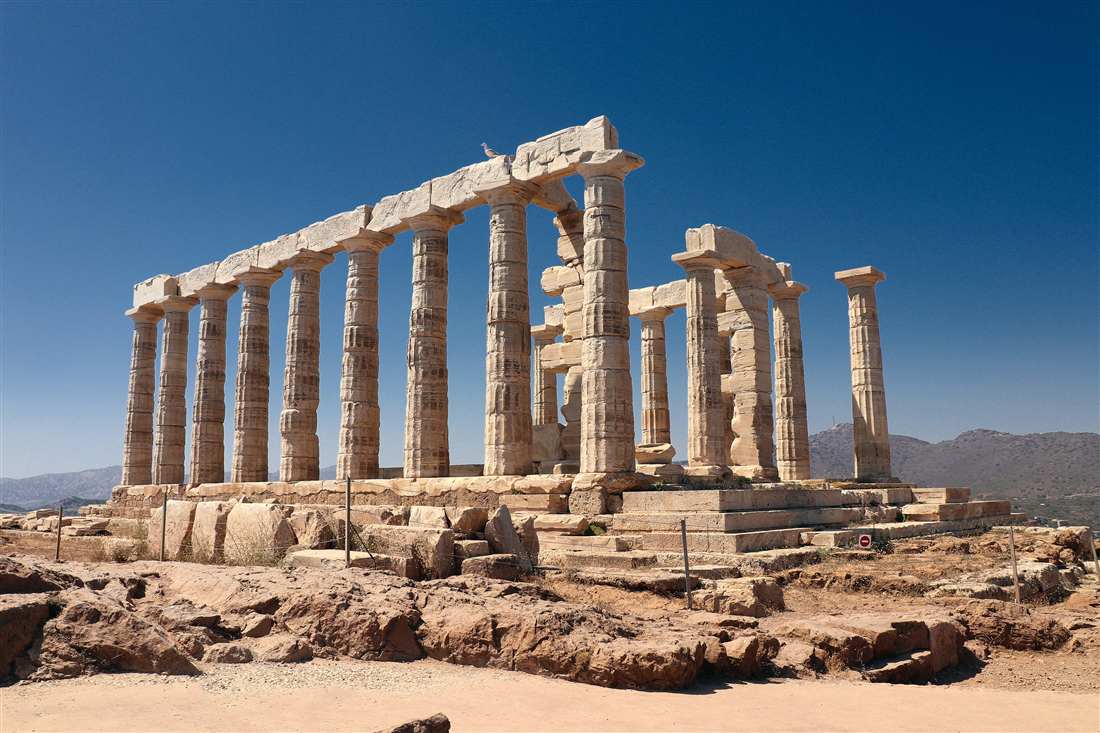
- It was built in the 5th century BC, in the time of Pericles.
- It stands on the ruins of an older Archaic temple.
- It ranks among the major monuments from the Golden Age of Athens.
- Of its 34 original columns, 15 still stand.
- Each column stands about 6 metres tall.
In Homer’s Odyssey, the cape is called “Holy Sounion, Cape of Athens.” The temple was easy to see for ships nearing Attica. The choice of site is tied to its view over the sea lanes to and from Piraeus. The Venetian name for the headland was Capo Colonne, the Cape of Columns, because its columns had stood since antiquity.
A Greek myth tells of King Aegeus of Athens. He saw his son Theseus sail home without the agreed white sail and believed his son was dead. In his grief he leapt into the waves, and the sea was named the Aegean after him. That is the sea you swim in on every Sounion snorkeling trip.
The name of the poet Lord Byron is carved into the base of one column. There is no direct proof that Byron cut it himself, though he made two recorded visits. Seen from the water, the temple sits high on the cliff edge against the open sky. Our page on the architecture of the Temple of Poseidon covers its design.
Can you pair Sounion snorkeling with sunset at the temple?
Yes, you can pair Sounion snorkeling with sunset at the temple on a day trip from Athens. Two GetYourGuide tours include a swim stop on the coast and reach the Temple of Poseidon for sunset over the Aegean. Both offer pickup.
The semi-private Cape Sounion sunset tour lasts 5 hours and runs as a small group. The day combines an optional swim, a dinner stop by the sea and the sunset at Cape Sounion. That swim is your window for a short Sounion snorkeling session. The tour lists a swim, not a guided snorkel.
The Athens Poseidon temple sunset tour with a beach stop runs 6 to 6.5 hours and lists free cancellation. A private option is also available. It has four stops:
- A photo stop at Lake Vouliagmeni
- A swim and a snack at a beach
- A visit to the ancient theatre of Thorikos
- The sunset at the Temple of Poseidon, which ends the day
The beach stop gives a Sounion snorkeling fan time in the water. Opening hours at the temple change by season, so check the official times before you book. Sunset at the temple has drawn visitors since modern tourism began in the early 19th century. Our page on the sunset at the Temple of Poseidon covers the evening view.
Which islands near Cape Sounion suit Sounion snorkeling?
Three islands sit within reach for Sounion snorkeling: Patroklos in the Saronic Gulf, Makronisos facing the port of Lavrio, and Kea farther out. All three need a boat. Patroklos is privately owned, and Makronisos is a protected historic monument.
Patroklos lies about 3 km from Sounion. It is also called Gaidouronisi, which means “donkey island”. It takes its name from Patroclus, a Ptolemaic admiral who built a fortified base there in ancient times. In the late Middle Ages, it was a notorious pirate haven. It is a small private island, so Sounion snorkeling there happens from a boat.
Makronisos faces the port of Lavrio. It is long, arid and rocky, about 13 km from north to south. Its ancient name, Macris, means “long”. It served as a place of exile and a military prison camp. Uninhabited today, it is a protected civil war monument, and its original buildings cannot be altered.
Kea is the Cycladic island closest to Attica, about 20 km from Cape Sounion. The ferry from Lavrio takes about one hour to its main port, Korissia. The wreck of the hospital ship Britannic lies in the Kea Channel at about 122 m, far below snorkel depth. Our Lavrio day trip from Athens page covers the ferry town.
Can you go Sounion snorkeling from a boat?
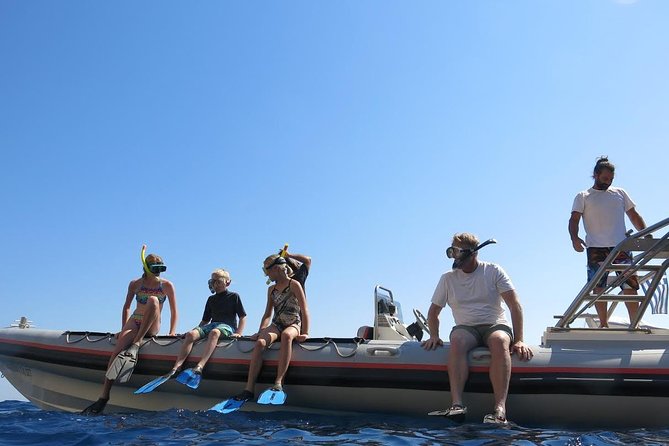
Yes. Sounion snorkeling from a boat means the skipper anchors in a sheltered cove, and you climb down the swim ladder into open water. You stay within sight of the boat and wear a bright cap or tow a surface marker.
Boat snorkeling skips the rocky entry from the shore, and the deck gives you a place to rest between swims. Passing boats spot a bright cap or a surface marker buoy from far off, so wear one on every swim. A Sounion snorkeling stop from a boat follows the same four steps:
- The skipper anchors in a sheltered cove, away from passing boat traffic.
- You fit your mask and fins on deck, then climb down the swim ladder at the stern.
- You swim with a buddy and keep the boat in view at all times.
- You return to the same ladder when the crew calls, and the crew counts heads before the boat moves on.
The spot where the boat drops anchor matters too. Anchors damage the Posidonia seagrass meadows on the Mediterranean seabed. Sounion snorkeling from a boat leaves a smaller mark when the skipper drops anchor clear of the seagrass.
Viator lists a trip called “Private Cruise to Poseidon Temple at Sounio Cape with Snorkeling”. Lavrio is a port town on a bay, about 60 km south-east of central Athens, and it overlooks Makronisos to the east. Our Lavrio yacht charter page covers private boats from that harbour for Sounion snorkeling days.


Which Athens Riviera spots pair with Sounion snorkeling?
Sounion snorkeling pairs well with Vouliagmeni, Varkiza, Lagonisi and Anavyssos. These four towns sit on the Athens Riviera, the coastal strip that runs from Piraeus to Sounio and Lavrio. Each one lies on the coast between Athens and the cape.
Vouliagmeni lies 18 km south of Athens city centre. Its name means “sunken” and comes from its small lake. The town’s beaches hold EU blue flags.
Varkiza sits 22 km south of central Athens and has a widely known beach. Lagonisi, 35 km north-west of Cape Sounion, means “island of the rabbit” after its rabbit-shaped peninsula. Anavyssos is a coastal resort known for water sports. With about 290 mm of rain a year, it is the driest area in mainland Greece.
The Athens Riviera starts about 16 km from downtown Athens, and Sounion forms its south-eastern endpoint. Of the four towns, Lagonisi and Anavyssos sit closest to the cape.
Three guided trips snorkel this stretch of coast, and each one adds a second sea day to Sounion snorkeling:
- Athens: Snorkeling Riviera Adventure, a 3-hour small-group trip based in Vouliagmeni.
- Athens Riviera Small-Group Snorkeling Tour, which lasts 3 to 4 hours.
- Athenian Riviera Sea-Cave Kayaking and Snorkeling Tour, a 2-hour paddle and swim.
Our Athens snorkeling page covers these Riviera trips in depth. This page keeps its focus on Sounion snorkeling at the cape itself.
How do you reach Cape Sounion for Sounion snorkeling?
Reach Sounion snorkeling trips by hire car, taxi or a tour pickup. Cape Sounion lies 69.5 km south-east of Athens, at the southern tip of Attica. The coastal road follows the Athens Riviera all the way down to the cape.
By car or taxi, take Greek National Road 91, the Athens to Sounion road. It runs along the coast past Varkiza and Anavyssos. The drive to Sounion snorkeling starts in the southern suburbs and ends at the headland.
Public transport covers part of the route. Tram line T6 runs from Syntagma towards Pikrodafni, and line T7 runs from Piraeus towards Voula. Bus line 122 runs from Argyroupoli Metro station to Saronida. Line 123 links Saronida, Anavyssos and Palaia Fokea. From there, a taxi or car covers the last stretch to the cape.
Pickup depends on the trip. The Cape Sounion guided kayaking tour from Athens lists pickup on its booking card. The cards for the shore snorkeling and photo trip and the Sounio coasteering trip do not list a pickup. For those two Sounion snorkeling trips, plan your own ride to the meeting point.
To build a full day out, see our Sounion day trip from Athens page. Then add Sounion snorkeling to the plan as the swim stop of the day.
What gear do you need for Sounion snorkeling?
Sounion snorkeling needs three core items: a mask that seals on your face, a snorkel for breathing and a pair of fins. Add sun cover, water shoes, reef-safe sun cream and a dry bag for the rocky Attica shore.
The kit lets you watch the seabed for long periods with little effort. Dive groups PADI and BSAC call built-in snorkel masks unsafe, since they are hard to clear if flooded. Pack these seven items for Sounion snorkeling:
- Mask: it traps an air space in front of your eyes, which lets them focus underwater.
- Snorkel: a bent tube with a mouthpiece lets you breathe while your mouth and nose stay underwater.
- Fins: human feet are too small to give much thrust, so fins push you through the water with less work.
- Rash guard or thin wetsuit: a rash guard blocks sunburn, and a wetsuit adds warmth in cooler water.
- Water shoes: they protect your soles when you walk in over rocks.
- Reef-safe sun cream: certain waterproof sun lotions damage the environment, so choose a reef-safe label.
- Dry bag: a sealed bag keeps your phone, keys and towel dry on the rocks or on a boat.
The GetYourGuide cards for the guided shore snorkeling trip and the Sounio coasteering trip do not list a gear kit. Neither card names a mask, fins, wetsuit or coasteering helmet. Ask the operator which items come with your Sounion snorkeling trip before you pack.
How safe is Sounion snorkeling?
Sounion snorkeling is safer with a buddy or a guide and close to the shore. Watch for boats, guard your feet against sea urchins and cover your skin from the sun. Drink water before you get in.
The British Sub-Aqua Club advises against snorkeling alone, so swim with a buddy, a guide or a tour group. The cape is a headland at the southern tip of Attica, open to wind and waves. On a guided Sounion snorkeling trip, follow the guide’s call on where and when to swim.
- Boats near the cape: jet skis and speed boats are the greatest danger to snorkelers. A driver sees little more than your tube, so wear bright colours or tow a dive flag on a float.
- Sea urchins: purple sea urchins live on rocks and boulders just below the low-water line throughout the Mediterranean. Their long, sharp spines are the reason to wear water shoes.
- Sun: your back, ankles and the backs of your thighs face the sun for long stretches. They can burn badly without you noticing, even slightly underwater.
- Water: drink before you get in, especially for a long swim. Good hydration also prevents cramps.
- Breath-holds: never breathe fast and hard before a dive down. It can lead to shallow water blackout.
If a swimmer gets hurt during Sounion snorkeling, call 112, the European emergency number. It works across Greece and the rest of the European Union, free of charge from mobile and landline phones.
Which skills help on Sounion snorkeling?
Sounion snorkeling calls for five simple skills: clearing the snorkel, clearing a flooded mask, equalising the ears, finning from the hips and practising in calm water first. The sport needs no special training, only basic swimming ability.
- Blast clear the snorkel: on return to the surface, give one sharp breath out to expel the water.
- Or use displacement clearing: tilt your head back just before the surface and breathe out until you break it.
- Clear a flooded mask: press the top of the mask to your face and breathe out through your nose.
- Equalise your ears as you dive down: pinch your nose, close your mouth and breathe out gently.
- Fin with straight legs and little knee bend, so the power comes from your hips.
Displacement clearing takes practice. A non-return drain valve at the bottom of the tube drains water as you breathe out. Such valves tend to fail when rarely used, so learn the blast method too. In a flooded mask, breathing out through the nose pushes water out along the bottom edge.
Diving down builds a pressure difference between the middle ear and the outside. Left unreleased, it can burst the eardrum. Do the Valsalva method gently on every Sounion snorkeling dive. The Toynbee method is to pinch your nose and swallow. If one method fails, switch to the other.
When you fin, bending the knees a lot, like riding a bicycle, wastes effort. Freediving courses start in confined water, such as a swimming pool. Practise each Sounion snorkeling skill first in calm water where you can stand.
What does the land around Sounion snorkeling protect?
The land behind Sounion snorkeling spots is a national park named after the cape at the southern tip of Attica. It lies in Lavreotiki, an ancient mining district. The Laurium silver mines there once helped pay for the Athenian fleet.
Greece lists the area among its national parks as Sounio National Woodland Park. The park has a protected core zone. A peripheral zone of 34.8 square kilometres surrounds that core. The park and Sounion snorkeling share one name, taken from the cape.
Sounion is part of the Lavreotiki municipality in East Attica. The municipality covers about 176 square kilometres at the south-eastern tip of the Attica peninsula. Its seat is the town of Lavrio. In ancient times, the territory of Sounion took in parts of the Laurium mines.
The earliest mining evidence at Laurium dates to the start of the Bronze Age. Systematic work began in the 6th century BC under Peisistratus. Slave labour mined the silver and lead. Early in the 5th century BC, miners struck a major silver vein. Themistocles persuaded the Athenians to spend the expected revenue on their fleet.
That silver grew the Athenian fleet to 200 triremes and laid the foundation of Athenian naval power. The silver went mainly into coinage. The mines were a chief source of state revenue.
Archaeologists have found more than 250 ore washeries in the same district as the Sounion snorkeling coast. The main mining centres were the villages of Lavrio and Thorikos.
When is the season for Sounion snorkeling?
Sounion snorkeling has its main season from late spring to early autumn, when the sea near Athens averages 19 to 27 °C. The shore snorkeling and coasteering cards on GetYourGuide list open dates in every month of the year.
The calendars on the cards show the open dates for each trip, so check your date before you plan the day. Shore trips and coasteering run on set days, and the kayak tour runs on its own calendar.
Water temperature sets the comfort level for Sounion snorkeling. Ten years of sea data for the coast near Athens show an April average of 16.1 °C. Late spring averages 19.1 °C, and June averages 23.1 °C. August is the warmest month at 26.7 °C. February is the coldest at 14.9 °C.
Athens has a hot-summer Mediterranean climate and has been called the hottest city in mainland Europe. The meltemi, a strong and dry north wind of the Aegean, blows from late spring to mid-September. It is at its strongest in the afternoon and can rise without warning in clear weather.
From June to October, the average sea temperature stays above 23 °C, so this is the warmest window for Sounion snorkeling. The meltemi overlaps with these warm months, so check the wind forecast before you book. Winter dates still appear on the calendars, yet water near 15 °C is cool for a long swim.
Who suits Sounion snorkeling?
Sounion snorkeling suits beginners, families and confident swimmers. The shore, coasteering, kayak and sunset trips each sell one adult ticket for ages 99 and younger. Their GetYourGuide booking cards carry no extra age notes or limits.
Snorkeling takes little effort, which makes shore snorkeling a gentle first step for beginners and families who have never tried it. A calm, shallow cove lets a first-timer stand up, rest and try again.
Pick the coasteering trip for Sounion snorkeling if you are fit and enjoy adventure. Pick the shore trip for a gentler swim that starts and ends at the water’s edge.
Confident swimmers have the full range of Sounion snorkeling trips to choose from. The widget cards show no swimming level or “not suitable for” list. Non-swimmers need to open the full card, read its details and ask the operator about flotation vests before booking.
Swimmers who want to go deeper can compare these trips with Athens scuba diving. Scuba divers train first and then go below the waves with breathing gear.
How do you take underwater photos on Sounion snorkeling?
On Sounion snorkeling, you take sharp underwater photos with a waterproof camera, a close subject and calm, shallow water. Water swallows red light first, so stay near the surface, keep the sun behind you and hold your body still.
One GetYourGuide shore trip is titled “Athenian Riviera: Shore Snorkeling & Underwater Photos”. Its card gives no further detail on cameras, photo files or delivery, so ask the guide what you receive.
On a Sounion snorkeling swim, the sea filters sunlight on its way down. Water absorbs the longer wavelengths, such as red and orange, very quickly. The deeper you go, the less red, orange and yellow remains, so scenes look blue-green even to the naked eye.
In shallow water, a custom white balance setting gives good colour without a flash. Natural light also suits upward shots of silhouettes and sun rays under the surface.
Follow these six habits on every swim:
- Carry a waterproof case or an action camera on a wrist strap, with a clean rubber seal.
- Shoot within arm’s reach of the subject, because water absorbs colour and light over distance.
- Keep the sun behind you, so it lights the fish and rocks in front.
- Shoot near the surface in shallow water, where colours stay strongest.
- Hold still and breathe slowly through the snorkel, so the frame does not blur.
- Rinse the camera, case and strap in fresh water after the swim to wash off salt.
Your Sounion snorkeling photos can also serve science. Biodiversity websites accept underwater photographs as records of species. Noting where you took each shot turns a holiday picture into usable data.
What rules protect the sea on Sounion snorkeling?
Sounion snorkeling follows four plain rules: look but do not touch, never stand on rocks covered in life, take nothing from the sea and never feed the fish. A Greek state office also oversees underwater antiquities and old shipwrecks in Greek waters.
During Sounion snorkeling, float flat and keep your fins clear of the bottom. One kick or one standing foot can crush the plants and animals living on the rocks. Leave shells, stones and creatures where you find them, and keep bread and snacks on land.
Neptune grass takes its name from Poseidon, the Greek god of the seas, whose temple stands above the cape. Its meadows are in decline across the Mediterranean. Where you see its green ribbons, swim above them and never pull them up.
The Ephorate of Underwater Antiquities, within the Greek Ministry of Culture, is responsible for underwater archaeology across Greece. It holds jurisdiction over every wreck of a ship or aircraft more than fifty years old. Its permission is needed for photography dives on structures such as shipwrecks. If you spot an old object on the seabed, leave it there.
What else pairs with Sounion snorkeling?
Sounion snorkeling pairs with four other sea trips in the Athens area. Pick a scuba dive at Sounio, a Riviera catamaran day, a Riviera morning cruise or a snorkel boat trip near Marathon. Each one lasts four to seven hours.
Sounion snorkeling covers one rocky cape at the south tip of Attica. The trips below add a dive at the same cape. They also reach Riviera bays and the sandy coast near Marathon.
- Scuba Diving and Temple of Poseidon Sounio (7 hours): a dive day from Athens with pickup. It visits rocky reefs, small caves and historic wreck sites, and suits beginners and experienced divers.
- Athens Riviera catamaran tour with fresh meal, beer and wine (5 hours): a cruise from Alimos with a swim in Asteras Bay. It also visits the island of Hydrousa and serves lunch on board.
- Athens Riviera premium morning cruise (5 hours): a traditional wooden boat with a Greek BBQ on board. Guests get unlimited drinks and a swim in turquoise water.
- Marathon Cape and Schinias Bay snorkeling trip (4 hours): a guided small-group speedboat trip from Nea Makri. It visits the bays of Marathon Cape and the sandy beaches of Schinias Bay.
A simple plan spreads the sea days out. Book Sounion snorkeling for one day, then keep a second day for a cruise or a dive. The Athens Riviera catamaran tour suits a slow day with lunch at sea. The Marathon trip gives a second snorkel on the east coast of Attica.
Where do you swim and eat after Sounion snorkeling?
After Sounion snorkeling, swim at the bay beside the cape or at Legrena beach to the west. Anavyssos and Lavrio add more coast. Eat at a seaside fish taverna, then stop at Lake Vouliagmeni on the drive back to Athens.
The cape sits between the villages of Kato Sounio and Legrena. Athenians keep summer homes around the bay northwest of the cape. Its shore is the closest swim after Sounion snorkeling. Legrena lies just west on the coast road, with a long beach on a bay of the same name.
Lavrio lies 8 km north of the cape. Up the Saronic coast to the north-west, the beach settlement of Paralia Anavyssou triples its population in summer. Seaside fish tavernas along this coast serve lunch after Sounion snorkeling.
Lake Vouliagmeni sits on the Riviera coast on the way back from Sounion snorkeling. Warm seawater flows in through flooded caves, and a freshwater spring makes it brackish. The water never drops below 18 °C and sits around 21 to 24 °C.
The lake has served as a spa since the late 19th century. It is a protected natural monument and home to the only known population of the sea anemone Paranemonia vouliagmeniensis. The Poseidon temple and Lake Vouliagmeni day tour joins the cape and the lake in one trip.
How do you book Sounion snorkeling?
Book Sounion snorkeling on a GetYourGuide card: pick the trip, set the date and group size, then confirm. Each of the four cards sets its own booking cut-off, from 4 to 10 hours before the start, and lists its own cancellation terms.
- Pick the trip: shore snorkel, coasteering, kayak day or sunset tour with an optional swim.
- Pick the date and the number of people on the card.
- Check the cut-off: 10 hours ahead for the shore snorkel and kayak day, 6 for the sunset tour and 4 for coasteering.
- Read the cancellation terms on the card before you pay.
- Save the confirmation and the meeting point.
- Check the sea forecast the day before.
Group size for Sounion snorkeling differs by card. The shore snorkel and the kayak day take up to 6 people per booking, the sunset tour 7 and coasteering 20. The shore snorkel and the sunset tour are small-group trips, and the sunset tour is semi-private.
What do travellers ask about Sounion snorkeling?
Which languages do Sounion snorkeling guides speak?
The sunset tour card lists English only. The shore snorkel, coasteering and kayak cards list English and Greek. If you need another language, message the operator through the booking page before you pay, and keep the reply with your confirmation.
What happens to Sounion snorkeling in rough sea?
The four cards do not state a weather policy for rough sea or strong wind, so check the card before booking. If the forecast for your date shows strong wind, contact the operator through your booking. Ask whether the trip still runs on that day or moves to a new date.
Can you cancel Sounion snorkeling?
Yes. All four cards list free cancellation. The card itself does not show the exact cancellation deadline, so open the full terms on the booking page before you pay. Keep your confirmation, because you cancel through that same booking. Cancel before the deadline in the terms to get your money back.