
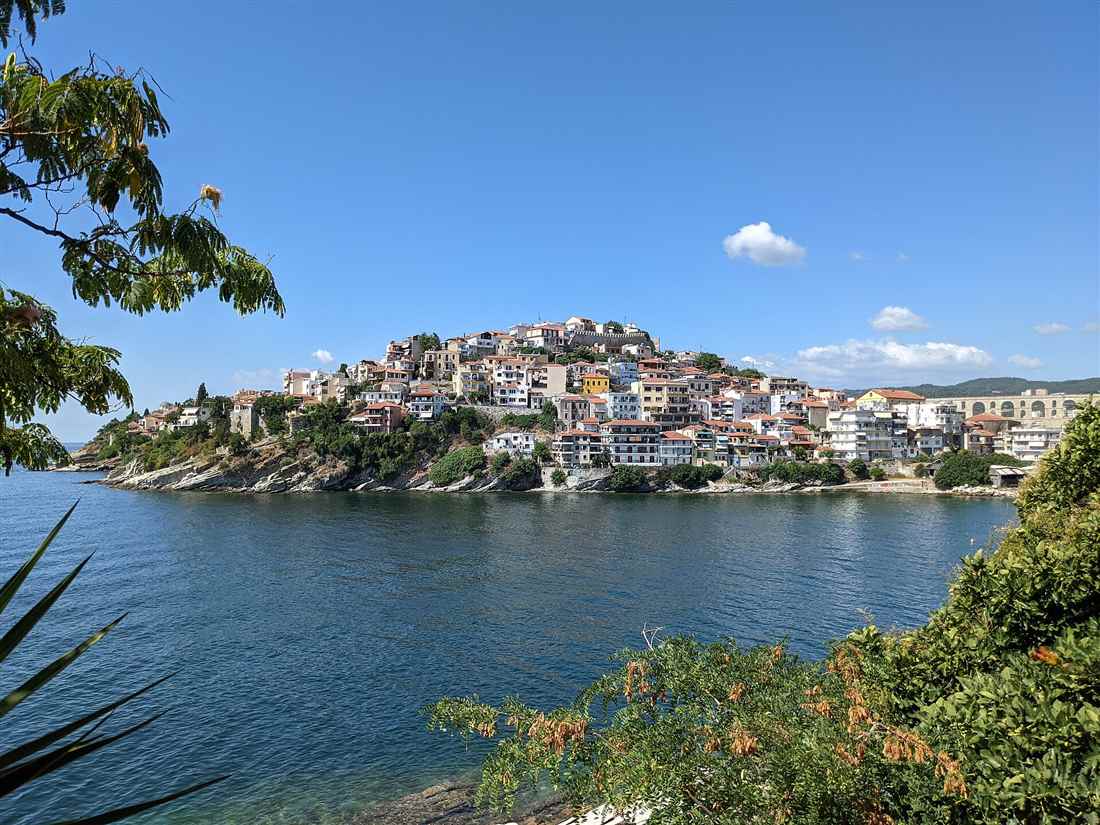
A Kavala photoshoot turns the old town on its peninsula, the Kamares arches and the harbour into a backdrop for holiday portraits. Photo sessions and tours in other cities sit on Greece Tours.
This page covers session types, the photo tour, the city and beach spots, Philippi, light, clothing, proposals, families, drones, rules and planning.
What is a Kavala photoshoot?
A Kavala photoshoot is a planned session with a professional photographer in Kavala, Greece. It covers spots such as the old town, the aqueduct, the castle, the harbour and the beaches. You receive edited photos after the session ends.
Kavala is a city in northern Greece and the principal seaport of eastern Macedonia. It sits on the Bay of Kavala, on the Aegean coast, facing the island of Thasos. In ancient times the city was called Neapolis, meaning “new city”. The Apostle Paul landed there on his first voyage to Europe.
Today Kavala is the capital of the Kavala regional unit. The town is built like an amphitheatre, with houses rising in tiers around the harbour and up the hills behind it. That layout gives a Kavala photoshoot a sea backdrop from the upper streets and a view of the slopes from the waterfront.
A Kavala photoshoot runs from a short walk-and-shoot through the old streets to a half-day session across the town. The photographer edits the images afterwards and sends them to you later. To fill the rest of your stay, see our list of things to do in Kavala.
Who books a Kavala photoshoot?
A Kavala photoshoot suits couples on holiday, honeymooners, people planning a proposal, families and solo travellers. Engaged couples book pre-wedding sessions, and cruise passengers book short shoots during their limited time ashore in the city’s port.
Each group comes with its own goal for the session. That goal shapes the route, the poses and the length of the shoot. Couples and solo travellers tend to want portraits, while groups want everyone in one frame. Here is what each one looks for:
- Couples on holiday: relaxed shots of the two of them together, with the town and the sea behind them.
- Honeymooners: a lasting record of their first trip as a married couple, in a setting they chose together.
- Proposals: a photographer who records the question and the reply as they happen.
- Families: one set of photos in which every member appears, including the parent who holds the phone.
- Solo travellers: clear, full-length photos of themselves instead of arm’s-length selfies.
- Pre-wedding sessions: engagement portraits for save-the-date cards or the wedding album.
- Cruise visitors: a short shoot that fits inside the hours their ship spends in port, with time left to get back on board.
The core service stays the same for every group. A Kavala photoshoot brings a photographer, a planned route and a set of edited images. What changes is the mood, the pace and the number of people in the frame. A solo portrait moves fast, while a group of six takes longer to arrange.
If your trip is based further west in Macedonia, a Thessaloniki photoshoot is the nearest city alternative. It offers the same kind of session in the second-largest city in Greece, on the Thermaic Gulf.
What does the Kavala evening snapshots tuk-tuk tour include?
The evening snapshots tour is a short Kavala photoshoot on wheels. GetYourGuide lists it as tour 998690, a 25-minute ride by eco-friendly tuk-tuk at sunset. It runs in small groups, with a private option, free cancellation and a 10-hour booking cut-off.
The listing now carries the title “Kavala: Aegean Sunset Photo Tour by Eco-Friendly Tuk-Tuk”. Its web address still reads “evening snapshots”, so both names point to the same product. Guests capture their own snapshots along the way, as the listing describes.
The card marks the tour as a small-group ride. A private option is also listed for guests who want the tuk-tuk to themselves. Free cancellation applies, and bookings close 10 hours before the start. For an evening ride, book on the morning of the day or earlier.
The cards do not name a start point, the exact route, the photo stops or the guide’s languages. Check those details in the booking step before you pay. A Kavala photoshoot by tuk-tuk gives quick city shots without a hired photographer. For the sightseeing side of these rides, read our Kavala tuk-tuk tour page.
How does a private Kavala photoshoot session work?
A private Kavala photoshoot commonly runs from first contact to delivery. You send a brief, agree a time and meeting point, then pose with guidance. Edited images arrive in an online gallery, with agreed usage rights. Common session lengths are 30, 60 or 120 minutes.
Holiday photographers follow a simple process from first message to final files. The steps below show the standard order for a booked Kavala photoshoot.
- First contact and brief: you send the date, the group size and the kind of shots you want. Photographers commonly ask for sample photos you like.
- Time and meeting point: both sides agree a start time and a clear meeting spot in town. A map pin avoids confusion on the day.
- Session length: 30 minutes gives a short set of portraits. 60 minutes adds a second location. 120 minutes allows a slower pace and more variety.
- Posing guidance: the photographer shows you where to stand, how to move and where to look. No modelling skill is needed.
- Edited gallery: the edited images arrive in a private online gallery for download. Galleries commonly stay online for a set period, so download the files early.
- Usage rights: personal use is commonly included. Commercial use, such as adverts, as a rule needs a separate licence.
Turnaround time for a Kavala photoshoot differs from one photographer to the next. Ask for a delivery date in writing before you pay a deposit. Ask too for the number of edited images in the package.
A Kavala photoshoot gallery holds finished, edited files. Unedited raw files are commonly not part of the deal. Read the usage terms before you share the images on a business account or in print.
Where do you shoot in Panagia for a Kavala photoshoot?
A Kavala photoshoot in Panagia uses the old town on its peninsula: colourful houses, winding cobbled lanes, the lead domes of the Imaret and open sea around the headland. Each lane gives a new backdrop within a short walk.
Panagia climbs the peninsula in a maze of cobblestone alleys. The houses wear bright colours, so a plain wall becomes a ready backdrop. Stand your subject one step away from the wall to soften shadows. Shoot down the lane, and the stones lead the eye straight to the person.
The Imaret is a long Ottoman Baroque complex on Poulidou Street. Muhammad Ali Pasha founded it as a gift to his home town. It now works as a hotel, so plan your Kavala photoshoot around its outside walls. Lead domes and repeated arches build a strong pattern behind a couple.
Seen from the sea side, the Imaret rises above old Byzantine walls. A low angle stacks the walls, the domes and the sky in one tall frame.
The headland juts south into the gulf, so the sea lies on three sides. Lanes on the east side catch the morning sun, and the west side takes the late light. Put the sun behind your camera for bright colours, or behind your subject for a soft rim of light.
Scout your corners first on a Kavala walking tour through the old town.
How do you photograph the Kamares aqueduct on a Kavala photoshoot?
On a Kavala photoshoot, frame the Kamares aqueduct three ways: a wide shot from the square at its foot, a portrait under one arch, and a long-lens view from a distance. Arrive early, before traffic fills the road beneath it.
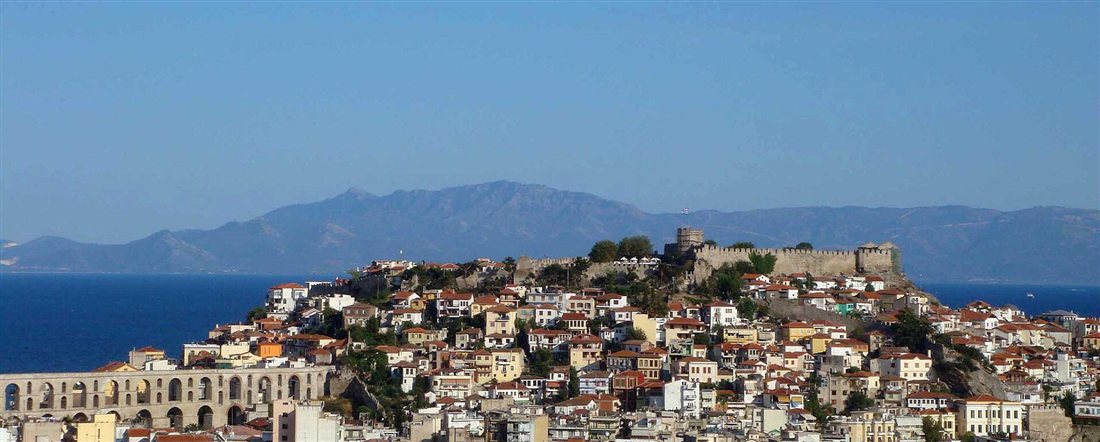
The Ottomans built the present aqueduct in the sixteenth century, under Suleiman the Magnificent. It rests on 18 heavy piers and reaches 25 metres at its highest point. Two rows of arches stack on top of each other, and in places there are three. It spans the low ground between the Panagia peninsula and the hills opposite.
The arches divide the historic quarter from the modern city, so one frame shows both sides of Kavala.
- Wide shot: stand in the square below and aim upward with a wide lens. Keep the full run of arches in frame and place your subject small at the base for scale.
- Portrait under an arch: place your subject inside one opening. The curved stone frames the person like a window.
- Long lens: walk back along the street and zoom in. The lens squeezes the arches into a tight wall of stone.
Cars pass under the arches through the day, so traffic crosses every frame. Start your Kavala photoshoot here early, while the street is quiet. Keep your subject on the pavement, never in the road, and pick a fast shutter when a car rolls through.
What views does Kavala castle give a Kavala photoshoot?
Kavala castle gives a Kavala photoshoot two kinds of frames: close shots of stone towers and walls, and wide views over the city, the harbour and the sea toward Thasos. The citadel sits at the highest point of Panagia.
The fortress began as a Byzantine citadel, and the Ottomans later extended it. Its walls and towers give a model a rough stone backdrop. Inside the walls stand the old arsenal and food stores, good for tighter detail frames. Place your subject beside a tower to show its scale.
From the top, the city spreads below like an amphitheatre, with houses stepping down to the water. A wide lens takes in the harbour and the Bay of Kavala, with the sea running toward Thasos. Keep your subject small in that frame, so the place tells the story.
For a Kavala photoshoot with tighter frames, switch to a medium telephoto lens. It stacks rooftops, boats and water into layers behind your subject. Use the line of the walls as a leading line toward the sea.
Check the site’s hours before you fix a session time. The castle is a monument with its own opening schedule.
Which harbour and waterfront spots suit a Kavala photoshoot?
A Kavala photoshoot on the waterfront has five strong spots. They are the fishing port, the promenade, the tobacco warehouses, the Mehmet Ali statue area and the marina. Each frames a different side of the port city.
Kavala is the main seaport of eastern Macedonia, and fishing was its traditional trade. Fishing boats and old tobacco warehouses still show the city’s working past to the camera.
From the quays, the Panagia peninsula and its castle rise above the water. Turn your subject so the castle sits over one shoulder. That links the harbour and the old town in one frame.
- Fishing port: moored fishing boats give candid portraits a working-harbour feel. Come in the early morning and shoot low across the hulls for colour and depth.
- Waterfront promenade: an open seafront path lets you shoot walking scenes with the sea alongside. Late afternoon suits couples on a stroll, walking toward the camera.
- Tobacco warehouses: the Municipal Tobacco Warehouse and other preserved interwar tobacco buildings add an industrial-heritage backdrop. Shoot in the morning or late afternoon for side light on the facades.
- Mehmet Ali statue area: the statue honours Mehmet Ali, the ruler of Egypt with roots in Kavala. Sculptor Konstantinos Dimitriadis made it, and Egypt donated it. Use a low angle against open sky in the morning.
- Marina: moored boats and masts frame evening portraits once the waterfront lights come on. Arrive at dusk to hold sky colour and lamps in one frame.
Split a Kavala photoshoot here into two slots. Shoot the port, warehouses and statue in the morning. Save the promenade and marina for late afternoon and dusk.
Which beaches near Kavala suit a Kavala photoshoot?
A Kavala photoshoot on the coast works at Rapsani, Kalamitsa and Batis on the city’s west side. Each spot gives sand and sea. Further out lie Nea Peramos and Ammolofoi, about 17 km southwest, where natural dunes back the shore.
Kavala is one of the rare Greek cities with four organised beaches inside its urban area. The Batis complex also runs a campsite and hosts concerts. With the centre so close, a session at Rapsani or Kalamitsa fits into a free hour.
Further west, the coast road passes Palio and Nea Iraklitsa before reaching Nea Peramos. This seaside town sits on the Bay of Eleftheres. On the hill above town stand the ruined walls and towers of Anaktoroupoli, a Byzantine fortress. They give a Kavala photoshoot a stone backdrop above the bay.
Ammolofoi starts where Nea Peramos ends and takes its name from those dunes. The beach runs for about 3 km of fine golden sand. Its waters have won Blue Flag awards again and again. Organised stretches have beach bars and water sports, so look for open sand between them for a clean frame.
Two more backdrops sit close to these beaches:
- Cape Vrasidas, the southern tip of Nea Peramos, named after the Spartan general Brasidas
- the Tower of Apollonia, a Byzantine watchtower a short drive west of Ammolofoi that is open to visitors
An evening Kavala photoshoot on the sand avoids the busy midday hours at organised beaches. Once swimmers leave, open sand and an empty sea fill the background. A light blanket helps with seated poses near the shore.
Can a Kavala photoshoot include Ancient Philippi?
Yes, a Kavala photoshoot can include Ancient Philippi, a UNESCO World Heritage Site about 13 km northwest of the city. Personal snapshots are allowed. A professional or commercial shoot needs a permit, so check with the site or the Ministry of Culture.
Thasian colonists founded the city as Crenides at the foot of Mount Lekani. Philip II of Macedon later renamed it Philippi. UNESCO listed the site for its Roman architecture and its role in early Christianity. Its town plan also mirrors Rome on a smaller scale. The Battle of Philippi was fought here too.
A Kavala photoshoot at Philippi can use three main backdrops:
- the ancient Greek theatre
- the Roman forum, once the public square of the city
- the early Christian basilicas, including the partly ruined Basilica B
Tripods and drones can need their own approval at Greek archaeological sites. Rules differ from site to site, so get any permission in writing before the shoot day. Keep to marked paths and never climb on the ruins for a pose.
For history between shots, a Kavala private tour adds a local guide to the day. The guide explains the theatre and the basilicas, which helps when captioning the photos later.
When is golden hour for a Kavala photoshoot?
Golden hour for a Kavala photoshoot falls in roughly the first hour after sunrise and the last hour before sunset. In June that means about 05:45 to 06:45 at dawn and 20:00 to 21:00 at dusk, local time.
Greece keeps Eastern European Summer Time (UTC+3) from the last Sunday of March to the last Sunday of October. Early July brings about 15 hours of daylight. These mid-month times for Kavala are rounded to the nearest quarter hour:
- April: sunrise 06:45, sunset 20:00
- Late spring: sunrise 06:00, sunset 20:30
- June: sunrise 05:45, sunset 21:00
- July: sunrise 06:00, sunset 20:45
- August: sunrise 06:30, sunset 20:15
- September: sunrise 07:00, sunset 19:30
- October: sunrise 07:30, sunset 18:45
After the clocks go back in late October, both times move one hour earlier. Golden hour is the time shortly after sunrise or before sunset, when daylight turns redder and softer. The sun sits low, so contrast drops and shadows look lighter. The warm tint lifts the colours of skin, clothes and stone. Its length shifts with season and latitude.
Blue hour comes just before sunrise and just after sunset, with the sun below the horizon. Its light is mostly blue and casts no sharp shadows. Plan each Kavala photoshoot frame by compass direction. East-facing walls, slopes and shorelines catch the first warm rays at dawn. West-facing ones hold the last glow at dusk.
Which season suits a Kavala photoshoot?
April, late spring and September give a Kavala photoshoot mild air, with average highs of 18 to 26°C. July and August peak above 30°C with hard midday light, while winter brings rain and about nine hours of daylight.
Kavala has a hot-summer Mediterranean climate. Its city weather station records average highs of 18.0°C in April and 22.9°C in late spring. March is the wettest month, with 68.2 mm of rain and the highest count of rainy days, at 11.6. Spring follows those wet months, so fields and hillsides stay green.
August, the driest month, averages 30.6°C with only 21.4 mm of rain over about three rainy days. Humidity stays moderate to high all year, and a soft haze can hang over distant views. The high midday sun casts hard shadows, so a summer Kavala photoshoot works at dawn or dusk. Peak holiday crowds fill busy spots by mid-morning.
Autumn brings softer light. September cools to an average high of 25.6°C, and the lower sun gives longer, gentler shadows through the day. An autumn Kavala photoshoot ends earlier, with sunset near 19:30. October highs fall to 19.9°C, and rain returns, with 64.7 mm over about seven rainy days.
Winter means short days and wet weather. December averages a high of 11.3°C, with 62.0 mm of rain over about nine rainy days. The sun sets before 17:00, so golden hour starts near 16:00. Snow is sporadic but arrives almost every year.
What do you wear for a Kavala photoshoot?
For a Kavala photoshoot, wear solid colours that stand out against stone walls and the blue sea. Pick light fabrics that move in the wind, skip busy patterns and logos, and bring comfortable shoes for cobbled lanes.
Photographers give the same advice for coastal shoots: solid colours read cleanly in photos. White, cream, terracotta, olive and deep blue sit well next to stone and water. Small busy patterns can turn into a wavy shimmer on camera. Logos pull the eye away from faces, so leave them at home.
Wind turns a flowing dress or a loose linen shirt into soft movement during a Kavala photoshoot. Linen creases, but the creases read as relaxed rather than messy. For groups, choose matching tones rather than identical outfits. A shared palette of two or three colours looks planned without looking like a uniform.
Old-town cobbles and stairs are hard on new shoes. Walk between spots in flat, comfortable pairs, then change shoes for the shots. Keep the spare pair in a small bag out of the frame. Pack a light jacket or shawl for the evening breeze. Bring sunscreen, a hat and water, and rest in the shade between sets.
What props and ideas work for a Kavala photoshoot?
Simple props work for a Kavala photoshoot: fresh flowers, a picnic blanket on the beach, local produce from the market and a paper map on the castle walls. Add walking shots in old-town lanes, a sunset silhouette and slow-shutter harbour lights.
- Flowers: a small bunch gives hands a job and adds one bright colour. Hold it at waist height so faces stay clear. Choose sturdy stems that cope with heat.
- Picnic blanket: spread a plain one on the sand for relaxed sitting shots. Weigh the corners down so the wind keeps it flat.
- Market produce: hold seasonal fruit or fresh bread for colourful close-ups. Keep pieces whole so they look fresh, then eat them later.
- Paper map: unfold it on the castle walls and point at the view. It tells a travel story without words.
- Vintage scooter or tuk-tuk: use one as a backdrop only with the owner’s consent and where stopping is legal. Do not ride it for the shot.
Movement shots feel natural on a Kavala photoshoot. Walk slowly through old-town lanes, hold hands and talk to each other. Glance down at the path or at your partner, not at the lens. The photographer shoots a burst, and the relaxed frames come from the moments between poses.
For a sunset silhouette, stand against the bright sky in a clear profile. After dark, a tripod and a slow shutter turn harbour lights into soft streaks. Stay still for two or three seconds per frame. Pick three or four ideas in total. A short list keeps a Kavala photoshoot calm and gives each idea time.
How does a proposal Kavala photoshoot work?
A proposal Kavala photoshoot works as a planned surprise. The photographer poses as a tourist or waits at a distance. You agree on a spot and a signal in advance, and the camera starts the moment you kneel.
Before the day, the photographer scouts the location, with you or alone. You pick the exact place to stand, the angle and the light. The signal is small, like touching your hat or checking your phone. Your partner sees nothing unusual, just another visitor with a camera.
Position matters as much as timing. Stand so your partner faces the camera, not the view. The photographer uses a long lens, so the shots stay close even from far away. A quick text before you walk up confirms everything is ready.
Golden hour is the common choice for proposals. It brings soft, warm light in the hour before sunset. Quiet spots keep the moment private, such as the castle walls, an old-town lane or a beach at sunset. A back-up plan covers strong wind or sudden crowds, with a second spot agreed beforehand.
After the yes, the Kavala photoshoot turns into a relaxed couple session. The photographer steps out and walks over to say hello. You get close-ups of the ring, the hug and the first laughs. Then come calm portraits while the golden light lasts.
How does a family Kavala photoshoot work?
A family Kavala photoshoot runs short and stays playful. Sessions with small children stay brief and fit around naps and the midday heat. Games, walks and hugs replace stiff poses, so the photos look relaxed and natural.
Small children tire quickly, so the photographer works fast and saves the key shots for the start. Book the slot after a nap, not just before one. In summer, early morning or late afternoon avoids the strongest sun. Pack snacks and water, because a hungry child rarely smiles for the camera.
Instead of lining everyone up, the Kavala photoshoot runs on small games. Children race into a parent’s arms, swing between two hands or play tag. Walking shots work well too: the family strolls hand in hand while the camera follows. On hot days, shaded spots under trees or beside old walls keep faces soft and eyes open.
Tell older children the shoot is a walk with games, not a photo session. Skip “say cheese”; real laughs come from jokes, tickles and silly sounds. Parents who relax get the warmest pictures, because children copy their mood.
A flat waterfront route suits families with a stroller. It keeps the walk easy and gives a sleepy baby a place to nap.
Grandparents and multi-generation groups need a clear order. The photographer takes the full group photo early, while everyone is fresh. A bench or low wall gives older relatives a seat. Then the Kavala photoshoot splits into smaller sets: grandparents with grandchildren, siblings together and each couple alone.
Can you fly a drone on a Kavala photoshoot?
Yes, a drone can join a Kavala photoshoot if the pilot follows EU drone rules. That means operator registration, an online pilot certificate, no flights over crowds and no flights in restricted zones. Check the current rules before every flight.
Greece follows the same drone rules as the rest of the European Union. The European Union Aviation Safety Agency (EASA) sorts flights into categories by risk. The open category covers low-risk flights. The specific category covers medium-risk flights that need an authorisation. Each member state handles registration through its own aviation authority.
In Greece, that body is the Hellenic Civil Aviation Authority (HCAA). The main steps for a drone pilot on a Kavala photoshoot are:
- Register as an operator with the HCAA if the drone weighs over 250 g or carries a camera.
- Pass the online A1/A3 training and test for the drone pilot certificate.
- Never fly over crowds, such as a busy beach or an open-air market.
- Stay out of restricted zones near airports.
Kavala International Airport “Alexander the Great” lies near Chrysoupoli, east of the city, in the municipality of Nestos. Look up the restricted zone around it before takeoff. Archaeological sites need permission from the authorities before any drone flight. Drone rules change, so check the EASA drone rules and the HCAA website before the trip.
What rules apply to photographing people and places on a Kavala photoshoot?
A Kavala photoshoot follows simple courtesy rules. Ask strangers before they appear clearly in shots, and ask before shooting inside churches. Ask shop owners too, and obey no-photo signs at military or port areas. This is general guidance, not legal advice.
The EU General Data Protection Regulation (GDPR) protects personal data. That means information about an identified or identifiable person. A photo where a stranger’s face is easy to recognise can count as personal data. The rules do not cover private people taking photos for purely personal use. A paid shoot has a commercial link, so consent matters.
Under GDPR, consent has to be freely given, specific and clear. The person can withdraw it at any time, and withdrawing must be as easy as giving it. On a Kavala photoshoot, ask the person before the shot rather than after it. When a person says no, frame the shot without them.
Churches and monasteries in and around Kavala are working places of worship. Ask the priest or caretaker before taking photos inside. During a service, keep the camera down and wait until it ends. Private homes, courtyards and shops belong to their owners, so ask before shooting there. The same goes for cafés and tavernas.
Where a sign at a military site or port security area bans photos, put every camera and phone away. On busy pavements, keep a tripod close to a wall and fold it away between shots. That leaves room for walkers and shop doors.
How do you choose a photographer for a Kavala photoshoot?
Pick a photographer for a Kavala photoshoot by their Kavala portfolio, editing style and written agreement. Then confirm languages, weather backup, travel fees, independent reviews and the deposit and cancellation terms. Check every point before you book.
- A portfolio with full sessions shot in Kavala, not only in other cities.
- An editing style you like, from natural colour to bright or film-look tones.
- The languages the photographer speaks, so directions during the session are clear.
- A written agreement on session length, number of edited photos, delivery time and usage rights.
- A backup plan for bad weather, such as a new date.
- The travel fee to beaches outside the city or to the ancient site of Philippi.
- Reviews on independent platforms, not only on the photographer’s own website.
- A deposit and a cancellation policy, both written down before you pay.
Greek business directories and wedding-photographer marketplaces list local photographers in Kavala. Use them to build a shortlist of three names. Send each one the same questions in writing, so the answers are easy to compare side by side.
Ask each photographer for one full gallery from a past Kavala photoshoot, not a highlights reel. A full gallery shows how they work with light and faces across a whole session, from the first frame to the last.
Usage rights matter if you plan to print the photos or post them online. The agreement for your Kavala photoshoot states who owns the files and where you can share them. Ask whether the photographer can reuse your images in their own portfolio.
How do you get to Kavala for a Kavala photoshoot?
Reach Kavala for a Kavala photoshoot by air, road, bus or sea. Kavala International Airport “Alexander the Great” lies 27 km from the city. The Egnatia Odos motorway links Kavala to Thessaloniki, 160 km to the west.
The airport’s IATA code is KVA, and scheduled flights link it with Athens. Book Kavala airport transfers to reach the city or your session location without a rental car.
By car, Kavala is about a one-and-a-half-hour drive from Thessaloniki. The A2 motorway, also called the Egnatia Odos, passes north of the city. It runs 670 km across northern Greece, from the port of Igoumenitsa to the Turkish border at Kipoi.
KTEL intercity buses link Kavala with Athens and Thessaloniki on regular routes. If you are staying in Thessaloniki, a Kavala day trip from Thessaloniki covers the journey there and back in one day.
Kavala sits on the Bay of Kavala, across from the island of Thasos. Ferries leave the port for Skala Prinou on Thasos, 20 km south of Thasos town. Other lines serve the North Aegean islands. Cruise ships berth inside the city, so passengers can walk straight into town for a Kavala photoshoot.
How do you plan a Kavala photoshoot day?
Plan a Kavala photoshoot day around the morning and evening light. Start with old-town coffee, shoot at golden hour, eat lunch by the harbour, then take an afternoon visit. Finish with an evening session at the castle or on the beach.
- Morning coffee in the old town, to settle in before the camera comes out.
- The first shoot at golden hour, in the soft light after sunrise.
- Lunch at the harbour, with time to rest and review the first shots.
- An afternoon visit, kept short so energy lasts until sunset.
- An evening shoot at the castle or on the beach as the sun goes down.
Treat this timeline as a suggestion and leave buffer time between each stage. Sea wind can lift hair and loose fabric, so spare time lets you wait for a calm spell. Crowds at popular viewpoints can also slow the shot list. A loose plan keeps the session relaxed.
Keep phones fully charged for behind-the-scenes clips. A friend can film short videos while the photographer works, which gives you a second record of the day. Pack a power bank, because the evening session comes last.
The harbour lunch slot pairs well with a tasting. A Kavala food tour fills the gap between the morning and evening light. It also gives everyone a rest before the final session.
Which questions do travellers ask about a Kavala photoshoot?
How long does a Kavala photoshoot take?
Each private photographer sets its own session length, so the answer depends on the package you choose. Ask whether the time covers travel between locations and outfit changes. Confirm the start time, the end time and any overtime terms in writing. Then plan the rest of your day around those fixed hours.
How large is the photo set from a Kavala photoshoot?
The number of edited photos depends on the photographer. Each one sets its own terms for the final count, the editing style and the delivery format. Ask whether you receive an online gallery or a download link. Get the photo count, the delivery date and the usage rights confirmed in writing before you pay.
What happens if it rains on a Kavala photoshoot day?
Each private photographer sets its own weather policy. Common options are moving the session to another day or shifting to a covered spot. Check the forecast the day before and keep in touch with your photographer. Confirm the rain plan in writing, including any rescheduling window, when you book the session.
Do you need to book a Kavala photoshoot in advance?
Yes. The GetYourGuide Aegean sunset photo tour by eco-friendly tuk-tuk must be booked at least 10 hours in advance. Its card lists free cancellation, a small group format and a private option. Private photographers set their own booking windows, so contact them early and confirm the date in writing.