
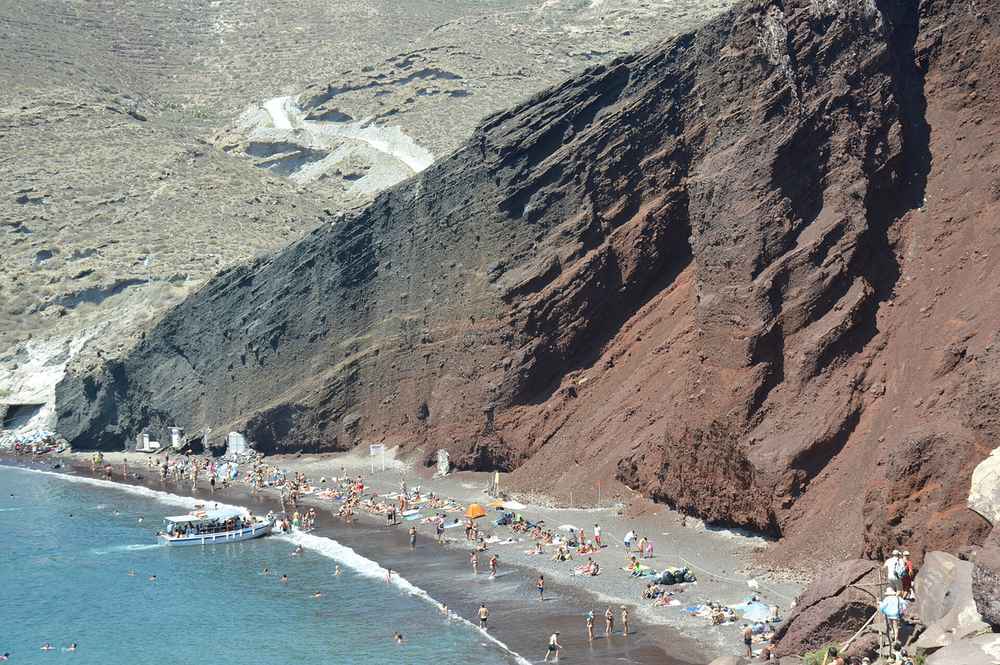
Santorini beaches are volcanic and dramatic rather than golden sand, led by the black sand of Perissa and Kamari, the famous Red Beach beneath rust-coloured cliffs, and the white moonscape of Vlychada. This guide covers the best beaches, what makes each special, which to pick and how to get to them.
The island’s beaches are a striking part of the wider Santorini travel guide. They line the gentler south and east coasts. The sections below cover where to swim.
What are Santorini’s beaches like?
Santorini’s beaches are volcanic, with black, red and white sand and pebbles rather than pale gold. The main beaches lie on the south and east coasts, away from the caldera cliffs, valued for their dramatic scenery and warm, clear water.
Santorini’s beaches are like nowhere else in Greece. The island is a volcano, so its shores are coloured black, red and grey by lava and ash, lined with dark sand and smooth pebbles instead of soft golden sand. The caldera side is a sheer cliff with no beaches, so the swimming is on the gentler south and east coasts. These beaches reward visitors with a unique, almost lunar beauty and warm, clear water rather than classic sand, and the main ones are well organised with sunbeds, watersports and tavernas, set within the wider things to do in Santorini. The black-sand beaches lead the way.
The colour comes straight from the volcano. Where other Cycladic islands built their beaches from pale quartz, Santorini built its shores from black lava grit, red-brown scoria and grey ash, so the sand ranges from charcoal to rust to bone-white depending on the cove. This volcanic origin explains why the water deepens quickly at pebbly stretches, why the sand stores heat through the afternoon, and why each beach carries a different colour and texture rather than one uniform gold.
What are Perissa and Kamari like?
Perissa and Kamari are Santorini’s two main black volcanic beaches, on the coast either side of the Mesa Vouno headland. Both are long, organised stretches of sand and pebbles with sunbeds, watersports and tavernas; Perissa’s sand is softer underfoot.
Perissa and Kamari are the island’s classic beach resorts. They lie back to back beneath the rocky headland of Mesa Vouno, crowned by the ruins of Ancient Thera, and both offer long sweeps of black volcanic sand and pebbles, warm shallow water and full facilities, from sunbeds and umbrellas to watersports and a strip of restaurants and bars behind. Perissa beach, with its smaller, smoother pebbles, is gentler underfoot and continues into lively Perivolos, while Kamari beach is more compact and polished, with a pretty promenade and one of the island’s best evening scenes. The black sand gets very hot, so footwear and a mat help, set out alongside the guide to Santorini’s villages. The Red Beach is the most photographed.
The Mesa Vouno headland is the pivot between the two. Perissa sits on its southern flank and Kamari on its northern side, so a short drive or a footpath over the ridge connects them, with the archaeological site of Ancient Thera perched on the rock between. Perissa runs longer and flatter, blending seamlessly into Perivolos, which suits a slow day drifting between sunbeds and beach bars. Kamari packs its tavernas, cafes and shops onto a tidy paved promenade, so an evening stroll after swimming feels closer to a resort town than an open stretch of coast.
What is Perissa Beach like?
Perissa is a long black-sand beach on the south-east coast, at the foot of Mesa Vouno. The soft, dark volcanic grit is fully organised with sunbeds, watersports and tavernas, and continues without a break into the Perivolos strip.
Perissa is the choice for a relaxed, roomy beach day. The dark sand here is finer and softer than the coarse pebbles of many Santorini coves, so it feels gentler underfoot even though it heats up fast in the sun. Sunbeds and umbrellas line the front, watersports operators run jet skis and paddleboards off the shallows, and a wall of tavernas and cafes sits just behind the sand for lunch or a cold drink. The beach flows straight into Perivolos beach, where the mood shifts toward chic beach bars and music as the afternoon goes on.
What is Kamari Beach like?
Kamari is a black-pebble and sand beach on the east coast, on the north side of Mesa Vouno. It is known for its long paved promenade backed by tavernas, cafes and shops, organised sunbeds and watersports, and a lively evening scene under the headland.
Kamari trades a little of Perissa’s raw space for polish and convenience. The seafront runs along a paved promenade rather than open sand, lined with restaurants, cafes, gelato stands and shops, which makes it easy to combine swimming with an evening out. The beach itself is dark grey pebbles and coarse sand, organised with rows of sunbeds and umbrellas and watersports on the water, and the towering bulk of Mesa Vouno gives it a dramatic backdrop. After dark the promenade fills with diners and strollers, giving Kamari one of the most sociable atmospheres of any beach on the island.
What is Vlychada Beach like?
Vlychada is a quiet grey-sand beach on the south coast, backed by tall white cliffs that wind has carved into smooth, lunar curves. It feels more natural than Perissa or Kamari, has a marina alongside, and draws visitors for its surreal scenery.
Vlychada is where Santorini’s beaches turn strange and beautiful. Pale volcanic cliffs rise directly behind the grey sand, sculpted by the wind into rippling, moon-like folds that make the whole beach look like a natural sculpture park. It stays quieter and more low-key than the big resort beaches, with fewer facilities and a more natural feel, though a marina sits at one end and a handful of tavernas serve the shore. Swimmers get the same warm, clear water as the rest of the south coast, framed by scenery that has no equal on the island. The relaxed pace and dramatic cliffs make Vlychada a favourite for a slower afternoon away from the busier resort strips.
What is the Red Beach?
The Red Beach is Santorini’s most famous beach, a small cove of dark sand framed by towering red cliffs near Akrotiri. The cliffs are unstable and the access path is closed for safety after rockfalls, so most admire it from a viewpoint or boat.
The Red Beach is the image most people picture of Santorini’s shores. It is tucked beneath sheer, rust-red cliffs near the Akrotiri archaeological site in the south-west, and the blend of red cliffs, dark sand and turquoise sea is genuinely spectacular. The soft cliffs above are prone to rockfall, and the official footpath has been closed for safety after rocks fell onto visitors, so the safest choice is to view the beach from the marked viewpoint at the top or to see it from the water on a boat trip. Nearby White Beach and the Black Beach of Mesa Pigadia are also best reached by boat, set out alongside the guide to Akrotiri. Vlychada offers a quieter, surreal alternative.
Which Santorini beach is best for families?
Monolithos is the most family-friendly beach on Santorini, with calm, shallow water, dark soft sand and a children’s playground on the east coast. Kamari also suits families, thanks to its organised sunbeds, gentle entry, tavernas and long paved promenade.
Monolithos beach is built for young children. The water stays shallow a long way out, the entry is gentle, and a playground sits right behind the sand, so parents can combine swimming with dry-land play without moving on. It is calmer and less crowded than the big resort beaches, and tavernas nearby handle lunch and snacks. Kamari is the second family pick: its sunbeds, easy entry, watersports and paved promenade make a full day simple to organise, and the flat seafront is easy to walk with a pushchair once the sun drops.
Are Santorini beaches good for swimming and watersports?
Yes. Santorini’s south and east beaches have warm, clear water and organised sections with sunbeds and watersports such as jet skis and paddleboards. The dark volcanic sand heats up strongly, so water shoes and a mat make the walk comfortable.
Swimming is a genuine pleasure on the organised beaches. The water is warm and clear along the south-east coast, and the main resort beaches of Perissa, Perivolos and Kamari run watersports operations through the summer, from jet skis and banana boats to paddleboards and pedalos. The one thing to plan for is heat: black volcanic sand absorbs the sun and can become too hot to cross barefoot in the middle of the day, so water shoes or flip-flops and a mat under a towel keep things comfortable. Pebbly stretches shelve quickly, so young or nervous swimmers do best at the shallow, gently sloping beaches.
How many Santorini beaches can you see in a day?
You can cover the cluster of Perissa, Kamari and Vlychada in one day, since they sit close together on the same coast. Adding the Red and White Beaches near Akrotiri means a boat trip, so pairing a car with a boat covers the most ground.
A single day covers a lot if the beaches are grouped by coast. Perissa, Perivolos, Kamari and Vlychada all lie within a short drive of each other on the south-east side, so a hire car, quad or ATV lets you hop between three or four in one outing, with KTEL buses linking most of them for a couple of euros. The Red Beach and White Beach near Akrotiri sit on the south-west coast and are gated by unstable cliffs, so a boat trip is the practical way to add them. Combining a morning on the black-sand beaches with an afternoon boat trip is the fullest way to see the coast.
Which beach should you choose?
Choose Perissa or Perivolos for soft black sand and beach bars, Kamari for a polished promenade and dining, Vlychada for dramatic white cliffs and quiet, Monolithos for families, and the Red and White Beaches for scenery seen by boat.
The right beach depends on the day you want. For a lively, fully equipped day with watersports and bars, Perissa, Perivolos or Kamari are the obvious picks, with Kamari adding the best evening promenade. For peace and dramatic scenery, Vlychada’s white cliffs are hard to beat, while families with young children are happiest at calm, shallow Monolithos. The famous Red Beach is for admiring rather than lounging, ideally from a boat trip that also reaches White Beach and the sea caves. A hire car or the buses link them all, set out alongside the guides to a Santorini itinerary and getting around. The table below sums up the main choices.
| Beach | Sand colour | Vibe | Access |
|---|---|---|---|
| Perissa | Black, soft | Long, lively, bars and tavernas | KTEL bus, car, quad |
| Perivolos | Black, soft | Chic beach bars | KTEL bus, car, quad |
| Kamari | Black-grey pebbles | Polished promenade, dining | KTEL bus, car, quad |
| Vlychada | Grey, white cliffs | Quiet, surreal, marina | Car, quad |
| Monolithos | Black, soft | Family-friendly, playground | KTEL bus, car |
| Red Beach | Dark, red cliffs | Photogenic, view only | Viewpoint or boat |
| White Beach | Pale pebbles | Secluded cove | Boat |
What should you know before visiting Santorini’s beaches?
Bring water shoes and a mat for the hot black sand, arrive early in peak summer when sunbeds fill fast, and check the wind: the meltemi whips up on exposed beaches while sheltered coves stay calm. Sunscreen, water and shade matter on the treeless coast.
A few habits make Santorini’s beaches easier to enjoy. The dark sand stores heat, so water shoes and a mat under a towel protect bare feet during the hottest hours, and there is little natural shade on the treeless volcanic coast, which makes an umbrella or a rented sunbed worthwhile. In peak summer the organised beaches fill quickly, so an early arrival secures a good spot. Wind is the other variable: the summer meltemi can blow strongly across exposed south and east beaches, kicking up chop and sand, while more sheltered coves stay calm, so it pays to pick the leeward side on a windy day.
- Pack water shoes or flip-flops and a mat for the hot black sand.
- Arrive early in peak summer, when sunbeds fill fast.
- Carry water, sunscreen and shade on the treeless volcanic coast.
- Check the wind and pick a sheltered cove on meltemi days.
How do you get to the beaches?
You reach the main beaches by KTEL bus from Fira, which serves Perissa, Kamari, Perivolos and Monolithos for a few euros, by hire car, quad or taxi. The Red and White Beaches near Akrotiri are best reached by boat.
Getting to the beaches is easy from a central base. KTEL public buses run frequently from the main station in Fira to Perissa, Kamari, Perivolos and Monolithos, costing only a couple of euros each way, which makes car-free beach days simple. A hire car, quad or ATV gives more freedom to combine beaches and reach quieter spots, with most lying 20 to 30 minutes from Fira on the south and east coasts. The Red Beach and White Beach near Akrotiri are reached on foot to a viewpoint or, better, by boat, since the cliff paths are unstable, set out alongside the guide to how to get to Santorini. The questions below cover the points travellers ask most.
Frequently Asked Questions
Does Santorini have good beaches?
Santorini has dramatic volcanic beaches of black, red and white sand rather than golden sand, valued for their unique scenery and warm water. The black-sand beaches of Perissa and Kamari are the best for a full beach day, while the Red Beach is famously photogenic.
Why is Santorini’s sand black?
Santorini’s sand is black, red and grey because the island is a volcano, and its beaches are formed of lava, ash and volcanic pebbles rather than pale quartz sand. The black sand at Perissa and Kamari gets very hot in summer, so footwear and a mat are useful.
Can you swim at the Red Beach in Santorini?
You can still reach the Red Beach, but the access path is closed for safety after rockfall from the unstable cliffs. Most visitors admire it from the viewpoint above or see it safely from a boat trip, along with nearby White Beach.
Which Santorini beach is best for children?
Monolithos on the east coast is the best beach for children, with calm, shallow water, soft dark sand and a playground behind the beach. Kamari is a good second choice, thanks to its gentle entry, organised sunbeds and long paved promenade for easy walking.
Are Santorini beaches sandy or pebbly?
Santorini’s beaches range from soft black volcanic sand at Perissa and Monolithos to coarser grey pebbles and grit at Kamari and Vlychada. All are dark and volcanic rather than golden, and the pebbly stretches tend to shelve into deeper water more quickly.
How do you get from Fira to the beaches?
KTEL buses run from the main station in Fira to Perissa, Kamari, Perivolos and Monolithos for a couple of euros each way, with most beaches 20 to 30 minutes away. A hire car, quad or taxi adds flexibility, and the Red and White Beaches are best reached by boat.