
Angelokastro Corfu is a dramatic Byzantine castle perched on a 305-metre cliff above Paleokastritsa on the north-west coast. Never conquered except once, it guarded the island for centuries and rewards the climb with 360-degree views. This guide covers its history, what to see and how to visit the “Castle of the Angel”. Plan the whole trip with Greece Tours.
Angelokastro is one of Corfu’s great historic sights, a highlight in the wider Corfu tours and travel guide. It crowns the heights above the coast near Paleokastritsa. The sections below cover the castle.
What is Angelokastro?
Angelokastro is a ruined Byzantine castle on a sheer cliff 305 metres above the sea on Corfu’s north-west coast, near Paleokastritsa. One of the island’s most important fortresses, it commands the coast and served as a centre of defence and refuge.
Angelokastro is the island’s great clifftop stronghold. Built on an almost unassailable crag high above the north-west coast, the “Castle of the Angel” was for centuries Corfu’s most important fortress after the capital, its position giving it command of the sea approaches and the surrounding coast. Though now ruined, its walls, gateway and the remains of its buildings still ring the rocky summit, and the site preserves a powerful sense of its former strength. Excavations have found early Christian remains, showing the crag was occupied by the early Byzantine period, set within the wider things to do in Corfu. Its history is remarkable.
What is its history?
Angelokastro was built in the 13th century by Michael Angelos II, Despot of Epirus, on an earlier fortified site. It served as the capital of Corfu from 1387 into the late 16th century and, thanks to its position, was almost never conquered.
The castle’s story is one of resistance. Raised in the 13th century by Michael Angelos II, Despot of Epirus, on the site of an older fortress, it became a key stronghold and from 1387 until late in the 16th century served as the administrative capital of Corfu. Its strategic, near-impregnable position meant it withstood siege after siege, falling a single time, to a six-month Venetian siege in 1386. Crucially, it was instrumental in repelling the Ottomans in the great sieges of Corfu in 1537, 1571 and 1716, providing refuge for thousands of islanders. This record of defiance defines the site, set out alongside the guide to Corfu Town and its fortresses. There is much to see at the top.
What is there to see at Angelokastro?
At Angelokastro you can explore the ruins of the gateway, a tower, the garrison quarters, rock-cut graves and two churches, including the chapel of the Archangel Michael at the summit. From the acropolis, 360-degree views sweep the west coast.
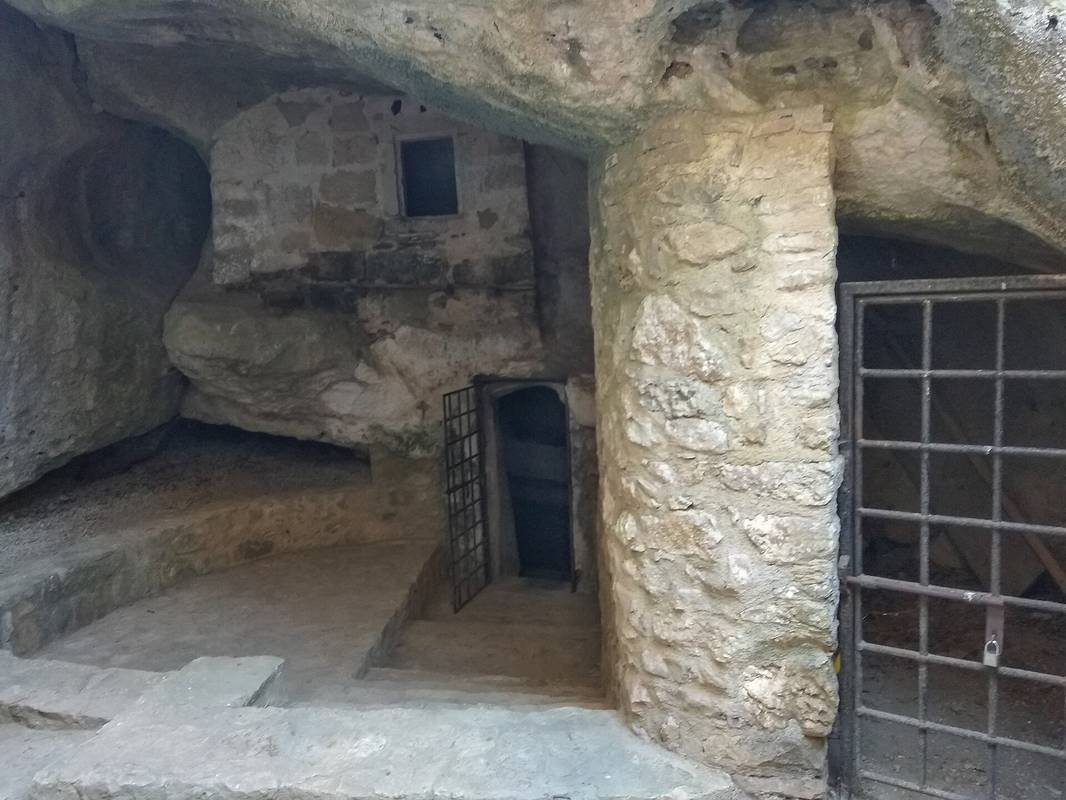
The castle rewards exploration despite its ruined state. Passing through the surviving gateway, visitors find the remains of a tower, the garrison buildings and graves cut into the living rock, along with two churches: the small church of Agia Kyriaki and, crowning the very top, the chapel of the Archangel Michael that gives the castle its name. The greatest reward, though, is the view. From the acropolis at the summit the panorama is breathtaking, an unbroken 360-degree sweep over the bays of Paleokastritsa, the green north-west coast, distant Corfu Town and the open Ionian Sea, set out alongside the guide to Paleokastritsa just below. Reaching it takes a little effort.
Why was Angelokastro almost never conquered?
Angelokastro was almost never conquered because its position on a sheer, isolated crag made assault extremely difficult, while its walls, gateway and cisterns let a small garrison hold out through long sieges. The single fall came after a six-month Venetian blockade.
Geography did most of the work of defence. The castle crowns a steep pinnacle that drops away on almost every side, so attackers could approach only along a narrow, exposed ridge, easily covered by the defenders above. This natural strength, reinforced by the gateway, tower and encircling walls, turned the crag into a refuge that repeatedly frustrated far larger forces.
Supplies mattered as much as walls. Rock-cut cisterns collected rainwater and storerooms held provisions, allowing the garrison and sheltering villagers to endure blockades of many months. The castle held against Ottoman assaults during the great sieges of the island, its one recorded fall coming only after a sustained six-month Venetian siege that starved the defenders out.
What can you combine with a visit to Angelokastro?
You can combine Angelokastro with the beaches and monastery of Paleokastritsa directly below, the hilltop viewpoint village of Lakones, and the traditional villages of Krini and Makrades. Together they make a full day exploring Corfu’s scenic north-west coast.
The castle sits at the heart of a rewarding west-coast circuit. Directly below lie the turquoise coves and clifftop monastery of Paleokastritsa, an easy pairing for a swim after the climb, while the road up passes the balcony village of Lakones with its celebrated panorama over the bays.
Nearby Krini and Makrades keep their traditional character, with tavernas serving Corfiot dishes and stalls of local produce along the roadside. A day that links the castle, a village lunch and the beaches below captures the best of the north-west, a route covered further in the guide to Corfu villages.
How do you visit Angelokastro?
You reach Angelokastro best by car, parking near the village of Krini, then climbing a steep, winding stone path and steps for 10 to 15 minutes to the entrance. A reasonable level of fitness and good footwear are needed.
Getting to the castle is part of the adventure. A car is the practical way to arrive, following the road above Paleokastritsa to the small village of Krini, where there is a car park near the foot of the crag. From there a steep, zig-zagging stone path with flights of steps climbs to the castle entrance, a walk of about 10 to 15 minutes that requires a reasonable level of fitness, sturdy shoes and some water in summer. There is a small admission charge in season. The climb and the heat are quickly forgotten once the summit panorama opens up, set out alongside the guides to Corfu villages and Corfu car rental. The questions below cover the points travellers ask most.
Why is Angelokastro worth visiting?
Angelokastro is worth visiting for its dramatic clifftop setting, its history as a castle that was almost never conquered, and above all for the 360-degree views over Paleokastritsa and the west coast. It offers one of Corfu’s finest panoramas.
The castle offers more than ruins. Its sheer-sided crag, rising straight from the green coast, is a spectacular sight in itself, and the sense of history is strong on a site that sheltered the island through its hardest sieges. The walk up through Krini and the wildflowers, the surviving gateway and chapels, and the sweeping view that suddenly opens at the top combine into one of the most memorable half-days on the island. Pairing it with the beaches and monastery of Paleokastritsa below makes an ideal west-coast outing, set out alongside a Corfu itinerary. The answers above and below cover the essentials.
Frequently Asked Questions
What is Angelokastro in Corfu?
Angelokastro is a ruined Byzantine castle on a 305-metre cliff above Paleokastritsa on Corfu’s north-west coast. Built in the 13th century, it served as the island’s capital for two centuries and, thanks to its position, was almost never conquered.
How do you get to Angelokastro?
You reach Angelokastro by car, parking near the village of Krini, then climbing a steep stone path and steps for 10 to 15 minutes to the entrance. A reasonable level of fitness and good footwear are needed, and there is a small admission charge in season.
Is Angelokastro worth visiting?
Angelokastro is well worth visiting for its dramatic clifftop setting, its history as a near-impregnable fortress, and its outstanding 360-degree views over Paleokastritsa, the west coast and Corfu Town. It pairs naturally with a visit to Paleokastritsa below.