
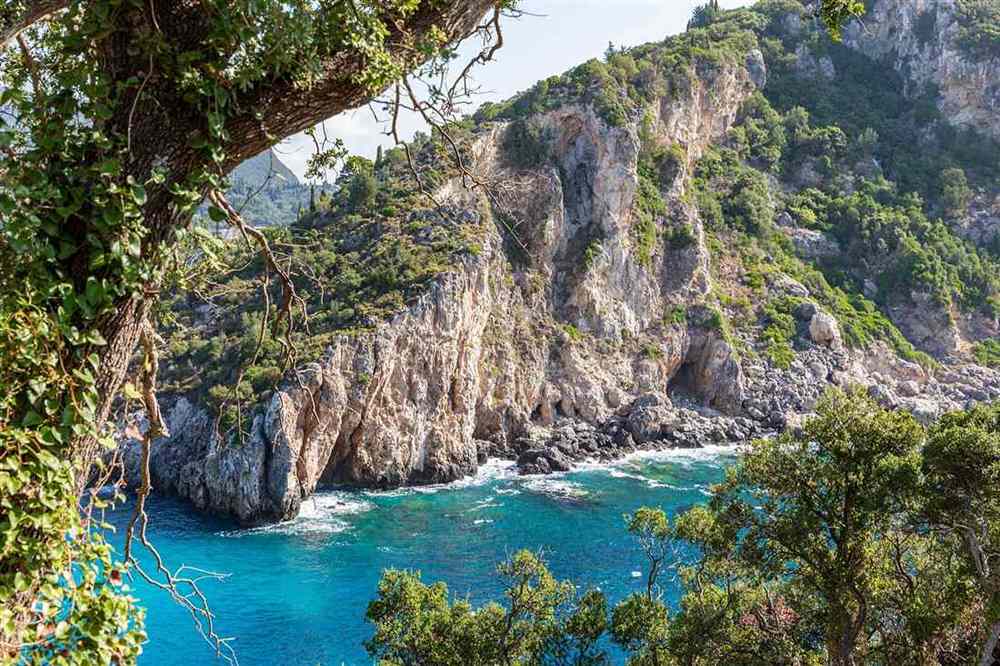
A Corfu glass bottom boat trip shows the seabed of the Ionian Sea through glass below the waterline, with no need to swim. Trips leave from Paleokastritsa on the west coast and from Kassiopi in the north-east. More trips across the country are on Greece Tours.
The sections below explain where the boats leave from, what the Paleokastritsa underwater cruise shows, how a semi-submarine differs and which fish swim below. They also cover children, weather, packing, other boat trips and cruise days.
What is a Corfu glass bottom boat trip?
A Corfu glass bottom boat trip is a short cruise on a boat with glass below the waterline. Passengers stay dry inside the hull and watch rocks and fish of the Ionian Sea pass beneath them. No swimming is needed.
The glass sits under the waterline, so the view is sharper than a look over the side. Ripples on the surface bend the light and blur the seabed. The glass cuts out that blur. The effect matches a diving mask, but nobody gets wet. Boats of this kind carry visitors at seaside resorts and lake towns.
The glass bottom boat began at Silver Springs in Florida. Hullam Jones and Philip Morrell fitted a dugout canoe with a glass viewing box for tourists at the springs. Today a Corfu glass bottom boat uses the same idea around the island of Corfu.
Each trip runs in three stages, from the harbour and back again.
- Passengers board at the harbour and take seats around the viewing glass.
- The boat cruises over calm, clear water near the shore, where daylight reaches the seabed.
- Passengers move up to the open deck for views of the coastline.
Where do Corfu glass bottom boat trips leave from?
Corfu glass bottom boat trips leave mainly from Paleokastritsa on the west coast. The underwater cruise there departs from Alipa harbour. Kassiopi, a village on the north-east coast, also offers glass-bottomed boat trips from its harbour below the castle.
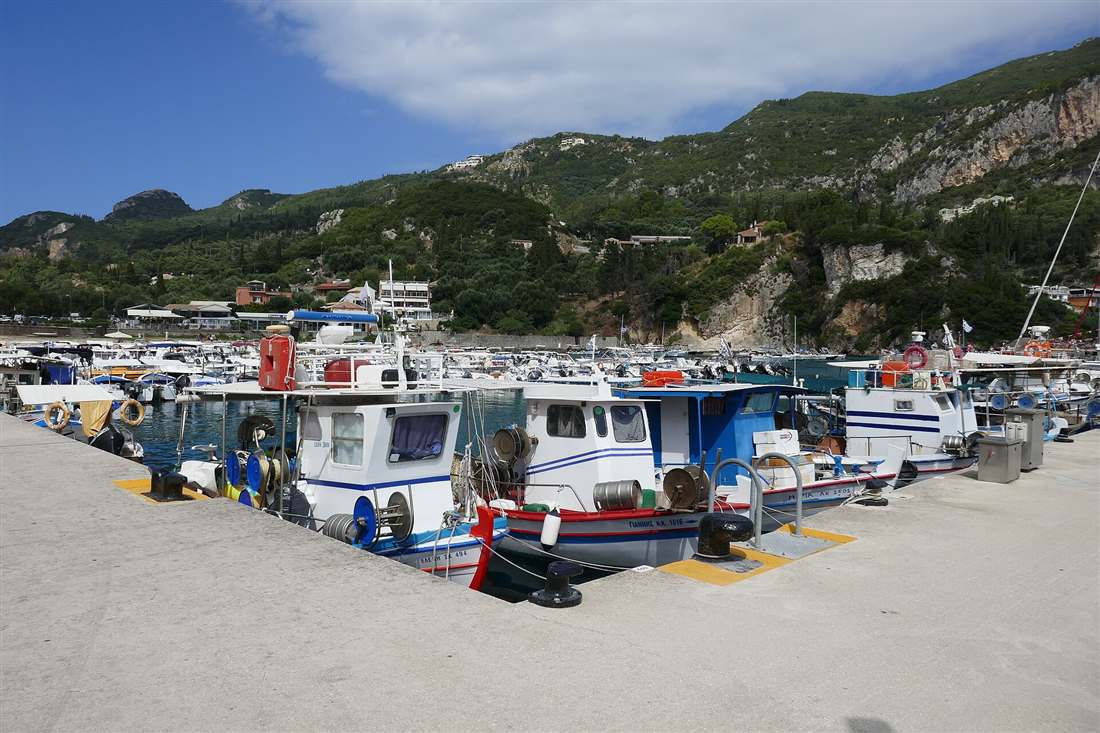
Paleokastritsa lies on the west coast of Corfu, just south of the Byzantine castle of Angelokastro. Its bay sits under tall cliffs, with beaches close by. The underwater cruise sails from Alipa, the harbour of Paleokastritsa village. The open Ionian Sea lies beyond the bay.
The Corfu Aquarium in Paleokastritsa runs the ticket office for the cruise. Passengers exchange their booking for a boarding pass at that office. The operator asks guests to arrive 30 minutes before departure. The trip lasts about one hour.
Kassiopi overlooks the Corfu Channel, and the ruins of Kassiopi Castle stand above the village. The castle walls are mainly Byzantine, with Venetian additions. Boat trips leave from its harbour. One of them is a Corfu glass bottom boat that adds a stop for a barbecue. The coast of Albania lies across the strait.
What do you see on the Paleokastritsa underwater cruise?
The Paleokastritsa underwater cruise shows the seabed through 22 large windows. The cabin sits 2.20 metres below the surface. Passengers watch rocks and fish pass by, then climb to the top deck to see the cliffs and bays.
The vessel is 15 metres long, with its cabin set low in the hull. Passengers look sideways through the windows, at eye level with the fish. The windows line the cabin, so each seat faces the water. This layout is closer to a semi-submarine than to a classic Corfu glass bottom boat.
Through the windows, the rocky floor of the bay comes into view. Fish swim between the rocks and the sea plants that grow on the bottom. Passengers move from window to window to follow them. The cabin is air-conditioned, so the trip stays cool on a hot day.
From the top deck, passengers see the cliffs, bays and beaches of Paleokastritsa. The monastery stands on its hill above the bay. Out at sea, a rock rises from the water. Locals call it the ship of Odysseus, turned to stone. One tradition places the landing of Odysseus and his meeting with Nausicaa in this bay.
How does a semi-submarine differ from a Corfu glass bottom boat?
A semi-submarine differs from a Corfu glass bottom boat in where the glass sits. A semi-submarine has a cabin below the waterline with large side windows. A glass bottom boat has a glass panel set into its floor.
A semi-submarine never dives. Its cabin stays a few metres under the surface. The cabin is open to the air above, so it needs no special air supply. Passengers climb up to the open deck at any time. The deeper hull works best in clear, calm water, where the windows show the seabed in sharp detail.
A Corfu glass bottom boat has a shallower hull and sits higher in the water. Passengers look down through the floor panel at the seabed directly below. The view comes from above, not side-on as in a semi-submarine cabin. Seats run around the glass so every passenger gets a view.
A semi-submarine suits non-swimmers and small children, who sit in a cabin at eye level with the fish. A glass bottom boat suits passengers who want deck time and a stop, like the Kassiopi barbecue trip. Swimmers who want to be in the water can turn to snorkeling in Corfu.
Which fish and sea life can you see from a Corfu glass bottom boat?
The sea life seen from a Corfu glass bottom boat includes damselfish, wrasse, sea bream, octopus and sea urchins. These animals live over rocky ground and green Posidonia meadows in shallow Ionian water, where sunlight reaches the seabed.
Rocky shores hold the busiest scenes. Damselfish swim in loose groups just above the rocks, and their young are bright blue. The ornate wrasse, a slim and colourful fish, darts between boulders. Sea bream patrol the edges in small schools. The saddled sea bream carries a black spot near its tail, ringed in white.
The seabed below the hull holds slower animals. Purple and black sea urchins cling to the rock. The common octopus hides in cracks, and piles of empty shells mark its den. Red starfish lie flat on the stones. Passengers spot them best when the boat drifts slowly over shallow ground.
Posidonia oceanica, also called Neptune grass, forms wide meadows on the sandy seabed. The plant grows only in the Mediterranean Sea, and its ribbon-like leaves reach about 45 centimetres. The meadows act as a nursery for young fish. From a Corfu glass bottom boat, salema with golden stripes can be seen grazing on the leaves.
Is a Corfu glass bottom boat trip good for children and non-swimmers?
A Corfu glass bottom boat trip suits children and non-swimmers because nobody needs to enter the water. Passengers watch the seabed through glass panels set in the hull. Covered seating gives shade, and crew stay on board.
Children follow the action right under their feet. Fish swim past the glass, and kids point out each new shape. Non-swimmers stay dry from start to finish. Grandparents and toddlers sit side by side at the same window. Families with young children also book the Corfu pirate ship, a themed trip on the same coast.
Safety rules on board are simple. Children stay seated while the boat is moving and follow the crew’s instructions. Life jackets are carried for every passenger. Parents keep small children within arm’s reach on the open deck, where the rail is the only barrier.
Looking down through glass for long spells can upset the stomach. The middle of the boat rocks the least, so it suits anyone prone to sea sickness. A glance at the horizon between viewing spells settles the balance sense.
How do wind and weather change a Corfu glass bottom boat trip?
Wind and weather decide how much a Corfu glass bottom boat passenger sees. Calm water keeps the glass clear and the seabed sharp. Wind raises waves, stirs sand off the bottom and blurs the view, and rough sea stops trips.
Morning trips meet the calmest water. The land heats up as the day goes on, and sea breezes build in the afternoon. Surface ripples bend the light and break up the picture through the glass. A flat sea in the morning gives the sharpest view of rocks and sea grass.
The west coast faces the open Ionian Sea. Paleokastritsa sits on this side of Corfu. Swell rolls in here more than on the east coast, which faces the mainland. Wind shapes all Corfu boat tours, but a glass floor shows the change first.
Captains cancel a Corfu glass bottom boat trip when the sea turns rough. A boat rocks hard in big waves, and the view through the glass turns to bubbles and sand. Travellers keep a spare day free in case a trip is called off.
What do you bring on a Corfu glass bottom boat trip?
The kit for a Corfu glass bottom boat trip is short. Pack sun cream, a hat, sunglasses, water and a light top. A camera or phone with the flash off records the seabed. Motion-sickness tablets help passengers who feel unwell at sea.
The Ionian sun is strong on open water, and the sea reflects light back onto the skin. Sun cream and a wide-brimmed hat protect the face and shoulders. Polarised sunglasses cut the glare on the water surface during time on deck.
Photos through the glass work without flash. A flash bounces off the panel and fills the picture with white glare. Holding the lens close to the glass cuts reflections from the cabin. Video mode catches moving fish better than single shots.
A bottle of water per person keeps everyone hydrated on deck. A light long-sleeved top guards against sun and the breeze on the way back. Visitors flying in on the day of the trip can pre-book Corfu airport transfers and drop their bags first.
Motion-sickness steps start before boarding. A light meal an hour before the trip settles the stomach better than a heavy, greasy one. Tablets work best when taken before the boat leaves the harbour.
Which other Corfu boat trips pair with a glass bottom boat?
Three Corfu boat trips pair with a Corfu glass bottom boat. They are the Paxos and Antipaxos cruise with the Blue Caves, a catamaran day and a sunset cruise. Each trip covers a different stretch of the Ionian Sea.
The glass bottom boat shows the seabed close to the shore. The three trips below head further out, to other islands or into the evening.
- A Paxos day trip sails south to Paxos and Antipaxos and stops at the Blue Caves.
- A Corfu catamaran cruise spends a full day at sea on a sailing catamaran.
- A Corfu sunset cruise sails out in the evening as the sun sets over the sea.
Paxos lies south of Corfu and belongs to the same regional unit. Antipaxos sits just south of Paxos. Ferries also link the port of Corfu Town with Gaios, the main harbour of Paxos.
How does a Corfu glass bottom boat compare with trips in Kos and Zakynthos?
A Corfu glass bottom boat explores the cliff bays of Paleokastritsa on the Ionian west coast. Kos trips sail the Aegean in the Dodecanese. Zakynthos trips aim for sea caves and a cliff-walled cove on its northwest shore.
Paleokastritsa sits on the northwest coast of Corfu, just south of Angelokastro. That castle stands on a cliff about 305 metres above the sea. The Paleokastritsa Monastery crowns the peninsula and houses a museum. Locals call one rock in the bay the petrified ship of Odysseus.
Kos Town is the main port of Kos. The islands of Kalymnos and Pserimos lie to its north. Nisyros lies to its south. Read about the Kos glass bottom boat for trips on that side of Greece.
Zakynthos lies further south in the Ionian Sea. The Blue Caves are cut into the cliffs around Cape Skinari, at the northwest tip. Navagio, known as Shipwreck Beach, is closed off by high cliffs and reached only by boat. Compare those routes on the Zakynthos glass bottom boat page.


Which months suit a Corfu glass bottom boat trip?
The warm summer months suit a Corfu glass bottom boat trip best. Corfu has hot, dry summers with long hours of sun. Calm, sunny days give the clearest view of the seabed through the glass.
June averages about 16 mm of rain and July about 9 mm, the two driest months. July logs about 365 hours of sunshine, and August follows with about 333. Boats at Paleokastritsa run through this summer season.
Rain returns in autumn. October, November and December are the wettest months, with about 140, 187 and 190 mm. Corfu’s winters are wetter than those of other Greek islands.
Late spring and early autumn are milder than midsummer. Water clarity depends on the weather of the day, not only the month. A still sea lets light reach the seabed. Wind ripples and rain run-off cloud the view.
Can cruise passengers fit in a Corfu glass bottom boat trip?
Cruise passengers can fit in a glass bottom boat trip on a Corfu port day. Ships dock at Corfu Town on the east coast. Paleokastritsa lies on the west coast, so the drive there and back plus the boat trip fit inside a port day.
Ships pass the island of Vido on their way into the harbour. The Corfu cruise port sits next to Corfu Town, whose old town is a UNESCO World Heritage Site. Hydrofoils from the same port run to Igoumenitsa on the mainland and Sarandë in Albania.
The road to Paleokastritsa crosses the island from east to west. Passengers go by taxi, hire car or a shore excursion that includes transport. Boats leave from the small harbour in the bay.
Every cruise ship sets an all-aboard time. A ship does not wait for passengers on an independent trip. Plan the return drive well before that time and allow for traffic on the road.


Which questions do travellers ask about a Corfu glass bottom boat?
How long does a Corfu glass bottom boat trip last?
The glass bottom boat trips from Paleokastritsa are short trips of about an hour. The boat leaves the small harbour and runs along the cliffs and coves around the bay before it returns. Add the drive from Corfu Town on each side when planning the day.
Do you get wet on a Corfu glass bottom boat?
Passengers stay dry in the viewing area, which sits inside the hull below the deck. The glass panels look down into the sea, and no water comes in. Seats on the open deck can catch sea spray on a windy day. Bring a light layer for the ride back.
Can you swim during a Corfu glass bottom boat trip?
A swim stop depends on the route of each trip. The short trips at Paleokastritsa focus on the view through the glass and along the cliffs. Paleokastritsa has a main beach close to the harbour, so a swim fits before or after the boat ride. Check the trip listing for a swim stop before booking.
Is a Corfu glass bottom boat trip suitable for older travellers?
Yes. The trip is short, the boat stays close to the shore, and passengers stay seated while they watch the seabed. Boarding takes a step from the quay onto the deck. The viewing area sits down a short flight of steps in the hull. Travellers with limited mobility can ask the operator about these steps when booking.