
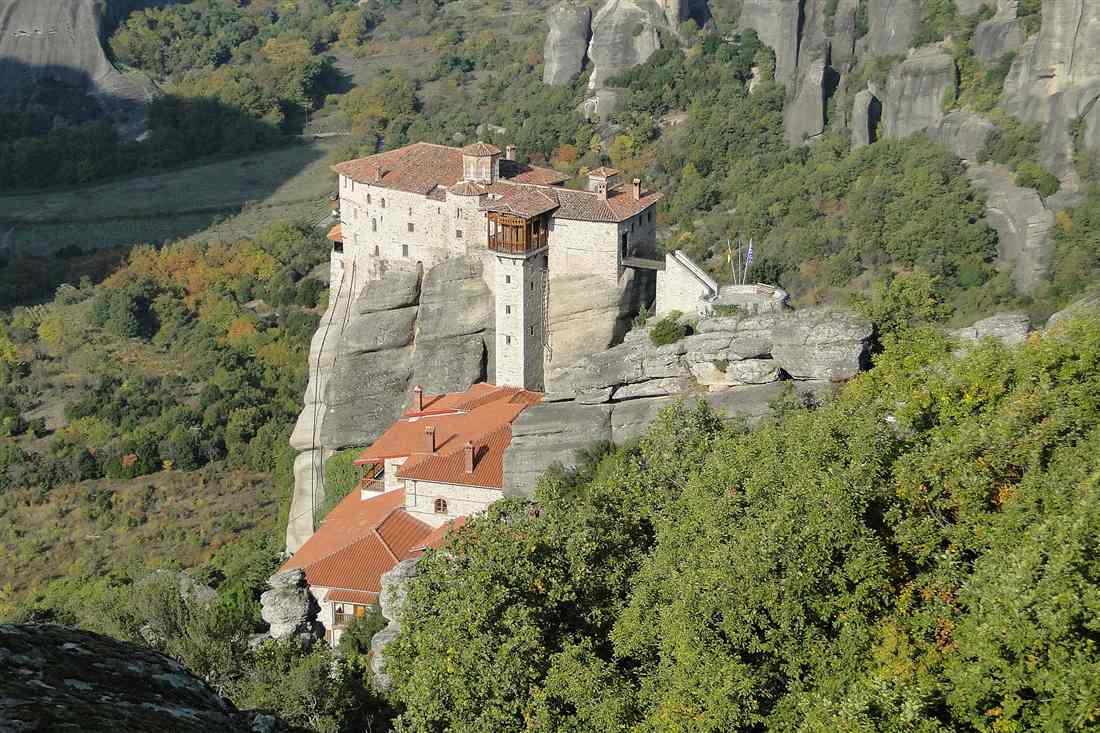
The 3-day Meteora and Delphi tour from Athens joins the Meteora sunset, a hike or half-day exploration and a transfer to Delphi with a stop at Thermopylae. Tours across the rest of the country are listed on Greece Tours.
The sections below cover what 3 days in Meteora and Delphi include, the comparison with the 2-day tour, the kerchief custom at Agios Georgios Mandilas, the Ypapanti cave monastery, season and booking, with links into the Meteora pages. The tours shown are checked on GetYourGuide and Viator.
What is the 3-day Meteora and Delphi trip from Athens?
It is a tour that starts in Athens and links two UNESCO World Heritage Sites in central Greece. Over 3 days in Meteora and Delphi, guests see the rock monasteries of Thessaly. They also reach the sanctuary of Apollo at Delphi.
GetYourGuide files this Athens departure as a rail tour. A plan of 3 days in Meteora and Delphi joins Thessaly with Phocis, two areas of mainland Greece. Meteora lies in the Trikala regional unit, and Delphi on the southwestern slope of Mount Parnassus.
Meteora rises at the northwestern edge of the Plain of Thessaly, between Kalabaka and the village of Kastraki. Its pillars are sandstone and conglomerate, not volcanic rock. Twenty-four monasteries once stood on them, and six remain today. During 3 days in Meteora and Delphi, these rock towers mark the northern end of the route.
Delphi stands on a scarp that rises up to 500 metres above the valley floor. The ruins of its Temple of Apollo date from the 4th century BC. The site museum holds the bronze Charioteer of Delphi. With Parnassus above the site, 3 days in Meteora and Delphi pair rock pillars with a mountain sanctuary.
Thermopylae is a narrow pass in the Lamia municipality of Phthiotis, named after its hot sulphur springs. The pass faces the Malian Gulf, named for the ancient Malian tribe. A modern monument to King Leonidas I of Sparta stands beside the highway there. Full Thermopylae tours spend longer at the battlefield of the 5th century BC than a transfer stop.
What does the 3-day Meteora and Delphi trip include?
The listing names hotel accommodation, the Meteora sunset and a choice between a hike and a half-day exploration. It also names a transfer to Delphi with a stop at Thermopylae. Those four items form the core of 3 days in Meteora and Delphi.
- Included: hotel accommodation
- Included: the Meteora sunset
- Included: a hike or a half-day exploration at Meteora
- Included: a transfer to Delphi with a stop at the Thermopylae battlefield
- Budget separately: monastery entry fees at Meteora
- Budget separately: the Delphi ticket
- Budget separately: meals
The hike is a walk on footpaths that run between the rock pillars, away from the road. The half-day exploration is a drive from one monastery to the next along the access road. Each guest picks one of these two formats during 3 days in Meteora and Delphi.
The hike suits guests who want time on foot among the rocks. The drive suits guests who prefer short walks from a vehicle to each monastery. Shoes with firm grip help on both options, since monastery approaches include stone stairs. Dedicated Meteora hiking tours spend the whole outing on the trails.
The listing names the Meteora sunset as one of its features. At dusk, the low sun lights the western faces of the rock pillars. The sunset item adds an evening visit to the daylight hours of 3 days in Meteora and Delphi.
Each Meteora monastery charges its own entry fee at the gate. The Delphi ticket covers both the archaeological site and the museum. Covered shoulders, long trousers for men and skirts for women meet the monastery dress code. Meals sit outside the listing, so lunches and dinners are extra on 3 days in Meteora and Delphi.
How does it compare with the 2-day Delphi and Meteora tour?
The 2-day tour fits Delphi and Meteora into two days with one night near Meteora. A trip of 3 days in Meteora and Delphi adds a third day and a Thermopylae stop. It also offers a hike or a half-day exploration at Meteora.
The 2-day Delphi and Meteora tour stays overnight in Kalabaka or nearby Kastraki. That tour visits Delphi and Meteora on consecutive days, then returns to Athens. A tour of 3 days in Meteora and Delphi gives the same sites a slower pace.
Alternative 2-day itineraries spend the night in Delphi village or Arachova instead. Arachova is a mountain village on the slopes of Parnassus, east of Delphi. The 3-day listing names hotel accommodation but no hotel town.
- Length: 2 days on the shorter tour, 3 days on the longer trip
- Nights: one night near Meteora on the 2-day tour, hotel accommodation across the 3-day trip
- Thermopylae: a stop on the 3-day transfer to Delphi, no listed stop on the 2-day tour
- Meteora choice: a hike or a half-day exploration on the 3-day trip, none on the 2-day tour
The stop on 3 days in Meteora and Delphi puts guests on the ground at the pass. At Meteora, the 2-day tour climbs cut-stone steps to the monasteries, with no separate hike.
The 2-day tour names no sunset at Meteora, while the 3-day listing does. The 3-day trip carries a rail tour label on GetYourGuide. Both start in Athens, so the choice rests on the number of free days.


What is the kerchief custom at Agios Georgios Mandilas?
Agios Georgios Mandilas is a cave chapel of Saint George in the rock above Kastraki. On his feast day each year, climbers swap the old kerchiefs for new ones. During 3 days in Meteora and Delphi, the coloured cloth is visible from the road below.
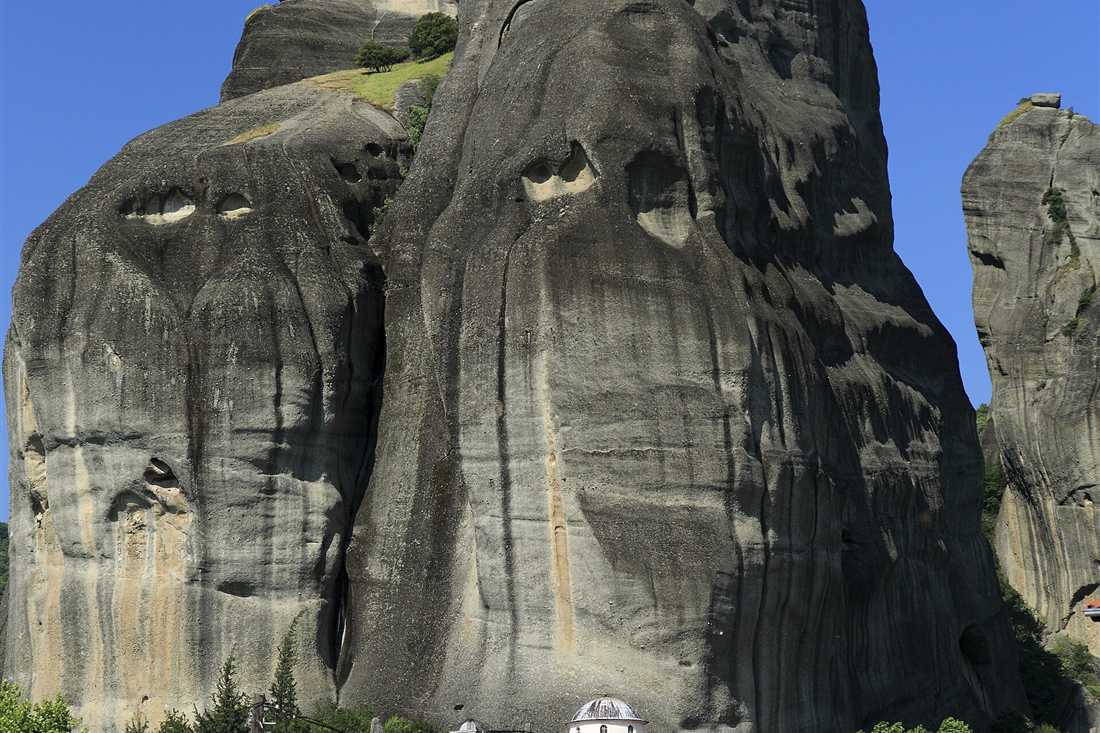
The name comes from the Greek word mandili, meaning a kerchief or headscarf. The chapel fills a cave hollow on the north side of Agio Pneuma, the Holy Spirit rock. This rock rises on the eastern edge of Kastraki in Meteora. The village square lies close by, an easy walk during 3 days in Meteora and Delphi.
The story told in Kastraki dates from Ottoman rule. A Turkish man cut trees in the grove of Saint George below the cave. A falling trunk left him badly hurt. His wife offered her headscarf to the saint, and a Kastraki villager carried it up to the chapel. The man recovered, and the kerchief gift became a yearly custom.
After the church service, climbers from Kastraki scale the cliff to the cave mouth. They carry the new kerchiefs tied around their waists on the way up. Villagers hold that Saint George keeps the climbers safe on the rock. Outside the feast, a traveller on 3 days in Meteora and Delphi sees the previous year’s cloth.
On the feast, people from Kastraki, nearby villages and other parts of Greece gather below the rock. Each one hands a new kerchief to the climbers. In return, visitors take home scraps of the old cloth as charms. During 3 days in Meteora and Delphi, the chapel stays out of reach for all but roped climbers.
- English name: Saint George of the Kerchiefs
- Site type: a ruined hermitage inside a natural cave
- Saint honoured: George, a Roman soldier and Christian martyr of the 4th century
- Feast date: 23 April, or Easter Monday when Easter falls after that date
- Gift meaning: each kerchief counts as a vow to the saint
- Nearest town: Kalambaka, about 2 km from Kastraki
The chapel is visible from the road along the edge of Kastraki. Walking trails lead to the foot of the cliff, right below the cave mouth. The Monks’ Prison, another old cave site, sits on the same rock. Packing binoculars for 3 days in Meteora and Delphi brings the knots of cloth into clear view.
What was the Ypapanti cave monastery near Kalambaka?
Ypapanti is a cave monastery set high in a cliff cavity in the north of Meteora. Its founding and its church frescoes both date from the 14th century. Over 3 days in Meteora and Delphi, its walled front shows clearly from the trails below.
The name Ypapanti refers to the Presentation of Christ, when the infant Jesus was brought to the Temple. Orthodoxy counts it among its Twelve Great Feasts. The hieromonk Neilos, abbot of the Doupiani skete, founded the monastery with the monk Kyprianos. For travellers on 3 days in Meteora and Delphi, an inscription above the entrance names Neilos as founder.
A built front wall closes the cavity, with a small church and monastery rooms behind it. The church frescoes share their style with 14th-century wall paintings at the Great Meteoron. They survive on the church walls behind the front. On 3 days in Meteora and Delphi, the frescoes mark the cave’s oldest surviving layer of art.
The monastery fell into ruin in the mid-18th century. Athanasios Vlachavas, a local leader, restored it soon after. Dimitrios Zoukis and his pupil Georgios, painters from Kalarrytes, decorated a new narthex late in that century. A narthex is the entrance hall placed before the main church. Its paintings came about four centuries after the church frescoes.
In the early 19th century, Ali Pasha’s troops wrecked it and seized the rebel leader Thymios Vlachavas there. He had prepared a large uprising against Ottoman rule, but a traitor gave the plan away. Ali Pasha then had him executed. On 3 days in Meteora and Delphi, Thermopylae adds an older story of war to this one.
- Feast day: 2 February, forty days after Christmas
- Founder’s rank: hieromonk, a monk who is also an ordained priest
- Owner today: the Great Meteoron, which holds it as a dependency
- Narthex painters’ home: Kalarrytes, a mountain village in Epirus
- Raid leader: Ali Pasha, the Ottoman governor of Ioannina
A stairway climbs to the cave from an unpaved road below. Trails link it with the Doupiani rock and the village of Kastraki. It is one of the caves and hermitages of Meteora, and visitors there are rare. The Meteora outing on 3 days in Meteora and Delphi takes place in this same rock forest.

Which season suits 3 days in Meteora and Delphi?
Late spring and early autumn suit 3 days in Meteora and Delphi, with mild days and late sunsets. Summer heat peaks on the Thessaly plain. Winter days are short and cold, with snow on Mount Parnassus.
Trikala, the regional city closest to Kalambaka, has hot summers and cold, wet winters. August averages a high of 34.5°C, and July reaches 33.5°C. Summer nights stay warm, near 20.3°C in July. January sits near 10.7°C by day and 1.8°C at night. February, March and November bring the heaviest rain.
The modern town of Delphi sits at 632 meters on Mount Parnassus. Arachova lies higher, at about 970 meters. The town averages highs of 27.5°C in August and 5.9°C in January. Its January nights drop to 0.2°C. The Parnassos Ski Center lies to the north of the town.
- Late spring: Trikala highs reach 26.7°C, Arachova has its driest month, and sunset falls near 20:50.
- Summer: sunset at Meteora comes close to 21:00 in late June, the latest of the year.
- Early autumn: October highs at Trikala hold at 24.6°C, and sunset falls near 19:30 in late September.
- Winter: sunset drops to about 17:10 in December, and monastery opening hours are shorter.
Over 3 days in Meteora and Delphi, pack a warm layer for cool nights between October and April. December and January bring the heaviest rain at Arachova. Compare travel dates against the page on when to visit Meteora before booking.
How do you book and cancel 3 days in Meteora and Delphi?
Travelers book 3 days in Meteora and Delphi online through the GetYourGuide listing for tour 87428. Pick a travel date, add the traveler count and confirm. The cancellation terms appear on the listing page before checkout.
- Open the listing for tour 87428 and read the itinerary and inclusions.
- Select a start date and the number of travelers.
- Enter the lead traveler’s name, email address and phone number.
- Pay online and confirm the booking.
- Check the confirmation email for the start time and meeting point.
On GetYourGuide, free cancellation runs up to 24 hours before the start on listings that show that label. Check for that label on tour 87428 before paying. A cancelled booking for 3 days in Meteora and Delphi earns a full refund before that cut-off. Cancel through the GetYourGuide app or the link in the booking email.
GetYourGuide files tour 87428 as a rail tour, so check which legs run by train. The operator’s contact details appear in the booking confirmation. The GetYourGuide app also stores the voucher for the start day.
Frequently Asked Questions
How long is the Meteora and Delphi trip?
The trip lasts 3 days and starts in Athens. Over 3 days in Meteora and Delphi, the route links Thessaly with Phocis, the region around Delphi. The full day order sits on the listing itinerary, so read it before picking a date.
Is the hotel included in the tour?
Yes. Hotel accommodation is part of the package on this 3-day listing from Athens. Over 3 days in Meteora and Delphi, travelers need no separate hotel booking. Read the inclusions on the listing for the hotel name, location and room type before paying.
What does the hike or half-day exploration choice mean?
At Meteora, the listing gives a choice between a hike and a half-day exploration. The hike suits travelers who walk rocky trails with ease. The half-day exploration suits travelers who want less time on foot. Confirm the chosen option with the operator before the start day.
Does the tour stop at Thermopylae?
Yes. The transfer to Delphi includes a stop at the Thermopylae battlefield. Over 3 days in Meteora and Delphi, this stop adds a third site to the route. The battlefield lies near Lamia in central Greece, beside the national road. A monument and a visitor center stand there.
Is monastery entry included in the tour?
The tour features named on this page do not cover monastery entry. Each Meteora monastery sells its own entry ticket at the gate. Before booking 3 days in Meteora and Delphi, check the listing’s inclusions. The page on Meteora monasteries tickets has the entry details.
What is the dress code at the Meteora monasteries?
Men wear long trousers, and women wear skirts that reach below the knee. Shoulders stay covered at every monastery. Wrap skirts are lent at the entrances. Over 3 days in Meteora and Delphi, pack one modest outfit for the Meteora visits. Shoes with grip suit the stone steps.
Which UNESCO sites does the trip reach?
The trip reaches two UNESCO World Heritage Sites: Meteora and the archaeological site of Delphi. Meteora counts as a mixed site, listed for both culture and nature. Over 3 days in Meteora and Delphi, travelers see both sites on one booking.
What do travelers pack for the trip?
Pack shoes with firm grip, a modest outfit for the monasteries and a warm layer for the evenings. A hat and water help at the open site of Delphi in summer. Binoculars bring the kerchiefs on the Holy Spirit rock into clear view.