
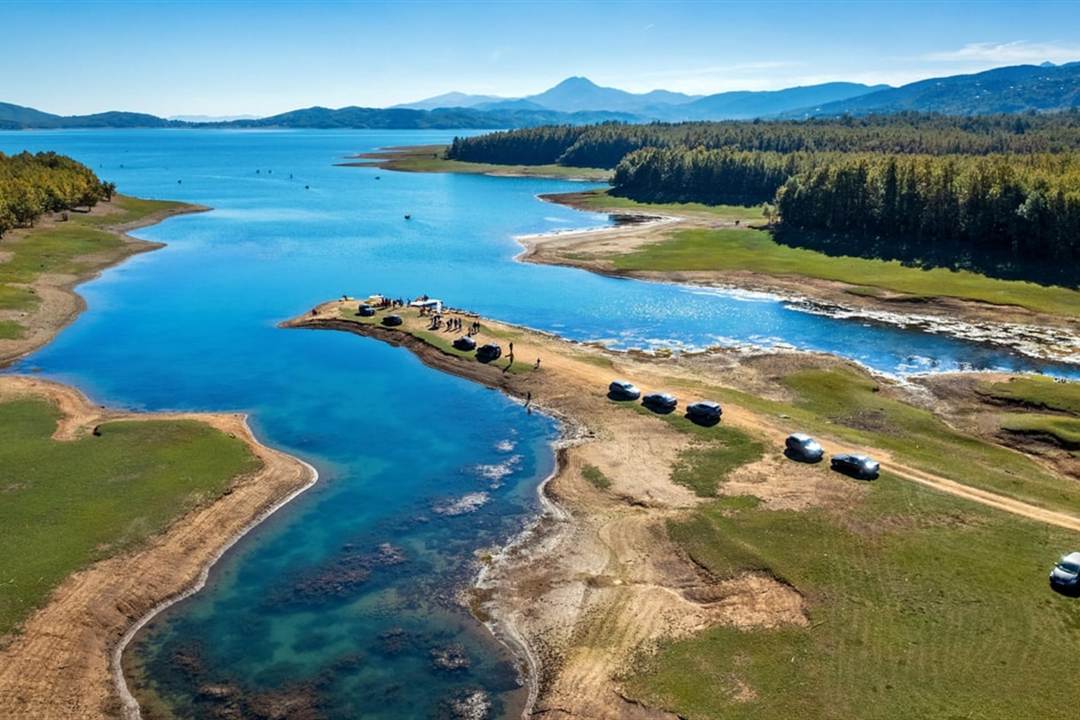
A Lake Plastira tour drives up from the Thessalian plain to a reservoir under the Agrafa mountains, stops at the Panagia Korona Monastery and leaves free time on the shore before the return. Tours across the rest of the country are listed on Greece Tours.
The sections below cover the tours you can book, the route from Larissa, the dam and General Plastiras, the monastery, the forests, the free time, the trails, the wildlife, the seasons, the Christmas tour, the length, packing and booking for a Lake Plastira tour, with links into the Karditsa tours page. The tours shown are checked on GetYourGuide.
What is a Lake Plastira tour?
A Lake Plastira tour visits an artificial reservoir in Thessaly’s Karditsa regional unit, beneath the Agrafa mountains. Selected itineraries pair the lakeside landscape with a nearby heritage stop. The lake is also known as Tavropos Reservoir in Greece.
The reservoir takes its second name from the Tavropos, the river that feeds it. The lake lies in the west of Thessaly, under the eastern edge of the Agrafa. The bookable day trip starts in Larissa, to the north-east.
For visitors, a Lake Plastira tour links the reservoir, the Agrafa setting, and religious heritage around Karditsa. The outing returns to its start city on the same day.
Lake Plastira reaches 12 kilometres in length and 4 kilometres at its maximum width. Its surface area reaches 24 square kilometres. The reservoir holds up to 400 million cubic metres of fresh water. Its surface sits 792 metres above sea level.
Which Lake Plastira tours can you book?
A Lake Plastira tour is available as a standalone Larissa excursion. A separate guided itinerary starts in Athens and joins the reservoir with other destinations. The options suit visitors choosing between a lake-centered outing and a broader regional trip.
The Larissa listing, “Lake Plastira: Nature, Monastery & Lakeside Escape,” starts in the city. This Lake Plastira tour centers on the lake and its nearby religious heritage. It lasts 7 hours from start to finish.
The Athens Christmas tour combines Meteora, Lake Plastiras, Trikala, Trikala’s Mill of the Elves, and lake activities. It serves as the wider multi-stop option beside the Larissa lake outing.
- Monastery visit: Panagia Korona
- Landscape: views over the reservoir
- Lakeside pause: free time by the water
How does the day trip from Larissa reach the lake?
A Lake Plastira tour from Larissa links two Thessalian cities. Larissa is the region’s capital, and the reservoir lies in Karditsa. The itinerary visits a lake beneath the Agrafa and includes Korona Monastery as a cultural stop.
Larissa is the capital of Thessaly and a road and rail hub. The road runs south-west across the plain to Karditsa, about 60 kilometres away. The Larissa tour listings include this departure for Lake Plastiras.
From Karditsa the road climbs about 25 kilometres into the Agrafa foothills. The flat cotton fields of the plain give way to fir forest near the lake. One Lake Plastira tour covers both landscapes in a single day.
Karditsa is known in Greece as the city of the bicycle, with flat streets and cycle lanes. The road to the lake leaves its western edge.
How was the lake made, and who was Nikolaos Plastiras?
A Lake Plastira tour introduces an artificial reservoir named for Nikolaos Plastiras, a Greek general and politician. His advocacy advanced the lake plan from idea to national engineering project. This happened after the Second World War.
The dam impounded the Tavropos, also called Megdovas, across the former Nevropolis plateau. The reservoir supplies water to Karditsa city and supports irrigation and hydroelectric power. Its construction transformed the area’s former plain into a water basin.
Nikolaos Plastiras served three times as prime minister of Greece. He proposed the dam after a visit to his home area in the early 20th century. The Tavropos had just flooded the valley. The lake and dam formerly carried the Tavropos name before taking his surname. He advocated for the plan until his death.
The state Public Power Corporation took up the project. It formed part of the drive to bring electricity to the country. A French firm won the international design contest. The dam opened in the mid-20th century, after his death.
- A flood of the Tavropos during his visit to the area
- A government committee formed to study the plan
- An international design contest after the Second World War
- Dam works begun in the mid-20th century
What is the Panagia Korona Monastery?
A Lake Plastira tour from Larissa stops at the Panagia Korona Monastery, on a slope near Mesenikolas. It looks east across Thessaly. The monastery is dedicated to the Nativity of the Virgin Mary, the feast of 8 September.
Tradition links the founding of the monastery with the discovery of an icon of the Virgin. A Lake Plastira tour adds this religious history to a day by the water. The monastery stands below the eastern rim of the lake. The stop fits on the way up from the plain.
The complex holds a main church and two wings of cells around a courtyard. Saint Seraphim, later bishop of Fanari and Neochori, took his monastic vows at Korona in the 16th century. He was born in Pezoula, a village above the lake.
- Carved wooden templon in the main church
- Chapel of Saint John the Baptist with wall paintings
- Feast day of the monastery on 8 September
Which mountains and forests frame the lake?
A Lake Plastira tour enters the foothills of the Agrafa, a mountain region on the southern Pindus. Forested slopes rise above the reservoir, while the river valley continues into Evrytania. The setting spans two regional units.
A Lake Plastira tour shows the Karditsa uplands rising from the Thessalian plain. The Agrafa region spans the Evrytania and Karditsa regional units. Its name means “unwritten”, a mark of its remote terrain.
Under Ottoman rule, the Agrafa villages kept their own militias and courts of arbitration. The region served as a refuge for Greeks and as a centre of Greek learning.
Beyond the lake, the river flows through a deep forested valley in Evrytania. It reaches Kremasta Reservoir and later joins the Acheloos system. Regional forests also have a long history of shared local stewardship.
- Monasteries managed regional forests for centuries
- Residents bought wooded tracts from monasteries
- Local communities retained collective forest ownership
What can you do during the free time by the lake?
The free time on a Lake Plastira tour goes to the water and the shore. Canoes, kayaks and pedal boats go out from the lake beaches. Riding farms lead horses along the banks. Others walk a short stretch of the shore.
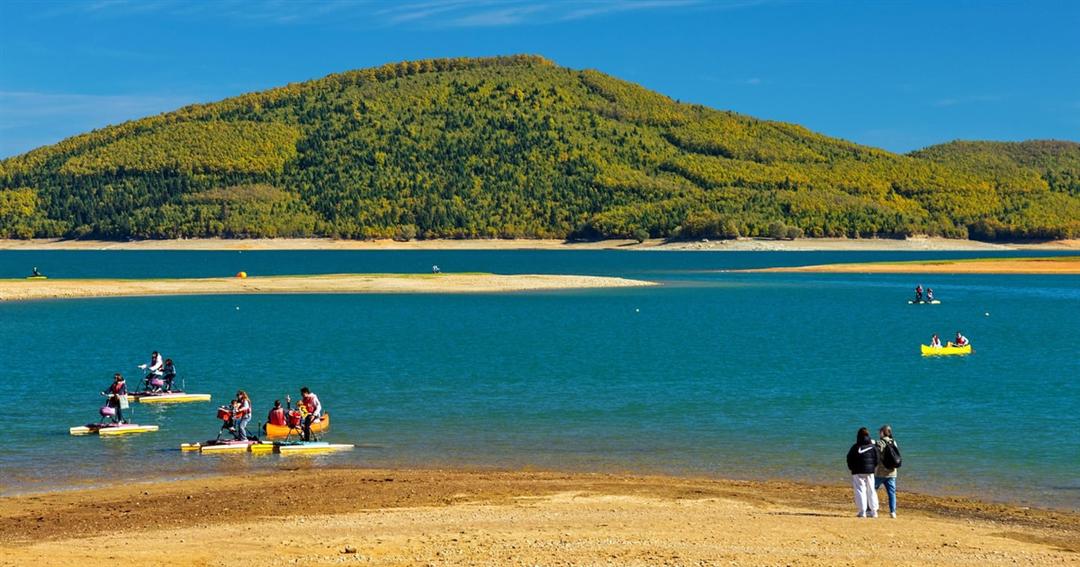
Canoe and kayak routes pass between small islands and narrow inlets. Organized horseback rides run from farms between Morfovouni and Kalivia of Pezoula. The rides take children and adults along the banks.
The annual swimming crossing spans five kilometres between Pezoula Beach and Lampero Beach. It takes place on the first weekend of August. A Lake Plastira tour on that weekend passes the swimmers in the water.
Which walking and cycling routes circle the water?
Marked footpaths link the lake villages with chapels, springs and viewpoints. A municipal cycling route follows lakeside and mountain roads. A Lake Plastira tour leaves time for a short walk on one of these paths.
The municipal cycling route covers about 35 kilometres, on lakeside roads and steeper mountain roads. Mountain bike centres operate in Kalivia of Pezoula and in Neochori, near the botanical garden.
For a Lake Plastira tour aimed at walking, the short marked paths below fit inside the free time. Each one carries a code on its signposts.
- B15: Kerasia–Mandania–Prophet Elias, 3.5 km, low difficulty, about one hour
- H9: Moschato stone bridge–Tsardaki shore, 2.9 km, moderate difficulty, about 45 minutes
- B14: Filakti–Ai-Elias, 2.3 km, low difficulty, about 45 minutes
- H8: Morfovouni–Vrises, 1.8 km, moderate difficulty, about 30 minutes
What wildlife lives in the Lake Plastira area?
Lake and shoreline wildlife ranges from freshwater fish and waterbirds to mammals. A Lake Plastira tour enters a habitat that supports aquatic species and familiar birds. Rare sightings include large raptors around the wider area.
Anglers on the lake use the rod only, a rule that protects the fish stocks. A Lake Plastira tour passes shores where these species feed.
- Eels, common carp and trout
- Bass, gibel carp and lavaret
- Tench, bleak and roach
Visitors on a Lake Plastira tour can look for herons, Eurasian coots, gulls, grebes and cormorants. Rarer sightings include little egrets, griffon vultures, peregrine falcons and golden eagles above the shoreline.
Foxes, wolves, wild boars, badgers and weasels inhabit the banks, with rarer reports of bears, deer and wildcats. Belokomitis has fifteen kilometres of marked nature-observation routes and six paths, including one to an observatory. Finches, coal tits, robins, goldcrests and magpies also inhabit the educational forest.
How does the lake look in each season?
A Lake Plastira tour meets snow on the fir trees in winter and green slopes in spring. Summer brings warm water for paddling, and autumn turns the oak leaves red and gold. The water level also drops through the dry months.
Broadleaf oak grows between 700 and 900 metres. Fir forest extends to 1,500 metres, while low bushes mark the higher sub-alpine zone. These bands of trees change colour at different times of the year.
During a Lake Plastira tour, the shoreline shows how far the water has dropped for irrigation. The reservoir reaches a maximum depth of sixty metres.
- Spring: snow lingers on the higher routes into late spring
- Summer: hot, dry days on the Karditsa plain
- Autumn: red and gold oak leaves on the slopes
- Winter: snow on the fir forest around the shore
What does the Christmas tour add with Meteora and Trikala?
The Christmas trip broadens the lake stop with Meteora’s monasteries and Trikala’s Mill of the Elves. It also includes activities by the water. A Lake Plastira tour within this mix links landscape, religious heritage and a seasonal city visit.
Meteora is a rock formation in Trikala. Eastern Orthodox monasteries stand on the natural pillars. The first of them rose on the rocks in the 14th century. The complex is on UNESCO’s World Heritage List, and six monasteries remain active at the site. Read more about Meteora tours when comparing regional destinations.
Trikala sits on the Lithaios river in north-western Thessaly, about 20 kilometres from Kalambaka and the Meteora rocks. Each winter, the Mill of the Elves turns the old Matsopoulos flour mill into a Christmas park.
On this 2-day route, a Lake Plastira tour shares time with the monasteries and the Christmas park. Explore Trikala tours for the other sights of the city.
How long does a Lake Plastira tour last?
A Lake Plastira tour from Larissa lasts 7 hours from start to finish. The monastery visit, the viewpoints and the free time by the water all sit inside that span. The Christmas tour from Athens runs over 2 days.
The 7 hours include the drive out and back across the plain through Karditsa. The rest of the day goes to the Korona stop, the views and the shore. Larissa lies on the main railway between Athens and Thessaloniki. Travellers from both cities reach the start by train.
The 2-day tour from Athens spends one night away from the capital. Its route joins the lake with Meteora and Trikala, so the water takes up part of one day. A Lake Plastira tour from Larissa gives the whole outing to the lake area.
How do you reach Lake Plastira without a tour?
Without a Lake Plastira tour, travellers reach Karditsa by train or intercity bus. A car covers the last stretch to the shore. Karditsa lies on the railway from Palaiofarsalos to Kalambaka, with changes at Palaiofarsalos for Athens and Thessaloniki.
Intercity buses run from Athens to Karditsa, and local buses link the town with the lake villages. A rented car lets travellers circle the water and stop at each viewpoint. Taxis from Karditsa cover the climb into the foothills.
From Athens, the drive north follows the A1 motorway past Lamia. It then turns west across the plain to Karditsa. A Lake Plastira tour removes the need to plan these legs and the return.
- Train to Karditsa, with a change at Palaiofarsalos
- Intercity bus to Karditsa from Athens
- Car or taxi from Karditsa to the shore
What do you bring on a Lake Plastira tour?
Pack layers for a Lake Plastira tour, since the Agrafa foothills are cooler than the plain. Add walking shoes, sun protection in summer and clothes that cover shoulders and knees for the monastery.
Summer days on the Thessalian plain run hot, while the shore stays fresher under the fir forest. Winter brings snow to the trees around the water. Boots and a warm coat belong in the bag from December to February.
The Korona monastery follows the dress code of Orthodox monasteries across Greece. Shorts and sleeveless tops stay outside the church. A light scarf in the day bag solves this on a Lake Plastira tour in any season.
- A warm layer and a rain jacket
- Walking shoes with a firm grip
- A sun hat and sunscreen
- A scarf or shawl for the church
- A refillable water bottle
How do you book and cancel a Lake Plastira tour?
Book a Lake Plastira tour on GetYourGuide by picking the date and the group size, then paying online. Free cancellation runs up to 24 hours before the start on listings that offer it.
The confirmation arrives by email with the meeting point and the contact details of the operator. Each listing shows its own inclusions. The booking page states whether transport and entry costs are covered.
The Christmas tour runs on set dates in the winter holidays. A Lake Plastira tour from Larissa runs on the dates shown in its calendar.
Frequently Asked Questions
Can you visit Lake Plastira in a day from Athens?
Karditsa lies about 300 kilometres from Athens by road. A day trip from the capital means long hours in a vehicle. The bookable tour from Athens spreads the journey over 2 days. The 7-hour Lake Plastira tour starts in Larissa instead.
Is Lake Plastira a natural lake?
No. It is a reservoir that formed behind a dam on the Tavropos river in the mid-20th century. Before the dam, the water ran through a valley of farms and pasture. A Lake Plastira tour shows a landscape made by engineering.
When does the Christmas tour with Lake Plastira run?
It runs in the weeks around Christmas, when the Mill of the Elves park in Trikala opens. The park works from late November to early January. The 2-day route adds Meteora and the lake to the Trikala visit.
Can you swim in Lake Plastira?
Yes. Swimmers use the lake beaches in summer, when the surface water warms. The water stays colder than the sea, since streams from the Agrafa feed it. A Lake Plastira tour in July or August leaves time for a short swim.
Which municipality covers Lake Plastira?
The Municipality of Lake Plastiras covers the shore villages, with its seat at Morfovouni on the eastern rim. It belongs to the Karditsa regional unit of Thessaly. A Lake Plastira tour crosses its land from the plain to the water.