
An Ancient Messene day trip from Athens drives south across the Peloponnese to one of the largest ancient cities in Greece, below Mount Ithome in Messinia, and returns the same evening. Tours across the rest of the country are listed on Greece Tours.
The sections below cover the tours you can book, the road, timing, stops, the founding of the city, the walls and the Arcadian Gate, the theatre and agora, the Asklepieion, the stadium, the museum, Mount Ithome, Mavromati, Kalamata, Bassae, the season, packing and booking for an Ancient Messene day trip from Athens, with links into the Ancient Messene tour pages. The tours shown are checked on GetYourGuide and Viator.
What is an Ancient Messene day trip from Athens?
An Ancient Messene day trip from Athens is a private full-day journey to a major site in Messenia. The route crosses the Corinth Canal, follows the Moreas Motorway, and reaches the ancient city below Mount Ithome.
An Ancient Messene day trip from Athens links a road journey with a site visit in southwestern Peloponnese. Ancient Messene occupies the location of a classical city rebuilt after Spartan control ended. Its remains stand below the mountain that protected resistance.
The archaeological site lies about 30 kilometres north-west of Kalamata, near the village of Mavromati. It is distinct from modern Messini, the town that carries the ancient name. The setting is a broad, fertile area below Mount Ithome.
- Private vehicle travel from Athens
- Corinth Canal crossing stop
- Ancient city visit below Ithome
- Optional Kalamata stop on selected itineraries
The city was founded in the fourth century after the Theban victory over Sparta. Epaminondas invited Messenian exiles to return, then established a fortified city on the site of Ithome. Remains include Hellenistic, Roman, early Christian, and Byzantine phases.
Which Ancient Messene day trips from Athens can you book?
An Ancient Messene day trip from Athens comes in private itineraries lasting 9, 10, or 13 hours. One adds Kalamata and the Corinth Canal, and one focuses on the city. The longest adds the Temple of Apollo at Bassae.
The 10-hour private tour combines the Corinth Canal, Kalamata, and Ancient Messene. Its itinerary includes a walk across the canal on a pedestrian bridge. The 9-hour luxury tour focuses on the temples, stadium, and theatres of the ancient city.
The 13-hour Ancient Messene day trip from Athens adds the Temple of Apollo at Bassae and lunch. Bassae lies in the Peloponnese, so this itinerary gives the day a second monument. The longer schedule leaves less time for stops.
- 10-hour route with Corinth Canal and Kalamata
- 9-hour route focused on Ancient Messene
- 13-hour route with Bassae and a lunch break
- Private vehicle and pickup from Athens
An Ancient Messene day trip from Athens suits travelers who want transport arranged for the long route. Listings with free cancellation allow cancellation up to 24 hours before the start. Confirm the operator’s current terms before reserving a departure.
After an Ancient Messene day trip from Athens, Kalamata tours last 5 or 6 hours. They cover features such as the theatre, stadium, city walls, and the surviving gate. These options serve as regional excursions, not Athens return journeys.
Which road leads from Athens to Ancient Messene?
An Ancient Messene day trip from Athens follows the A8 to Corinth. The A7 Moreas Motorway then runs through Tripoli and Megalopoli. North of Kalamata, the route leaves the motorway and crosses the Messenian countryside to Mavromati.
An Ancient Messene day trip from Athens starts on the A8 towards Corinth and the Isthmus. At Corinth, the journey joins the A7, called the Moreas Motorway. This road connects Corinth with Tripoli and Kalamata across the Peloponnese.
An Ancient Messene day trip from Athens passes Tripoli, the capital of Arcadia in the central Peloponnese. The motorway continues south towards Megalopoli. Megalopoli occupies a valley and shares the route corridor between Tripoli and Kalamata.
After the motorway exit, local roads lead through Meligalas towards Mavromati and the site. Ancient Messene sits 30 kilometres north-west of Kalamata. The final approach reaches the hillside below Ithome.
- A8 from Athens towards Corinth
- A7 Moreas Motorway through Tripoli
- Megalopoli section towards Kalamata
- Local road to Mavromati and the site
An Ancient Messene day trip from Athens follows a clear road sequence. A driver handles motorway junctions and the final local section. A traveler planning a self-drive route needs a navigation map for the last approach.
How long does an Ancient Messene day trip from Athens take?
An Ancient Messene day trip from Athens covers about 230 km each way. The drive takes about two and a half to three hours without stops. A private tour lasts 9 to 13 hours with the stops and the site.
An Ancient Messene day trip from Athens makes this road distance a demanding return journey. The quoted time describes continuous travel, not a tour schedule. Traffic near Athens, motorway conditions, and the final local road affect the actual arrival time.
An Ancient Messene day trip from Athens offers a compact visit. The 10-hour plan adds the Corinth Canal and Kalamata. The 13-hour plan reaches Bassae, reflecting a second destination and a lunch break.
An Ancient Messene day trip from Athens works in one day with an early start. The site visit needs a clear time allowance because the ancient city extends across a large hillside area. The selected itinerary determines how much time remains for each stop.
- About 230 km each way
- About two and a half to three hours without stops
- 9-hour focused private itinerary
- 10-hour Corinth Canal and Kalamata itinerary
- 13-hour Bassae combination itinerary
Private transport reduces changes between trains, buses, and local connections. It also keeps the return route with one vehicle. Tour comparisons need the included stops, because duration alone does not show sightseeing balance.
Where can you break the drive at the Corinth Canal and Megalopoli?
The Corinth Canal makes the first break on an Ancient Messene day trip from Athens. Megalopoli marks a later point along the A7. The canal separates the Peloponnese from mainland Greece, and Megalopoli sits in Arcadia between Tripoli and Kalamata.
The Corinth Canal cuts through the Isthmus of Corinth. It links the Gulf of Corinth with the Saronic Gulf. It is about 6.4 kilometres long and has steep rock sides. A pedestrian bridge gives visitors a direct view into the waterway.
The canal stop divides the journey soon after Corinth. A short walk across the bridge adds a clear landmark before the motorway continues south. The 10-hour Athens itinerary specifically includes this pedestrian crossing.
Megalopoli provides a different type of break along the A7. The town lies in a broad Arcadian valley surrounded by mountains. Ancient Megalopolis was founded in the fourth century by the Arcadian League as a political counterweight to Sparta.
- Walk across the Corinth Canal pedestrian bridge
- View the canal cut through the Isthmus
- Pass Tripoli in central Arcadia
- Use Megalopoli as a later route landmark
An Ancient Messene day trip from Athens does not require a Megalopoli sightseeing stop. Its value is route orientation and a possible rest point. The itinerary needs a planned pause because the ancient site and the return drive already fill the day.
The route leaves the A7 near Kalamata and turns north-west. The final road reaches Mavromati and the archaeological area below Mount Ithome. A driver can coordinate the canal stop with departure time.
Why did Epaminondas found Messene below Mount Ithome?
Epaminondas founded Messene below Mount Ithome after the Theban victory at Leuctra. An Ancient Messene day trip from Athens walks the city he planned. The site joined high ground, water and farmland at a historic centre of Messenian resistance. Exiles returned to it from across Greece.
The Messenian Wars began with conflict between Messenia and Sparta in the eighth and seventh centuries. Ithome became a centre of resistance because its high position offered strong natural protection. The mountain also formed the setting for later revolts against Spartan rule.
The Battle of Leuctra took place in the fourth century. The Thebans, led by Epaminondas, defeated the Spartans and broke their influence over the Greek mainland. After that victory, Epaminondas entered the Peloponnese and supported a free Messenia.
Messene was built over the earlier site of Ithome. Its position below the mountain connected the city to defensive ground above it. The settlement also held agricultural land and spring water, resources that helped it withstand pressure from Sparta.
- Spartan control followed the Messenian Wars
- Leuctra changed the balance of power
- Epaminondas supported Messenian independence
- Exiles returned to rebuild their homeland
- Ithome supplied defensive and water advantages
An Ancient Messene day trip from Athens gives this history a physical setting. The mountain, valley, and surviving urban remains show why the location mattered beyond a single battle. The city was also part of a wider Theban strategy that included Megalopolis and Mantinea.
Epaminondas invited builders and craftsmen from different places to join the project. Ancient accounts describe the city and its fortifications rising rapidly. The foundation therefore marked both the return of a displaced population and a permanent challenge to Spartan power.
The surrounding landscape also connects the visit with later religious history. Mount Ithome was later associated with Voulkano, and a monastery developed on the mountain. Mavromati occupies the upper area near the spring, above the ancient urban remains.
For wider Peloponnese context, the Mystras day trip from Athens follows a different historical route. A separate Mani day trip from Athens explores the southern peninsula. Both comparisons help place Messene within a larger regional itinerary.
How far do the city walls and the Arcadian Gate still stand?
The city walls still run for about nine kilometres and rise seven to nine metres in places. The Arcadian Gate still frames the northern approach. An Ancient Messene day trip from Athens reveals towers, protected walkways, and a limestone entrance built for defence.
The wall enclosed the city, Mount Ithome, farmland, and captured springs. This makes an Ancient Messene day trip from Athens a lesson in defensive planning. Thirty square or horseshoe-shaped towers strengthened the circuit. Each tower included doors leading towards the guarded walkway above the wall.
The Arcadian Gate has a rectangular plan and a lintel made from one massive limestone beam. An Ancient Messene day trip from Athens places this entrance at the start of the city’s northern route. Protective structures flank the entrance. The road through it still leads north towards Arcadia. Inside the gate, a round courtyard forced attackers into a trap between two doors.
Look along the wall for changes in height and slope. An Ancient Messene day trip from Athens brings these changes into view across the ridge. Builders carried the fortification up the ridge beside Mount Ithome and Mount Eva. The line did not include Mount Eva itself.
- The outer circuit measures about nine kilometres around the ancient city.
- The wall rises between seven and nine metres in its surviving sections.
- Thirty guard towers reinforced the route and supported a protected walkway.
- The Arcadian Gate used a single massive limestone lintel above its passage.
What happened in the theatre and the agora of Messene?
The theatre gave Messene a stage for plays and public meetings. The agora served as the market of the city. An Ancient Messene day trip from Athens walks between them along the paved streets of the centre.
The theatre stands on the slope at the edge of the centre, close to the Arsinoe fountain. Restorers have set parts of its seats and stage building back in place. An Ancient Messene day trip from Athens enters the centre beside it.
The agora was the marketplace described in accounts of ancient Messene. An Ancient Messene day trip from Athens links this commercial space with the theatre nearby. Its propylaeum marked a formal entrance to the market area. Long stoas once lined the sides of the square.
Nearby remains include the council chamber, also called the Bouleuterion. An Ancient Messene day trip from Athens shows how these civic buildings formed one centre. The theatre hosted performances, the agora supported exchange, and the council chamber provided a place for civic decisions.
Why did the Asklepieion sit at the centre of the city?
The Asklepieion sat at the centre because it served as both a sanctuary and a civic heart. A Doric temple stood in a courtyard ringed by colonnades. An Ancient Messene day trip from Athens finds the small theatre and the council hall beside it.
The sanctuary was dedicated to Asklepios, the Greek god associated with healing. An Ancient Messene day trip from Athens places this religious space inside the civic core. Its setting formed part of the main urban core rather than a remote shrine. That location placed religious practice inside the daily life of the city.
An altar stood in front of the temple, and statues of gods and leading citizens lined the colonnades. On the east side, a small theatre called the Ekklesiasterion held assemblies of the citizens.
Excavation east of the sanctuary has also revealed an early Christian church. The church took over the site of a wealthy Roman house. It served as a prayer room and assembly hall. Its later use records continued settlement after the classical city.
The sanctuary of Zeus in Elis appears on the Ancient Olympia day trip from Athens page. The two sites differ, yet both show how sacred places shaped public space.
What makes the stadium and the gymnasium of Messene stand out?
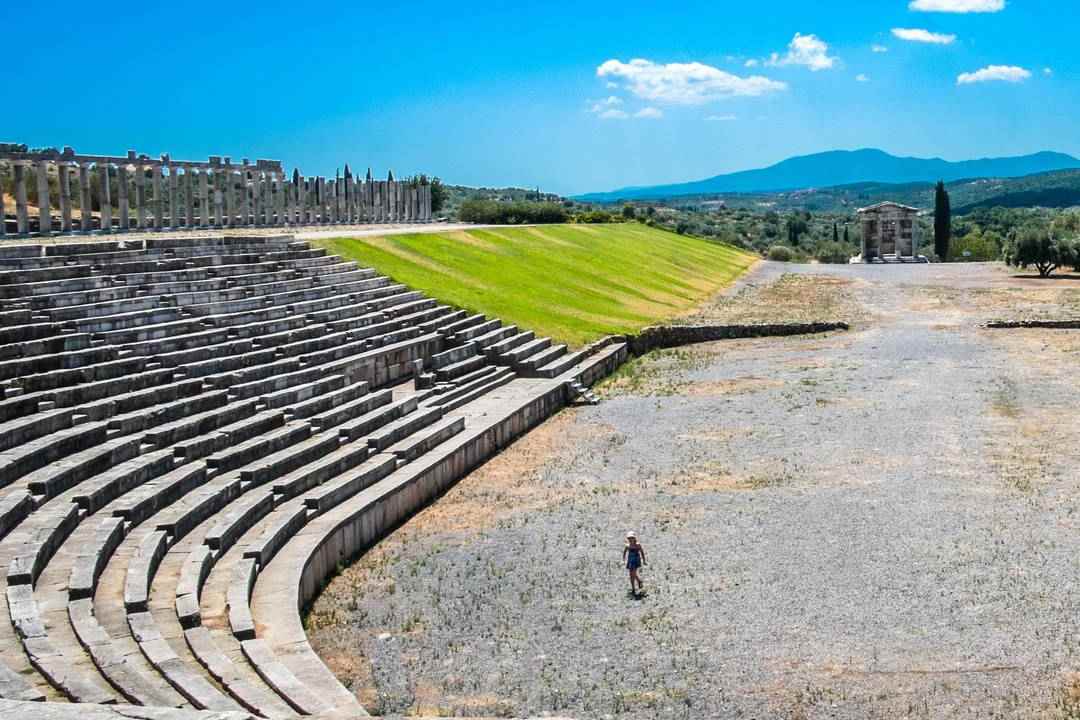
The stadium of Messene keeps rows of stone seats around its track. The colonnades of the gymnasium frame it. An Ancient Messene day trip from Athens ends the walk here, at the lowest point of the city.
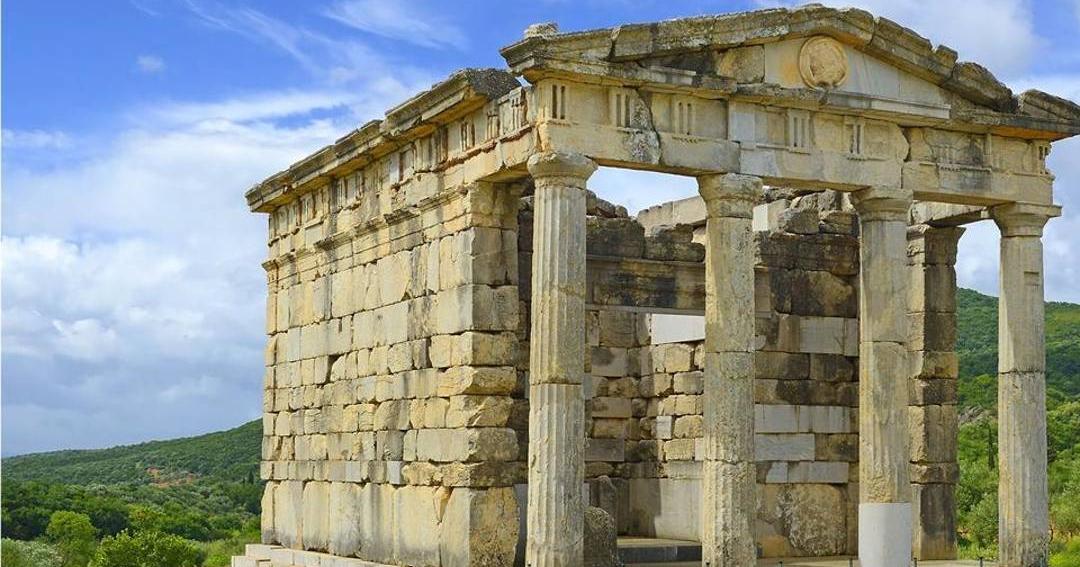
Doric colonnades run around three sides of the stadium. Restorers have set dozens of their columns back upright. At the far end, a temple-like tomb rises on the line of the city wall.
The gymnasium appears in the descriptions of Messene alongside the market, springs, and sanctuary. Greek gymnasia served physical training and education. Their presence also points to a community that valued organised instruction, athletic practice, and preparation for civic life.
The tomb at the end of the stadium belonged to a leading family of the Roman period. An Ancient Messene day trip from Athens finds it fully rebuilt, with its columns and pediment in place.
- The stadium forms a long athletic space within the excavated city.
- The gymnasium belonged to the public buildings recorded for ancient Messene.
- Training and education placed athletics within organised civic life.
- Roads linked the athletic complex with sanctuaries and other public areas.
Which finds fill the Archaeological Museum of Messene?
The Archaeological Museum of Messene holds sculptures, inscriptions and building parts from the ancient city. An Ancient Messene day trip from Athens gains detail inside this museum within the old city walls.
The museum stands inside the former city, close to the buildings where the finds came to light. An Ancient Messene day trip from Athens therefore joins objects with their original setting. A statue, inscription, or architectural element becomes easier to understand beside the sanctuary or theatre.
Excavation at Messene began in the nineteenth century and continued through later campaigns. An Ancient Messene day trip from Athens reveals the results of that long investigation. The collection reflects this long work across temples, houses, streets, public buildings, and funerary areas.
Allow time to compare the museum with the open-air remains. The galleries preserve details that distance and weather hide outside. The site then supplies scale, layout, and setting. Together, both parts explain how Messene functioned as a complete urban centre.
The museum also helps separate original ancient material from modern restoration. Architectural blocks reveal construction methods, while sculptures identify the religious and civic figures honoured in the city. The collection turns a walk among foundations into a more precise reading of the settlement.
What crowns the summit of Mount Ithome above the site?
The summit of Mount Ithome holds the sanctuary site of Zeus Ithomatas and the Old Monastery of Voulkano. An Ancient Messene day trip from Athens views the summit from the city below.
Mount Ithome rises to about 800 metres and forms the northern peak of a twin-peaked mountain. An Ancient Messene day trip from Athens places the city beneath this summit. Mount Eva is the other peak, reaching about 700 metres. A thin ridge connects them. The ancient city occupied the lower western side of Ithome.
The summit held a temple dedicated to Zeus Ithomatas. The site also hosted the Ithomaea, a yearly festival for Zeus. It began with a musical contest. The mountain therefore served as a religious centre above the urban settlement.
The monastery on the summit dates back at least to the Byzantine emperor Andronikos II Palaiologos. The old monastery later closed except for a caretaker. A new Voulkano monastery was built on the lower eastern slope of Mount Eva.
- Mount Ithome reaches about 800 metres above the surrounding Messenian landscape.
- The summit sanctuary honoured Zeus Ithomatas and held the Ithomaea festival.
- The Old Monastery reused stone from the earlier temple and stood above the site.
- The newer Voulkano monastery occupies the lower eastern slope of Mount Eva.
The mountain also shaped the city’s military history. Ithome became a centre of resistance during the Messenian Wars against Sparta. Its steep position offered defence, while the city walls extended protection around the urban area and routes below.
From the summit, the Pamisos river valley opens towards Mount Taygetus and the Gulf of Messenia. This view explains the mountain’s value as a lookout. It also shows why the builders joined elevated ground, springs, farmland, and fortifications in one plan.
Another Peloponnese day from the capital appears on the Mycenae and Epidaurus day trip from Athens page. Ancient Messene adds a full city plan, rather than a single palace, tomb, or theatre.
What does Mavromati village offer beside the site?
Mavromati adds a living village setting to an Ancient Messene day trip from Athens. The village has a spring and mountain views beside the ruins. The settlement occupies the ancient city’s upper slope, while the archaeological site spreads below.
Mavromati grew around Klepsydra, a spring that emerges from Mount Ithome. Ancient channels carried its water towards the city. The spring still serves as a village watering place. It gives the stop a direct link with the ancient settlement.
An Ancient Messene day trip from Athens reaches the village after the main road journey. The pause breaks the long drive before the walk through the ruins.
The village stands on the slope above the lower ruins. Its position gives a wide view over the site. Mount Ithome rises behind it, while the Messenian landscape opens towards Kalamata and the Gulf.
A short village pause helps divide a long sightseeing day. Use it for water, a simple refreshment, and a look at the local lanes. Keep the archaeological visit separate, since the ruins require steady walking across open ground.
- Spring and ancient water channels
- Village lanes around the upper settlement
- Views towards the Messenian plain
- Access towards the mountain monastery
Can an Ancient Messene day trip from Athens add Kalamata?
An Ancient Messene day trip from Athens pairs the archaeological site with Kalamata. Kalamata is the capital and chief port of Messenia, beside the Messenian Gulf. Its urban setting contrasts with the mountain valley around Messene.
An Ancient Messene day trip from Athens gains a clear contrast in Kalamata. Ancient stone gives way to a working regional capital beside the sea before the return to Athens.
Kalamata gives the return journey a coastal city pause. The city lies beside the Nedon River at the head of the gulf. A short walk through its central streets adds modern Messenian life after the ancient site.
One private Athens tour lasts 10 hours and includes Kalamata, Ancient Messene, and the Corinth Canal. Its plan places three distinct stops into one full day. The city visit works better as a focused walk than as a second archaeological tour.
For a slower city experience, base the visit in Kalamata on another day. The city also provides a practical starting point for a Mani day trip from Kalamata. A separate day leaves more time for villages and coastal scenery.
- City walk beside the Nedon River
- Views towards the Messenian Gulf
- Modern streets after the ruins
- Optional separate regional excursions


Can an Ancient Messene day trip from Athens add the Temple of Apollo at Bassae?
An Ancient Messene day trip from Athens can add a visit to the Temple of Apollo at Bassae. A full private 13-hour itinerary links both sites for an early start, late return, and lunch break.
An Ancient Messene day trip from Athens becomes a two-sanctuary route with Bassae. The added stop changes the balance from city study to regional archaeology during one long private day.
Bassae brings a separate sanctuary into the day. The Temple of Apollo stands in the mountains of the western Peloponnese. Its remote setting differs from Messene’s broad urban remains below Mount Ithome.
The listed private route includes a lunch break between the two ancient places. That pause matters because the combined programme lasts 13 hours. Keep the meal simple and protect enough daylight for the open-air ruins at Messene.
The Bassae route also suits travellers interested in mountain landscapes and sanctuary architecture. Keep the programme’s lunch break protected, since the two sites have no shared urban centre. The private format joins distant stops without changing vehicles.
Choose the single-site tour when the city’s public buildings need careful attention. Choose Bassae when two major sanctuaries matter more than a relaxed pace. A private vehicle keeps the sequence flexible within the booked programme.
- Remote mountain sanctuary at Bassae
- Ancient city below Mount Ithome
- Lunch break between visits
- Thirteen-hour private programme
Which months suit an Ancient Messene day trip from Athens?
Late spring, early summer, and early autumn suit an Ancient Messene day trip from Athens. Summer opening hours run into the evening. Winter hours end in the afternoon.
An Ancient Messene day trip from Athens benefits from daylight that supports a long open-air visit. Seasonal hours also affect the timing of every added stop on the full route itinerary.
Late spring brings longer daylight without the full force of high summer. Start the ruins early, then use the later hours for Mavromati or Kalamata. Wear a hat because the archaeological ground has exposed sections.
Early autumn keeps long opening hours and brings softer light on the stone. The closing time moves earlier through September and October, so the return to Athens needs planning.
Winter hours end in the mid-afternoon from November to March. That window leaves less room for extra stops. Check the day’s opening time before departure, especially around Good Friday and Holy Saturday.
What do you bring on an Ancient Messene day trip from Athens?
Bring water, sun protection, firm shoes, and a light layer for an Ancient Messene day trip from Athens. The site covers open archaeological ground. The village and mountain setting add uneven paths and changing exposure.
Pack a refillable water bottle for the drive and the ruins. Add a hat, sunglasses, and sunscreen for the exposed city spaces. A small snack helps during a long private itinerary with three stops.
Choose shoes with a secure sole rather than smooth casual footwear. Ancient paving, soil, and sloping paths appear across the site. A compact layer helps during early departures, mountain stops, and the cooler return journey.
Carry a phone charger, identification, and the meeting details for the booked vehicle. Keep luggage small, since a full-day route includes repeated exits and entries. A notebook also helps record names without relying on memory.
- Water bottle and compact snack
- Hat, sunglasses, and sunscreen
- Firm shoes with secure soles
- Light layer for changing temperatures
- Phone charger and meeting details
How do you book and cancel an Ancient Messene day trip from Athens?
Book an Ancient Messene day trip from Athens by choosing the route length and stop pattern. Set pickup details first, then compare 9-hour, 10-hour, and 13-hour private programmes. Eligible listings allow free cancellation up to 24 hours before start.
The 9-hour luxury route focuses on Messene’s temples, stadium, and theatres. The 10-hour route adds Kalamata and the Corinth Canal. The 13-hour route combines Messene with Bassae and includes a lunch break.
Write the pickup address and start time into the travel plan. Keep a copy of the booking details offline for the morning departure. This simple step prevents delays when mobile reception changes along the route.
Read the selected listing for pickup time, meeting point, duration, and cancellation deadline. Keep the reservation details available on the travel day. Confirm with the operator when a special pickup or unusual stop matters.
From Kalamata, shorter options last five or six hours. They cover the theatre and stadium, or the walls and surviving gate. A separate Pylos day trip from Kalamata suits a later regional day.
Compare the programme with the opening timetable and the group’s walking pace. Select a route with enough time for the locations that matter. For broader local planning, review Kalamata tours before fixing extra days.
Frequently Asked Questions
Is an Ancient Messene day trip from Athens possible in one day?
Yes. Private programmes from Athens last 9, 10, or 13 hours, depending on added stops. The shortest route focuses on Messene, while longer plans include Kalamata, the Corinth Canal, or Bassae. An early pickup creates time for the full itinerary.
Can an Ancient Messene day trip from Athens work without a car?
Public transport requires careful connections through the Peloponnese. It also requires onward travel to Mavromati. A private tour removes those changes and links Athens with the archaeological site. From Kalamata, local private tours last five or six hours.
How long do visitors spend at Ancient Messene?
Allow at least two to three hours for a focused walk through the extensive ruins. Add time for Mavromati, photographs, and pauses on uneven ground. A longer private programme gives the site more attention before the return journey.
Is there shade during an Ancient Messene day trip from Athens?
Shade is limited across the open archaeological areas. Carry a hat, water, and sunscreen, then plan pauses near available structures or the village. Early visits reduce direct sun exposure and leave more comfortable walking conditions.
How far ahead is an Ancient Messene day trip from Athens booked?
Reserve after fixing the travel date, pickup point, and preferred stops. Private vehicles have limited availability, while longer Bassae programmes need more planning. Review the cancellation deadline before payment, since eligible listings allow cancellation up to 24 hours before start.