
A Sparta day trip from Kalamata crosses Mount Taygetos from Messenia into Laconia for the acropolis of ancient Sparta, the Leonidas statue and the Evrotas valley, and returns the same evening. Tours across the rest of the country are listed on Greece Tours.
The sections below cover the tours you can book, the route, the timing, Sparta’s rule over Messenia, the helots, the agoge, the kings, Thermopylae, the ancient sites, modern Sparti, food, the season, packing and booking for a Sparta day trip from Kalamata, with links into the Sparta tours pages. The tours shown are checked on GetYourGuide and Viator.
What is a Sparta day trip from Kalamata?
A Sparta day trip from Kalamata is a return journey from Messenia into Laconia across Mount Taygetos. It reaches the site of the ancient Spartan state in the Eurotas valley. The same evening, the road brings travellers back to Kalamata.
Kalamata is the capital of Messenia. Sparta, also called Sparti, is the capital of Laconia. Mount Taygetos rises between the two regions and forms the border between them. A Sparta day trip from Kalamata crosses that border twice, once out and once back.
The road crosses land that Sparta once ruled. For about three centuries, Spartan citizens took the harvests of Messenia. A Sparta day trip from Kalamata therefore starts in the region that fed the ancient city.
Ancient Sparta had three social classes. Citizens formed the political core. Perioikoi were free non-citizens who lived in the towns around Laconia. Helots worked the land and supplied the food that kept citizens free for war.
- Start: Kalamata, on the Messenian Gulf
- Crossing: Mount Taygetos
- Goal: Sparti, in the Eurotas valley
- Return: the same road to Kalamata
Which Sparta day trips from Kalamata can you book?
GetYourGuide sells a Sparta day trip from Kalamata in four formats. They cover Sparta alone, Sparta with Mystras, Sparta with Monemvasia and a Taygetos summit hike. Viator adds two Mystras and Sparta days from Kalamata.
“From Kalamata: Private Day Trip to the Acropolis of Sparta” lasts 6 hours. Its description covers the drive over Taygetos, the everyday life of the Spartans and the Keadas pit.
“From Kalamata: Mystras and Sparta Day Trip” lasts 8 hours and adds the Byzantine town of Mystras. “Explore Sparta and Mystras on a Private One-Day Tour” pairs the same two places for one private group. “Monemvasia & Sparta: Castles, Legends & Local Flavors” lasts 12 hours. It ends with a tasting of Greek delicacies and craft beer.
“Hiking Mount Taygetos – Summit of Profitis Ilias (Pyramid)” lasts 10 hours. The hike climbs to the 2,405-metre summit above Sparta. Viator lists two more from Kalamata. They are “Mystras and Sparta Day Trip Explore Greece’s Heritage” and “Private Day Tour to Mystras and Sparta”.
GetYourGuide files two of the listings under other towns. The Monemvasia day sits under Monemvasia and the hike under Sparta. Check the meeting point before booking either one as a Sparta day trip from Kalamata.
- Sparta alone, private: 6 hours
- Mystras and Sparta: 8 hours
- Sparta and Mystras, private: one day
- Monemvasia and Sparta: 12 hours
- Taygetos summit hike: 10 hours

Which route over Taygetos does a Sparta day trip from Kalamata take?
A Sparta day trip from Kalamata follows National Road 82 over Taygetos to Sparti. The mountain road covers about 60 km between the two capitals. A longer motorway route runs north through Tripoli and then south to Sparta.
National Road 82 is the direct road between Kalamata and Sparti. It climbs the western slopes above the Messenian Gulf. It then drops down the eastern face into the Eurotas valley. Tour descriptions treat the crossing as part of the day, not only as transport.
The western slopes drain toward the Messenian Gulf. The eastern side overlooks Sparta and the farmland of ancient Laconia. On a clear day, the change of landscape marks the border that ancient armies crossed.
A Sparta day trip from Kalamata spends about 1.5 hours on the road in each direction. That leaves about 3 hours at the sites on the 6-hour private tour.
The motorway route through Tripoli avoids the mountain bends. It adds distance, so tours from Kalamata use the mountain road. More departures from the city appear on the Kalamata tours page.
- Kalamata: west of Taygetos
- National Road 82: over the range
- Sparti: east of Taygetos
- Tripoli: the motorway detour to the north
How long does a Sparta day trip from Kalamata last?
A Sparta day trip from Kalamata lasts 6 to 12 hours in the listed tours. Sparta alone takes 6 hours. Adding Mystras stretches the day to 8 hours. A summit hike needs 10 hours, and Monemvasia needs 12.
The 6-hour private Sparta day trip from Kalamata covers the ancient city and the mountain drive only. It leaves the evening free in Kalamata.
The 8-hour Mystras option turns the Sparta day trip from Kalamata into a two-site day. Mystras stands about 6 km west of modern Sparti, so the extra stop costs little driving time.
The 10-hour hike is a mountain day, not a sightseeing day. Walkers need fitness, boots and a good weather window. The 12-hour Monemvasia route adds the long drive to the castle town on the east coast of Laconia.
Match the length of a Sparta day trip from Kalamata to the main interest. Six hours give a focused visit. Eight hours add Byzantine Mystras. Ten hours centre on the mountain, and twelve hours add the sea fortress of Monemvasia.
Why did Sparta conquer Messenia, the land around Kalamata?
Sparta conquered Messenia in the Messenian Wars of the 8th and 7th centuries BC. The prize was the fertile land west of Taygetos. A Sparta day trip from Kalamata crosses the mountain those armies fought over.
Pausanias dates the First Messenian War to the 8th century BC. In his account it lasted about two decades and ended with a Spartan victory. Part of the Messenian population emigrated. Those who stayed became subjects in hereditary servitude.
Pausanias also describes a deeper rivalry between Laconia and Messenia. His sources set Dorian communities against Achaean ones. Modern historians still debate the motives behind the wars.
The Second Messenian War began with a revolt of the conquered population. Its traditional date falls in the 7th century BC. The Messenians held out in fortified positions with outside support, yet Sparta restored control.
Messenia mattered because its farmland fed Sparta. Conquered families worked the fields and handed over part of every harvest. That income freed Spartan citizens to train as full-time soldiers. Every Sparta day trip from Kalamata drives out through olive groves on that same land.
- First war: Spartan victory over Messenia
- Aftermath: emigration and servitude
- Second war: a revolt crushed by Sparta
- Result: Messenian farmland fed Spartan citizens
Who were the helots who worked Messenian land for Sparta?
Helots were the subject population of Laconia and Messenia, tied to the land they farmed. Their status stood between free people and chattel slaves. A Sparta day trip from Kalamata starts in the region where they formed the majority.
Helots outnumbered the citizens in the territories Sparta ruled. Ancient and modern writers disagree about their exact legal status. The secure point is their role: they farmed the land and fed the citizen households.
Helot families lived on the land and kept limited property of their own. Unlike purchased slaves, they belonged to the land rather than to one owner.
The Spartans feared a helot revolt. Herodotus recorded seven helots for each of the 5,000 Spartan soldiers at Plataea. Aristotle reported that the ephors declared war on the helots every year. The Crypteia, a secret band of young Spartans, killed helots seen as a threat.
Helots also served in war. By the 5th century BC, they fought as light troops. Sparta freed certain helots in return for military service, yet the system stayed in place.
Helot labour explains why Messenia mattered to Sparta. A Sparta day trip from Kalamata covers both ends of that system. It links the farmland in the west with the citizen city in the east.
How did Messenia break free from Sparta?
Messenia broke free after Thebes defeated Sparta at Leuctra in the 4th century BC. The Theban general Epaminondas then founded the city of Messene on Mount Ithome. A Sparta day trip from Kalamata starts in the region that regained its freedom.
The Battle of Leuctra took place in Boeotia. Epaminondas led the Theban army, and King Cleombrotus I commanded the Spartans. The Spartan king fell, and Sparta lost its grip on the Peloponnese.
The defeat removed the military pressure that held Messenia down. The helots revolted again as the Theban victory shifted the balance of power.
Epaminondas entered the Peloponnese with Boeotian, Argive and Messenian forces. He founded Messene on the slopes of Ithome, a strong mountain position. Messenian exiles and their descendants returned after generations abroad.
Ancient Messene therefore stands for liberation. Ithome had served as a refuge in the earlier wars. After Leuctra, it became the centre of a free Messenian state. The Mystras day trip from Kalamata covers the Byzantine side of the same mountain crossing.
Ancient Messene lies north-west of Kalamata, away from the route of a Sparta day trip from Kalamata. It makes a separate outing from the city.
- Leuctra: Spartan defeat by Thebes
- Revolt: Messenian helots rose again
- Foundation: Messene on Mount Ithome
- Return: exiles came home to a free Messenia
How did the agoge train Spartan boys?
The agoge was the state training system that every future Spartan citizen passed through. Boys entered at seven and trained in age groups until adulthood. A Sparta day trip from Kalamata explains the system that produced Sparta’s soldiers.
The agoge was required for citizen status. The training ran in three stages. The paides were boys, the paidiskoi were adolescents and the hēbōntes were young men. Exercise, hunting, singing, dancing and endurance filled the days.
Clothing, sleep and food were kept short on purpose. Boys were expected to steal extra food, and they were punished when caught. The lesson was stealth and resourcefulness, not theft itself.
The boys also learned to speak briefly, a style still called laconic after Laconia. They learned to take teasing and to compete with their peers. These habits built obedience to the laws and loyalty to the group.
Not every child entered the agoge. It was open to the sons of Spartan citizens. Helots and other boys outside the citizen class stayed out.
At about 20, young men entered the hēbōntes stage. At 30, a man joined a common mess, the syssition, and became a full citizen.
Plutarch and Xenophon both described the agoge. Their accounts shape how guides on a Sparta day trip from Kalamata explain the Spartan army.
How did two kings and the ephors rule Sparta?
Sparta had two hereditary kings, five elected ephors and a council of elders called the gerousia. The kings led armies and religious rites, while the ephors and the council limited their power. A Sparta day trip from Kalamata visits the city that ran this system.
The two kings came from the Agiad and Eurypontid royal houses. They held equal authority. With two kings, neither ruled alone.
The kings served as state priests and kept contact with the oracle at Delphi. They commanded the army in war and kept a share of judicial duties.
The five ephors were elected each year. They judged civil and criminal cases and supervised state business. Their office gave the citizens a check on the kings. On campaign, two ephors travelled with the king and watched his conduct.
The gerousia had 28 men over the age of 60, elected for life, plus the two kings. It prepared proposals for the citizen assembly, which voted on them.
Tradition credits Lycurgus with Sparta’s laws and good order. Modern historians cannot confirm his life or link every institution to him.
- Two kings from two royal houses
- Five ephors elected each year
- Gerousia of 28 elders and the kings
- Assembly of citizens voting on proposals
- Lycurgus as the traditional lawgiver
What did Leonidas and the 300 do at Thermopylae?
Leonidas, a king of Sparta, led 300 Spartan citizens at Thermopylae in the 5th century BC. With a larger Greek army, they held the pass against Xerxes I. A Sparta day trip from Kalamata reaches the city that sent them.
Leonidas came from the Agiad royal house. He had passed through the agoge, unlike a typical heir to the throne. He commanded the allied Greek force during the second Persian invasion of Greece.
Sparta sent 300 full citizens. Troops from other Greek cities made up the rest of the army. The Greeks held a narrow pass between the mountains and the sea.
The Greeks threw back Persian attacks for two days. A local man then showed the Persians a mountain path around the pass. Leonidas sent the bulk of the allies away and stayed with a rearguard.
The rearguard included the 300 Spartans, 700 Thespians and 400 Thebans. The Thespians stayed by choice. Leonidas and his men were killed, and the Thebans surrendered.
The battle was a defeat, but the Persian invasion failed the following year. Sparta then led the Greek army at Plataea. The Sparta day trip page covers tours to the same city from Athens.
Thermopylae lies in central Greece, far outside the route of a Sparta day trip from Kalamata. In Sparti, the statue of Leonidas keeps the link to the battle.
What role did women play in ancient Sparta?
Spartan women owned land, trained their bodies and ran households while the men served in the army. Other Greek cities kept women at home. A Sparta day trip from Kalamata reaches the one Greek city known for its free women.
Girls in Sparta received a public education. They ran, wrestled and threw the javelin, since the state wanted strong mothers for strong soldiers. They also married later than girls in Athens.
Spartan women owned and inherited land. Aristotle wrote that women held about two-fifths of the land of Laconia in his day. With the men away on campaign, women managed the estates and the helots who worked them.
Gorgo, the wife of Leonidas, appears in the ancient sources more than any other Spartan woman. Plutarch records a question put to her: why did Spartan women rule their men? She replied that only Spartan women gave birth to men.
- Public education and athletics for girls
- Ownership and inheritance of land
- Management of estates and helots
- A later marriage age than in Athens
The Spartan princess Cynisca was the first woman to win at the Olympic Games. She won in the 4th century BC. Her horses won the four-horse chariot race. On a Sparta day trip from Kalamata, guides add her name to the city’s story of champions.
What stands on the acropolis hill of ancient Sparta?
A Sparta day trip from Kalamata reaches the low acropolis hill just north of modern Sparti. The sanctuary of Athena Chalkioikos crowned its summit. A circular building, Roman shops, the theatre and a Byzantine basilica share the hill.
Athena Chalkioikos means Athena of the Bronze House. Bronze sheets with relief scenes once covered the inner walls of her temple. Little of the temple survives above the ground today.
The theatre and the Roman shops stand on the southern side of the hill. The basilica belongs to the Middle Byzantine period. It is linked with Saint Nikon, who preached in the Peloponnese.
- Sanctuary of Athena Chalkioikos at the summit
- Circular building of unknown use
- Roman-period shops beside the theatre
- Middle Byzantine basilica remains
American and Greek archaeologists began digging here near the end of the 19th century. The British School at Athens has worked on the hill since the early 20th century. Later campaigns focused on the theatre and the shops.
On a Sparta day trip from Kalamata, the acropolis is the main stop. Olive trees cover much of the hill, and paths link the ruins.
What is left of the theatre of ancient Sparta?
The theatre of ancient Sparta is an early Roman building on the south side of the acropolis. The orchestra, the retaining walls and part of the seating survive. On a Sparta day trip from Kalamata, it is the largest structure on the site.
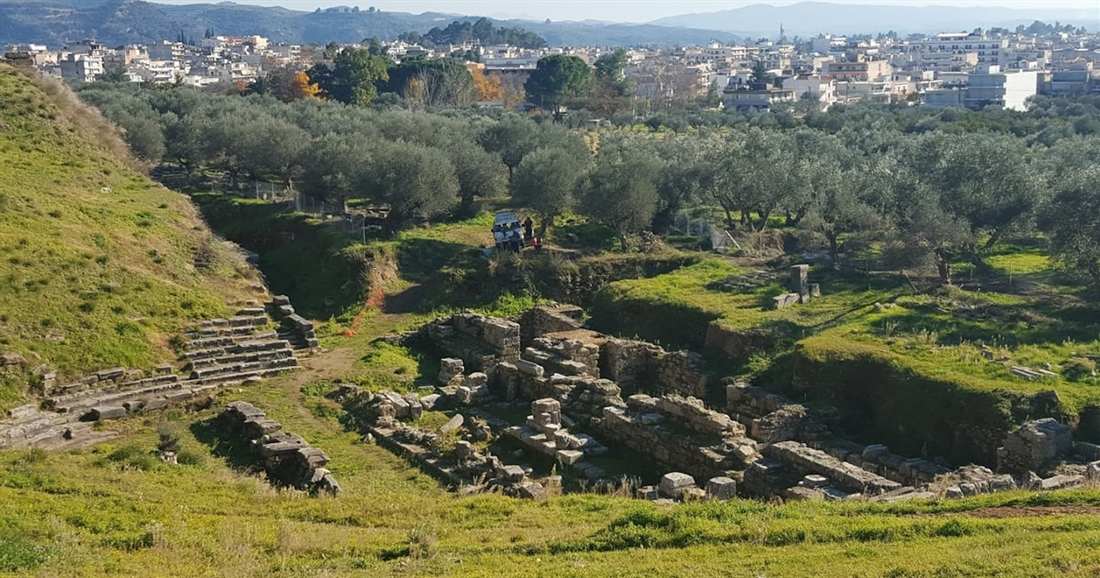
The orchestra formed the central performance floor. Retaining walls held up the cavea, the curved bank of seats. At first, the stage was a wooden structure that ran on wheels along stone tracks. The seats faced south, toward the town and the Eurotas valley.
Inscriptions on the walls list Spartan officials of the Roman period. They show that Sparta kept its own magistrates under Roman rule.
Shops beside the theatre served the crowds at performances and festivals. Their remains date from the Roman Imperial period. Together, the theatre and the shops formed a public quarter at the foot of the hill.
- Orchestra at the centre
- Retaining walls of the cavea
- Surviving rows of seats
- Inscriptions naming Roman-period officials
Wear shoes with a firm sole on a Sparta day trip from Kalamata. The theatre ground mixes loose earth, stone steps and uneven blocks.
What happened at the sanctuary of Artemis Orthia?
The sanctuary of Artemis Orthia stood beside the Eurotas river and hosted rites of the Spartan youth. In Roman times an amphitheatre rose around its altar. A Sparta day trip from Kalamata passes close to the site on the edge of town.
The cult of Artemis Orthia is older than the temple whose foundations survive. Boys of the agoge took part in contests at the altar. In Roman times, spectators watched these rites from the amphitheatre seats.
The British School at Athens excavated the sanctuary in the early 20th century. The dig turned up thousands of offerings. The sanctuary lies on the west bank of the Eurotas, at the eastern edge of modern Sparti.
- Painted pottery and geometric vessels
- Small lead figures
- Clay masks
- Carved ivory and bone
- Animal bones from sacrifices
Entry to the sanctuary needs an arrangement with the Ephorate of Antiquities of Laconia. Before a Sparta day trip from Kalamata, ask the operator whether the stop is open that day.
Why do visitors climb to the Menelaion above the Evrotas?
Visitors climb to the Menelaion for its shrine to Menelaus and Helen. The hill also gives a view over the Evrotas valley. The site stands at Therapne, on a ridge east of the river. A Sparta day trip from Kalamata adds it as a short drive from town.
The Menelaion sits on a hill above the left bank of the Evrotas. The Therapne ridge holds a row of hilltops, and the shrine crowns one of them. From the top, the whole valley spreads out toward Taygetos.
Spartans built a hero shrine here in the 8th century BC, over older Mycenaean remains. Later inscriptions dedicated to Helen and Menelaus confirmed whom the shrine honoured.
- Hero shrine of Menelaus and Helen
- Mycenaean buildings beneath it
- Open-air site on a ridge
- View over the Evrotas valley
The site is open air and stays open all day. On a Sparta day trip from Kalamata, the short climb needs walking shoes and water.
What was the Amyklaion, the shrine of Apollo south of Sparta?
The Amyklaion was the sanctuary of Apollo and Hyakinthos at Amyclae, south of Sparta. It was Sparta’s second religious and political centre for centuries. A Sparta day trip from Kalamata reaches it by a short drive down the valley.
The sanctuary stood on the hill of Agia Kyriaki. Retaining walls, circuit walls, foundations of different periods and a circular altar survive.
Pausanias described the Throne of Apollo here. A colossal bronze statue of Apollo, shaped like a column, stood on the tomb-altar of Hyakinthos. Bathycles of Magnesia designed the throne building around it. Carved parts of the throne are on show in the Archaeological Museum of Sparta.
- Hill of Agia Kyriaki at Amyclae
- Sanctuary of Apollo and Hyakinthos
- Retaining and circuit walls
- Circular altar
The Hyakinthia festival took place at the Amyklaion each summer. It mourned Hyakinthos and then celebrated Apollo. On a Sparta day trip from Kalamata, the shrine shows that Spartan religion reached well beyond the city.
How was modern Sparti laid out?
Modern Sparti was founded in the 19th century under King Otto. Its grid plan lies beside the ancient site. Wide streets and large squares mark the plan. A Sparta day trip from Kalamata uses the town as its base for lunch and breaks.
Sparti lies in the Evrotas valley at the eastern foot of Taygetos. The Parnon range rises on the other side of the valley. The main avenue, Konstantinou Palaiologou, runs north through the centre toward the statue of Leonidas.
Ancient Sparta was a group of villages without a city wall for centuries. The modern planners chose straight streets and open squares instead. Orange and olive groves still reach the edge of town.
- Grid plan of the 19th century
- Evrotas valley setting
- Taygetos to the west
- Parnon to the east
- Wide, tree-lined streets
Sparti is the capital of Laconia. On a Sparta day trip from Kalamata, the central square gives shade and cafés between site visits.
What does the statue of Leonidas in Sparti show?
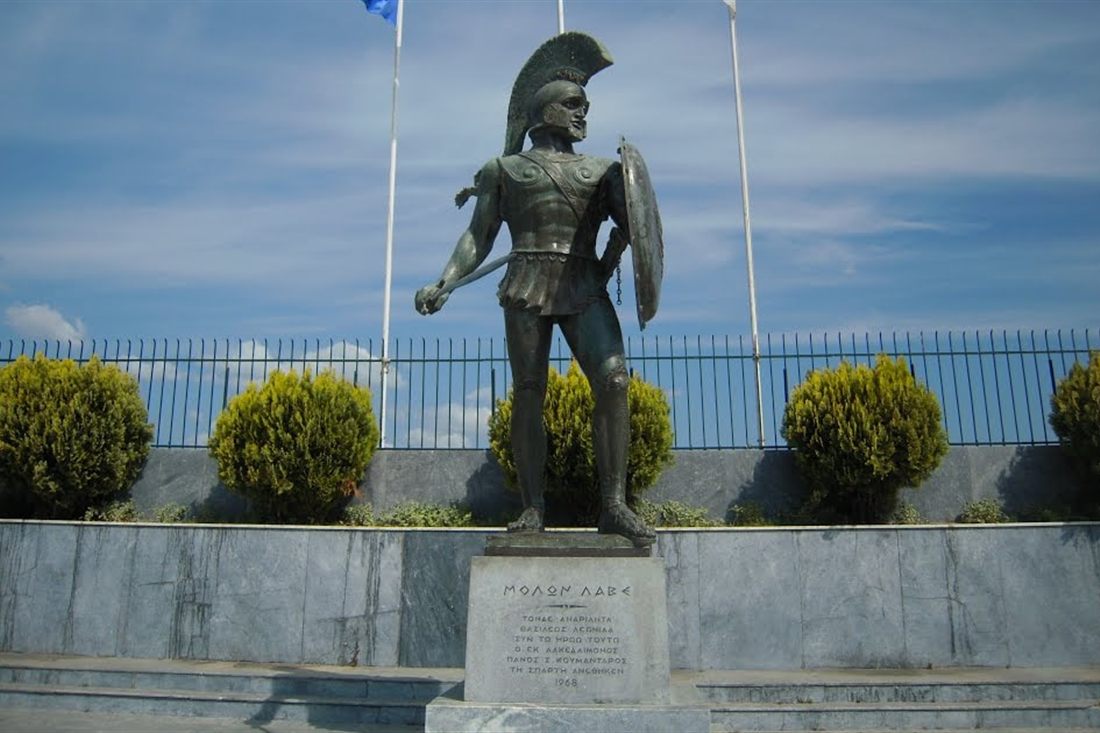
The statue of Leonidas in Sparti shows the king in bronze. He holds a spear and a round shield and wears a crested helmet. It stands on a marble base near the ancient acropolis. A Sparta day trip from Kalamata stops here for photos.
The statue is a modern work, not an ancient monument. It stands at the northern edge of the town, on the way to the acropolis hill.
The base carries the words “Molon labe”, meaning “come and take them”. Plutarch records the phrase as Leonidas’s reply when Xerxes ordered the Greeks to hand over their weapons.
- Bronze figure of Leonidas
- Crested helmet, spear and shield
- Marble base with the inscription
- Location near the acropolis hill
Pair the statue with the Archaeological Museum of Sparta on a Sparta day trip from Kalamata. The museum shows excavated objects, while the statue shows how the town remembers its past.
Which Laconian foods suit lunch on a Sparta day trip from Kalamata?
Laconian lunches draw on olive oil, oranges from the Evrotas valley and pork from the hills. Syglino, smoked pork from the Mani, is a regional speciality. A Sparta day trip from Kalamata breaks for lunch in Sparti between sites.
Laconia produces olive oil under a protected regional name. Orange and citrus groves fill the valley floor around Sparti. Both appear on local menus and at the market stalls in town.
Ancient Spartans ate a black broth called melas zomos. It was made from pork boiled with blood and vinegar. Plutarch wrote that visitors found it hard to swallow.
- Laconian olive oil
- Oranges from the Evrotas valley
- Syglino smoked pork
- Kalamata olives from the departure city
Ask the tour operator whether lunch is included or free. Travellers with more days in Kalamata can follow the coast on the Mani day trip from Kalamata. The Olympia day trip from Kalamata adds the site of the ancient Games.
Which months suit a Sparta day trip from Kalamata?
Late spring and autumn suit a Sparta day trip from Kalamata. Both seasons give milder heat for walking on open archaeological ground. July and August bring the strongest sun, so summer visits start early in the day.
The acropolis, the Menelaion and the Amyklaion have little shade. Water, sun protection and a hat matter more in summer than in any other season.
Winter brings snow to the high slopes of Taygetos. The road over the mountain needs a weather check before departure in the cold months.
- Late spring: green valley and mild walking weather
- Summer: early starts and shade breaks
- Autumn: warm days and the olive harvest
- Winter: snow on Taygetos and a road check
Access rules differ between sites. Artemis Orthia needs an arrangement with the Ephorate, while the Menelaion stays open. Check each stop before fixing the date of a Sparta day trip from Kalamata.
What do you wear and bring on a Sparta day trip from Kalamata?
Pack water, sun protection, a hat and walking shoes for a Sparta day trip from Kalamata. Add a light layer for the mountain road over Taygetos. The day mixes open ruins with a cooler drive across the range.
Walking shoes suit the unpaved ancient sites. They also help on the acropolis paths and the climb to the Menelaion. Choose a firm sole and secure fastening.
Sun protection and a hat cover the open ground, where shade is scarce. A refillable bottle saves trips back to the vehicle.
- Water bottle
- Sun protection
- Hat
- Walking shoes
- Light layer
Keep the bag small enough for narrow paths between walls. Pack the light layer even when Kalamata feels warm. The mountain air is cooler at the top of the pass.
How do you book and cancel a Sparta day trip from Kalamata?
Book a Sparta day trip from Kalamata on GetYourGuide or Viator. Check the stops, the length and the private status first. The private acropolis trip lasts 6 hours. Other listings combine Sparta with Mystras or Monemvasia.
GetYourGuide lists three Sparta days from Kalamata. They are the private acropolis trip, the 8-hour Mystras and Sparta day and a private tour of both. Read each listing on its own, since the stops differ.
Viator lists Mystras and Sparta trips from Kalamata, including a private day tour. Ask whether the booking includes the acropolis, the museum, the sanctuaries and the hilltop stops. Keep every requested stop in the written booking.
- Check the named stops
- Confirm private or shared status
- Check the stated duration
- Ask about site access
- Read the cancellation rule
GetYourGuide listings with free cancellation allow it up to 24 hours before the start. Confirm the wording on the chosen listing before paying for a Sparta day trip from Kalamata.
Frequently Asked Questions
Is a Sparta day trip from Kalamata possible by bus?
KTEL regional buses serve both Kalamata and Sparti. Check the current KTEL timetables for a same-day return before planning the trip by bus. A tour removes the need to match bus times with site hours.
Does a Sparta day trip from Kalamata include Mystras?
Only on the listings named Mystras and Sparta. The 6-hour private tour covers the acropolis of Sparta alone. Read the itinerary of the chosen listing before booking.
Is a Sparta day trip from Kalamata private?
It can be. The 6-hour acropolis trip and one Mystras and Sparta tour on GetYourGuide are private. Viator lists a private day tour too. Shared group days also run.
How much walking does a Sparta day trip from Kalamata involve?
The ancient sites need walking on unpaved ground, stone steps and short hill paths. The Menelaion adds a short climb. Walking shoes and water cover the needs of the day.
How far ahead do you book a Sparta day trip from Kalamata?
Each listing shows its own booking cut-off. Private tours need a free driver and vehicle on the chosen date. Booking before arriving in Kalamata keeps the choice of dates open.