
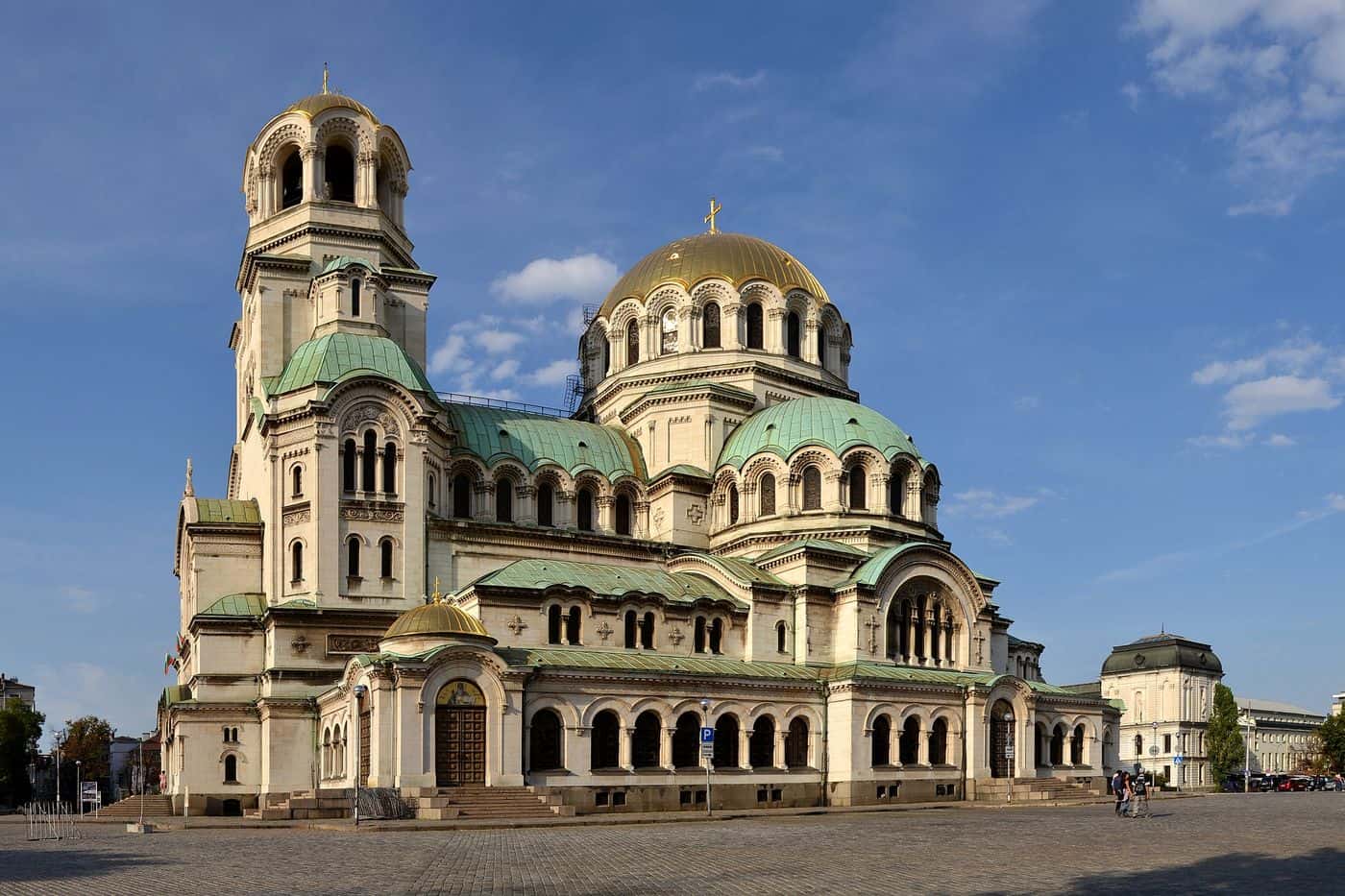
Sofia tours start in Sofia, the capital and largest city of Bulgaria, at the foot of Mount Vitosha. The routes cover the Alexander Nevsky Cathedral, the churches and the mosque of the centre, the ruins of ancient Serdica, the museums, Vitosha Boulevard and the day trips to Koprivshtitsa, Belogradchik and the Rose Valley. Greece Tours lists the trips that cross into Bulgaria from northern Greece.
This page covers what Sofia tours see in the city and on the mountain above it, which tours taste the food and trace the communist past, which day trips leave the capital, how visitors reach Sofia from Greece, and which season suits each route. The tours below are checked on GetYourGuide and Viator and leave from Sofia.
What do Sofia tours cover?
Sofia tours cover the capital and largest city of Bulgaria, which sits in the Sofia Valley at the foot of Mount Vitosha. A city walk links the Alexander Nevsky Cathedral, the churches, mosque and synagogue of the centre, and the excavated ruins of Roman Serdica.
Sofia tours walk through nearly 7,000 years of history. Khan Krum took Serdica into the First Bulgarian Empire in 809, and the city became known as Sredets. The Ottomans conquered it in 1382, Bulgarian rule returned in 1878, and Sofia became the capital of the Third Bulgarian State the following year.
Sofia ranks among the top tourist destinations in Bulgaria, next to the coastal and mountain resorts. Visitors on Sofia tours find the main tourist information centre at 22 Tsar Osvoboditel Boulevard, in the underpass of Sofia University, and a second centre in the Largo underpass, at the entrance to the Serdika II metro station.
Sofia tours also leave the centre. A bike tour starts at the Ivan Vazov National Theatre and rides into the countryside around the city from April to November. The classic day trip heads south, under the slopes of Rila, and our Rila Monastery tours page covers it.
- Population: about 1.28 million residents live within 500 square kilometres of city territory.
- Altitude: the Sofia Valley averages 550 metres, which makes Sofia the second highest capital of the European Union after Madrid.
- Mountains: Vitosha rises to the south, Lyulin to the west and the Balkan Mountains to the north.
What do Sofia tours see at the Alexander Nevsky Cathedral?
Sofia tours see the Alexander Nevsky Cathedral, a Neo-Byzantine Bulgarian Orthodox cathedral that serves as the cathedral church of the Patriarch of Bulgaria. It covers 3,170 square metres, holds 5,000 worshippers and ranks among the ten largest Eastern Orthodox church buildings.
Sofia tours start with the dedication. The cathedral honours the Russian soldiers who died in the Russo-Turkish War of 1877–1878, which freed Bulgaria from Ottoman rule, and it bears the name of Saint Alexander Nevsky, a Russian prince. The foundation stone was laid in 1882, and the main build ran from 1904 to 1912.
Alexander Pomerantsev designed the church, aided by Alexander Smirnov and Alexander Yakovlev, after he radically changed the 1884–1885 project of Ivan Bogomolov. The marble parts and lighting fixtures came from Munich, the gate metalwork from Berlin, the gates from Karl Bamberg’s factory in Vienna and the mosaics from Venice. The church was consecrated on 12 September 1924.
Sofia tours then go down to the crypt, which holds a museum of Bulgarian icons, part of the National Art Gallery; the cathedral claims the largest collection of Orthodox icons in Europe. Left of the altar, a case displays relics of Alexander Nevsky, given by the Russian Orthodox Church.
- Central dome: gold-plated, 45 metres high, or 46.3 metres with the cross.
- Bell tower: 53 metres high, with 12 bells weighing 23 tons in total.
- Interior: Italian marble, Brazilian onyx and alabaster, with the Lord’s Prayer in thin gold letters around the central dome.
Which churches and mosques do Sofia tours see in the centre?
Sofia tours see the Saint Sofia Church that gave the city its name, the Rotunda of St. George, the Banya Bashi Mosque, the Sofia Synagogue, the Russian Church and St. Nedelya, which forms a “triangle of religious tolerance” with the mosque and the synagogue.
Sofia tours begin at the Saint Sofia Church, believed to date from the reign of Justinian I (527–565); the city took its name from it in the 14th century. The church served as a mosque from the 16th century, and its floor carries Early Christian mosaics.
Sofia tours step down to the Rotunda of St. George, a red-brick church below the level of the modern streets, between Hotel Balkan and the Presidency. The oldest building in modern Sofia, it resembles the Rotunda of Galerius in Thessaloniki, and frescoes of 22 prophets crown its 13.7-metre dome.
Mimar Sinan designed the Banya Bashi Mosque, completed in 1566 over natural thermal spas; it is the only functioning mosque in Sofia. The Sofia Synagogue, opened on 9 September 1909, is the largest synagogue in Southeastern Europe and holds about 1,300 worshippers.
- Russian Church: the Church of St Nicholas the Miracle-Maker on Tsar Osvoboditel Boulevard, designed by Mikhail Preobrazhenski, carries five gold-coated domes.
- St. Nedelya: the cathedral of the Sofia bishopric keeps the relics of the Serbian king Stefan Uroš II Milutin, and its central dome raises it to 31 metres.
- Synagogue chandelier: the main chandelier weighs 1.7 tonnes, the largest in Bulgaria.
What do Sofia tours see of ancient Serdica?
Sofia tours see Roman Serdica right under the modern centre of Sofia: excavated gates, walls and baths, ruins in full view around and inside the Serdika metro stations, and glass domes on Independence Square that expose the Thracian and Roman city.
Sofia tours start with the Serdi, a tribe of Thracian, Celtic or mixed Thracian-Celtic origin that gave the city its name; an Athenian inscription from the 1st century BC calls it the city of the Serdi. The Romans conquered Serdica around 29 BC, and under Emperor Trajan (98–117) it became a municipium named Ulpia Serdica.
Serdica stood on the Via Militaris between Singidunum and Byzantium and served as the capital of Dacia Mediterranea. The emperors Aurelian and Galerius were born here. Galerius issued the Edict of Serdica in 311, the first edict legalising Christianity, and Constantine the Great said “Sardica mea Roma est”: Serdica is my Rome.
Sofia tours pass the excavated eastern and western gates, the city walls, the thermal baths and the amphitheatre of Serdica. The ruins lie about six metres below ground at the Serdika metro station, and a large section of the old city stands in full view around and inside Serdika and Serdika II.
The Largo, a 1950s ensemble of three Socialist Classicism buildings, frames Independence Square, where glass domes have shown the ruins since 2006. Its underpasses link the medieval Church of St Petka with both metro stations.
- First walls: built between 176 and 180 under Marcus Aurelius, after the Costoboci burnt the city in 170.
- Warehouses: no fewer than 8 horrea stood in the southwestern quarter of the walls in the early 4th century.
- Fall: the Huns destroyed Serdica in 447, and Justinian rebuilt it in the 6th century.
Which museums do Sofia tours visit?
Sofia tours visit the National Archaeological Museum in a 15th-century mosque, the National Art Gallery in the former royal palace, the National Museum of Natural History, the Earth and Man mineral museum, the National Historical Museum and the National Museum of Military History.
The National Archaeological Museum occupies the largest and oldest former Ottoman mosque in Sofia, begun in 1451 and completed in 1494. Sofia tours enter its five halls: the Central Hall, Prehistory, Middle Ages, Treasure and a temporary exhibition. The Prehistory Hall covers finds from 1,600,000 BC to 1,600 BC, and the Treasury holds the Valchitran and Lukovit Treasures.
The National Art Gallery fills the former royal palace on Battenberg Square, inaugurated on 26 December 1882. It holds over 50,000 pieces of Bulgarian art and more than 4,000 icons. Sofia tours with an art focus add National Gallery Square 500, or Kvadrat 500, where about 2,000 works fill 28 exhibition halls, including works by Albrecht Dürer and Auguste Rodin.
The National Museum of Natural History, founded in 1889, is the first and largest museum of its kind in the Balkans. Sofia tours see over 400 stuffed mammals, over 1,200 bird species and samples of about one quarter of the minerals of the world. The Earth and Man National Museum opened on 19 June 1987, covers 40% of all known natural minerals and shows the biggest collection of giant crystals in the world.
The National Historical Museum, founded in 1973, is the largest museum in Bulgaria, with over 650,000 objects, of which only 10% are on display. Its halls show the Dabene Treasure and gold and silver mugs from the Thracian and Roman periods. Sofia tours that add the National Museum of Military History cross a 2.5-hectare outdoor park with over 280 units of heavy equipment, including tanks and aircraft.
- Former library: the mosque of the archaeology museum housed the National Library from 1880 to 1893.
- Natural history departments: the museum runs four departments, from Palaeontology and Mineralogy to Botany, Invertebrates and Vertebrates.
- Earth and Man building: the museum fills a 4,000-square-metre building from 1896 to 1898 and hosts chamber music concerts.
What do Sofia tours see on Vitosha Boulevard and in the city parks?
Sofia tours walk Vitosha Boulevard, the main commercial street, which runs from St Nedelya Square to the Southern Park, and stop at the National Palace of Culture, Borisova Gradina park, the City Garden and the Ivan Vazov National Theatre, which faces the garden.
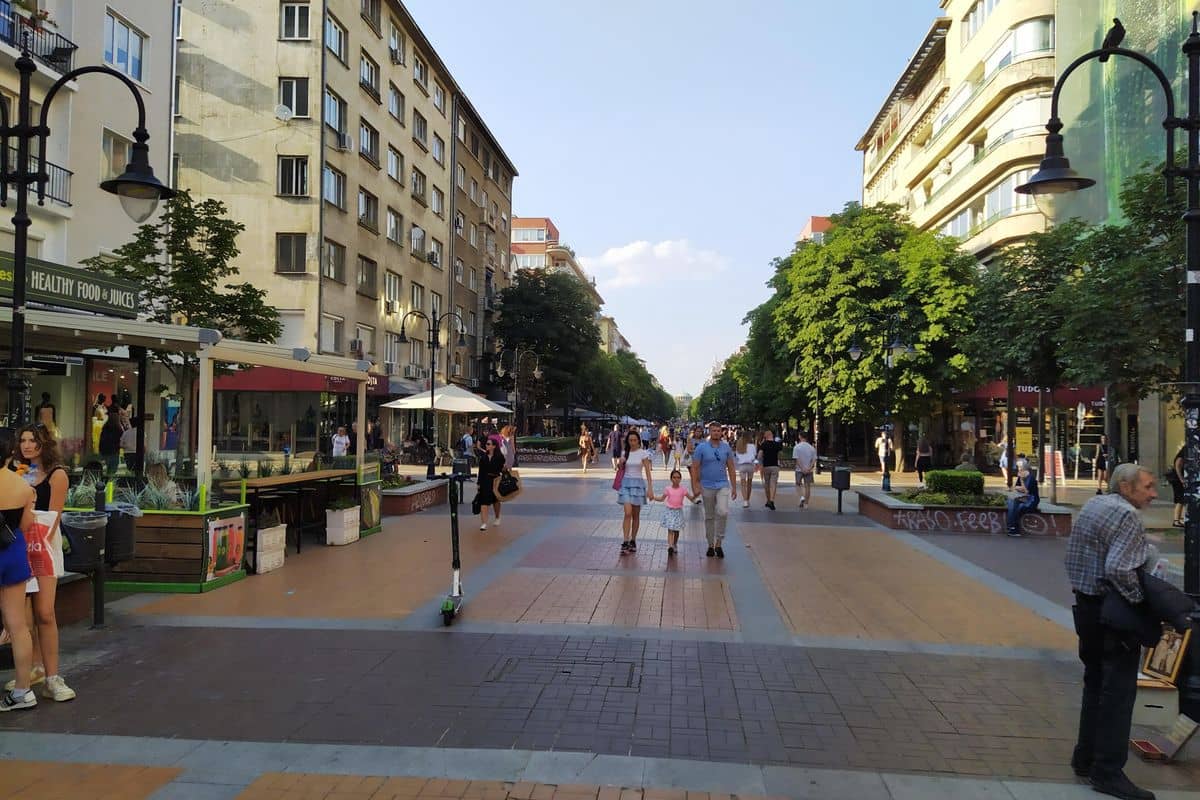
Vitosha Boulevard, called Vitoshka, takes its name from the mountain and became Vitosha Street in 1883, after the Liberation. A 2007 study by Cushman & Wakefield ranked it the 22nd priciest trade street in the world. Sofia tours stop at its corner with Patriarch Evtimiy Boulevard, a meeting point known as the Pharmacy.
A renovation announced in 2007 brought back the style of 1930s Sofia, with Art Nouveau round kiosks, fountains and a clock tower that shows the time in world capitals. Sofia tours along the boulevard pass the Palace of the Courts and the house where the poet Peyo Yavorov lived and died.
Sofia tours end the boulevard at the National Palace of Culture, known as NDK. NDK opened on 31 March 1981 for the 1300th anniversary of the Bulgarian state and has 123,000 square metres of space over eight floors. Hall 1 has more than 3,000 seats, and the Sofia International Film Festival takes place in the building.
Borisova Gradina is the oldest and best known park in Sofia. Swiss gardener Daniel Neff started work in 1884, and in 1940 a Japanese Corner was laid out with plants sent by the Japanese minister. Sofia tours in the City Garden, the oldest public garden in the city, pass amateur chess players in front of the Ivan Vazov National Theatre. Viennese architects Hermann Helmer and Ferdinand Fellner designed the neoclassical theatre, which opened on 3 January 1907.
- Rosarium: gardener Georgi Duhtev extended the Borisova Gradina rose garden to 7,000 square metres with over 1,400 new rose species.
- Park name: Borisova Gradina carried the name Freedom Park from 1944 to 1989.
- Theatre banknote: the facade of the Ivan Vazov National Theatre appears on the Bulgarian 50 levs banknote.
Which Sofia tours climb Vitosha mountain?
Sofia tours climb Vitosha, the mountain that rises directly south of the city, to reach Cherni Vrah at 2,290 metres, the Golden Bridges stone river, the 25-metre Boyana Waterfall and Aleko, the principal tourist and winter sports centre on the mountain.
Vitosha Nature Park covers the entire mountain, an area of 266.06 square kilometres. It was declared in 1934 and was the first park of its kind in the Balkans. Sofia tours reach the mountain by bus 63 from the Tsar Boris III stop, by bus 66 from the Vitosha metro stop, or by car.
Cherni Vrah, the Black Peak, is the fourth highest peak in Bulgaria. The easiest route is a 1.4-km track from the upper station of the Romanski chair lift on Malak Rezen peak. Sofia tours at the top find a weather station from 1935 with a cafeteria. On 27 August 1895, the writer Aleko Konstantinov led 300 people from the City Garden to the summit, a date that marks the birthday of the Bulgarian tourist movement.
The Golden Bridges, or Zlatnite Mostove, form the largest stone river on Vitosha, a ribbon of boulders 2.2 km long in the valley of the Vladayska River, named for the golden lichens on the stones. Sofia tours to the Boyana Waterfall, the largest waterfall on Vitosha, walk about one hour from the Kopitoto hotel. The water freezes in winter, when climbers use it for alpine climbing.
A 6.27-km gondola lift climbs to Aleko from Simeonovo, and a road climbs from Dragalevtsi. The longest ski run at Aleko is Vitoshko Lale, built for the 1983 Winter Universiade. On foot, Sofia tours leave Aleko on tracks to Cherni Vrah, the Bistrishko Branishte Nature Reserve and Zlatnite Mostove.
- Plant life: the mountain holds 1,500 species of higher plants and 500 species of fungi.
- Longest cave: Duhlata, the longest cave in Bulgaria at 18,200 m, lies in Vitosha near the village of Bosnek.
- Summit wind: Cherni Vrah averages 9.3 m/s, the second windiest peak in Bulgaria after Murgash.
Which Sofia tours visit the mineral springs and the Central Market Hall?
Sofia tours stop at the Central Mineral Baths, a 1913 bathhouse that now holds the Regional History Museum, fill bottles at the mineral water fountains beside it, and continue to the Central Market Hall and the Women’s Market near Lions’ Bridge.
The architects Petko Momchilov and Friedrich Grünanger designed the Central Mineral Baths in the Vienna Secession style, and Haralampi Tachev and St. Dimitrov added the ceramic majolica. The building served as the city’s public baths until 1986, when it closed over the risk of a roof collapse. Sofia tours now enter for the Regional History Museum, housed here at 1 Banski Square since September 2015.
Sofia is known for its 49 mineral and thermal springs, and hot water still flows in the city centre. Walking Sofia tours point out a mineral water tap on a corner of the museum façade and a larger cluster of drinking fountains across the small street to the north, where visitors top off their water bottles.
Sofia tours then cross to the Central Sofia Market Hall on Knyaginya Maria Luiza Boulevard, opposite the Banya Bashi Mosque. Naum Torbov designed the hall, which opened in 1911 and carries a little clock tower with three dials, and Haralampi Tachev made the relief of Sofia’s coat of arms above the main entrance. Until the late 1940s the municipality let out about 170 shops and stalls inside.
The Women’s Market, Zhenski pazar in Bulgarian, is the largest and oldest open-air market in Sofia, close to Lions’ Bridge. It fills the north-eastern two-thirds of Stefan Stambolov Boulevard and traded as a market before the Liberation of 1878. Until 1990 it carried the name Georgi Kirkov. For self-guided Sofia tours, tram 3 stops at Pirotska Street, close to the market.
- Old baths: The Bohemian traveller Hans Dernschwam counted 1 large bath and 2 smaller baths in Sofia in 1553–1555.
- Museum rooms: Sofia tours see luxury items of Bulgaria’s last monarchs, on a timeline from prehistory to 1944–1989.
- Market history: The hall closed in 1988 for reconstruction and reopened for Easter in 2000.
Which local food do Sofia tours taste?
Sofia tours taste banitsa, a filo pie layered with eggs, yogurt and white brined cheese, then shopska salad, the cold cucumber soup tarator, grilled kebapche, Bulgarian yogurt, the thick fermented drink boza and rakia, the local fruit brandy served with the salad.
Breakfast on Sofia tours starts in a bakery, where banitsa comes hot or cold with plain yogurt, ayran or boza. The spinach version is spanachnik and the pumpkin version is tikvenik. At Christmas and on New Year’s Eve, families bake lucky charms called kasmeti, small pieces of dogwood branch, into the pie.
Shopska salad combines tomatoes, cucumbers, onion, peppers and grated sirene, a white brined cheese milder than feta; Balkantourist named it in 1956 after Shopluk, the westernmost Bulgarian region. Tarator, the summer soup on Sofia tours, mixes yogurt, cucumbers, garlic, dill and walnuts and arrives chilled. Bulgarian yogurt is made with Lactobacillus bulgaricus, which the doctor Stamen Grigorov identified in 1905.
On Sofia tours the skara, or grill, serves kebapche: minced pork and beef shaped into a stick, seasoned with black pepper, cumin and salt, and never fried or baked. The well-known order is troika kebapcheta s garnitura, three kebapcheta with sides such as chips under grated sirene, with lyutenitsa as a dip and beer as the preferred drink.
Boza is a thick malt drink of fermented grain with around 1% alcohol, and the popular Bulgarian recipes come from Radomir and Lyubimets. The EU recognises 12 brands of Bulgarian rakia under PDO and PGI marks. Among free Sofia tours, Balkan Bites runs a daily food tour with stops such as Mekitsa and Coffee and Pastry of Sofia.
- Mekitsa: Deep-fried yogurt dough, eaten for breakfast with icing sugar, jam, honey or sirene.
- Meshana skara: A mixed grill plate of kebapche, kyufte, shishche and karnache or nadenitsa.
- Shkembe chorba: A spicy tripe soup with a reputation in Bulgaria as a hangover cure.
Which Sofia tours cover street art and the communist past?
Sofia tours of the communist past visit the Museum of Socialist Art and its park of 77 statues, the Monument to the Soviet Army that anonymous artists painted as comic heroes in 2011, and the former Party House on the Largo.
The Museum of Socialist Art opened on 19 September 2011 as a branch of the national art gallery, after a dispute over the first proposed name, the Museum of Totalitarian Art. It covers 7,500 square metres in the Red Star suburb, and Sofia tours move through its statue park, an exhibition hall with 60 paintings and a video hall of propaganda films and newsreels.
A large five-pointed star at the museum entrance once adorned the Party House, the former Communist Party headquarters on the Largo, completed in 1955 to a design by a team under Petso Zlatev. After the fall of communism a helicopter removed the red star from the top of the building. Sofia tours also recall the fire of 26 August 1990, which destroyed forty rooms.
The Monument to the Soviet Army, built in 1954 on Tsar Osvoboditel Boulevard near Sofia University, has a secondary group of soldiers that served again and again as a canvas for political artists. On 17 June 2011 a group called Destructive Creation painted the soldiers overnight as nine pop-culture characters, among them Superman, Captain America and Santa Claus, and the artists were called the Banksy of Bulgaria. On Sofia tours the site stands fenced off since the partial dismantling began on 12 December 2023.
The 365 Association lists four Sofia tours, including the Free Sofia Tour, a daily free walking tour of the main landmarks, and the Communist Tour about life behind the Iron Curtain. Its project The Red Flat, at 24 Ivan Denkoglu Street, recreates a communist flat from the 1980s with an audio guide in English, Spanish and Bulgarian.
- Pink paint: On 21 August 2013 unknown artists painted the monument pink for the anniversary of the 1968 Prague Spring.
- Public vote: A survey of 1,003 Sofia voters between 30 September and 3 October 2023 found 30.7% for keeping the monument and 22% for demolition.
- Museum hall: Sculptures of Todor Zhivkov, Vladimir Lenin and Joseph Stalin stand inside the museum hall.
Which Sofia tours go to Koprivshtitsa?
Sofia tours to Koprivshtitsa travel about 2 hours by road to a museum town of the Bulgarian National Revival, 111 km east of the capital in the Sredna Gora mountains, where the first shot of the April Uprising against Ottoman rule was fired in 1876.
The town keeps 383 architectural monuments from the 19th-century National Revival, the majority restored to their original appearance. Sofia tours visit the house museums: the Oslekov House (1853–1856), today an ethnographical museum, the Lyutov House (1854) and the Lyuben Karavelov Memorial House complex (1810–1835). Its collections hold old weapons, fretwork, embroidery, national costumes and Bulgarian jewelry.
On 20 April 1876, the local rebel committee attacked and surrounded the headquarters of the Ottoman police in Koprivshtitsa, after the police tried to arrest its leader, Todor Kableshkov. The attack forced the rebels to proclaim the insurrection two weeks ahead of the planned date. Sofia tours stop at the Kalachev bridge of 1813, where the first shot was fired, and at the Memorial Ossuary of April 20, built in 1926 for the uprising’s dead.
Since 1965, the National Festival of Bulgarian Folklore has taken place about every five years in Koprivshtitsa. Sofia tours in a festival year see thousands of performing artists in the hills above the town, at the only significant Bulgarian music event focused on amateur performances. Balkanton recorded the majority of authentic Bulgarian village music records released during Communist rule here, in the 1970s and 1980s.
- Altitude: 1,030 m above sea level, on the Topolnitsa River.
- Oldest church: the Church of the Dormition of the Theotokos, built in 1817.
- First class school: the Sts. Cyril and Methodius School, founded in 1837.
- Native revolutionaries: Georgi Benkovski (1843–1876) and Todor Kableshkov (1851–1876).
Which Sofia tours go to the Belogradchik Rocks?
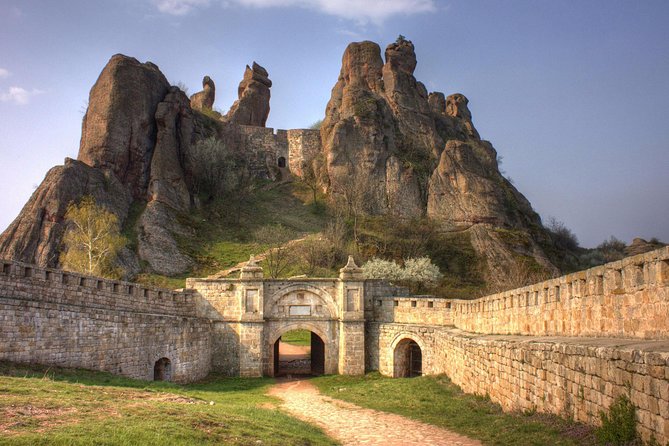
Sofia tours to the Belogradchik Rocks travel about 3 hours by car to northwest Bulgaria, where red and yellow sandstone and conglomerate formations up to 200 m high surround a fortress first built under the Roman Empire, with the painted Magura Cave nearby.
The rocks cover 50 square kilometres on the western slopes of the Balkan Mountains. Their formation started in the Permian period, about 230 million years ago, and iron oxide gave them their rusty red colour. Sofia tours walk the central group beside the town, where the stones carry names such as Adam and Eve, the Mushrooms, the Lion, the Camel and the Shepherd Boy.
Local legends explain the shapes: a nun expelled with her child became the Madonna, and the Schoolgirl, the Bear and the Dervish froze in stone during a chase. Sofia tours here enter a protected landscape: the rocks became a natural monument in 1949, joined the UNESCO tentative list in 1984 and remain the only habitat of the critically endangered plant Hieracium belogradcense.
The Belogradchik Fortress, also called Kaleto, uses the rocks as a natural defence. Tsar Ivan Stratsimir of Vidin extended it in the 14th century, the Ottomans captured it in 1396, and French and Italian engineers joined its early 19th-century expansion. Sofia tours climb through three fortified yards over 10,210 square metres; the fortress last saw warfare in the Serbo-Bulgarian War of 1885.
The Magura Cave lies near the village of Rabisha, 25 km from Belogradchik, and runs 2.5 km through the limestone Rabisha Hill. Sofia tours see the paintings only with a guide: more than 750 images in bat guano, made between 10,000 and 8,000 years ago, including the Fertility Dance, the Hunting Ceremony and a Bronze Age group read as a solar calendar.
- Fortress walls: over 2 m thick at the foundation and up to 12 m high.
- Cave climate: 12 °C on average, with one room at a constant 15 °C.
- Lake Rabisha: the largest inland natural freshwater lake in Bulgaria, close to the cave.


Which Sofia tours go to the Rose Valley and Kazanlak?
Sofia tours to the Rose Valley travel 170 km east to Kazanlak, the centre of Bulgaria’s rose oil industry, for rose fields, the Rose Museum and the Thracian Tomb of Kazanlak, a 4th-century BC tomb on the UNESCO World Heritage list since 1979.
The Rose Valley lies just south of the Balkan Mountains and joins two valleys: the Karlovo Valley on the Stryama and the Kazanlak Valley on the Tundzha. Its growers produce close to half of the world’s rose oil, 1.7 tonnes, from the damask rose, Rosa × damascena, grown in long hedges. Sofia tours in the picking season, which ends in June, watch pickers cut the flowers one by one into willow baskets bound for the distilleries.
Villages around Kazanlak, including Yasenovo, Rozovo and Kanchevo, stage rose-picking rituals, and visitors join the harvest on weekend mornings. It takes around 3,500 kg of roses to make 1 kg of rose oil, which steam distillation produces as rose otto, with rosewater as the by-product. Sofia tours in the first week of June meet the Rose Festival, held since 1903, with the crowning of the Rose Queen, a parade and the Horo folk dance.
In Kazanlak, the Rose Museum holds more than 15,000 items, a restored rose oil laboratory from 1912 and a vessel last used in 1947 that still smells of roses. The Thracian Tomb of Kazanlak, a brick “beehive” tholos, has murals of a Thracian couple at a ritual funeral feast and a chariot race on its dome. Sofia tours visit the full-size replica, since the original stays closed to protect the paintings.
The Kazanlak Valley is also known as the Valley of the Thracian Rulers, believed to hold over 1,500 tumuli, of which only 300 have been researched. The Iskra Town History Museum, founded on 29 June 1901, shows finds from Seuthopolis, a Thracian city now at the bottom of the Koprinka Reservoir. Sofia tours that take the 16 km side road from Kazanlak via the Shipka Pass reach the Buzludzha Monument, built by the communist government, opened on 23 August 1981 and closed to the public due to its weakened structure.
- Protected name: Bulgarian rose oil, a Protected Geographical Indication since September 2014.
- First plantations: rose fields in Kazanlak since the 16th century.
- Shipka Memorial Church: 12 km north of Kazanlak, consecrated on 27 September 1902.
How do visitors reach Sofia on Sofia tours?
Sofia tours start at Sofia Airport, 10 km east of the centre, at Sofia Central Station, or at the bus stations beside it. The M4 metro line links the airport with the city, and drivers from Greece arrive on the E79 road.
Sofia Airport, also called Vasil Levski Sofia Airport, is the main international airport of Bulgaria, with the IATA code SOF. It passed 8 million passengers in a year for the first time. Sofia tours on EasyJet, Eurowings or Wizz Air land at Terminal 1, while Bulgaria Air and Ryanair use Terminal 2.
The Sofia Airport metro station on the M4 line stands next to Terminal 2, and a free shuttle bus links it with Terminal 1. The metro ride to the city centre takes 40 minutes. Bus line 84 serves both terminals and reaches the centre in 30 to 40 minutes, with a stop beside the Sofia University metro station.
The Sofia Metro, the only metro in Bulgaria, opened on 28 January 1998 and now runs four lines with 50 stations over 52 km. The M1 Red line links Lyulin with Mladost, and the M2 Blue line crosses the centre from Nadezhda to Lozenets. The airport extension opened on 2 April 2015, so Sofia tours ride from Terminal 2 straight into town.
Sofia Central Station, the largest railway station in Bulgaria, stands 1 km north of the city centre. Its white-marble building by lead architect Milko Bechev opened on 6 September 1974 and was completely renovated in 2016. Direct trains run to Bucharest, Craiova and Istanbul, and Sofia tours change to the M2 Blue line in the station underpasses.
The Central Bus Station, whose building opened in 2004 beside the railway station, serves national and international lines from 50 bus stops, and Bus Station Serdika between the two handles international coaches. Sofia tours by car from Thessaloniki follow the E79 road, and the Struma motorway (A3) already covers about two thirds of that route.
- Rail lines: BDZ Line 2, the longest national railway, runs from Sofia to Varna, the largest coastal city.
- Iskar Gorge: trains to northern Bulgaria cross the Balkan Mountains through the Iskar Gorge, about an hour out of Sofia.
- Airport rail link: Iskarsko shose railway station, two metro stops from the airport on the M4 line, serves southbound trains.
When do Sofia tours run best?
Sofia tours run best in summer, when the city stays slightly cooler than other parts of Bulgaria thanks to its 550-metre altitude. Winter brings an average of 56 days with snow cover, ski trips on Vitosha and smog during the heating season.
That altitude makes Sofia the second highest capital of the European Union after Madrid and the third highest capital of Europe. Sofia tours meet a humid continental climate, Köppen type Dfb, with an average annual temperature of 10.9 °C.
Summers are warm and sunny, yet heat waves push the hottest days to 35 °C or more in July and August, and the record of 40.2 °C was set on 5 July 2000. Rain peaks in late spring and early summer, when thunderstorms are common, so Sofia tours in June pack a rain jacket.
Winters are cold and snowy. On the coldest days the temperature drops below −15 °C, above all in January, and the record low of −31.2 °C dates from 16 January 1893. Sofia receives a total snowfall of 98 cm in an average winter, and Sofia tours add one-day ski trips on Vitosha.
Spring and autumn are short and variable. The heating season brings smog, as temperature inversions and the surrounding mountains trap the air; between October 2017 and March 2018, particulate levels broke the norm on 70 occasions. A network of 300 volunteer sensors has measured the air since 2017, so Sofia tours in winter check the readings first.
Sofia tours can follow the city calendar. The Sofia International Film Festival, founded in 1997, takes place every March, and Sofia Pride has marched every June since its first parade on 28 June 2008. The Sofia Marathon, run since 1983, starts and finishes on Battenberg Square in front of the National Art Gallery.
- Open-air opera: the Sofia Opera and Ballet stages open-air shows on summer evenings.
- Bike tours: the Sofia Bike Tour runs from April to November and starts at the Ivan Vazov National Theatre.
- Race weekend: the Sofia Marathon weekend adds a half marathon, a 10K race and a 3 km fun run.
Frequently Asked Questions
Where do Sofia tours find tourist information?
VisitSofia.bg is the official tourist information website of the city, with an English version. The Chitalnyata (Reading Room) glass kiosk in the City Garden adds a third point of information beside the two centres in the underpasses.
How do Sofia tours use trams, buses and trolleybuses?
Sofia runs 15 tram lines, 9 trolleybus lines and 93 bus lines next to the metro. Contactless bank cards, Apple Pay and Google Pay work on blue electronic readers on board, and contactless spending is capped at the cost of a daily travel pass. Four night lines, N1 to N4, cover the late hours.
Can Sofia tours be done on foot?
Sofia is a safe and walkable city, even at night. Its tiled pavements are frequently uneven and potholed, and parked cars, street vendors and cafes crowd them. Large intersections are crossed through pedestrian underpasses. Walkers on Sofia tours watch the traffic, because Bulgarian drivers do not always yield right of way to people on foot.
How do Sofia tours use taxis?
Taxis in Sofia are yellow, and around 13,000 cabs work in the city. A regular taxi takes no more than 4 passengers and shows the driver’s card with his name on the front. The TaxiMe app works in Sofia like Uber, and the carsharing company Spark rents all-electric vehicles for self-drive trips.
Can Sofia tours include a football match?
The 43,000-seat Vasil Levski National Stadium hosts Bulgaria’s international matches. Five city clubs play in the First League: CSKA Sofia, CSKA 1948, Levski Sofia, Slavia Sofia and Lokomotiv 1929, and Levski Sofia plays at the Georgi Asparuhov Stadium, 3 km east of the centre. Visitors leave Sofia club shirts and scarves at the hotel on match days.