
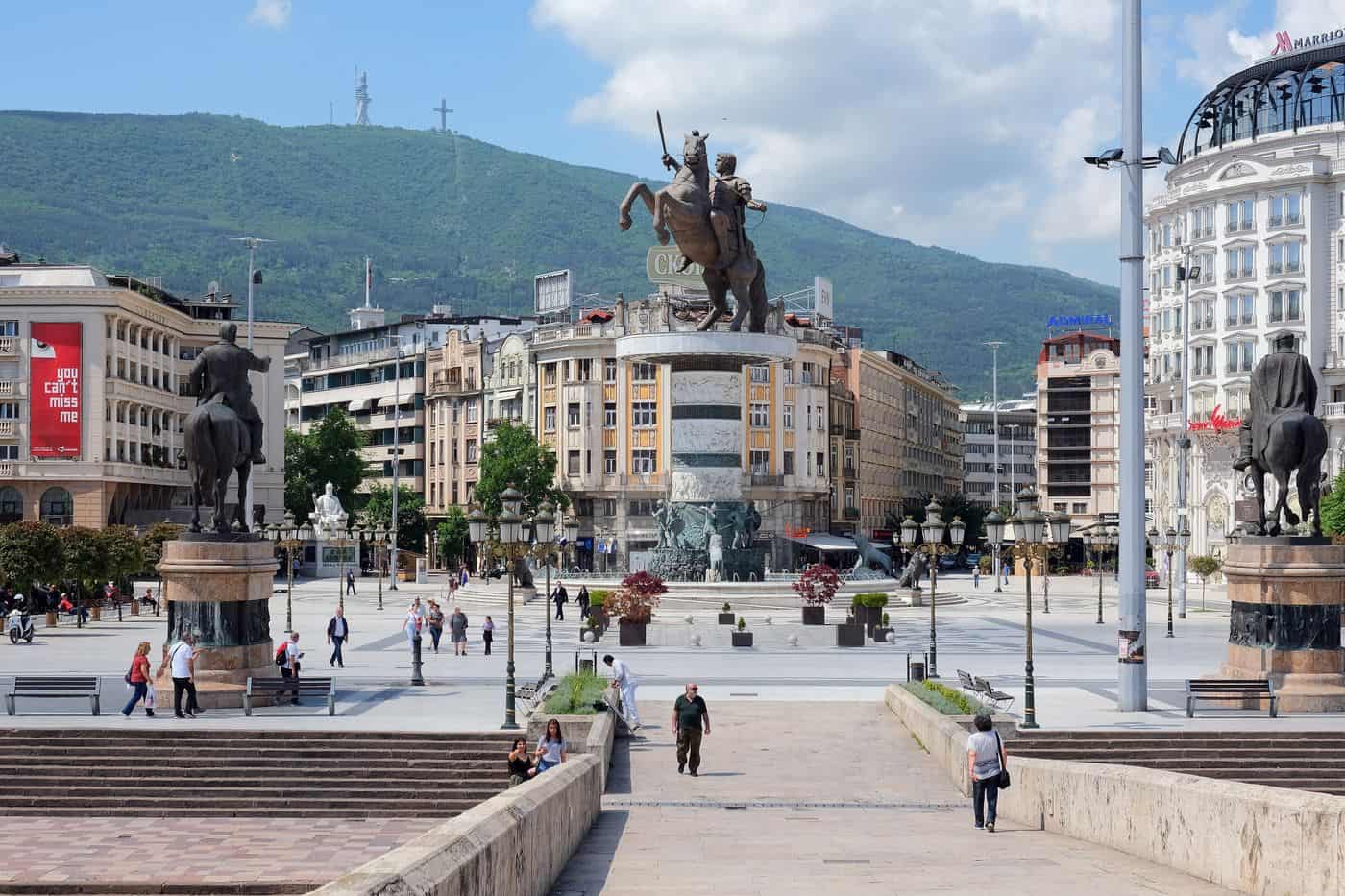
Skopje tours start in Skopje, the capital and largest city of North Macedonia, on the Vardar river below Mount Vodno. The routes cover Macedonia Square and the Stone Bridge, the Old Bazaar, Kale Fortress, the Millennium Cross, Matka Canyon, the monasteries, Tetovo, Mavrovo and Stobi. Greece Tours lists the trips that cross into North Macedonia from Thessaloniki.
This page covers what Skopje tours see in the city and on the mountain above it, which day trips run to the canyon, the monasteries and the wine country, how visitors reach Skopje from Greece, and which season suits each route. The tours below are checked on GetYourGuide and Viator and leave from Skopje.
What do Skopje tours cover?
Skopje tours cover the capital and largest city of North Macedonia on the Vardar River: Macedonia Square and the Stone Bridge, the Old Bazaar and Kale Fortress across the river, and Mount Vodno with the Millennium Cross, south-west of the city.
Skopje lies in the Skopje Valley along the Vardar River, and the city covers 571.46 km2 of urban and rural land. Walking Skopje tours pivot on the Stone Bridge, the link between Macedonia Square and the Old Bazaar. The city’s coat of arms shows the same core: the Stone Bridge with the Vardar, Kale Fortress and the snow-capped peaks of the Šar mountains.
The main tourist walk starts at the Old Railway Station, whose remains house the City of Skopje Museum. It runs down Macedonia Street past the Mother Teresa Memorial House, crosses Macedonia Square and the Stone Bridge, passes the Holocaust Museum, and ends at Kale Fortress after the Turkish Bazaar.
- Population: 526,502 people at the 2021 census.
- Peoples: an ethnic Macedonian majority, a significant Albanian minority, and Roma, Turks and Serbs.
- Faiths: Orthodox Christianity and Islam, the two faiths behind the churches and mosques on Skopje tours.
The lake town south-west of Skopje has its own page: Ohrid tours.
What do Skopje tours see around Macedonia Square and the Stone Bridge?
Skopje tours around Macedonia Square see the 214-metre Stone Bridge over the Vardar, the Warrior on a Horse statue and fountain, the Skopje 2014 museums and monuments, and the Mother Teresa Memorial House on Macedonia Street, just east of the square.
Sultan Mehmed II the Conqueror had the Stone Bridge built on Roman foundations between 1451 and 1469. Solid stone blocks rest on firm columns joined by 12 semicircular arches, and the deck is 6 m wide. Skopje tours stop at its watchtower, shaped like a mihrab and rebuilt in 2008.
Macedonia Square is the biggest square in North Macedonia, at 18,500 m2, and Kiro Gligorov, the first president, declared independence from Yugoslavia here. Its centrepiece, the Warrior on a Horse, officially Warrior on Horseback, is a bronze by Valentina Stevanovska, unveiled on 8 September 2011 on a 10 m column in a fountain ringed by 8 bronze soldiers and 8 bronze lions. Under the Prespa Agreement of 2018, a plaque by the monument states that Alexander belonged to Hellenic civilisation.
Skopje 2014 put up 136 structures from 2010 to 2014, and these stand around the square:
- Archaeological Museum: opened in 2014 in Greek Revival style, with finds from Prehistory to the Ottoman period.
- Museum of the Macedonian Struggle: 2,500 m2 on the east bank, opposite Macedonia Square.
- Porta Macedonia: a 21 m arch on Pella Square, with 193 m2 of marble reliefs.
The Mother Teresa Memorial House, opened on 30 January 2009, stands on the site of the church where she was baptized; she lived in Skopje from 1910 to 1928. Skopje tours see part of her relics, kept inside.
What do Skopje tours see in the Old Bazaar and at Kale Fortress?
Skopje tours in the Old Bazaar see one of the oldest and largest marketplaces in the Balkans: the Mustafa Pasha Mosque, the Daut Pasha Hamam, the Kapan An and Suli An inns, the Church of the Holy Saviour and Kale Fortress overlooking the Vardar.
The Old Bazaar stretches from the Stone Bridge to the Bit-Pazar and from Kale Fortress to the Serava river, and it has been the city’s centre for trade since at least the 12th century. Roughly thirty mosques, a 16th-century clock tower and a 15th-century covered market, the bezisten, survive from Ottoman rule.
Mustafa Pasha built his mosque in 1492 on a plateau above the bazaar, and roses fill its courtyard. The Daut Pasha Hamam, built in the 15th century by Daut Pasha, Grand Vesir of East Rumelia, has fifteen rooms under thirteen domes, and Skopje tours visit the National Gallery, housed there since 1948.
- Kapan An: built in the mid-15th century by Isa-Beg Isaković, with 44 rooms for guests and traders.
- Suli An: rebuilt in 1972 after the 1963 earthquake, now home to the Old Bazaar Museum.
- Kuršumli An: the largest of the three remaining caravanserais, named for its lead roof.
The Church of the Holy Saviour (Sv. Spas) sits half underground, because Ottoman rule barred Christian buildings taller than mosques. Its carved wooden iconostasis is 10 m long, and the revolutionary Goce Delčev lies in a white stone sarcophagus in the courtyard.
Skopje tours end at Kale Fortress, first built in the 6th century AD with material from Roman Skupi. Digs there from late 2006 found clay ornaments dating as far back as 3000 BC.
Which Skopje tours go up Mount Vodno to the Millennium Cross?
Skopje tours to Mount Vodno take the cable car from Middle Vodno, at 557 m, to Krstovar peak, at 1066 m, where the 66-metre Millennium Cross stands; hiking tours climb the same slope on foot along pedestrian paths through the woods.
Vodno rises south-west of the city and is the highest point inside the city limits, part of the Jakupica range and the largest protected area within the city. The cross on its peak is the best observation point for the panorama of the capital.
The Millennium Cross was built in 2002 as a memorial for 2,000 years of Christianity, on a summit known as Krstovar, the “place of the cross”. It stands on a platform of twelve columns for the twelve apostles, an elevator inside reaches the top level, and thousands of lights cover it at night.
The Millennium Cross cable car carries Skopje tours to the summit:
- Opened: 2011, built by the Austrian company Doppelmayr.
- Length: 1,750 m from Middle Vodno to the Millennium Cross.
- Ride time: 6 to 8 minutes.
- Cabins: 28 gondolas for eight people and 2 VIP gondolas for four.
Hiking Skopje tours follow the trail from Middle Vodno to Krstovar peak, and a city bus line runs round trips from the centre of Skopje to Middle Vodno. Other stops are the Prskalo waterfall and Dolno Sonje, a hillside village with medieval churches.
Which Skopje tours go to Matka Canyon?
Skopje tours to Matka Canyon cover a 5,000-hectare canyon on the Treska River west of central Skopje, with Lake Matka, ten caves and the underwater Vrelo Cave. Half-day private and group tours add an optional boat cruise, hiking trails and lunch.
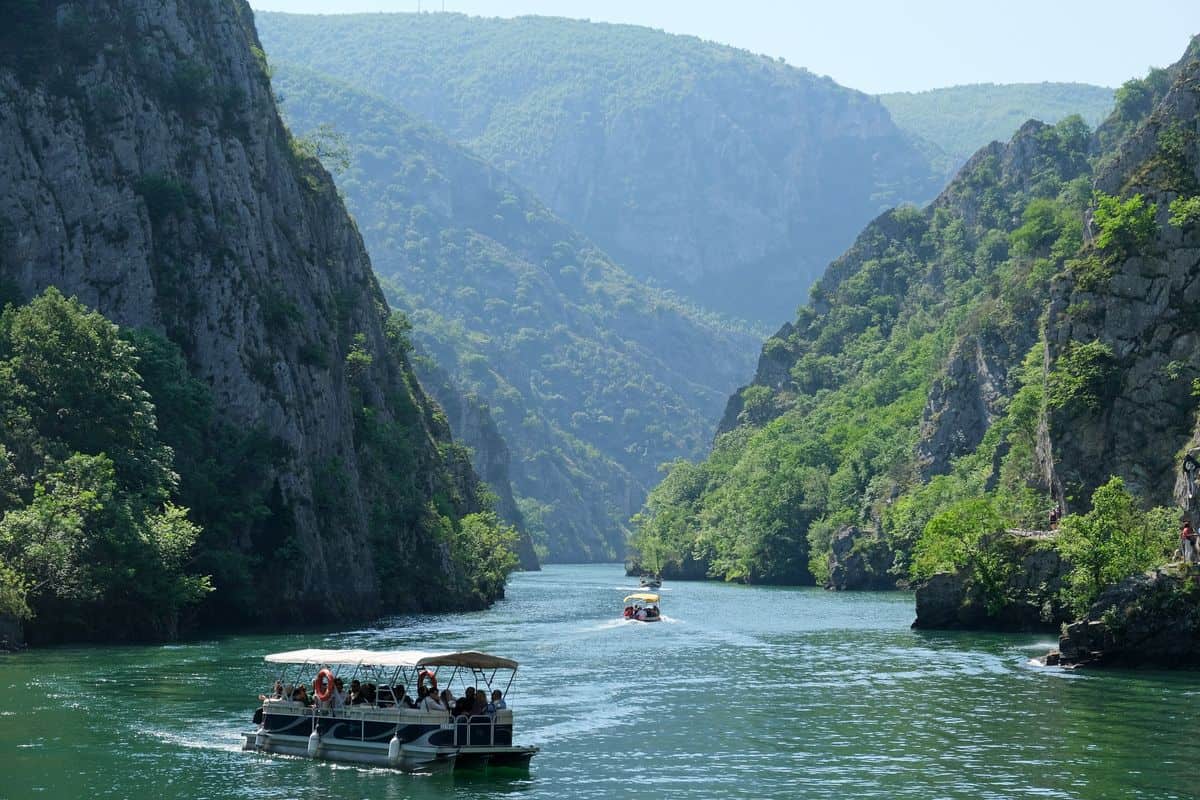
Lake Matka, where Skopje tours run their river cruise, is the oldest artificial lake in North Macedonia. The St. Andrew dam formed it in 1938 as the first dam built in the country, 29.5 m high and 64 m long.
Vrelo Cave sits on the right bank of the Treska and was listed among the top 77 natural sites in the world in the New7Wonders of Nature project. A stalactite called the “Pine Cone” stands in the middle of the cave, and the larger of its two lakes runs 35 m long and 18 m deep. As an underwater cave, Vrelo goes down over 203 m. On Skopje tours, the boat cruise to the cave is optional.
- Caves: ten caves from 20 m to 176 m long, plus two vertical pits about 35 m deep.
- Kayaking: paddling on the Treska River ranks among the popular activities, with fishing and swimming.
- Climbing: the climbing season runs from around Easter to November.


Which Skopje tours visit St. Panteleimon and the monasteries?
Skopje tours to the monasteries pair Matka Canyon with the Church of St. Panteleimon in Gorno Nerezi, a Byzantine church built in 1164. Inside the canyon, St. Andrew’s Monastery, Matka Monastery and St. Nicholas Šiševski Monastery date from the 14th century.
Skopje tours that combine Matka Canyon and Mount Vodno stop at Gorno Nerezi, a village at 771 m on the wooded slopes of the mountain. Alexius Angelus Comnenus, a member of the imperial family, ordered the church in 1164 for St. Panteleimon, the patron saint of physicians. Its Komnenian-era frescoes include the Lamentation of Christ, in which Mary mourns Jesus. Art historian Andrew Graham-Dixon notes that these 1160s frescoes precede Giotto’s Arena Chapel frescoes in Padua, circa 1305.
St. Andrew’s Monastery stands on a small natural platform by the Treska, 17 km southwest of Skopje. Andrijaš, a son of King Vukašin, founded it in 1389, and Metropolitan Jovan, monk Makarij and monk Grigoriy painted its frescoes. On the left bank, Matka Monastery, the Monastery of the Holy Mother of God, dates from the 14th century; in 1497 a woman named Milica replaced its roof and added frescoes and a portico.
- St. Nicholas Šiševski: the monastery sits 480 m above sea level and 160 m above Lake Matka, reached only on foot.
- Walking routes: half an hour from the bridge near the kayaking area, 1 hour from Šiševo village and 2 hours 30 minutes from the summit of Mount Vodno.
- Frescoes: the narthex keeps well-preserved frescoes from 1630.
Which Skopje tours visit Tetovo and Mavrovo?
Skopje tours to the west reach Tetovo’s Painted Mosque and Arabati Baba Tekke, Mavrovo National Park, Galičnik and the Monastery of St. Jovan Bigorski. One private tour joins Matka Canyon with both Tetovo sights; the Mavrovo and Bigorski tour runs 8 to 9 hours.
Tetovo, where Skopje tours visit the Painted Mosque, lies on the foothills of Šar Mountain, divided by the Pena River. The Šarena Džamija dates from 1438, when two sisters, Hurshida and Mensure, paid for it, and Abdurrahman Pasha rebuilt it in 1833. Masters from Debar painted the ornament in oil paints, and more than 30,000 eggs went into the paint and glaze.
The Arabati Baba Tekke grew from 1538 around the türbe of the dervish Sersem Ali Baba. The Bektashi complex holds flowered lawns, prayer rooms, dining halls, lodgings and a marble fountain inside a wooden pavilion.
Private Skopje tours to Mavrovo National Park run a full day. Founded in 1949, the park is the largest of North Macedonia’s four national parks at about 780 km2, and Korab peak, at 2,764 m, is the highest point in the country. Mavrovo Lake, less than 100 km from Skopje, holds the half-submerged church of Saint Nicholas.
- Galičnik: one of the two biggest and oldest Mijak villages hosts the Galičnik Wedding on the weekend nearest to 12 July.
- Teškoto: during the wedding, local men dance the Teškoto, the “heavy” dance.
- St. Jovan Bigorski: the monastery near the road between Debar and Gostivar keeps a walnut iconostasis that Mijak wood-carvers made between 1829 and 1835.
Which Skopje tours visit Stobi and the wineries?
Skopje tours into the central Vardar valley reach Stobi, the ancient city near Gradsko where the Crna River meets the Vardar, and the Tikveš wine region around Kavadarci and Negotino. Wine day trips visit Stobi Winery, Chateau Sopot and the Demir Kapija vineyards.
Stobi began as a Paeonian settlement and became the capital of the Roman province of Macedonia Salutaris. The historian Livy first mentioned it for a victory of Philip V over the Dardani in 197 BC, and Emperor Theodosius I stayed there in 388. The site keeps a 3rd-century theatre, the Episcopal Basilica and the House of Peristerius with its floor mosaics. Skopje tours to Stobi reach a site 5 minutes from Gradsko, with a visitor centre and free parking.
The Tikveš plain has produced wine for over 2,500 years, and Smederevka, Vranec and Temjanika make up 80% of its grape production. In Kavadarci, the Tikveš winery, the largest in Southeast Europe, processes up to 55 million kilograms of grapes a year; Negotino adds the Bovin, Lazar and Venec wineries.
- Stobi Winery: half-day Skopje tours drive about 1 hour to a guided winery visit, a tasting with a cold plate and a traditional North Macedonian lunch.
- Chateau Sopot: a 103-hectare estate 45 minutes from Skopje makes Cabernet Sauvignon, Chardonnay and Muscat, on a 5 to 6 hour trip.
- Demir Kapija: private Skopje tours taste wine where King Aleksandar Karadjordjevic built the oldest winery in the Balkans, still bottling under the Agropin name beside newer Popova Kula.
How do visitors reach Skopje on Skopje tours?
Skopje tours from Greece follow the road north from Thessaloniki, 233 km (145 mi) south of Skopje, over the Evzonoi–Bogorodica border crossing and up the A1 motorway. Air travellers land at Skopje International Airport in Petrovec, 20 km east of the city.
The Greek A1 motorway, part of European route E75, connects Thessaloniki with Polykastro and the Evzonoi border station, the main crossing between Greece and North Macedonia. Road Skopje tours continue on North Macedonia’s A1, a four-lane, tolled motorway of 173 km that follows the Vardar valley north.
- Gevgelija: the border town lies 70 km from Thessaloniki and 165 km from Skopje.
- Demir Kapija: the 33 km Smokvica–Demir Kapija section, finished in 2018, completed the motorway between the Serbian and Greek borders.
- Airport junction: the A1 meets the A2 and A4 motorways close to Skopje Airport.
Coach Skopje tours arrive at the coach station under the main railway station; it can host 450 coaches a day. The 240 km Thessaloniki–Skopje railway runs to the same station through Idomeni, Gevgelija and Veles. Skopje International Airport (SKP), managed by TAV Airports Holding since 2008, handled 2,158,258 passengers in 2018.
When do Skopje tours run best?
Skopje tours run best in spring and autumn, when Skopje’s day temperatures range from 15 to 24 °C. Summers are long, hot and dry, with highs above 31 °C, and winters are short, cold and wet, with day highs of 5 to 10 °C.
Skopje has a humid subtropical climate (Köppen Cfa) and a mean annual temperature of 12.6 °C. Summer days sometimes pass 40 °C, and winter nights fall below 0 °C.
Winter Skopje tours also meet smog: PM2 and PM10 particulate matter regularly reaches over twelve times the WHO-recommended maximum. The AirCare app, launched by local activist Gorjan Jovanovski, tracks the air hour by hour.
The Skopje Jazz Festival, held every October and part of the European Jazz Network, has hosted Ray Charles and Tito Puente, and four more festivals fill the calendar:
- March: the Skopje Film Festival shows over 50 films in five days.
- July: the Blues and Soul Festival runs in early July and has hosted Mick Taylor and the Temptations.
- Summer: the Skopje Summer Festival, founded in 1979, gathers 2,000 participants for music, opera, ballet, theatre and film.
- September: the Young Open Theater Festival (MOT), first held in 1976, runs at the end of the month.
What history do Skopje tours tell?
Skopje tours tell a story of repeated rebuilding: Roman Scupi fell to an earthquake in 518, the Ottomans ruled the city for over five centuries, a 1963 earthquake destroyed about 80 percent of it, and Kenzo Tange and the Skopje 2014 project reshaped it.
Scupi grew as a colony of Roman veterans, mainly of the Legio VII Claudia, under Emperor Domitian (AD 81–96), and at its peak covered 40 hectares inside a 3.5 m wall. Stefan Dušan was crowned Emperor of the Serbs and Greeks in Skopje in 1346, and the city became part of the Ottoman Empire in 1392.
Skopje tours retell the earthquake of 26 July 1963: the 20-second tremor struck at 5:17 am, killed 1,070 people and drew relief from 78 countries, hence the motto “The City of International Solidarity”. In 1965 the United Nations invited Kenzo Tange to a limited competition; he won 60% of the prize and a Yugoslav team 40%, and his plan stands partly built.
Skopje 2014, announced in 2010 by the VMRO-DPMNE government, planned around 20 buildings and over 40 monuments to give the capital a more classical look. Cost estimates range from 80 to 500 million euros; critics called it nationalist kitsch, other residents value its classical nod to the past, and the government halted the programme in late February 2018.
- Skopje Aqueduct: 50 arches in cloisonné masonry stand between Scupi and the city centre; their date of construction is unknown.
- Transportation Center: Tange’s Brutalist railway station, completed in 1981, carries 10 tracks on a 2 km concrete bridge.
- Contemporary Art Museum: Poland donated the post-earthquake building, and Picasso donated his Head of a Woman (1963).
Frequently Asked Questions
What food and drink do Skopje tours include?
Food stops on Skopje tours serve tavče gravče, the national dish of fresh beans baked in an unglazed earthenware pot, and ajvar, a relish of sweet bell peppers and eggplants. Skopsko beer, from the Skopje brewery that began operating in 1924, holds 64% of the national market, and rakija, a fruit spirit, is normally 40% ABV.
How do Skopje tours get around the city?
JSP Skopje, a public company founded in 1948, runs 67 of the city’s 80 bus lines; only 24 lines are urban. Its fleet includes red Yutong double-deckers designed to resemble the British AEC Routemaster. Sloboda Prevoz and Mak Ekspres run the other lines, and small buses have served the centre since June 2014.
Do Skopje tours make day trips to Pristina and Prizren?
Yes. Pristina, the capital and largest city of Kosovo, lies 87 km from Skopje, and the R6 motorway, completed in 2019, links the two cities. Prizren, Kosovo’s second city by population, lies on the Prizren River between the foothills of the Sharr Mountains; its Sinan Pasha Mosque dates from 1615, and its hilltop fortress overlooks the river.
Do Skopje tours suit families with children?
Yes. The 12-hectare Skopje Zoo is home to 300 animals, and the Macedonian Museum of Natural History shows about 4,000 items. Parks and gardens cover 4,361 hectares of the city, including the City Park, built by the Ottoman Turks at the beginning of the 20th century, the Gazi Baba forest and the university arboretum.
Which stages do Skopje tours visit for opera, theatre and concerts?
The Macedonian Opera and Ballet seats 800 and the National Theatre 724. The Univerzalna Sala, built in 1966 with donations from around 35 countries, seats 1,570 and hosts concerts, fashion shows and congresses; its prefabricated building came from Bulgaria. The Metropolis Arena seats 3,546 for large concerts, and the Drama Theatre adds 333 seats.