
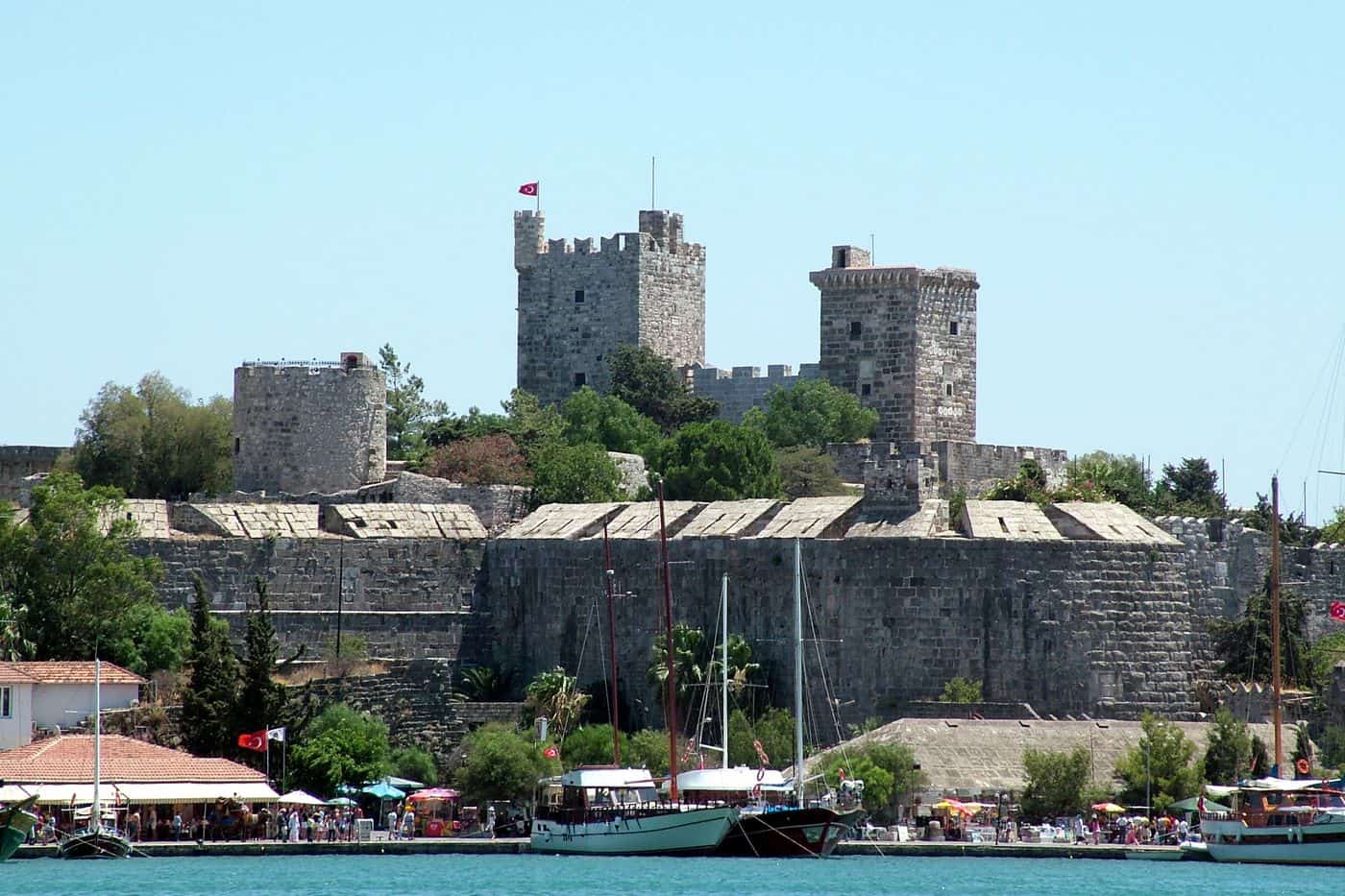
Bodrum tours start in the port town of Bodrum, ancient Halicarnassus, in Muğla Province on the Aegean coast of Turkey, across the strait from the Greek island of Kos. The routes cover Bodrum Castle and its museum of underwater archaeology, the Mausoleum of Halicarnassus, the ancient theatre, gulet trips around the gulf, the towns of the peninsula, Ephesus and Pamukkale. Greece Tours lists the day trips that cross to Bodrum from Kos.
This page covers what Bodrum tours see in the town and at sea, which day trips reach Ephesus, Didyma, Pamukkale and Dalyan, how visitors reach Bodrum from Kos and from its airport, and which season suits each route. The tours below are checked on GetYourGuide and Viator and leave from Bodrum and Kos.
What do Bodrum tours cover?
Bodrum tours cover Bodrum, the ancient city of Halicarnassus in Muğla Province, Turkey: the Castle of St Peter and its Museum of Underwater Archaeology, the ruins of the Mausoleum, one of the Seven Wonders of the Ancient World, and the ancient city walls.
Bodrum tours start in a port town at the entrance to the Gulf of Gökova. The Bodrum Peninsula covers 689 square kilometres with 215 kilometres of coastline. The name Bodrum comes from Petronium, the medieval name taken from the Castle of St Peter.
Bodrum tours sold as a Bodrum day trip from Kos begin at the port, the main ferry link to Kos. Traditional Bodrum houses are built of stone, wood, clay and cane, and a 2006 order by Muğla Governor Temel Koçaklar allows only white paint on exterior walls.
Beyond the castle and the Mausoleum, Bodrum tours reach these sights:
- Zeki Müren Art Museum: the later home of the singer Zeki Müren, opened to the public on 8 June 2000.
- Bodrum City Museum: a small museum in the city centre on the history of the Bodrum Peninsula.
- Carian Trail: a hiking route past Bodrum and the ruins at Kızılağaç and Pedasa.
What do Bodrum tours see at Bodrum Castle and its museum?
Bodrum tours at Bodrum Castle enter the Castle of St Peter, which the Knights Hospitaller began building after they arrived in 1402, and see the English, French, German and Italian towers, named after the nations that built them, and the Bodrum Museum of Underwater Archaeology.
Building began in 1404 under the German knight architect Heinrich Schlegelholt, with green volcanic stone, marble columns and reliefs from the nearby Mausoleum, and the first walls were finished in 1437. Bodrum tours pass through seven gates, reached by twisting passages that left attackers without cover.
On Bodrum tours, the English Tower, finished in 1413, shows an antique lion relief under the coat of arms of King Henry IV of England, and 249 separate designs of coats of arms and reliefs survive across the walls. The knights repelled Sultan Mehmed II in 1480.
In 1962 the Turkish Government turned the castle into a museum for finds from ancient Aegean shipwrecks, the biggest museum of its kind, and in 2016 the castle joined the UNESCO Tentative List of World Heritage Sites. Bodrum tours see two reconstructed ships: the Fatımi ship, sunk in 1077 AD, and the Uluburun Shipwreck from the 14th century BC.
- Uluburun cargo: 10 tons of Cypriot copper ingots, one ton of tin ingots and Egyptian seals, including a seal of Queen Nefertiti.
- Glass collection: one of the four largest ancient glass collections in the world.
- Carian princess room: the tomb of a Carian princess who died between 360 and 325 BC.
- Former chapel: Mycenaean vases and amphoras from the 14th to 12th centuries BC.
What do Bodrum tours see at the Mausoleum of Halicarnassus?
Bodrum tours at the Mausoleum of Halicarnassus see the foundations of the tomb built between 353 and 351 BC for Mausolus, a Carian satrap of the Persian Empire, and his sister-wife Artemisia II, with a small site museum next to the ruins.
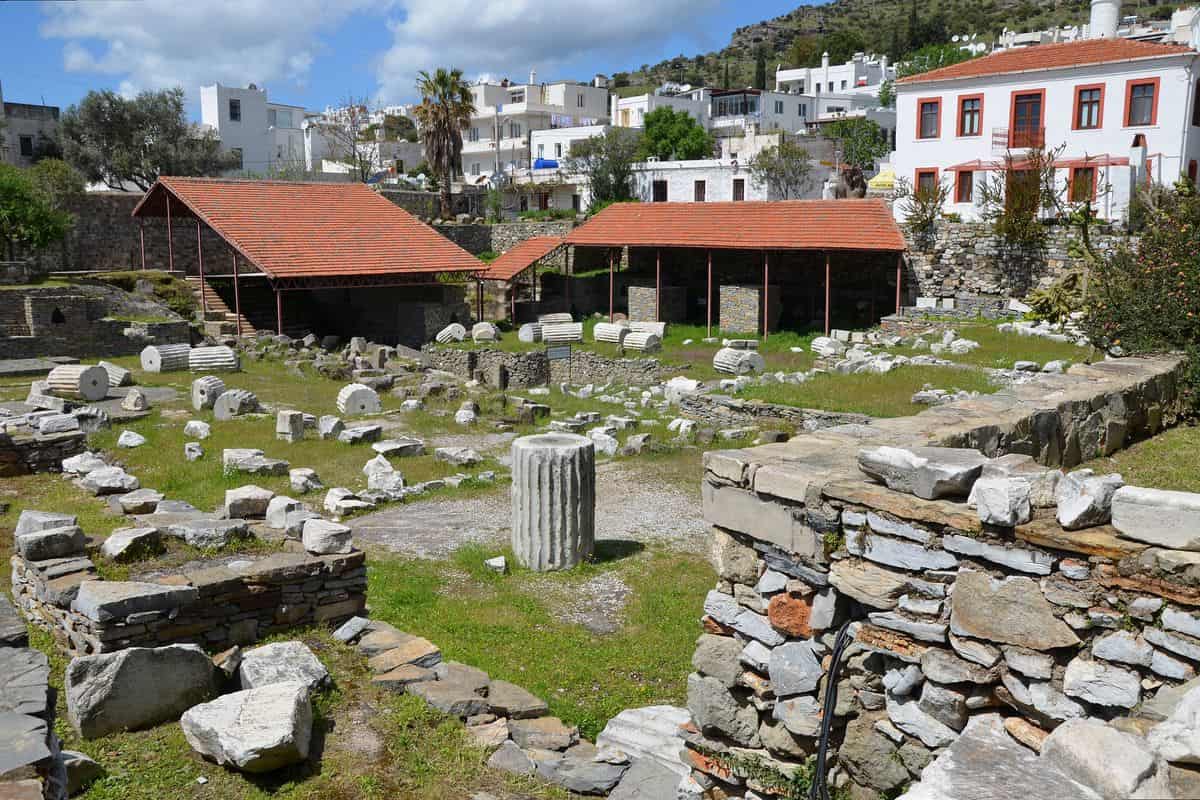
Satyros of Paros and Pythius of Priene designed the tomb, which stood 45 metres high above the harbour, and its name gave the word mausoleum, now used for any above-ground tomb. The foundation that Bodrum tours see today is a rock cut 2.4 to 2.7 metres deep over an area of 33 by 39 metres.
Earthquakes from the 12th to the 15th century brought the tomb down, and the Knights broke up its blocks for the castle in 1494 and 1522. In 1852 the British Museum sent the archaeologist Charles Thomas Newton, who found the statues of Mausolus and Artemisia and a stone chariot wheel 2 metres across. Guides on Bodrum tours point to the British Museum, which now holds those statues and slabs of the frieze showing the battle between the Greeks and the Amazons.
- Sculptors: Scopas carved the north side, Bryaxis the east, Timotheus the south and Leochares the west.
- Statues: 400 freestanding sculptures, including 20 lion statues.
- Roof group: a quadriga, four horses pulling a chariot with images of Mausolus and Artemisia.
- Persian jar: an alabaster jar signed by Xerxes I, found at the foot of the western staircase.
What history do Bodrum tours tell?
Bodrum tours tell the story of Halicarnassus, a city founded by Dorian Greeks that passed through Persian rule, the reign of Mausolus, the siege by Alexander the Great in 334 BC, Roman rule from 129 BC, the Knights Hospitaller and Ottoman rule.
The first settlement, Zephyria, stood on a former island that is now the castle site. Halicarnassus belonged to the Doric Hexapolis with Kos, Cnidus, Lindos, Kameiros and Ialysus until the league expelled it over a prize tripod.
Mausolus ruled Caria from 377 to 353 BC from his new capital at Halicarnassus, where his workmen deepened the harbour and built a fortified palace. During the siege, Memnon of Rhodes set the city on fire and withdrew, and Alexander handed Caria to Queen Ada, who adopted him as her son. The ruins of the citadel and moat that Alexander left under blockade are a stop on Bodrum tours today.
After Alexander, Antigonus I, Lysimachus and the Ptolemies ruled the city, and earthquakes and pirate raids left little of it by the Byzantine era. After Suleiman the Magnificent took Rhodes in 1522, the Knights left for Malta and Bodrum passed to the Ottoman Empire. In the 1923 population exchange, the Greeks of Bodrum settled in Nea Alikarnassos on Crete.
- Artemisia I: ruler of Halicarnassus and a naval commander at the battle of Salamis.
- Herodotus: the historian called “The Father of History”, c. 484 to c. 425 BC, forced out of the city by the tyrant Lygdamis around 457 BC.
- Cevat Şakir Kabaağaçlı: writer who took the pen name Halikarnas Balıkçısı, “The Fisherman of Halicarnassus”.
What do Bodrum tours see at the ancient theatre, the Myndos Gate and the windmills?
Bodrum tours on land link three sights around the town: the 4th-century BC theatre north of the centre, the Myndos Gate in the western walls of ancient Halicarnassus, and the stone windmills on the ridge between Bodrum and Gümbet bays.
Bodrum tours enter the Theatre at Halicarnassus, built under the Carian satrap Mausolus in the style of the Ancient Theatre of Epidaurus in Greece and enlarged by the Romans around the 2nd century AD. Guides point out the altar for sacrifices to Dionysus before plays and the 40-centimetre gap between seats. Restored in the 1970s and the 1990s, the theatre now seats 10,000 people for the Bodrum International Ballet Festival and concerts.
- Cavea: 86 metres wide.
- Orchestra: 18 metres in diameter.
- Rows: 55 in total, 30 below and 25 above.
- Sections: 12, divided by 11 stairways.
- Original capacity: 10,000 to 13,000 people.
The Myndos Gate, locally called Diktiri, stands west of the town centre. The western walls of Halicarnassus crossed open plain, so builders strengthened them with towers of about 7 by 8.5 metres, and one of the gate’s two towers still rises almost to its original height. Bodrum tours learn that the gate faced ancient Myndos, at the tip of the peninsula, which gave it its name.
Bodrum tours then climb to the windmills in the old Gümbet neighbourhood. From the 18th century, farms across the peninsula sent grain up here, and each tower turned a pair of grindstones with sails of timber and canvas until small motor mills ended the work in the 1970s. Seven mills survive on the crest, and coaches stop so guides can show the castle, the theatre and the Mausoleum site from afar, with Kos on the horizon on clear days.
Which boat trips do Bodrum tours run in the gulf?
Bodrum tours run three kinds of boat trip from the town: day cruises to Karaada and its hot spring cave, day cruises to Orak Island at the entrance of the Gulf of Gökova, and multi-day Blue Cruise voyages on wooden gulets.
Karaada, Turkish for Black Island, sits at the entrance of Bodrum harbour and is the largest Turkish island around the peninsula, with no village or hotel. Bodrum tours stop at its cave, which holds a sulphurous hot spring of about 30 degrees Celsius. Visitors use the cave mud for an informal treatment, and legend says Cleopatra spread it on her face and body. Meteor Bay, on the south side, takes its name from a legend that a meteor strike formed the deep hollow in its seabed.
Orak Island, 1,800 metres long and reachable only by sea, holds no settlement, only a lighthouse and olive troughs. Turkish press calls it Bodrum’s Maldives for its aquarium-clear water, and it is a fixed stop of Blue Cruise boats.
Bodrum tours sail on gulets, two- or three-masted wooden boats built in Bodrum and Marmaris, 14 to 35 metres long. The Bodrum type, with a clipper stem and a rounded “watermelon stern”, appeared in the early 1970s, when builders added cabins and deck seating to fishing and sponge boats to carry visitors to nearby bays.
- Gulet: broad stern, room for groups of 6 to 24 guests.
- Square-sterned boat: square stern, space for extra cabins.
- Tirhandil: pointed stern, 11 to 30 metres, the oldest Aegean type.
The Blue Cruise began with the writer Cevat Şakir Kabaağaçlı, the Fisherman of Halicarnassus, exiled to Bodrum in 1925, who sailed with friends on the sponge divers’ gulets. Bodrum tours on this route sail the 100-kilometre Gulf of Gökova, which has Kos at its entry, and longer routes reach Kekova or the Greek islands.
Which Bodrum tours dive or snorkel?
Bodrum tours dive at about 20 sites off the Bodrum Peninsula, where two shipwrecks, a sunken plane, walls, caverns and pinnacles lie at depths of up to 30 metres, and snorkel stops cover Aquarium Bay and the clear anchorages of Karaada.
Go Türkiye names the Big and Small Reefs as Bodrum’s two top dive spots. Named for their diameters, they lie just outside Bodrum harbour, on the line to Karaada.
- Big and Small Reefs: two walls 200 metres apart, from 5 metres down to 36 metres.
- SG115: a 29-metre cargo ship wreck.
- Pınar 1: a 37-metre former Turkish Navy water tanker.
- Dakota: a Douglas C-47 Skytrain, an ex-Turkish Air Force parachute plane sunk as an artificial reef.
The wreck dives on Bodrum tours lie between Wolf’s Point and Kargı Island, an uninhabited 2.13-hectare rock with a lighthouse, about 4.5 kilometres from Kos. In 5 to 25 metres of water on the Kos side lie amphorae from Roman wrecks of the 4th century AD.
Off Turgutreis, Bodrum tours reach Yassıada, about 3.5 nautical miles out, where a reef 200 metres long forms a graveyard of ships. George Bass of Texas A&M University excavated three wrecks there: a 4th-century Byzantine ship, a 7th-century Byzantine ship and a 16th-century Ottoman ship.
Divers on Bodrum tours meet octopuses, stingrays, barracudas, tunas and moray eels, and the region is home to the endangered Mediterranean monk seal. Modern sponge diving took hold here after Koan and Cretan immigrants settled in the early 1920s, and about 150 boats worked sponges in its golden age, from 1945 to 1965.
Snorkellers on Bodrum tours head for Adaboğazı, known as Aquarium Bay, between Bitez and Gümbet, named for its clear water over pale sand. Karaada’s anchorages are clear enough for casual snorkelling, and the cape on Orak Island’s south coast is known for underwater sports.
Which Bodrum tours explore the towns of the peninsula?
Bodrum tours of the peninsula follow the coast west and north from Bodrum town through Gümbet, Bitez, Ortakent, Turgutreis, Gümüşlük, Yalıkavak and Gündoğan. The peninsula covers 689 km2 with a 215 km coastline, and Gümüşlük stands on the remains of ancient Myndos.
Bodrum tours heading west reach Gümbet first, the next bay, 4 km from Bodrum city centre, then Bitez, with blue flag beaches and a climate suited to olive, citrus and tobacco. Bodrum town has pebble beaches, so swimmers who want sand go to Gümbet or Bitez.
Ortakent, merged with Yahşi in 1999, holds the Bodrum Golf & Tennis Club, the closest golf course to Bodrum. Bodrum tours along the west coast reach Turgutreis, the second largest town on the peninsula, with 5 kilometres of sandy beaches. It takes its name from the Ottoman admiral Turgut Reis, born there in 1485.
Bodrum tours to Gümüşlük visit ancient Myndos, a Dorian colony of Troezen under this fishing port. Foundations show in knee-deep water on the way to Rabbit Island (Tavşan Adası). Myndos had strong walls, and its people, helped by Halicarnassus, drove back a surprise attack by Alexander the Great.
Yalıkavak, 18 km from Bodrum on the north side, was the area’s main sponge diving port and now has a marina with 620 berths. Bodrum tours on the north coast continue to Gündoğan, once called Vera and then Farilya, “the place where the sun rises”.
- Peynir Çiçeği Cave: the “Cheese Flower Cave” at Gündoğan, with finds from the Copper and Bronze Ages.
- Leleges graveyard: graveyard stones left by the Leleges, one of five peoples who controlled Gündoğan.
- Little Rabbit Island: the ruin of the Apostolic Church on Küçük Tavşan Adası, reached by boat trip from Gündoğan.
Which Bodrum tours go to Ephesus?
Bodrum tours to Ephesus pass the ridge of Priene, Miletus and Didyma, 80 km north of Bodrum, to the ruins 4 km west of Selçuk. The city holds the Library of Celsus and the Great Theatre and became a UNESCO World Heritage Site in 2015.
Ephesus was an ancient Greek city of Ionia, 19 km northeast of Kuşadası, with roots in the 10th century BC. Bodrum tours cover the grounds on foot in 90 minutes to 2.5 hours, plus 30 minutes for the Terrace Houses, and the bulk of the ruins is Roman work from 100 BC to 260 AD.
Bodrum tours stop at the Library of Celsus, commissioned in the 110s CE by the consul Tiberius Julius Aquila Polemaeanus as a funerary monument for his father, Celsus, who lies in a marble sarcophagus beneath it. It held around 12,000 scrolls, third in the Greco-Roman world after Alexandria and Pergamum. Fire gutted it in 262 CE, and the façade was re-erected between 1970 and 1978.
The Great Theatre held 24,000 spectators. Built from 200 BC, it was never roofed, and in later Roman times gladiators fought on its stage. A crowd once surged into it and seized two of Saint Paul’s companions. Bodrum tours look from its seats down Arcadiane, the Harbour Street, which runs west for 500 m and is named for Emperor Arcadius.
- Upper Gate: the southern entrance used by coach tours, beside the agora, the Odeon and the Baths of Varius.
- Curetes Street: the main boulevard, running downhill to the northwest from the Gate of Hercules.
- Temple of Artemis: the nearby temple, completed around 550 BC, one of the Seven Wonders of the Ancient World.


Which Bodrum tours visit Didyma, Miletus and Priene?
Bodrum tours to Didyma, Miletus and Priene run as the combined “PMD” day trip to three Greek ruins on a ridge 80 km north of Bodrum. Groups spend an hour or two at each site, from the Temple of Apollo to the Priene street grid.
Didyma was the sanctuary of Miletus and the seat of a famed oracle of Apollo, 3 km north of Didim town. The Persians destroyed it in 494 BC, and the Milesians started a new temple after Alexander the Great freed Miletus in 334 BC. Bodrum tours walk around its base of 7 steps, almost 60 by 120 metres, ringed by a double file of Ionic columns 19.70 metres high.
It was the largest temple in the Hellenic world after those of Hera on Samos and Artemis at Ephesus. A 20 km Sacred Way, built in the 6th century BC for festival processions, linked it with Miletus. The temple was abandoned after an earthquake in 1493 AD, and its signature image is the Gorgon Medusa with her fractured head.
Bodrum tours continue to Miletus, near the mouth of the Maeander River, home of the Milesian school of Thales, Anaximander and Anaximenes. Its grid layout by Hippodamus of Miletus became the “Hippodamian plan” for new Hellenistic and Roman cities. Silt cost Miletus its harbour and left the ruins 10 km inland, while its Market Gate stands in the Pergamon Museum in Berlin.
Priene sits at the base of a Mycale escarpment, west of Güllübahçe in the Söke district. The Carian satrap Mausolus planned the city around 350 BCE, and Alexander the Great offered to pay for its Temple of Athena, designed by Pytheos; its inscription reads “King Alexander dedicated the temple to Athena Polias”. Bodrum tours walk its public area, laid out in a grid up the steep slopes.
- Miletus: at Balat, with a well-preserved amphitheatre, an Ionic stoa, a Roman bathhouse and a mosque built in 1403.
- Priene: at Güllübahçe, a city whose harbour was lost by 200 AD, when its people moved to Miletus.
- Museum Pass – The Aegean: one pass for all three sites, sold online and at the Miletus and Didyma ticket booths.
Which Bodrum tours go to Pamukkale and Hierapolis?
Bodrum tours to Pamukkale cross from Muğla into Denizli Province to see the snow-white travertine terraces and the ruins of Hierapolis, the ancient Greek spa city built on top of them. UNESCO listed Hierapolis-Pamukkale as a World Heritage Site in 1988.
The name Pamukkale means “cotton castle” in Turkish and refers to the shimmering limestone shaped over millennia by calcite-rich springs. Bodrum tours reach a travertine formation about 2,700 metres long, 600 metres wide and 160 metres high in the River Menderes valley. Its 17 hot springs range from 35 °C to 100 °C, and the water deposits calcium carbonate as a soft gel that crystallises into travertine.
Above the terraces, Bodrum tours walk the ruins of Hierapolis. The theatre was built in 129 for a visit by the emperor Hadrian; its facade runs 91 metres, and its cavea holds 50 rows of seats. Pluto’s Gate, a small cave that emits carbon dioxide gas, was filled with stones by Christians in the 4th century. The necropolis extends for over 2 kilometres and holds about 1,200 tombs, one of the best preserved in Turkey.
Pamukkale attracts more than two million visitors a year, and guests on Bodrum tours can bathe in Cleopatra’s Pool, where ancient marble columns lie submerged. The Hierapolis museum fills three halls of the vaulted bath buildings and shows finds from Laodiceia, Colossae and Tripolis. The Martyrium stands on the spot where, by tradition, Philip the Apostle was crucified in AD 80. Our Pamukkale from Bodrum page covers this route on its own.
- Frontinus Gate: three arched openings in squared travertine blocks, flanked by two round towers.
- Main street: about 1,500 metres long and 13.5 metres wide, bordered on both sides by an arcade.
- Laodicea on the Lycus: ruins with one of the seven churches of Asia Minor, a stadium and an odeon.
- Karahayıt: red thermal water spa hotels, 5 kilometres north of Pamukkale.
Which Bodrum tours reach Dalyan and Kaunos?
Bodrum tours to Dalyan ride river boats past Lycian rock tombs cut into the cliffs, cross to the ruins of ancient Kaunos and continue to İztuzu Beach, a 4.5-kilometre spit of land where endangered loggerhead sea turtles lay their eggs.
Dalyan sits in the Ortaca district of Muğla Province, between Marmaris and Fethiye, and life there revolves around the Dalyan Çayı River. Bodrum tours board the boats that navigate the maze of reeds, the preferred means of transport to local sites. The name means “fishing weir” in Turkish: bass, mullet and sea bream swim upstream to Köyceğiz Lake to spawn and are caught in the weirs on the way back.
The six rock tombs on the river date from the 4th to the 2nd century BC, and their façades resemble the fronts of Hellenistic temples, with two Ionian pillars and a triangular pediment. Across the water, Bodrum tours explore Kaunos, a city of ancient Caria whose theatre has a diameter of 75 metres and held 5,000 spectators. The silting of the former Bay of Dalyan has left the old port about 8 kilometres from the coast.
İztuzu Beach forms a natural barrier between the fresh water delta of the Dalyan river and the Mediterranean, and it averages 300 loggerhead nests a year. Bodrum tours follow the rules in force since 1988: no vehicles on the beach, no parasols or sunbeds in the marked nesting zones and no speedboats within a 1-mile zone. During the nesting season, which ends on 31 October, the beach closes to the public overnight.
- Kaunos acropolis: a 152-metre rock with views of Dalyan, the river, the estuary and İztuzu Beach.
- Lake Köyceğiz: a 5,200-hectare coastal lake joined to the sea by the narrow, reedy Dalyan channel.
- Sultaniye Spa: sulfurous hot springs on the fault line along the south side of the lake.
- Haimoff hut: the beach hut of conservationist June Haimoff, now a small museum at İztuzu.
Which local food do Bodrum tours taste?
Bodrum tours taste Aegean Turkish food cooked in olive oil and rich in vegetables, herbs and fish, from çökertme kebabı, the veal speciality of Bodrum, to sea bass in chard leaves, grilled octopus, stuffed mussels and the Mediterranean mandarin sold as Bodrum.
In the western parts of Turkey, where olive trees grow abundantly, olive oil is the primary cooking oil, and Bodrum lies in the Aegean Region, whose kitchen is rich in vegetables, herbs and fish. Bodrum tours order çökertme kebabı, a particular speciality of the district: marinated strips of veal served with fried potatoes, garlic yoghurt and tomato sauce. Çökertme itself is a village in the Milas district of Muğla Province.
Along the coast, Bodrum tours meet fish grilled, fried or cooked by buğulama, a method that steams fish with lemon and parsley under a cover. Pazıda levrek wraps sea bass in chard leaves, and the popular sea fish of Turkey include gilt-head bream, called çupra or çipura, and red mullet, called barbun. Coastal meze brings stuffed mussels, fried mussels, fried kalamar with tarator sauce and octopus served as a salad or grilled.
In summer, a cold dish of vegetables cooked in olive oil, zeytinyağlı yemekler, takes the place of soup, and artichoke dolma, enginar dolması, is an Aegean region specialty. Rakı, a spirit of twice-distilled grape pomace flavoured with aniseed, joins Bodrum tours at the seafood and meze table. Water turns it milky white, which gave the drink its popular name, aslan sütü, or lion’s milk.
- Bodrum mandarin: Citrus × deliciosa, the Mediterranean mandarin, carries the market name Bodrum, and its Turkish name is yerli.
- Mandarin uses: the sweet fruit is eaten, and the rind oil flavours food and drinks.
- Turkish delight: the tangerine-flavoured kind is a popular Bodrum souvenir, beside nazar amulets.
- Muğla halkası: a Turkish cookie made from olive oil, baking powder, yogurt, egg, lemon juice and flour.
- Deniz börülcesi: a salad of marsh samphire shoots with garlic, lemon juice and olive oil.
How do visitors reach Bodrum on Bodrum tours?
Bodrum tours start at Milas–Bodrum Airport, 36 km northeast of the town, at the Torba bus station for coaches from across Turkey, or at the marina by the castle, where the Tilos Travel catamaran from Kos lands after a 25-minute crossing.
Milas–Bodrum Airport (BJV) lies 16 km south of Milas and handles both domestic and international flights, with year-round daily flights from Istanbul. Bus 48-24 links the airport with the Torba bus terminal and downtown Bodrum. İzmir and Dalaman airports, both 3 hours of travel away, give Bodrum tours two more gateways.
The main bus station moved in 2021 from the town centre to a solar-powered facility in Torba, around 6 km away, to ease high-season traffic jams. Coaches from Istanbul take 11 hours overnight, from Ankara 10 hours and from Antalya 7 hours.
Bodrum tours from Kos travel on small catamarans. Tilos Travel carries foot passengers only and sails twice a day year-round, Sky Marine docks at Bodrum Cruise Port instead of the marina, and the Turgutreis marina runs its own ferry link to Kos. Bodrum is a Port of Entry into Turkey, with these entry rules:
- EU and EFTA citizens: Turkey requires no visa, except from citizens of the Republic of Cyprus, who can apply for an electronic visa.
- ID card holders: Citizens of Greece, Germany, France, Italy, Spain and the Netherlands can enter with an ID card for up to 90 days within any 180-day period.
- British citizens: UK passport holders stay up to 90 days in any 180-day period without a visa, on a passport valid for at least 150 days.
When do Bodrum tours run best?
Bodrum tours run best from June to October, when sea temperatures stay above 24 °C for water sports. Bodrum has a hot-summer Mediterranean climate, Csa in the Köppen classification, with average temperatures of around 34 °C in summer and 15 °C in winter.
NOAA data for 1991–2020 give a mean daily maximum of 35.2 °C in July and 35.3 °C in August, and the record high reached 46.8 °C in July 2017. July averages 0.1 mm of rain and 320.7 hours of sunshine, while December brings 150.0 mm of rain.
The sea warms a month behind the land, so shore-based Bodrum tours suit late spring. Water temperatures reach a mean daily maximum of 27.4 °C in August and fall to 16.6 °C in March. Climate and popularity give Bodrum a longer holiday season than other Turkish resorts.
The international terminal at Milas–Bodrum Airport handles charter flights from Europe in summer and turns very quiet in winter. Three festivals add culture to Bodrum tours:
- Ballet: The Bodrum International Ballet Festival has run every summer since 2002.
- Art: The Bodrum International Biennial has run since 2014.
- Music: The Bodrum Baroque Music Festival returns every year.
Which Bodrum tours cross to Kos?
Bodrum tours to Kos make a day trip easy in either direction and land in Kos town, the island’s main port, where a Knights Hospitaller fortress guards the harbour entrance. The day covers the Asklepieion, the Plane Tree of Hippocrates and the ancient market.
Kos is the third largest island of the Dodecanese, after Rhodes and Karpathos, and had 37,089 residents in the 2021 census. The island measures 42.1 by 11.5 km, and its Turkish name is İstanköy.
In the centre of Kos town stands the Plane Tree of Hippocrates, where the physician is traditionally said to have taught, its limbs now held up by scaffolding. The ancient market was one of the biggest in the ancient world, a yard 50 m wide and 300 m long that an earthquake destroyed in 469 AD.
Bodrum tours to Kos continue to the Asklepieion, the ruins where Herodicus taught Hippocrates medicine. It was a therapeutic centre built around a temple of Asclepius and one of the first hospitals and medical schools in the world, later directed by the sons of Hippocrates, Thessalus and Polybus.
- Castle: The Knights Hospitaller built the harbour fortress in 1315, and the Ottomans later repaired it as Nerantzia, the largest castle on the island.
- Museum: The Archaeological Museum, built in Italian style in 1936 and renovated in 2016, holds a statue of Hippocrates and a mosaic from the Casa Romana.
Frequently Asked Questions
Can Bodrum tours continue by ferry to Rhodes or Datça?
Bodrum tours reach Rhodes via Kos, since ferries no longer sail direct between Bodrum and Rhodes, and Kos joins the wider Greek ferry network. Bodrum Feribot sails from the Bodrum Kale Limanı pier to Kairos Marina on the Datça peninsula in 1 hour 45 minutes, two or three times daily from June to August.
How do Bodrum tours get around the peninsula?
Bodrum tours use the dolmuş, a privately owned shared minibus that shows its route on a signboard behind the windscreen. The name comes from the Turkish for “full”, since each one leaves the terminal once enough passengers board. Muğla Municipality adds scheduled buses between peninsula towns, and bus 2-34 reaches Turgutreis every ten minutes.
Why do Bodrum tours pass white and blue houses?
Traditional Bodrum houses have prismatic shapes and use local stone, wood, clay and cane, with white walls and blue doors and windows. Lime in the white paint repels bugs and scorpions and reflects heat, while locals believe blue protects against envy. In 2006 Muğla Governor Temel Koçaklar banned any exterior paint other than white.
Which wildlife do Bodrum tours meet on the peninsula?
Forests cover 61.3% of the Bodrum district, led by pines, stone pines, cedars and junipers, with maquis shrubland near the coast. Wild boars, foxes, pygmy cormorants, Dalmatian pelicans and lesser kestrels live in the area, alongside the endangered Mediterranean monk seal. Hikers on the Carian Trail pass the Kızılağaç and Pedasa ruins.