
Philippi tours start at the walled site of ancient Philippi in East Macedonia and Thrace, about 13 km north-west of Kavala, on the UNESCO World Heritage List since 2016. The routes cover the theatre, the Roman forum, the early Christian basilicas, the baptistery of Lydia and the Archaeological Museum of Philippi. Greece Tours lists the day tours that pair Philippi with Kavala and Amphipolis.
This page covers what Philippi tours see on the site and in the museum, which trips combine Kavala, Amphipolis, Drama and the Angitis springs, how visitors reach Philippi, and which season suits each route. The tours below are checked on GetYourGuide and leave from Thessaloniki, Kavala and Philippi.
What do Philippi tours cover?
Philippi tours cover the walled archaeological site of ancient Philippi in East Macedonia and Thrace, close to Krinides and about 13 km north-west of Kavala. The site joined the UNESCO World Heritage List in 2016 and sits on the old Via Egnatia.
The ruins lie at the foot of an acropolis, on the edge of the marshes of the plain of Drama. The site sits directly west of the town of Krinides, inside the municipality of Kavala. The Greek Ministry of Culture calls Philippi the main archaeological site in Eastern Macedonia.
UNESCO added the site to its list on 15 July 2016, at its 40th session in Istanbul. It cites the Roman layout of the colony as a small Rome and the remains of its churches as early evidence of Christianity. Philippi tours walk through a protected property of 87.545 hectares.
- Region: East Macedonia and Thrace, in the Kavala regional unit.
- Old road: the Via Egnatia, the ancient route linking Europe with Asia.
- Hellenistic remains: the walls and their gates, the theatre and a funerary heroon.
- Roman and Christian remains: the forum, a temple terrace and the basilicas.
Philippi tours that start in Thessaloniki are covered in the Philippi day trip from Thessaloniki.
What do Philippi tours see at the theatre and the forum?
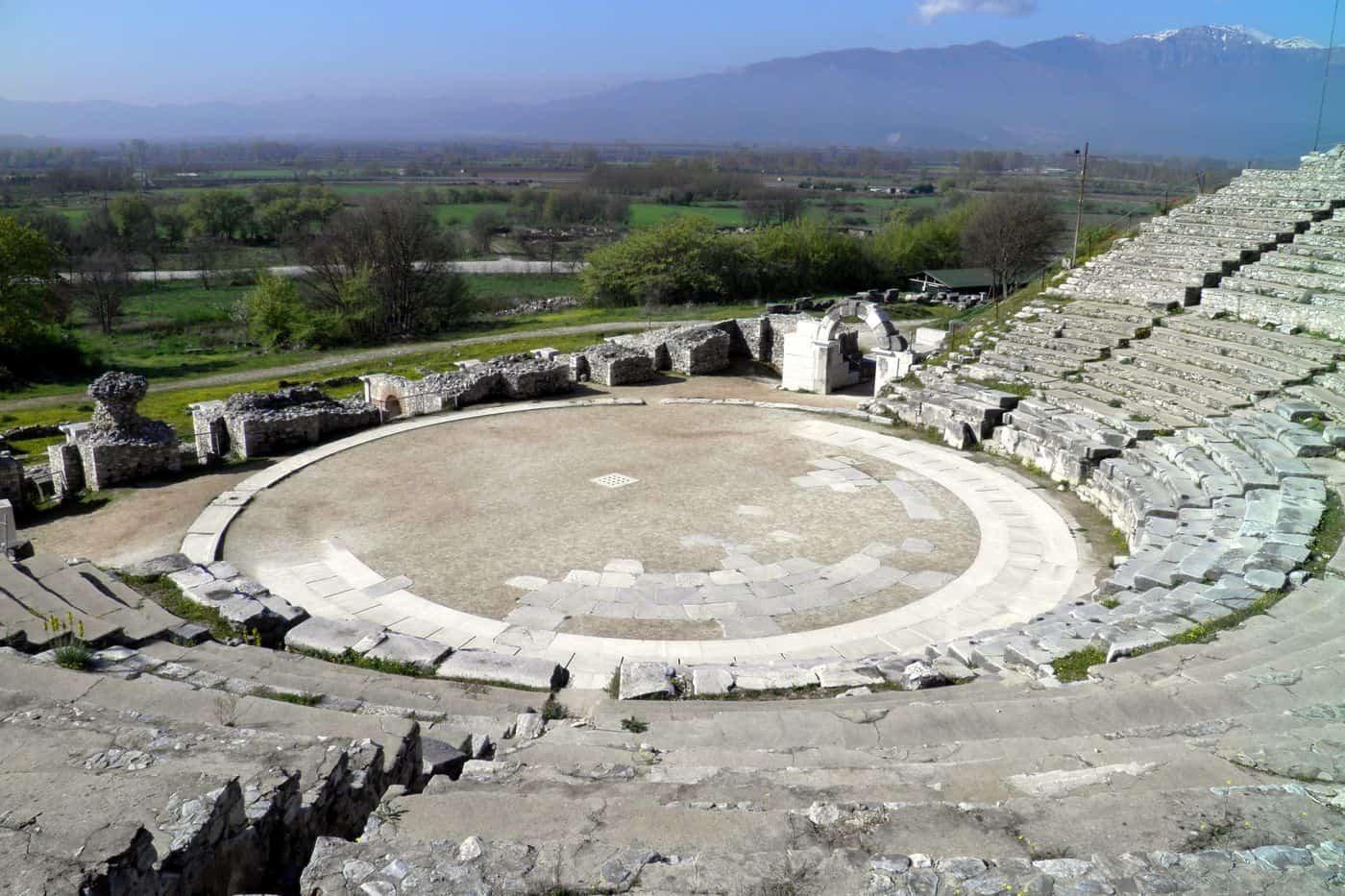
Philippi tours see a theatre from the mid-4th century BC, set into the slope of the acropolis hill and later turned into a Roman arena, and a Roman forum laid out on two terraces on both sides of the main road.
The theatre ranks among the early stone theatre buildings in Greece, and its seats face south over the city. In the 2nd century AD the Romans added a three-storey stage building with a wooden proscenium, widened the orchestra and decorated the stage with Dionysian themes. A later phase turned it into an arena: the proscenium came down, the orchestra became circular and a stone parapet protected the spectators.
Philippi tours in the high season can include a show at the Philippi Festival. The first ancient drama performance in the restored theatre took place in 1957, the first in 24 centuries. The Philippi–Thasos Festival opened officially in 1961, and its programme mixes ancient and modern performances, ballet and concerts.
The forum stands a little east of the old Greek agora and rose in phases between the reigns of Claudius (41–54) and Antoninus Pius (138–161). UNESCO cites it as an example of a Roman public square in the eastern provinces. A paved stretch of the Via Egnatia survives there, and Philippi tours use it to show the old road.
- Seating: a walkway splits the cavea into two zones of 8 wedges each.
- Lower rows: the lower zone keeps ten rows of seats.
- Excavation: French archaeologists uncovered the theatre between 1921 and 1937.
What do Philippi tours see at the early Christian basilicas?
Philippi tours see the ruins of Basilica A, Basilica B and the Octagon, the cathedral complex dedicated to Saint Paul. These churches rose in the city centre between the 4th and 6th centuries AD, when Philippi grew into a centre of Christian faith and pilgrimage.
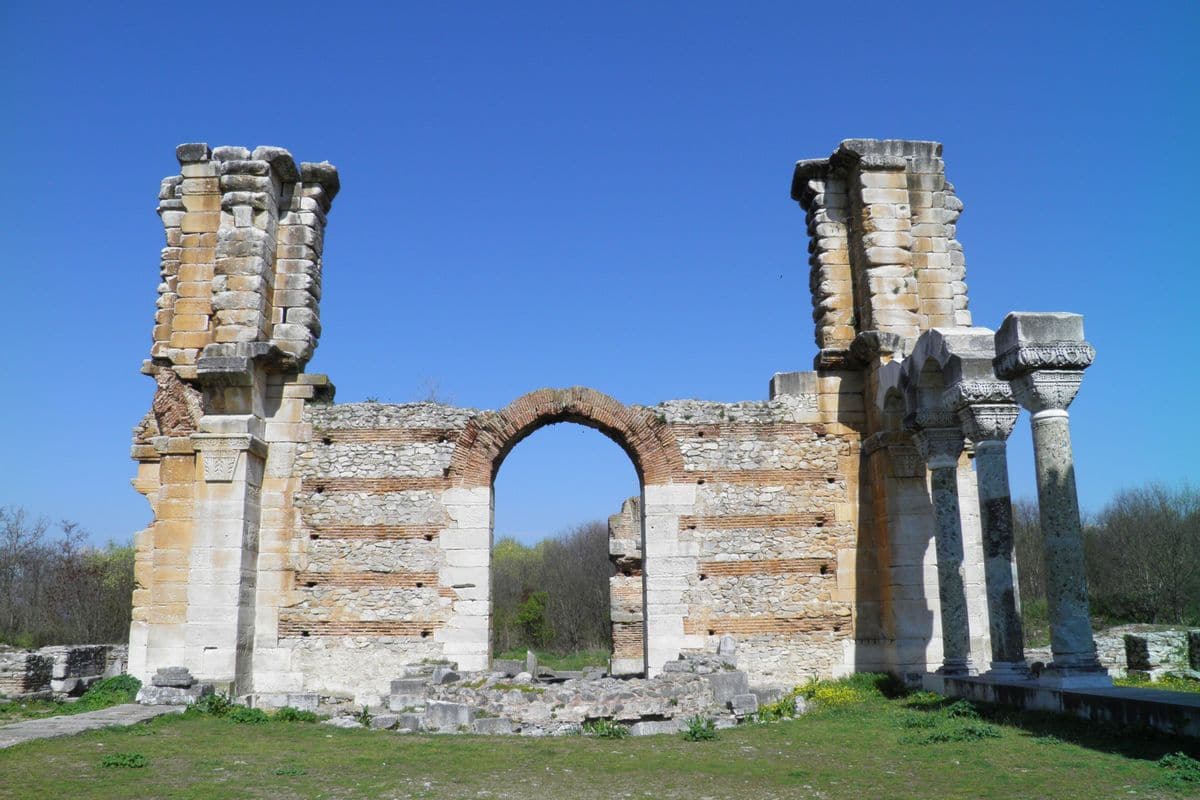
Philippi tours count seven churches built in the city between the mid-4th and late 6th centuries. The first on record is the Basilica of Paul, named in a floor mosaic and dated to around 343 through bishop Porphyrios. At the end of the 5th century a cathedral complex built around an octagonal church took its place and rivalled the churches of Constantinople. Greek excavations between 1958 and 1978 uncovered the Octagon and the bishop’s quarter.
French excavations between 1914 and 1937 brought Basilica A and Basilica B to light. The plan and architectural decoration of Basilica B link it with Hagia Sophia and Saint Irene in Constantinople. Philippi tours also point out verd antique, a dark green stone from Thessaly, in both basilicas and in the Octagon.
- Octagon mosaics: mosaics of the 5th to 6th centuries in the octagonal church complex.
- Floors in place: mosaic and opus sectile floors still lie where they were laid.
- Church types: UNESCO singles out the Octagon Church, the transept basilica and the domed basilica.
- Bulgar inscription: in 838 kavhan Isbul marked his capture of the city on the stylobate of Basilica B; two of its six marble slabs survive.
What history do Philippi tours tell?
Philippi tours tell the story of Krenides, a Thasian colony that Philip II of Macedon took and renamed in 356 BC, of the Battle of Philippi in 42 BC, of the Roman colony that followed, and of the visit of the apostle Paul.
Colonists from Thasos founded Krenides, a name that means Fountains, in 360/359 BC at the foot of Mount Orbelos, today Mount Lekani. In 356 BC the Thracians threatened the town, and it asked Philip II, the father of Alexander the Great, for help. Philip took the city, fortified it and gave it his own name. He wanted the nearby gold mines and a garrison on the route between Amphipolis and Neapolis.
Philippi tours point to the plain west of the walls as the battlefield. In October 42 BC Mark Antony and Octavian fought Brutus and Cassius there in two clashes, with up to 200,000 men in the field. Cassius and Brutus both took their own lives. Veterans then settled the city as Colonia Victrix Philippensium, and after 27 BC it carried the name Colonia Augusta Iulia Philippensis.
Philippi tours link the city with the apostle Paul, who reached it in AD 49 or 50 on his second missionary journey, with Silas and Timothy, and founded the first Christian church on European soil.
- 2nd century BC: the Romans build the Via Egnatia through the city.
- Around AD 160: Polycarp of Smyrna writes to the Christian community of Philippi.
- Early 7th century: earthquakes and Slavic raids empty the lower city.
- Late 14th century: the Byzantine fortress ends after the Turkish conquest.
Which Philippi tours visit the baptistery of Lydia?
Philippi tours that visit the baptistery of Lydia stop at the village of Lydia, 17 km north-west of Kavala, where an open-air baptistery stands on the Zygaktis river at the traditional spot where Paul baptized Lydia of Thyatira in AD 49 or 50.
Lydia came from Thyatira in Asia Minor, modern Akhisar in Turkey, and sold purple cloth. Acts 16 records that she heard Paul preach, received baptism with her household and hosted Paul and his companions in her house. She is regarded as the first documented convert to Christianity in Europe.
Paul landed at Neapolis, modern Kavala, and reached Philippi along the Via Egnatia. On a Sabbath he spoke to the women gathered beside the Zygaktis, near the west side of the city wall, and Lydia was the first to accept baptism. For Philippi tours, this river bank marks the founding of the first Christian church in Europe.
The Holy Baptistery of Saint Lydia was built in 1972 at the initiative of Metropolitan Alexandros of Philippi, Neapolis and Thasos. On the same spot stands an octagonal baptistery church with mosaic and stained-glass decoration, the only such church in Greece. On her feast day each year, adults receive baptism in the open-air baptistery.
- Village: Lydia, called Ydromyloi until 1968.
- River: the Zygaktis, which Philippi tours reach west of the ancient city.
- Conference centre: the Apostle Paul centre, opened by Ecumenical Patriarch Bartholomew in 2011.
What do Philippi tours see in the Archaeological Museum of Philippi?
Philippi tours that enter the Archaeological Museum of Philippi see the finds from the excavations of the ancient city, shown on two levels of exhibition space in four major collections: prehistoric Dikili Tash and the Hellenistic, Roman and Early Christian city.
For Philippi tours, the museum stands near the west entrance of the archaeological site. Excavations began in 1914 under the French School at Athens, which continues the work today with the Greek Archaeological Service and the Aristotle University of Thessaloniki.
The prehistoric collection takes Philippi tours back to Dikili Tash, a tell that rises 16 m above the Drama plain, 1.5 km east of ancient Philippi. The tell is a Neolithic and Bronze Age site of about 6400/6200 to 1100 BC. Excavators found timber-framed buildings of the Late Neolithic there; one was decorated with a bull’s skull plastered over with clay.
The Turkish name Dikili Tash means “upright stone”. It refers to the inscribed funerary altar of Gaius Vibius Quartus, a military officer of the Roman colony of Philippi, buried beside the Via Egnatia at the foot of the tell.
- Prehistoric collection: finds from the tell of Dikili Tash.
- Hellenistic and Roman collections: finds from the city that Philip II of Macedon renamed in 356 BC and from the Roman colony.
- Early Christian collection: finds from the city of the 4th to 6th centuries AD, with its basilicas and the Octagon, the cathedral dedicated to Saint Paul.
Which Philippi tours combine Kavala?
Philippi tours that combine Kavala add the port city about 13 km south-east of the ruins, ancient Neapolis, and cover four landmarks: the Panagia old town, the Kamares aqueduct, the Imaret of Muhammad Ali Pasha and the fortress at the top of Panagia.
Settlers from Thasos founded Neapolis in the late 7th century BC. For Philippi tours, the old town on the Panagia peninsula keeps the house of Muhammad Ali Pasha, the governor of Egypt from 1805 to 1848, as a museum.
On Philippi tours, the Kamares aqueduct, named for its arches, marks the line between the old and new parts of the city. The Ottomans built the present structure in the 16th century on an aqueduct of Roman origin, and it supplied drinking water as late as 1911. The fortress began as a Byzantine citadel and was rebuilt under Suleiman the Magnificent.
Muhammad Ali Pasha founded the Imaret below the fortress in the early 19th century, with madrasas, a school and a kitchen open to all students and travellers. Since 2004 it has operated as a hotel. Visitors based in Thessaloniki, 160 km to the west, can follow the Kavala day trip from Thessaloniki.
- Kamares: the aqueduct rises 25 m on 18 piers.
- Imaret: a complex 120 m long, covering 4,200 square metres under lead domes.
- Fortress: 360-degree views of the Aegean Sea and the city.
- Archaeological Museum of Kavala: parts of an Ionic temple of Thasian marble from Neapolis.


Which Philippi tours combine Amphipolis?
Philippi tours that combine Amphipolis add the ancient Athenian colony on the Strymon river, which Paul and Silas passed through on the road between Philippi and Thessaloniki, and cover the Lion of Amphipolis, the Kasta Tomb and the Archaeological Museum of Amphipolis.
Athenian colonists under Hagnon founded Amphipolis in 437 BC and gave it walls 7.5 km long. For Philippi tours, the link is the old road: Amphipolis and Philippi stood on the same Macedonian royal route, later the Via Egnatia.
Philippi tours that stop at the Lion of Amphipolis see a 4th-century BC tomb sculpture about 1 km outside the south gate of the ancient city. Oscar Broneer and Dimitris Lazaridis linked it to Laomedon of Mytilene, a general of Alexander. Greek soldiers found the first pieces in 1912–13 in the bed of the Strymon, and the lion was restored in 1937.
The Kasta Tomb, of the last quarter of the 4th century BC, is the largest ancient burial mound found in Greece. Its three chambers hold two sphinxes, two caryatids and a pebble mosaic of Hades carrying off Persephone. In April 2023 the tomb opened to specific groups: tour operators, researchers and scientists. Visitors based in Thessaloniki can follow the Amphipolis day trip from Thessaloniki.
- Lion of Amphipolis: a seated marble lion more than 4 m tall, over 8 m with its base.
- Kasta Tomb: an almost circular wall 158 m across, faced with Thasian marble, around a mound about 30 m high.
- Archaeological Museum of Amphipolis: gold jewellery from the Kasta Tomb, a gold stater of Alexander the Great and a 4th-century BC golden wreath.
Which Philippi tours combine Drama and the Angitis springs?
Philippi tours that combine Drama and the Angitis springs head 20 km north-west from Krinides, the town beside the ruins, to the Agia Varvara springs in Drama. The Maaras cave, the largest river cave in Greece, lies 25 km north-west of Drama.
The name Drama comes from the ancient Dyrama or Hydrama, both meaning “rich in water”. In Roman times the town was a vicus, or village, of the colony of Philippi. A branch of the Via Egnatia left Philippi, crossed the Agia Varvara torrent and the Angitis, and ran on to Serres.
The Agia Varvara springs feed the Angitis, together with the marshes of Philippi and the springs at the village of Angitis. The Agia Varvara park holds the Marble House of 1875, now the Museum of Cameras and Photography. Tradition says a lake formed here in 1383 and covered a chapel of Saint Barbara. On 3 December, the eve of her feast, hundreds of children set home-made lit boats on the lake.
The cave of the Angitis springs, also called Maaras, lies 500 m from the village of Angitis in the Prosotsani municipality. The river flows along its floor under large stalactites. Philippi tours walk the visitable section, 500 m long and open since 2001. Finds from the area, among them a mammoth tusk, sit in the Archaeological Museum of Drama.
- Drama: 37 km north of Kavala, a forty-minute drive.
- Agia Varvara: springs, lake and park, one source of the Angitis.
- Maaras cave: 25 km north-west of Drama, with 500 m open to visitors.
The town itself is covered in full on the Drama day trip from Thessaloniki page.
How do Philippi tours reach the site from Kavala and Thessaloniki?
Philippi tours reach the site 13 km north-west of Kavala on National Road 12, the Drama road, which passes west of Krinides. From Thessaloniki, the A2 Egnatia Odos motorway covers 160 km to Kavala, a drive of one and a half hours.
The A2, known as the Egnatia Odos, is a tolled motorway that runs 670 km from the port of Igoumenitsa to the Turkish border at Kipoi. Two junctions, Kavala West and Kavala East, serve the city.
Kavala International Airport “Alexander the Great”, code KVA, stands near Chrysoupoli, 30 km from Kavala. It serves the Kavala, Drama and Xanthi areas, with daily flights to Athens and weekly flights to other European destinations. KTEL Kavala runs buses between the city and the airport, with a change at Chrysoupoli.
Philippi tours by public transport use the KTEL bus network. Bus lines link Kavala with all the local villages. The intercity station in the centre of Kavala runs daily scheduled services to Thessaloniki, Athens and every city of East Macedonia and Thrace.
- From Kavala: 13 km to the site on National Road 12.
- From Thessaloniki: 160 km on the A2, one and a half hours by car.
- From Drama: 20 km south-east to Krinides on the same road.
- By air: Kavala International Airport, 30 km from Kavala.
- By bus: KTEL Kavala, with daily services to Thessaloniki and Athens.
When do Philippi tours run best?
Philippi tours run best from April to June and in September and October, when average highs in Kavala stay between 18.0 °C and 27.3 °C. July and August average above 30 °C and host the Festival of Philippi, with theatre and music.
Kavala has a hot-summer Mediterranean climate, type Csa in the Köppen system. The Kavala weather station records average highs of 30.1 °C in July and 30.6 °C in August, with average lows of 23.1 °C and 23.7 °C. Drama has hot, dry summers and chilly, wet winters.
Rain drops to its low point in summer. August averages 21.4 mm over 2.8 days, and July 25.4 mm over 4.2 days. March is the wettest month, with 68.2 mm over 11.6 days, and October brings 64.7 mm.
The Festival of Philippi runs from July to September, with theatre and music concerts. It began in 1957, when the ancient theatre of Philippi came back to life after 24 centuries with a performance of ancient drama. It stands as the leading cultural event of Kavala. Philippi tours in early summer also meet the Eleftheria in Drama, held at the end of June or the start of July.
- July and August: average highs of 30.1 °C and 30.6 °C.
- September and October: average highs of 25.6 °C and 19.9 °C.
- Drama events: the Eleftheria in early summer and a short film festival in September.
Frequently Asked Questions
What else do Philippi tours see in Drama?
Philippi tours that stop in Drama add the church of Hagia Sophia, built in the 10th century together with the city walls and used as a mosque under Ottoman rule. The Archaeological Museum of Drama traces human presence from the mid-Palaeolithic period, 50,000 years ago, to 1913.
Can Philippi tours add the Angitis gorge?
Philippi tours can add the Angitis gorge, 17 km from Drama between Mount Pangaio and Mount Menoikio. It runs 15 km from Symvoli to the Angista railway station and reaches 100 m in depth. Visitors enter at Symvoli, in the Amphipolis municipality. Rafting, canoe and kayak trips run on the river.
Can Philippi tours reach the area by train?
Philippi tours by train use Drama station, since Kavala has no rail link. The station stands on the Thessaloniki–Alexandroupoli line, with daily services to Thessaloniki. The Jonction Salonique–Constantinople company built it in 1895, and its depots, engine shed, turntable and water tower survive in their original form.
What weather do Philippi tours meet in winter?
Philippi tours in winter meet cool, wet days. In Kavala, January averages a high of 9.7 °C and a low of 4.2 °C, with 57.5 mm of rain over 9.2 days. Snow is sporadic but falls almost every year. Drama stands at the foot of Mount Falakro, which has a modern ski resort.