
Volos Walking Tour
A Volos walking tour is a guided walk on foot through Volos, the port city of Magnesia at the head of the Pagasetic Gulf, below Mount Pelion. The route links the old Palia district, the waterfront promenade, the neoclassical centre and its museums. This Greece Tours page sets out what a Volos walking tour shows and which walks are open for booking.
Volos holds 5,000 years of settlement inside one compact street plan. A Volos walking tour reads that history in stone: a Bronze Age mound, Byzantine and Ottoman walls, tobacco warehouses, merchant mansions and a city rebuilt after the earthquakes of 1955.
What is a Volos walking tour?
A Volos walking tour is a guided walk through the streets of Volos, the capital of Magnesia, that explains the city’s Bronze Age mound, Byzantine and Ottoman walls, neoclassical mansions, museums and waterfront, stop by stop, with a local guide.
Volos sits at the innermost point of the Pagasetic Gulf, about 170 kilometres north of Athens and 140 kilometres south of Thessaloniki, on a plain at the foot of Mount Pelion. Three torrents from the mountain cross its districts to the sea. A Volos walking tour uses this compact layout: the old quarter, the port and the centre sit close together, so a group moves from the Bronze Age to the modern harbour in a single walk.
The guide on a Volos walking tour links each stop to the events that shaped it. The earthquakes of 1955 destroyed most of the old mansions, so guides point out the buildings that survived: neoclassical banks and houses, two waterfront churches and tobacco warehouses turned into public spaces. In the old quarter, the walk reads the ground itself, from Byzantine walls down to a Mycenaean palace site. Some private walks are led by local archaeologists who explain each layer.
Which Volos walking tours can you book?
Two Volos walking tours are open for online booking: a food and walking tour with tsipouro tasting, and a tsipouro ritual and slow-living walking tour. Both explore the city on foot; check the tour listing for the meeting point.
The food and walking tour with tsipouro tasting joins a guided walk through Volos with tastings of the local spirit, covered on our Volos food tour page. The walking half is the part this page covers: the group crosses the city on foot while the guide explains the streets and landmarks between stops. Check the tour listing for the route, start point and group size before booking this Volos walking tour.
The tsipouro ritual and slow-living walking tour puts local habits and an unhurried pace at the centre of the walk, and the guide explains local customs along the way. Outside these two listings, a Volos walking tour also runs in two other formats: a weekly guided city walk from June to October, booked in advance through the city tourism information centre, and private walks led by archaeologists from the University of Thessaly building to the Historic District.
What does a Volos walking tour see in the Palia district?
A Volos walking tour in the Palia district sees the Kastro mound, where the remains of a Mycenaean palace, a tholos tomb, Roman baths, early Christian churches, a Byzantine wall with a moat and an Ottoman gunpowder magazine stand within one neighbourhood.
Palia, the name locals give the old town of Volos, sits on the Kastro mound in the west of the city. The mound held a Bronze Age settlement, and excavations there uncovered a Mycenaean palace complex and a couple of Linear B tablets. Settlement layers in the quarter go back to the third millennium BC, so a Volos walking tour here covers about 5,000 years on one patch of ground. A guide reads the history behind the stones.
The walls tell the later story. The fortifications of medieval Golos, the Byzantine name of Volos, follow the line of older defences on the mound, and the old castle wall is open to visitors. The Ottomans strengthened these walls against a Venetian attack, and their gunpowder magazine still stands in the quarter. A Volos walking tour through Palia also passes old tobacco warehouses converted into modern spaces, and the private archaeologist-led walks end outside the Volos City Museum.
Which museums does a Volos walking tour pass?
A Volos walking tour passes or ends at the Athanasakeion Archaeological Museum, the Volos City Museum in the Historic District, the Giorgio de Chirico Art Centre, the Thessaly Railway Museum at the station and the Tsalapatas Rooftile and Brickworks Museum.
The Athanasakeion Archaeological Museum is one of the oldest museums in Greece, housed in a neoclassical building constructed in 1909 and paid for by Alexios Athanassakis, a merchant from Portaria. It holds jewellery, utensils and farm tools from the Neolithic settlements of Dimini and Sesklo, Geometric clay figures, classical jointed statuettes and Hellenistic steles with their painted colours intact. Whole tombs sit inside with the skeleton and offerings, and reconstructed Neolithic houses stand outside, a stop that sets the timeline for a Volos walking tour.
The other museums follow the modern city. The Volos City Museum stands in the Historic District of Palia. The Giorgio de Chirico Art Centre honours the painter born in Volos in 1888, whose father, Evaristo De Chirico, designed the railway station, home to the Thessaly Railway Museum. The Tsalapatas Rooftile and Brickworks Museum occupies the old Tsalapatas factory. Check opening days before building a Volos walking tour around a museum visit.
- Archaeology – Athanasakeion Archaeological Museum, with finds from Dimini and Sesklo.
- City history – Volos City Museum, in the Historic District of Palia.
- Art – Giorgio de Chirico Art Centre and Theofilos Museum in Anakasia.
- Industry – Tsalapatas brickworks museum and Thessaly Railway Museum.
- Nature – Volos Natural History Museum and Entomological Museum of Volos.
Which buildings and squares line a Volos walking tour through the centre?
A Volos walking tour through the centre passes neoclassical banks, hotels and merchant mansions built after 1881, the railway station, the City Hall, the Averofeian Courthouse, the square in front of Saint Nicholas church and the waterfront church of Saints Constantine and Helen.
The new city grew as neoclassicism spread, and public buildings and merchant houses followed the style. The three-storey Hotel de France of 1894, on Iasonos and K. Kartali Street, keeps its decorative murals. The banks mark the commercial boom: the National Bank of 1895 began as the Privileged Bank of Epirothessaly, the Bank of Athens of 1903 is now the University of Thessaly library, and the Agricultural Bank of 1909 and the Bank of Greece of 1935 complete the set on a Volos walking tour.
The earthquakes of 1955 brought down most mansions, and only some were restored for new, mainly public, uses. The Sarafopoulos Mansion of 1927 houses the Volos Club, the Regas house keeps its painted murals as the Lyceum of Greek Women, and the Kitsos Makris house is now a folklore centre. On the waterfront, the churches of Saint Nicholas and Saints Constantine and Helen are both by the architect Aristotelis Zachos. The Aegli Hotel of 1927, designed by Kassiopoulos, closes a Volos walking tour of the centre.
Which parks and viewpoints does a Volos walking tour reach?
A Volos walking tour reaches the waterfront promenade with its view across the Pagasetic Gulf, Agios Konstantinos Park, the Kastro mound in Palia and the seaside paths of Anavros, with Mount Pelion rising behind the city.
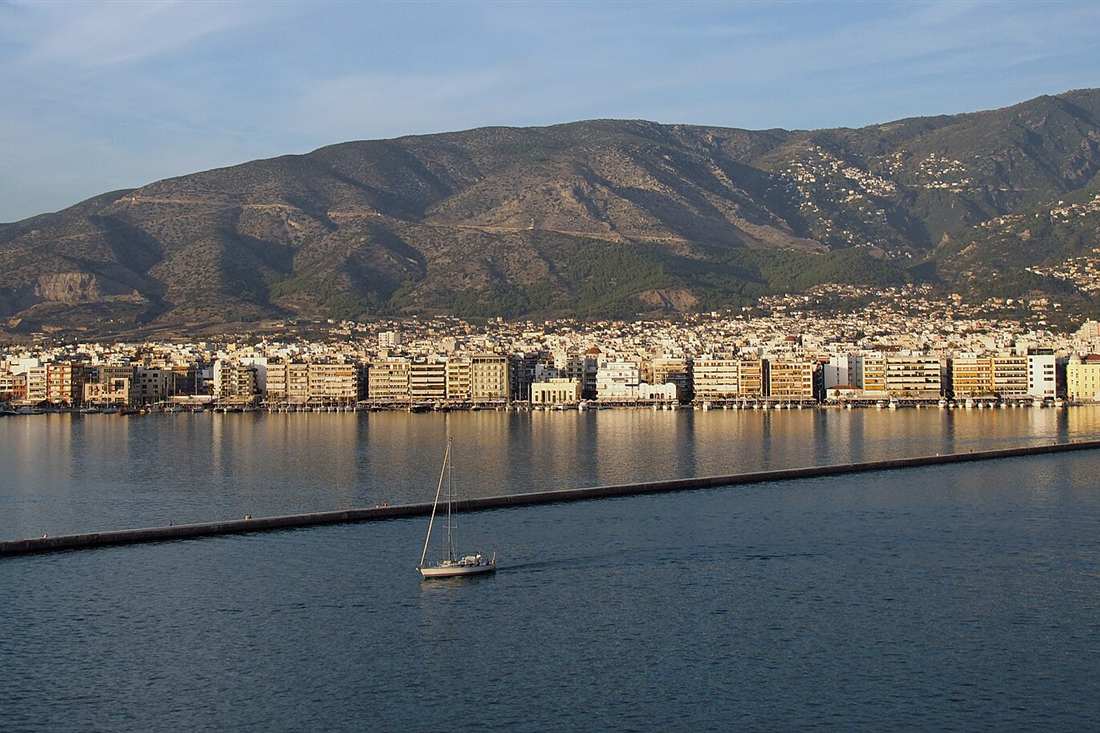
The promenade is the main viewpoint of a Volos walking tour. It runs from the University of Thessaly, the large yellow building at its east end, toward the port, where ferries leave for Skiathos, Skopelos and Alonissos. The gulf opens to the south, and the slopes of Mount Pelion, rising to 1,610 metres, fill the view behind the city. Agios Konstantinos Park adds a green stop on the water, near the Air Force officers’ club believed to be a Le Corbusier design.
East of the centre, the Anavros district offers seaside paths with views of the Pagasetic Gulf, and the weekly city walk ends at Anavros beach. The Anavros torrent runs down from Pelion and separates the Nea Demetriada district from the rest of the city, while the Krafsidonas river forms the natural lung of Volos and its boundary with Nea Ionia. On the west side, a Volos walking tour reaches the Kastro mound of Palia, the raised ground of the oldest town.
- Promenade – the gulf, the port and the Sporades ferries in one view.
- Agios Konstantinos Park – a green stop by the sea near the officers’ club.
- Kastro mound – the raised ground of Palia and its castle wall.
- Anavros – seaside paths and the beach where the city walk ends.
- Krafsidonas river – the green corridor between Volos and Nea Ionia.
How did Volos grow into the city a walking tour crosses today?
Volos grew from a walled medieval town on the Kastro mound into a merchant port, joined Greece in 1881, took in refugees in the 1920s and was rebuilt after 1955, the layers a Volos walking tour crosses today.
Neolithic Sesklo and Dimini lie west of the city, and the Kastro mound held a Bronze Age settlement identified with ancient Iolcos, the home port of Jason and the Argo in myth. The town reappears in 1333 as Golos, a name of Slavic origin, and the Ottomans held it for good from 1423, strengthening the walls while the Christian population moved up to the slopes that a Pelion villages tour visits. The town spread outside its walls in the late 16th and early 17th centuries, as trade grew around a twice-weekly fair.
Volos joined the Greek Kingdom in November 1881 with only 4,900 residents; the new port opened in 1893 and the first Labour Union in Greece formed here in 1908. Refugees from Ionia, Pontus, Cappadocia and Eastern Thrace arrived in the 1920s and shaped its music and social life. The earthquakes of 1955 made Volos the newest of the Greek port cities, with a far younger building stock than the Roman and Byzantine monuments on a Thessaloniki walking tour, and a large share of the buildings on a Volos walking tour date from that rebuilding.
How long does a Volos walking tour last, and how far does it go?
A Volos walking tour led by local guides lasts about two hours, and one city route covers about 6 kilometres from the old town to Anavros beach. For the two guided walks on sale, check the tour listing for the exact duration.
Two hours is the length that local guides set for a walk through the city. One scheduled group walk visits the Palia district, follows the port promenade, crosses the centre and ends on Anavros beach, a line of about 6 kilometres. The finish differs from the start, so walkers return on their own. A private Volos walking tour led by a local archaeologist also lasts two hours and runs the other way, from the east end of the promenade to the Historic District.
Volos is compact, and the waterfront forms the spine of a city route. The Palia district sits at the western end, the port and the central squares lie in the middle, and the University of Thessaly and Anavros beach mark the eastern end. A Volos walking tour of 6 kilometres in two hours includes time at each stop, so the pace stays relaxed. The duration and the meeting point vary by tour, so check the tour listing before booking.
When is the best time of day and year for a Volos walking tour?
The best time for a Volos walking tour is the morning, before the warmest hours, from late spring to autumn. Local guides start on time to avoid the heat, and one scheduled group walk runs on Friday mornings from June to October.
Summer is the main season for a Volos walking tour. The scheduled group walk leaves at 10:30 every Friday from June to October, and the guides start on time so the group finishes before the hottest part of the day. The promenade and the open squares take the full sun at midday, so a morning start keeps the walk comfortable. An evening stroll along the gulf after sunset suits a slower second visit to the waterfront.
The climate supports walking for most of the year. Volos has a dry climate with low humidity, and temperatures stay moderate, without extreme highs or lows. Rain falls on about 89 days a year, which leaves roughly three days in four dry, and thunderstorms are more frequent in the warmer months. Mount Pelion shelters the city from north-easterly winds, so Volos receives less rain than the far side of the mountain. Spring and autumn give a Volos walking tour mild air and soft light.
What do you wear and bring on a Volos walking tour?
Wear comfortable walking shoes and clothes that match the weather for a Volos walking tour. Bring water, sun protection and a plan for the trip back, because some routes end at a different point from where they start.
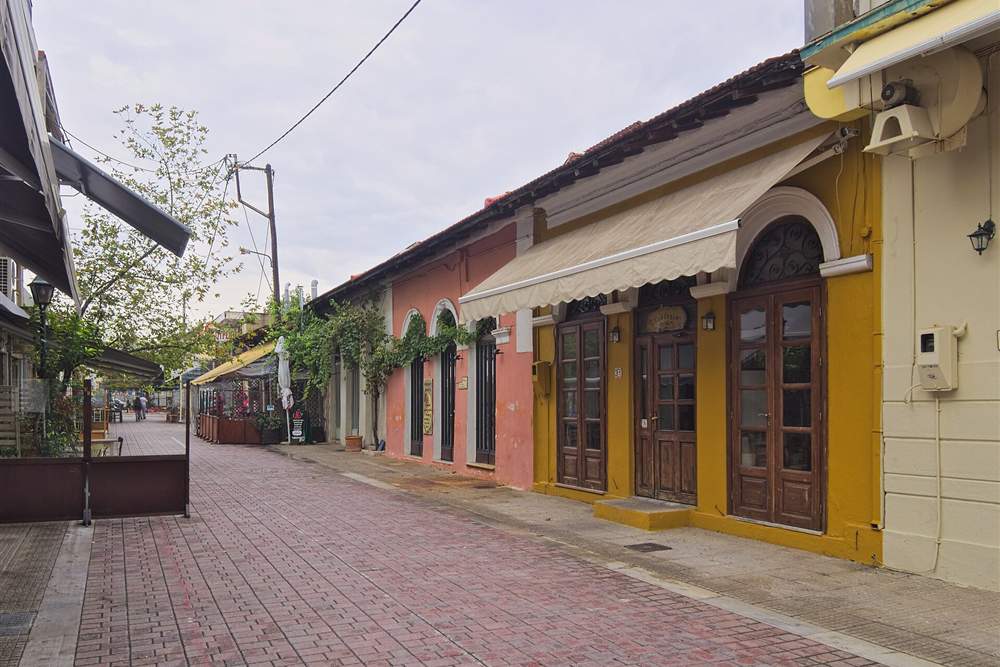
Local guides ask walkers to wear comfortable shoes and to dress for the conditions, and both requests fit the ground. The promenade and the central streets are paved and level, but the old town has cobbled lanes, excavated remains and a Byzantine wall with a moat around the Kastro mound. A Volos walking tour through these streets calls for closed shoes with a firm grip rather than sandals, and a light layer for a breezy morning by the sea.
Summer mornings warm up fast, so a hat, sunscreen and a refillable bottle belong in a small day bag. In the cooler months, a waterproof layer covers the rain days. A route that finishes on Anavros beach leaves walkers on the eastern edge of the city. Local buses link the port with nearby neighbourhoods, but evening and weekend service is limited, so plan the return before a Volos walking tour starts.
- Shoes – closed walking shoes with a firm sole for cobbles and paving.
- Clothing – light layers that match the season and the forecast.
- Water – a refillable bottle for the open stretches of the promenade.
- Sun cover – a hat and sunscreen for the midday waterfront.
- Return plan – a bus route or taxi number for the finish point.
Is a Volos walking tour suitable for families and slow walkers?
Yes, a Volos walking tour suits families and slow walkers, because the city centre lies on a flat plain and the main route follows the level waterfront. One local group walk is open to all ages, and private walks set their own pace.
Volos spreads across a plain at the foot of Mount Pelion, so the central streets involve few climbs. The Agiou Nikolaou district, with its pedestrian street of cafes and shops, suits families and mixed-age groups, and children enjoy the street performers there. A Volos walking tour that passes through this district gives young walkers space away from traffic, and the cafes give older walkers a place to rest between stops.
For slow walkers, the format matters more than the terrain. Private walks in Volos are shaped around personal interests and pace, and the guide shortens or reorders stops on request. Local archaeologists also lead a mythology walk designed for children, which turns the city into a story trail for a young group. For age limits, wheelchair access and group size on the two walks on sale, check the tour listing before booking a Volos walking tour.
How do you plan a self-guided Volos walking tour route?
Plan a self-guided Volos walking tour along the waterfront, from the Palia district in the west to Anavros beach in the east. This line links the old town, the railway station, the port, the central churches and the university in one walk.
Start in Palia, which locals also call the Historic District, outside the Volos City Museum. From there, walk to the Railway Station of Volos, designed by Evaristo De Chirico, which also houses the Thessaly Railway Museum. Continue to the corner of Iasonos and K. Kartali Street to see the three-storey Hotel de France and its painted murals, then turn toward the port. This first half of the Volos walking tour covers the oldest and the most industrial parts of the city.
Follow the promenade east past the port and the Church of Saint Nicholas, one of two waterfront churches by the architect Aristotelis Zachos. The second, the Church of Saints Constantine and Helen, stands farther east near Agios Konstantinos Park. The large yellow University of Thessaly building marks the east end of the promenade, and the walk ends on Anavros beach beyond it. This self-guided Volos walking tour keeps the sea on one side for most of its length.
- Palia – start outside the Volos City Museum in the Historic District.
- Railway station – see the station building and the Thessaly Railway Museum.
- Hotel de France – view the murals at Iasonos and K. Kartali Street.
- Port promenade – walk east past the Church of Saint Nicholas.
- Anavros – finish on the beach past the University of Thessaly.
What can you add to a Volos walking tour on the same day?
Add a sail on the Pagasetic Gulf, a visit to the Neolithic sites west of the city, a birdwatching stop at Lake Karla or an airport transfer to a Volos walking tour on the same day. Each one fits around a two-hour morning walk.
A morning Volos walking tour leaves the afternoon open for the water, and a Volos yacht charter takes the same waterfront out onto the Pagasetic Gulf for the afternoon. Summer visitors also paddle a sea kayak near Afissos, on the gulf coast south-east of the city. West of Volos, Sesklo holds the remains of the oldest acropolis in Greece, and Dimini keeps a ruined acropolis, walls and two beehive tombs.
Lake Karla, a wetland north-west of the city, draws herons and flamingos that visitors watch from hides. The Theofilos Museum in Anakasia, a village on the slopes above Volos, shows the work of the folk painter Theofilos Hatzimikhail. Travellers who land at Nea Anchialos in the morning use Volos airport transfers to reach their hotel in the centre and still join an afternoon Volos walking tour on the same day.
How does a Volos walking tour compare with other Greek city walks?
A Volos walking tour is flatter and more modern in look than a hill-town walk, because the city rebuilt after the earthquakes of 1955 on a plain beside the sea. Its depth comes from the 5,000-year-old Palia district and the neoclassical merchant buildings.
Volos is the newest of the Greek port cities, and a large share of its buildings went up after the 1955 earthquakes destroyed most of the old mansions. The neoclassical banks, hotels and tobacco warehouses that survived now serve mainly public uses. The old town of Kavala climbs a rocky peninsula to its castle, so a Kavala walking tour involves steps and steep slopes that a Volos walking tour on the flat waterfront avoids.
The mix of eras sets a Volos walking tour apart. In one morning, the route passes a Mycenaean palace site and a Byzantine wall in Palia, an Ottoman gunpowder store, neoclassical merchant houses and a station building by Evaristo De Chirico. For a wider view of how Volos fits among the walking cities of the country, from Athens to the islands, the overview of Greece walking tours sets out the main routes.
Frequently Asked Questions
Is Volos flat enough to explore on foot?
Yes. Volos spreads across a plain at the foot of Mount Pelion, and the centre, the port and the promenade are level. A Volos walking tour in the centre involves few climbs, and only the old Kastro mound in Palia adds short rises and uneven ground.
Do you need a guide to explore Volos?
No. Visitors explore the Palia district and the waterfront alone without trouble, but a guide explains the history behind the stones that walkers miss on their own. A guided Volos walking tour adds context on the Mycenaean, Roman, Byzantine and Ottoman remains in the old town.
Can you walk from the port or the railway station into the centre?
Yes. The port lies on the city waterfront, and the railway station stands beside it on the western side of the centre, so both sit within a short walk of the main streets. Ferry and cruise passengers reach the promenade on foot and start a Volos walking tour there.
Is Volos a good city to explore in winter?
Yes. Temperatures in Volos stay moderate through the year, snow falls only a few times each winter and rarely disrupts daily life, and Mount Pelion blocks the north-easterly rain. The scheduled group walk ends in October, so winter visitors book a private or listed Volos walking tour.
What language do the guided walks in Volos run in?
The scheduled group walk runs in English when visitors from abroad join and in Greek when every walker is Greek. Private walks are arranged directly with the guide. For the language of each Volos walking tour on sale, check the tour listing before booking.