
Rhodes Rock Climbing
Rhodes rock climbing is guided outdoor climbing and rappelling on the limestone sea cliffs of Ladiko Bay, on the east coast of the island. A guide sets the ropes, checks every knot and coaches beginners and experienced climbers up each route. Among the outdoor trips listed on Greece Tours, it pairs a physical challenge with clear water and pine-covered headlands.
Two sessions are on sale at Ladiko Bay: a climbing and rappelling experience, and a climbing session paired with a swim. The bay sits just south of Faliraki, about 15 km from Rhodes Town, so Rhodes rock climbing fits easily into a beach holiday on the east coast.
What is Rhodes rock climbing?
Rhodes rock climbing is a guided outdoor activity in which travellers climb limestone cliffs on a rope and descend by rappelling, with a guide managing the ropes, the anchors and every safety check on the day.
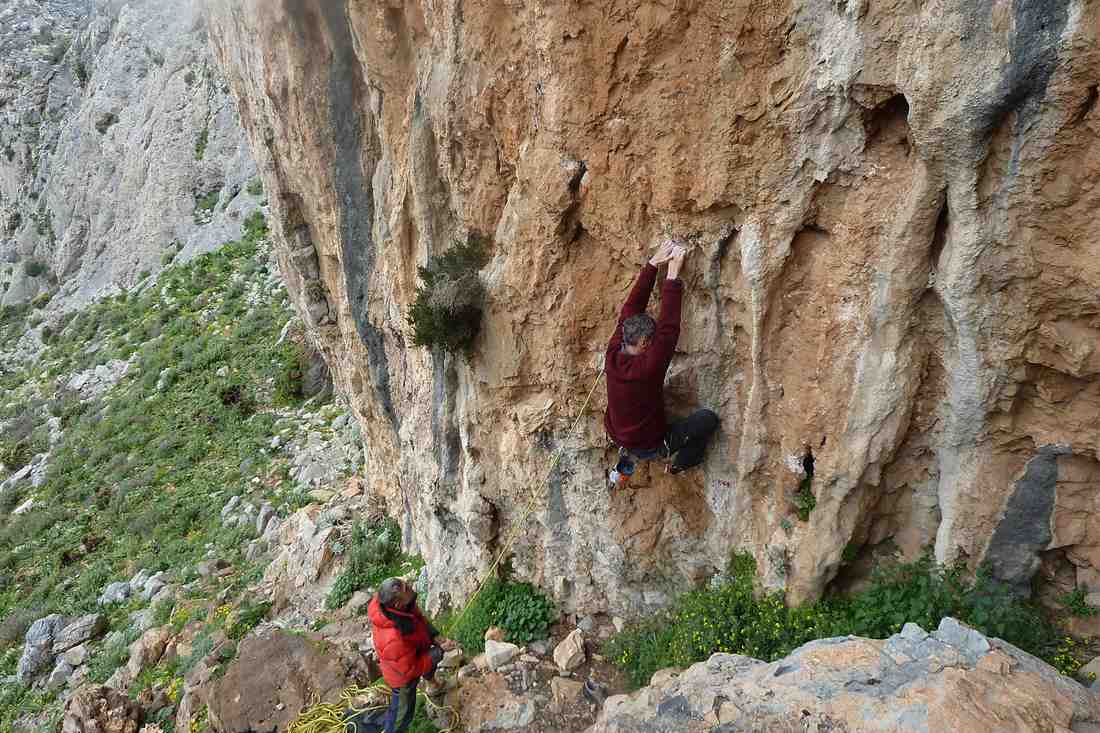
The activity takes place on the sea cliffs of Ladiko Bay, on the east coast of the island. Climbers wear a harness, climbing shoes and a helmet, tie into a rope that runs through an anchor above the route, and move up on natural holds. A Rhodes rock climbing session suits first-timers, since the guide holds the rope from below and takes the load whenever a climber rests or slips.
Experienced climbers book the same sessions to reach the rock fast, with a local guide who knows the bay. Rhodes rock climbing differs from indoor climbing in three ways: the holds are natural limestone rather than plastic, the sun and wind shape the day, and the sea lies next to the base of the cliffs. The first tour on sale adds rappelling, and the second adds a swim in the bay.
Which Rhodes rock climbing sessions can travellers book?
Two Rhodes rock climbing sessions are on sale: the Ladiko Bay Rock Climbing and Rappelling Experience, and a Rock Climbing and Swimming session at Ladiko Bay. Both are guided and both are booked online in advance.
The first, Rhodes: Ladiko Bay Rock Climbing and Rappelling Experience, joins two skills in one outing: climbing up the cliff on a rope and rappelling back down it under control. The second, Rhodes: Rock Climbing & Swimming at Ladiko Bay, pairs the climb with a swim in the bay, which suits hot days. Pick the first for more rope work, and the second for Rhodes rock climbing with beach time built in.
Summer dates for Rhodes rock climbing fill first, so reserve ahead for July and August. Before booking, check the listing for five details: the start time, the meeting point, whether climbing gear is included, whether hotel pickup is offered, and any minimum age or level. The group size and the guide’s languages also appear on the listing page, next to the reviews. Cancellation terms differ between listings, so read them too.
Where does the climbing take place on Rhodes?
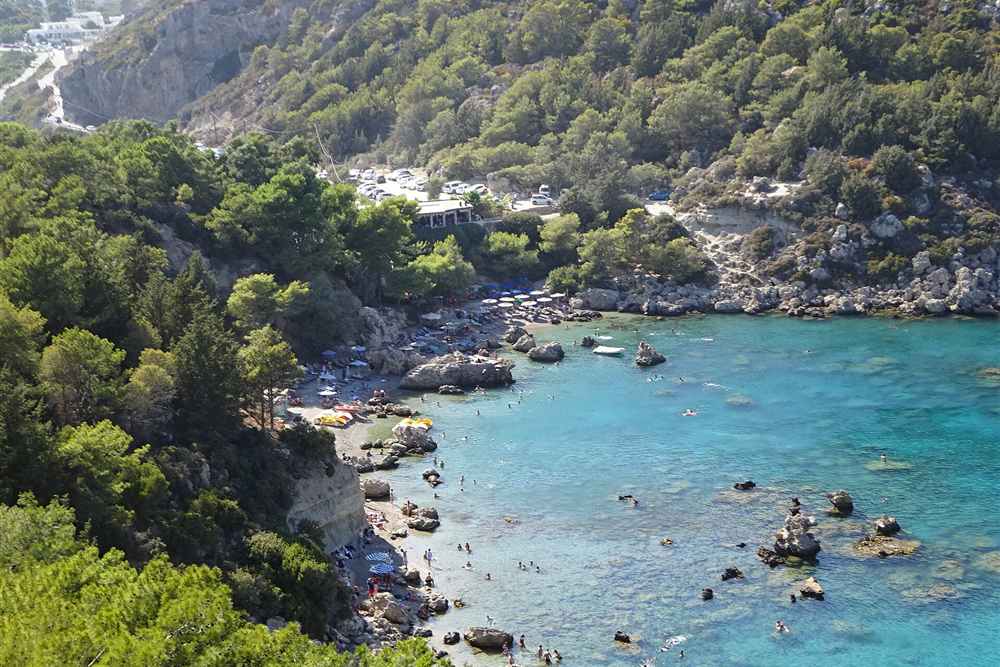
Both sessions take place at Ladiko Bay, on the east coast of Rhodes just south of Faliraki and about 15 km from Rhodes Town, where pine-covered limestone headlands drop into clear water beside a small beach.
Ladiko is a small cove, and Ladiko beach sits at its head, a strip of pebbles and sand below pine-covered slopes. Next to it lies Anthony Quinn Bay, named after the actor who filmed The Guns of Navarone on Rhodes in the early 1960s. For Rhodes rock climbing, the draw is the limestone that frames both coves, with headlands that rise from the water and give climbers open views across the sea.
Climbing on sea cliffs brings conditions that inland crags lack. Salt spray leaves a fine film on holds close to the water, rock near the waterline is polished and slippery, and the east coast catches wind that cools climbers but also pushes at them on the wall. The bay is reached from Faliraki, the nearest resort, or from Rhodes Town; check the listing for transfer details and the exact meeting point.
How does a beginner session run step by step?
A beginner session moves from a safety briefing to fitting the harness, helmet and shoes, learning the knot and the calls, climbing on top-rope with the guide belaying, and lowering or rappelling back to the ground.
Every Rhodes rock climbing session opens at the base of the cliff with a briefing on top-rope climbing: the rope runs from the climber’s harness up to an anchor above the route and back down to the guide, who belays and takes in slack. Each climber learns the figure-of-eight knot and the partner check, in which climber and guide inspect each other’s knot, harness buckles and belay device.
The climber then learns the calls that keep both people in step: “climbing” before moving, “take” to ask for a tight rope and a rest, and “lower” to be let down from the top. The guide picks an easy first route so each person learns to trust the rope, then moves to longer lines as confidence grows, and the session ends back at the base with a lower-off or a rappel.
What is rappelling and how does it work?
Rappelling, also called abseiling, is a controlled descent down a rope using a belay device that creates friction, while the guide backs the climber up so that a slip ends in a stop, not a fall.
On the Ladiko Bay Rock Climbing and Rappelling Experience, rappelling is named in the title, and it is a standard part of beginner Rhodes rock climbing. The climber sits back in the harness at the top, feeds the rope through the belay device with one hand, and keeps the brake hand low on the rope below. Walking the feet down the rock while leaning back is the core of the skill.
The first step over the edge feels the hardest, because the body has to lean out past the vertical before the feet can grip. The guide gives instructions throughout, and nerves fade once the feet are flat on the rock. From there, the descent becomes a steady backward walk down the wall, with the sea below and the sky above. The skill carries over to every climbing trip that follows, anywhere.
Which gear and techniques does a first climb use?
A first Rhodes rock climbing session uses a harness, climbing shoes, a helmet, chalk and a belay device, and teaches four techniques: weight on the feet, straight arms, hips close to the wall and three points of contact.
Guides provide the gear on most Rhodes rock climbing sessions, but inclusions differ between tours, so check the listing before the day of the climb. Climbing shoes fit tight to give the toes precision on small holds, and they come off between climbs to rest the feet. The helmet stays on for the whole session, at the base and on the wall, and chalk keeps sweaty hands dry in the heat.
Technique matters more than arm strength. The legs are the strongest muscles in the body, so climbers push with their feet and keep their arms straight to save grip strength. Hips stay close to the wall to keep weight over the feet, and three limbs stay on the rock while the fourth moves to the next hold. On Rhodes rock climbing sessions, the guide calls out these four cues from below.
- Harness – a waist belt with leg loops that holds the rope.
- Helmet – a hard shell that guards against falling stones.
- Belay device – a metal brake that controls the rope.
What rock type and grades does Rhodes rock climbing involve?
Rhodes rock climbing takes place on limestone, as sport climbing on bolted routes plus top-rope sessions for beginners, graded on the French scale, with first-timers on the easiest grades, around 4a to 5c.
Limestone gives climbers pockets, edges and flakes to hold, and it grips well when dry. Greece uses the French grading scale, in which numbers rise with difficulty and the letters a, b and c split each number into three steps, so 5c is harder than 5a. Beginners on Rhodes rock climbing sessions climb around the 4a to 5c band, and the exact grades at Ladiko are a detail to check with the guide.
Ladiko is not the only rock on the island. Archangelos, further south on the east coast, has limestone cliffs of its own, and route details there are a matter to check with a local guide. A single session of Rhodes rock climbing is also the start of a longer path toward independent sport climbing, which runs through three stages, each learned with an instructor before a climber moves on to the next.
- Top-rope – stage one, with the guide holding the rope from below.
- Belaying – stage two, with the climber holding the rope for a partner.
- Lead climbing – stage three, with the climber clipping bolts on the way up.
Who can join a guided climbing session on Rhodes?
Guided Rhodes rock climbing suits active travellers with no climbing experience as well as seasoned climbers, and it needs average fitness, a head for moderate heights and the ability to follow instructions, not strong arms or prior training.
Top-rope climbing lets a person with no training climb real rock with full protection, which makes it a fit for first-timers. Couples, friends and families with older children join the same session, and the guide matches routes to each person. Fear of heights is common on a first climb, and the guide lets each climber stop at any point and lower. Minimum ages differ between listings, so check before booking.
Fitness needs are modest. A climber who can manage a short approach walk, climb a ladder and hold a squat has enough strength for Rhodes rock climbing at beginner level. Grip tires fast on the first climbs, so rest between turns, drink water and eat a light snack. Experienced climbers gain local route knowledge and set anchors, and the swimming session gives both groups a way to cool down after the effort.
When is the best time for Rhodes rock climbing?
The best months for Rhodes rock climbing run from October to May, with spring and autumn ideal, while in July and August sessions move to early morning or late afternoon because midday rock is too hot to climb.
Rhodes is one of the sunniest islands in Greece, and bare limestone in full summer sun heats up fast, burns the fingertips and makes shoe rubber lose grip. Summer Rhodes rock climbing therefore runs at the edges of the day, when the sun is low and the rock is cooler. Check the listing for the start time, and plan the rest of the day around the midday heat instead of climbing through it.
Shade planning is the detail most visitors miss. The east coast takes the morning sun, and shade moves across each wall as the day turns, so ask the guide which routes sit in shade at the session time. October to May is the prime climbing season, and the sea is warm enough to swim from June to October, so October pairs cool rock with warm water for a swim after the climb.
How do climbers stay safe on the sea cliffs?
Rhodes rock climbing stays safe when climbers wear a helmet against rockfall, follow every guide instruction, take care on polished limestone near the water, watch the wind, and carry sun protection, water and sturdy shoes.
Limestone cliffs shed small stones, so climbers keep helmets on and stand clear of the line below anyone on the wall. Every knot and buckle gets a partner check before each climb, and nobody unclips from the rope until the guide confirms it is safe. On polished rock by the water, climbers step with care and keep hands free on the approach, and in strong gusts the guide decides whether climbing continues.
Sun is the second risk. Rhodes rock climbing puts climbers on bare rock in open sun, so sunscreen, a cap and water matter as much as the rope. The approach walk to the cliff is short, and sturdy shoes grip on it better than sandals, so walk in and change into climbing shoes at the base. Long hair is tied back and rings come off, so nothing catches in the belay device.
- Clothing – stretchy shorts or leggings and a light top.
- Footwear – sturdy trainers for the approach walk.
- Sun kit – sunscreen, sunglasses and a cap.
- Swim kit – a swimsuit and a towel for after the climb.
Can a climbing session be combined with other trips?
Rhodes rock climbing combines well with hiking, cycling, kayaking, snorkelling, jeep safaris and quad tours on the island, and with climbing trips further afield, above all to Kalymnos in the Dodecanese, a ferry ride to the north.
The Rhodes hub gathers the island’s outdoor trips, and the natural partners share the same active pace. Hiking on Rhodes reaches Mount Attavyros and Profitis Ilias, two of the island’s mountains, on a rest day for the hands, while a kayak tour explores the coast from sea level. Snorkelling on Rhodes uses the same clear water, and it rounds off a session of Rhodes rock climbing with time under the surface.
For climbers who want more after Rhodes rock climbing, Kalymnos lies north in the Dodecanese and is Greece’s best-known sport-climbing island. A session at Ladiko is the opening step toward a trip there once belaying and lead climbing are learned. Mainland Greece adds climbing at Meteora and around Athens, and the skills from Ladiko carry over to each. Ferry timetables change by season, so check them before planning the crossing.
- Cycling – coastal and inland rides on a rest day.
- Jeep safari – off-road drives into the pine-covered interior.
- Quad tour – ATV rides on dirt tracks across the island.
Is Rhodes rock climbing worth it?
Rhodes rock climbing is worth it for travellers who want an active outing with full guide support, since the two Ladiko Bay sessions give beginners a safe first climb and experienced climbers quick access to local limestone.
The value lies in the mix. One Rhodes rock climbing session teaches knots, calls and movement on real rock, and it takes place beside a beach where a swim cools the body after the effort. Climbing is a skill that lasts beyond the holiday, and it carries on to Kalymnos, Meteora or an indoor wall back home. The setting at Ladiko, with pine-covered headlands and clear water, adds to the day.
The activity suits travellers less if they want a passive day or plan to climb at midday in August. For everyone else, the checks are simple: pick the session that fits, climbing with rappelling or climbing with swimming, confirm the start time and inclusions on the listing, pack the clothing list above, and book early for summer dates. Rhodes rock climbing then delivers a day that stands apart from a sunbed.
Frequently Asked Questions
Is experience needed for Rhodes rock climbing?
No experience is needed. Beginners climb on top-rope with the guide belaying from below, learn the knot, the partner check and the calls at the base, and climb the easiest grades on the French scale, around 4a to 5c.
Where do the climbing sessions on Rhodes take place?
Both Rhodes rock climbing sessions on sale take place at Ladiko Bay on the east coast, just south of Faliraki and about 15 km from Rhodes Town, next to Anthony Quinn Bay, on limestone headlands above clear water.
What is the best time of year to climb on Rhodes?
The best months for Rhodes rock climbing are October to May, with spring and autumn ideal. In July and August, sessions run early in the morning or late in the afternoon, because the midday sun makes the limestone too hot to climb.
Is climbing gear included on the sessions?
Guides provide the harness, climbing shoes, helmet, chalk and rope on most Rhodes rock climbing sessions, but inclusions differ between tours, so check the listing. Climbers bring comfortable clothes, sturdy shoes for the approach walk, sun protection, water and swimwear.
How do climbers progress after a first session on Rhodes?
After a first Rhodes rock climbing session, climbers learn to belay and to lead on bolted sport routes, then travel to Kalymnos, Greece’s best-known sport-climbing island, reached by ferry from Rhodes. Meteora and Athens also offer climbing on the Greek mainland.