
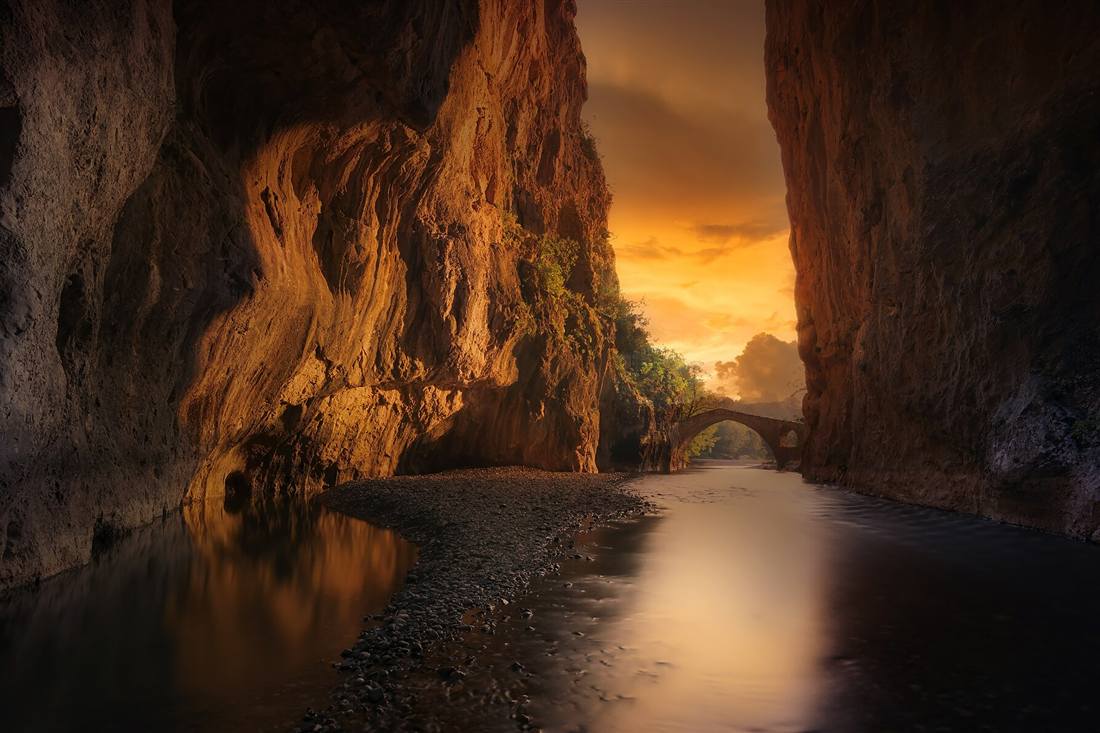
Grevena tours cover the mountain unit of western Macedonia: the Valia Calda national park in the northern Pindus, the Portitsa canyon and the stone bridges of the Venetikos, the Aziz Aga bridge below Spileo, the Vasilitsa ski centre, Samarina and the Vlach villages, and the forests that made Grevena the mushroom capital of Greece. Plan the rest of the trip with Greece Tours.
This page covers the Grevena tours you can arrange from the town, what the park, the gorges and the mountain villages hold, the mushrooms and the Vlach kitchen, and how the roads and the seasons shape the route.
What do Grevena tours cover?
Grevena tours cover the Valia Calda national park in the Pindus, the Portitsa canyon and the stone bridges of the Venetikos river, the village of Spileo and its Aziz Aga bridge, the Vasilitsa ski centre, the mushroom forests of the unit, and the fossil museum at Milia.
Grevena is the mountain unit of western Macedonia, set against the northern Pindus with forest covering much of its ground. It is one of the least visited parts of Greece, and its draw is outdoor: gorges, stone bridges, beech and black pine forest, wild mushrooms and snow.
- Valia Calda – the core of the Pindus national park, shared with Ioannina.
- Portitsa canyon – the narrow gorge of the Venetikos with its stone bridge.
- Spileo – the village above the Aziz Aga bridge on the Venetikos.
- Vasilitsa ski centre – the slopes at 1,750 to 2,113 m on the Pindus.
- Mushroom forests – the woods that made Grevena the mushroom capital of Greece.
- Milia – the natural history museum with the mastodon tusks.
Our Macedonia tours page covers the wider region and the Kozani tours page the unit to the east. Grevena tours work as two days from the town with a car.
What do Grevena tours see at Valia Calda?
Grevena tours at Valia Calda see the heart of the Pindus national park, a valley of black pine and beech between Mount Avgo and the Lygkos range, the Arkoudorema stream, brown bears, wolves and chamois in the forest, and the trails from Perivoli and Smixi.
The name means warm valley in the Vlach language. The park, created in 1966 and later extended, covers about 6,900 hectares at its core and protects one of the largest stands of black pine in southern Europe, with beech on the northern slopes and meadows above the tree line.
- Black pine forest – one of the largest stands in southern Europe.
- Arkoudorema – the bear stream running through the valley.
- Brown bears and wolves – the large mammals of the park.
- Perivoli – the Vlach village at the park’s edge, with the guesthouses.
- Mount Avgo – the 2,177 m peak above the valley.
- Off-road routes – the forest tracks that link Grevena and Ioannina.
The park is reached by forest roads from Perivoli, 55 km west of the town. Grevena tours take it with a local guide or a four-wheel-drive, since the tracks are rough.
What do Grevena tours see at Portitsa and the stone bridges?
Grevena tours at Portitsa see a canyon a few metres wide where the Venetikos cuts through the rock, the stone bridge at its mouth, and along the river the Aziz Aga bridge at Spileo, the Ziakas bridge and about 15 other Ottoman arches across the unit.
The Portitsa gorge is short and dramatic: the river runs through a slot between vertical walls, and a single-arch bridge spans the entrance. The Aziz Aga bridge, built in 1727 below Spileo, is the largest in the unit, its arch rising 12 m over the water.
- Portitsa canyon – the slot gorge of the Venetikos with its bridge.
- Aziz Aga bridge – the 1727 arch below Spileo, the largest in the unit.
- Ziakas bridge – the stone crossing on the road to the Pindus villages.
- Spileo – the village above the river, with the path down to the bridge.
- Venetikos rafting – the river descents in spring when the water is high.
- Mount Orliakas – the ridge above the canyon, walked from Spileo.
The canyon and the Aziz Aga bridge are 20 km west of Grevena town. Grevena tours walk both in half a day and raft the river in spring.
What do Grevena tours see at Vasilitsa and the mountain villages?
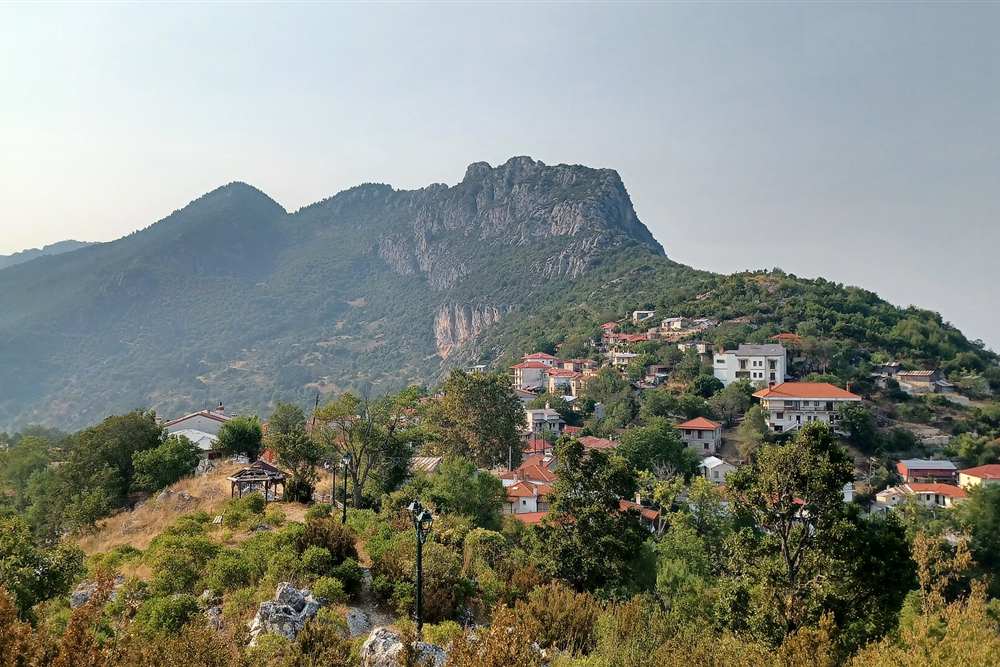
Grevena tours at Vasilitsa ski on the Pindus between 1,750 and 2,113 m, then reach the Vlach villages of Samarina, the highest in Greece at 1,450 m, Smixi, Perivoli and Avdella, with their stone houses and summer feasts.
Samarina fills in summer when the Vlach families return with their flocks, and its August feast of the Dormition is one of the great mountain panigyria of Greece. Avdella, nearby, is the birthplace of the Manakis brothers, the first film-makers of the Balkans.
- Vasilitsa ski centre – the slopes on the Pindus from December to March.
- Samarina – the highest village in Greece, with its August feast.
- Smixi and Perivoli – the Vlach villages near Valia Calda.
- Avdella – the village of the Manakis brothers, pioneers of Balkan film.
- Stone houses – the Vlach architecture of the high villages.
- Summer panigyria – the August feasts when the villages refill.
The villages lie 40 to 70 km west of the town on mountain roads. Grevena tours plan a full day for them in summer and the ski centre in winter.
What do Grevena tours eat, and when do the tours run?
Grevena tours eat the wild mushrooms that give the town its festival, trout from the mountain streams, lamb and cheese from the Vlach villages, and pies from the plain. The tours run in all seasons: snow from December, mushrooms in autumn, walking from May to October.
Grevena calls itself the mushroom capital of Greece. More than 1,000 species grow in its forests, the town holds a mushroom festival every autumn, and the tavernas cook porcini, chanterelles and the local amanita in pies, risottos and grills.
- Wild mushrooms – porcini, chanterelles and the autumn harvest.
- Mountain trout – from the Venetikos and the Pindus streams.
- Vlach cheeses – the hard and soft cheeses of the high villages.
- Lamb and goat – roasted in the mountain tavernas.
- Milia fossils – the museum with the mastodon tusks, a stop on the way.
- Getting there – Thessaloniki 180 km, Ioannina 105 km by the Egnatia.
The Milia museum holds the longest mastodon tusks found in the world, at about 5 m. Grevena tours take it on the drive from Kozani, 15 km outside the town.
What do Grevena tours see at Samarina and Mount Smolikas?
Grevena tours at Samarina see the stone village at 1,450 m, the church of the Great Panagia with a pine tree growing from its roof, the Vlach summer life of the families and their flocks, and the trail up Mount Smolikas, at 2,637 m the second highest peak in Greece.
Samarina sits on the eastern flank of Smolikas, and the village is the start of the main route to the summit and to the Dragon Lake of Smolikas, a small alpine tarn below the peak. The walk to the top takes a full day, out and back, across meadows, black pine and bare serpentine rock.
The village is empty in winter. From June to September the Vlach families return from the lowland towns, the houses reopen, the tavernas grill lamb and serve the local cheeses, and the square fills for the feast of 15 August, when music and dancing run for three days.
- Great Panagia church – the stone church with a pine tree growing from its roof.
- Smolikas summit – the 2,637 m peak, the second highest in Greece.
- Dragon Lake of Smolikas – the alpine tarn below the summit.
- Village square – the heart of the August feast and the summer evenings.
- Vlach flocks – the sheep that return to the high pastures each June.
- Stone mansions – the houses of the old merchant and shepherd families.
Samarina lies 70 km west of Grevena town, past Vasilitsa. Grevena tours reach it on a paved mountain road from May to October; in winter snow closes the last section.
What do Grevena tours see in the east of the unit?
Grevena tours in the east of the unit see the Aliakmonas valley, the monastery of Saint Nikanor at Zavorda above the river, the town of Deskati on the Chasia slopes near Thessaly, and the farmland around Grevena town, a different landscape from the Pindus forests of the west.
The monastery of Saint Nikanor at Zavorda was founded in the 16th century on a hill above the Aliakmonas. Its library held a manuscript of the Lexicon of Photius, the Byzantine patriarch, which scholars thought lost until it was found there in 1959. The monks keep the relics of the founder, and the view from the walls runs down the river valley.
Deskati is the second town of the unit, a mountain municipality of farming and livestock villages on the Chasia range. The road south from Deskati crosses into Thessaly, which makes it a link between Grevena and the Meteora side of Greece.
- Aliakmonas river – the longest river in Greece, crossing the east of the unit.
- Zavorda monastery – the 16th-century house of Saint Nikanor above the river.
- Photius Lexicon – the manuscript found in the monastery library in 1959.
- Deskati – the mountain town on the Chasia slopes near Thessaly.
- Grevena town – the capital, with the tavernas and the mushroom shops.
- Chasia range – the hills on the border with Thessaly.
Our Meteora page covers the rocks south of Deskati. Grevena tours pair the monastery with Milia on the drive from Kozani.
Which outdoor activities do Grevena tours offer?
Grevena tours offer rafting and kayaking on the Venetikos, canyon walks at Portitsa, hiking in Valia Calda and on Smolikas, off-road trips on the Pindus forest tracks, skiing and snowshoeing at Vasilitsa, mushroom foraging walks in autumn, and wildlife watching for bears and birds of prey.
The outdoor season runs all year because each activity has its months. Spring brings the high water for rafting, summer the high trails, autumn the mushrooms and the forest colours, and winter the snow at Vasilitsa. Local outfitters in Grevena town and in the villages supply guides, boats and four-wheel-drive vehicles.
The wildlife is the draw for many visitors. The forests of the northern Pindus hold one of the largest brown bear populations in Greece, along with grey wolves, chamois on the high rock, roe deer and wild boar in the woods, and golden eagles over the ridges.
- Venetikos rafting – river descents from March to June on high water.
- Canyon walks – Portitsa and the gorges of the Venetikos.
- Hiking – Valia Calda, Smolikas and Orliakas in summer and autumn.
- Off-road trips – forest tracks between Grevena and Ioannina.
- Snow sports – skiing and snowshoeing at Vasilitsa in winter.
- Mushroom walks – guided foraging in the autumn forests.
Our Epirus tours page covers the Pindus from the Ioannina side. Grevena tours book rafting and off-road trips a day ahead with the local outfitters.
How do Grevena tours plan two or three days?
Grevena tours plan the first day for Grevena town, Milia and the Portitsa canyon with the Aziz Aga bridge, the second for Vasilitsa, Smixi and Samarina, and the third for Valia Calda from Perivoli, with the mushroom tavernas each evening.
The unit is large and the mountain roads are slow, so the plan groups the sights by area. The east and the bridges suit the first day from the town. The high villages suit the second, with a night in Samarina or Smixi in summer. Valia Calda needs a full third day with a guide and a four-wheel-drive.
In winter the plan changes: the high villages close, Samarina is cut off by snow, and the days split between the Vasilitsa slopes, the bridges and the town. In autumn the mushroom forests and the colour of the beech woods take the place of the high trails.
- Day one – Grevena town, Milia museum, Portitsa canyon and the Aziz Aga bridge.
- Day two – Vasilitsa, Smixi and Samarina, with a night in the mountains.
- Day three – Valia Calda from Perivoli with a guide.
- Winter plan – Vasilitsa slopes, the bridges and the town.
- Autumn plan – mushroom walks and the beech forests.
- Where to stay – Grevena town, Spileo, Smixi, Samarina or Perivoli.
Our Kastoria tours page covers the lake town to the north. Grevena tours link to Kastoria in 90 minutes for a longer route through western Macedonia.
Who are the Vlachs that Grevena tours meet in the mountains?
The Vlachs that Grevena tours meet are Aromanian-speaking Greeks, a pastoral people whose Latin-based language descends from the Roman era, who spend the summer in the high villages of Samarina, Smixi, Avdella and Perivoli and the winter in the lowland towns.
For centuries the Vlach families moved their flocks twice a year: up to the Pindus pastures in late spring and down to the plains of Thessaly and Macedonia before the snow. The move is made by truck now, but the rhythm holds, and the high villages still come alive only in summer.
The Vlach kitchen and crafts shape the mountain visit. The villages make hard and soft cheeses from sheep milk, weave wool blankets and rugs, and keep the clarinet music and the slow dances that fill the August feasts.
- Aromanian language – the Latin-based tongue still spoken in the villages.
- Transhumance – the twice-yearly move of the flocks between mountain and plain.
- Summer villages – Samarina, Smixi, Avdella and Perivoli.
- Wool crafts – the woven blankets and rugs of the mountain homes.
- Clarinet music – the sound of the August panigyria.
- Sheep cheeses – the dairy of the high pastures.
What do Grevena tours see at the Milia fossil museum?
Grevena tours at Milia see the natural history museum built around the mastodon found in the Aliakmonas valley, with tusks of 5.02 m, the longest ever recorded, plus the story of the warm river valley where it lived about three million years ago.
The find came from the clay banks near the village of Milia, where excavators uncovered the skeleton of a Mammut borsoni, a mastodon larger than the modern elephant. The two tusks entered the record books as the longest known from any animal, and the village built its museum to keep the find where it was discovered.
The dig site lies a short walk from the museum. The clay and sand layers there were laid down by the ancestor of the Aliakmonas, and they show a warm, wooded river valley very different from today’s Grevena landscape of pine and snow.
- Mastodon tusks – the 5.02 m pair, the longest on record.
- Mammut borsoni – the species of the Milia mastodon.
- Dig site – the clay banks where the skeleton was found.
- River layers – the clay and sand beds of the ancient valley.
- Village museum – the hall built to keep the find at home.
- Aliakmonas valley – the river setting of the fossil beds.
Milia lies 15 km from Grevena town on the road to Kozani. Grevena tours give the museum an hour and pair it with the Zavorda monastery on the same side of the unit.
What do Grevena tours see in Grevena town?
Grevena tours in the town see the central Aimilianos square, the clock tower, the shops that sell dried and pickled wild mushrooms, and the tavernas of the centre, which serve as the base for the day trips to the gorges, the bridges and the Pindus villages.
Grevena is a small market town and the capital of the unit, set in the valley of the Grevenitis stream below the Pindus. Its square carries the name of Aimilianos, the martyred bishop of the town, and its streets hold the shops that turn the forest harvest into jars of mushrooms, sauces and pies.
The town fills in autumn for the mushroom festival and in winter with the skiers heading to Vasilitsa. In summer it is the gateway to the high villages, with the last fuel and supplies before the mountain roads.
- Aimilianos square – the centre of the town and its evening walk.
- Clock tower – the landmark above the old centre.
- Mushroom shops – dried porcini, pickled mushrooms and sauces.
- Town tavernas – the mushroom and grill menus of the centre.
- Grevenitis valley – the stream valley that holds the town.
- Base for day trips – the gorges, the bridges and the Pindus villages.
Grevena tours use the town as a base for two or three nights, with the gorges 20 km away and the high villages within 70 km. The Egnatia motorway runs just south of the town, which puts Kozani, Ioannina and Thessaloniki within reach, and the hotels of the centre stay open all year, while the guesthouses of the high villages close for the winter snow.
Frequently Asked Questions
Where is Grevena?
In western Macedonia, against the northern Pindus, with Kozani to the east, Ioannina to the west and Kastoria to the north.
What is Valia Calda?
The core of the Pindus national park, a valley of black pine and beech between Mount Avgo and the Lygkos range, home to brown bears, wolves and chamois.
What is the Portitsa canyon?
A slot gorge where the Venetikos river cuts through the rock, with a single-arch stone bridge at its mouth, 20 km west of Grevena town.
Can you ski in Grevena?
Yes, at Vasilitsa on the Pindus, with slopes between 1,750 and 2,113 m, open from December to March.
Why is Grevena called the mushroom capital?
More than 1,000 species grow in its forests, the town holds an autumn mushroom festival, and the tavernas cook porcini and chanterelles in pies and grills.
When is the best time for Grevena tours?
May to October for walking and the gorges, autumn for the mushrooms, August for the Samarina feast, and December to March for the snow.