
Kozani tours cover the largest unit of western Macedonia: the 18th-century painted mansions of the fur merchants at Siatista and their sweet liastos wine, Lake Polyfytos on the Aliakmonas with the Servia bridge across it, the clock tower and the Koventareios library of Kozani town, the ancient capital of Elimeia at Aiani, the saffron fields of Krokos and the Askio and Vourinos mountains. Plan the rest of the trip with Greece Tours.
This page covers the Kozani tours you can arrange from the town and from Siatista, what the plateau, the lake and the mountains hold, the saffron, fruit and wine, the history from Elimeia to the lignite era, and how the roads and the seasons shape the route.
What do Kozani tours cover?
Kozani tours cover the mansions of Siatista and its wine, the Polyfytos lake and its high bridge on the Aliakmonas, the old town and library of Kozani, the ancient city of Aiani with its museum, Velvendos and its orchards, the Vermio and Askio mountains, and the Byzantine monasteries of the unit.
Kozani is the largest unit of western Macedonia, a high plateau between the Vermio and Pieria ranges on the east and the Askio and Vourinos on the west, crossed by the Aliakmonas river. Its capital is a market and university town, and its lignite fields power a large share of the country, which marks the plain south of Ptolemaida.
- Siatista – the 18th-century mansions of the fur merchants and the local wine.
- Lake Polyfytos – the Aliakmonas reservoir with the 1,372 m Servia bridge.
- Kozani town – the clock tower, the Koventareios library and the old quarter.
- Aiani – the ancient capital of Elimeia and its archaeological museum.
- Velvendos – the orchard town on the slope of the Pieria mountains.
- Vermio and Askio – the mountains, the forests and the ski slopes.
Our Macedonia tours page covers the wider region and the Kastoria tours page the lake town to the west. Kozani tours work as a two-day loop from Kozani or Siatista, with a car.
Where is Kozani, and what is in each part of it?
Kozani fills the centre of western Macedonia: the Kozani plateau with the capital and Ptolemaida in the north, Siatista and the Voio villages in the west, the Aliakmonas valley and Lake Polyfytos in the south, and the Pieria and Vermio ranges along the eastern edge.
The plateau lies at 600 to 700 m and grows wheat, saffron and fruit. The lignite fields around Ptolemaida and Amyntaio supply the power stations that generated much of Greece’s electricity through the 20th century, and the open-cast mines are the largest human-made landscape in the country.
The Aliakmonas, the longest river running entirely inside Greece at 297 km, crosses the south of the unit and was dammed at Polyfytos in 1974, creating the lake that now defines the landscape between Kozani and Servia.
- Kozani plateau – the capital, the plain and the wheat fields.
- Ptolemaida and the lignite fields – the power stations and open mines.
- Siatista and Voio – the merchant town and the western villages.
- Aliakmonas and Polyfytos – the river, the lake and the Servia bridge.
- Velvendos and the Pieria slopes – the orchards on the eastern side.
- Krokos – the saffron villages south of the capital.
The unit covers about 3,516 square kilometres and holds roughly 150,000 people. Kozani tours drive 30 to 60 km between the main stops on good roads.
What do Kozani tours see at Siatista?
Kozani tours at Siatista see the 18th-century mansions of the fur and wine merchants, the Poulkidis and Nerantzopoulos houses with their painted walls, the churches of Agia Paraskevi and Agios Dimitrios, the Trianemi wine cellars, and the fur workshops that still carry the trade.
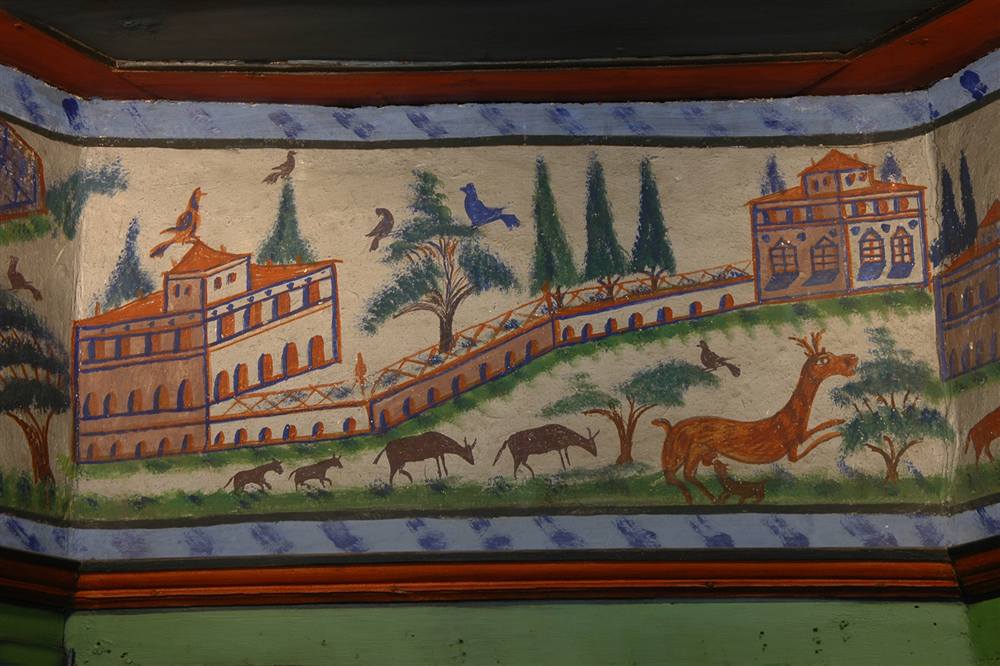
Siatista grew rich on fur and wine traded to Vienna and Budapest in the 18th century, and its merchants built fortified mansions with thick stone ground floors and wooden upper storeys painted inside with landscapes, flowers and views of the cities they traded with.
The Nerantzopoulos mansion of 1754 and the Poulkidis mansion of 1752 are open, their reception rooms painted from floor to ceiling. The town’s wine, a sweet liastos made from sun-dried grapes, carries the old trade’s name, and the fur workshops still make coats in the town.
- Nerantzopoulos mansion – the 1754 house with its painted reception rooms.
- Poulkidis mansion – the 1752 merchant house, open to visitors.
- Agia Paraskevi – the church with 17th-century frescoes.
- Siatista liastos – the sweet wine made from sun-dried grapes.
- Fur workshops – the trade that built the town, still working.
- Geraneia and Chora – the two historic quarters of the town.
Siatista stands 30 km west of Kozani at 930 m. Kozani tours give it half a day, with the mansions in the morning and the cellars after.
What do Kozani tours see at Lake Polyfytos?
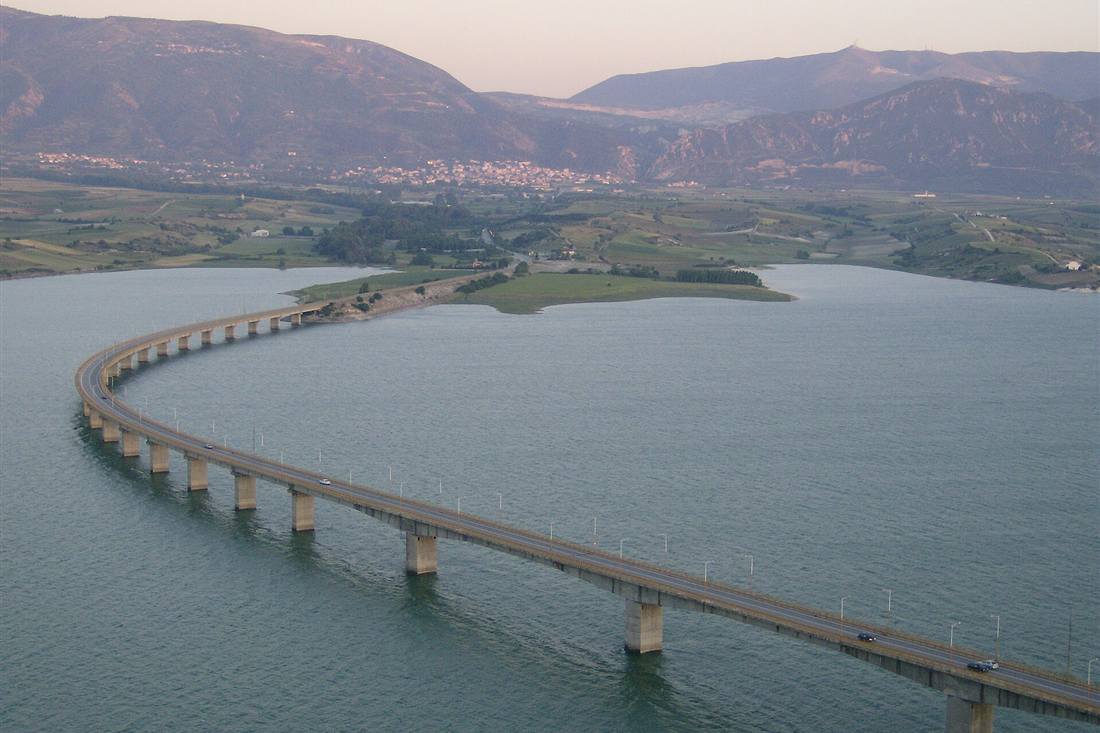
Kozani tours at Polyfytos see a reservoir of about 75 square kilometres on the Aliakmonas, the Servia bridge crossing it at 1,372 m, the longest in Greece before the Rio bridge, the Neraida viewpoint, the lakeside villages and water sports on the calm water.
The dam at Polyfytos closed in 1974 and flooded the Aliakmonas valley, drowning four villages whose church towers show when the water drops. The high concrete bridge between Neraida and Rymnio carries the Kozani to Larissa road straight across the water and is the unit’s best-known image.
- Servia bridge – 1,372 m across the lake between Neraida and Rymnio.
- Neraida viewpoint – the lookout over the bridge and the water.
- Drowned villages – the church towers that appear when the lake drops.
- Water sports – rowing, water-skiing and kayaking on the lake.
- Servia castle – the Byzantine castle above the town of Servia.
- Velvendos – the orchard town on the northern shore slope.
The lake is 20 km south of Kozani and the bridge carries the main road south. Kozani tours stop at Neraida and Servia on the way to or from Larissa.
What do Kozani tours see in Kozani town?
Kozani tours in the town see the clock tower of 1855 on the central square, the Koventareios library with its manuscripts and early printed books, the Folklore and Historical Museum, the Grammatiko mansion, and the church of Agios Nikolaos with its carved screen.
Kozani was a trading town on the routes between Epirus, Thessaly and Macedonia, and its merchants funded a school and a library in the 18th century that made the town a centre of Greek learning under the Ottomans. The Koventareios library still holds about 90,000 volumes, among them manuscripts and 16th-century printed books.
- Clock tower – the 1855 tower on the square, the town’s landmark.
- Koventareios library – about 90,000 volumes, with manuscripts and early prints.
- Folklore and Historical Museum – the costume, crafts and trades of the region.
- Grammatiko mansion – the restored merchant house of the old quarter.
- Agios Nikolaos – the church with its 18th-century carved wooden screen.
- Kozani carnival – the Fanoi bonfires and songs before Lent.
The town’s carnival, with the Fanoi bonfires lit in every neighbourhood and the old songs sung round them, is one of the most distinctive in Greece. Kozani tours give the town half a day, and the square holds the cafes and the pastry shops.
What do Kozani tours see at Aiani and the ancient sites?
Kozani tours at Aiani see the capital of the ancient kingdom of Elimeia, the Archaeological Museum of Aiani with its gold jewellery and Archaic sculpture, the royal cemetery with its monumental tombs, and the Byzantine churches of the village.
Elimeia was one of the upper Macedonian kingdoms before Philip II absorbed it into Macedon, and its capital at Aiani has given finds that pushed the history of the region back to the Bronze Age. The museum, opened in 2004, holds the gold, the pottery and the marble sculpture from the city and its cemeteries.
- Archaeological Museum of Aiani – gold jewellery, pottery and Archaic sculpture.
- The ancient city – the terraced houses and public buildings of Elimeia.
- Royal cemetery – the monumental tombs of the Elimeiot kings.
- Byzantine churches – Agios Nikolaos and the frescoed chapels of the village.
- Servia castle – the Byzantine fortress above the Aliakmonas valley.
- Velvendos museum – the local history and folklore collection.
Aiani is 20 km south-west of Kozani on the road to Siatista. Kozani tours take the museum and the village in two hours.
What do Kozani tours eat and drink?
Kozani tours eat the saffron of Krokos, the peaches and cherries of Velvendos, pies and mountain cheeses from the villages, lamb and pork from the plateau, and drink the Siatista liastos, the Xinomavro reds of the western Macedonian estates and tsipouro.
Krokos Kozanis is the protected saffron of Greece. The crocus is grown on the plateau south of the town, the flowers are picked by hand in October and the stigmas dried, and the cooperative in Krokos village sells the harvest across Europe; the fields turn purple for about three weeks.
- Krokos Kozanis saffron – the protected saffron of the plateau, harvested in October.
- Velvendos fruit – peaches, cherries and apricots from the orchard town.
- Siatista liastos – the sweet sun-dried wine of the merchant town.
- Mountain pies – the hand-rolled cheese and leek pies of the villages.
- Kozani cheese – the feta and hard cheeses of the plateau.
- Tsipouro – distilled after the vintage across the unit.
The saffron harvest in October draws visitors to Krokos for the picking and the museum. Kozani tours in autumn combine it with Siatista and the wine.
Which outdoor trips run in Kozani?
Kozani tours ski at the Vasilitsa and Seli centres within reach, walk the Askio and Vourinos mountains, row and water-ski on Lake Polyfytos, cycle the plateau and the orchard roads, and follow the Aliakmonas gorge south of Servia.
The unit sits between four mountain ranges, so every direction leads to walking. Askio, west of Siatista, is known for its wildflowers and griffon vultures; Vourinos, south of the town, for its serpentine rock and endemic plants; and the Pieria slopes above Velvendos for their beech forest.
- Askio – the western range with wildflowers and vultures.
- Vourinos – the serpentine mountain with its endemic flora.
- Pieria slopes – the beech forest above Velvendos.
- Lake Polyfytos – rowing, kayaking and water-skiing on the reservoir.
- Aliakmonas gorge – the river canyon south of Servia.
- Cycling the plateau – the flat roads between the villages.
The walking season runs from May to October and the lake from June to September. Kozani tours pair a morning on the mountain with an afternoon on the water.
Which villages and towns do Kozani tours reach?
Kozani tours reach Siatista and its two quarters, Velvendos in its orchards, Servia under the Byzantine castle, Aiani on the Elimeia hill, Krokos in the saffron fields, Ptolemaida in the lignite basin, and the mountain villages of Vlasti and Eratyra on Askio.
Eratyra and Vlasti are the mountain pair. Eratyra, at 800 m on the road west of Siatista, keeps stone houses and a church of Agios Nikolaos with 18th-century paintings, and Vlasti, at 1,200 m on Askio, is a Vlach village of stone mansions in beech forest with a festival of mountain music in August.
Velvendos, on the northern slope above Lake Polyfytos, is the fruit town of the unit: its terraces grow peaches, cherries, apricots and walnuts, and the town keeps a folklore museum and a riverside walk in the gorge above it.
- Siatista – the mansions, the wine and the fur workshops.
- Velvendos – the orchard town above the lake, with its gorge walk.
- Servia – the market town under the Byzantine castle.
- Eratyra – the stone village west of Siatista with its painted church.
- Vlasti – the Vlach mountain village at 1,200 m on Askio.
- Krokos – the saffron village with the cooperative and its small museum.
The villages sit within 30 km of the town on good roads. Kozani tours string three of them into the Siatista day or the lake day.
Which festivals do Kozani tours meet?
Kozani tours meet the Fanoi carnival in Kozani before Lent, the Siatista Holy Week and Easter riders, the Krokos saffron harvest festival in late October, the Vlasti mountain music festival in August, and the Velvendos cherry feast in June.
The Fanoi are the town’s own carnival. Each neighbourhood builds a bonfire, the residents gather round it on the last evenings before Lent, and the old satirical songs are sung in turn; the tradition has run for centuries and fills the town every year.
- Fanoi carnival – the neighbourhood bonfires and songs in Kozani before Lent.
- Siatista Easter – the horsemen who ride on Easter Monday.
- Saffron festival – the late October harvest feast at Krokos.
- Vlasti music festival – the August gathering in the mountain village.
- Velvendos cherry feast – the June celebration of the orchard harvest.
- Servia castle events – the summer concerts under the Byzantine walls.
Rooms fill for the Fanoi and for the saffron weekend. Kozani tours in those weeks book ahead.
What history do Kozani tours tell?
Kozani tours tell of the kingdom of Elimeia at Aiani, the Byzantine fortress of Servia, the merchant towns of Kozani and Siatista that traded with Vienna under the Ottomans, the schools and libraries they funded, and the lignite industry that powered 20th-century Greece.
The upper Macedonian kingdoms held the plateau until Philip II united them with Macedon in the 4th century BC, and the Byzantine castle at Servia guarded the Aliakmonas crossing through the Middle Ages. The Ottomans took the region in the late 14th century.
The 18th century was the high point. Kozani and Siatista merchants traded furs, wine and saffron to the Habsburg cities, sent their sons to study in Vienna and Padua, and funded the schools, the library and the painted mansions that still stand. The region joined Greece in 1912.
Lignite changed it again after 1950. The power stations at Ptolemaida and Agios Dimitrios generated much of the country’s electricity for half a century, and their closure is now reshaping the plateau. Kozani tours read the sequence from Aiani to the mines within 40 km.
Which trips combine with Kozani tours, and how do visitors reach the unit?
Kozani tours combine with Kastoria an hour west, Florina and Prespa an hour and a half north-west, Veria and Vergina an hour east, Meteora an hour and a half south, and Mount Olympus from the Servia side. Visitors reach Kozani by the Egnatia and the Kozani to Larissa motorway.
The town sits where the Egnatia motorway meets the road south to Larissa and Athens, which puts it at the centre of western Macedonia’s road network. Kozani airport takes a few seasonal flights, and Thessaloniki is an hour and a half east.
- Thessaloniki to Kozani – 120 km, about an hour and a half.
- Athens to Kozani – 470 km, about four and a half hours.
- Kozani to Siatista – 30 km, about 30 minutes.
- Kozani to Kastoria – 70 km, about an hour.
- Kozani to Vergina – 60 km, about 50 minutes by Veria.
- Where to stay – Kozani for the centre, Siatista for the mansions, Velvendos for the lake.
Our Florina tours page covers the unit to the north-west and the Pella tours page the one to the north-east. Kozani tours use the town as the hub of a western Macedonia loop.
Which visitors do Kozani tours suit, and what does a two-day route cover?
Kozani tours suit visitors after merchant mansions and painted interiors, wine travellers on the Siatista and Xinomavro routes, walkers in the Askio and Vourinos, families using Lake Polyfytos, and drivers linking Kastoria, Meteora and Vergina. Two days take the town, Siatista, Aiani and the lake.
The unit is one of the least visited in Greece and has no coast. Its value lies in the mansions, the saffron, the lake and its position at the centre of western Macedonia, from where every major site of the region is within an hour and a half.
- Day 1 morning – Kozani town, the clock tower and the Koventareios library.
- Day 1 afternoon – Siatista, the painted mansions and the liastos cellars.
- Day 2 morning – Aiani, the museum and the ancient city.
- Day 2 afternoon – Lake Polyfytos, the Servia bridge and the castle.
- October – the saffron harvest at Krokos.
- Extra day – Kastoria, or Vergina and Veria to the east.
One day keeps the town and Siatista only. Kozani tours built over two days drive about 180 km in total on good roads.
Frequently Asked Questions
Where is Kozani?
In western Macedonia, on a plateau between the Vermio and Pieria ranges to the east and the Askio and Vourinos to the west, with the Aliakmonas river crossing the south of the unit.
What is Siatista known for?
Its 18th-century fur merchants’ mansions with painted reception rooms, such as the Nerantzopoulos house of 1754, and its sweet liastos wine made from sun-dried grapes.
What is Lake Polyfytos?
A reservoir of about 75 square kilometres on the Aliakmonas, created in 1974, crossed by the 1,372 m Servia bridge between Neraida and Rymnio.
What is at Aiani?
The capital of the ancient kingdom of Elimeia, with a royal cemetery and a museum opened in 2004 that holds gold jewellery, pottery and Archaic sculpture.
What is Krokos Kozanis?
The protected saffron of the Kozani plateau, picked by hand in October in the villages around Krokos and sold through the local cooperative.
What is the Koventareios library?
The town library founded with 18th-century merchant funds, holding about 90,000 volumes including manuscripts and 16th-century printed books.
How far is Kozani from Thessaloniki?
120 km, about an hour and a half on the Egnatia motorway, with Kastoria an hour west and Vergina 50 minutes east.
When is the best time for Kozani tours?
October for the saffron harvest and the vintage, the weeks before Lent for the Fanoi carnival, summer for the lake, and spring for the mountains and the orchard blossom.