
Xanthi tours cover the westernmost unit of Thrace: the old town where the tobacco merchants built their painted mansions, the Nestos gorge with its famous river loop, the Pomak villages of the Rhodope mountains, the white monastery of Agios Nikolaos on its islet at Porto Lagos, ancient Abdera where Democritus was born, and the sands of the Thracian Sea. Plan the rest of the trip with Greece Tours.
This page covers the Xanthi tours you can arrange from the town and from Kavala, what the old quarter, the gorge, the mountains and the coast hold, the sweets and the mixed Thracian kitchen, the carnival, and how the roads and the seasons shape the route.
What do Xanthi tours cover?
Xanthi tours cover the old town of Xanthi with its tobacco merchants’ mansions, the Nestos gorge and its river walk, the Pomak villages of the Rhodope mountains, Lake Vistonida with the monastery of Agios Nikolaos at Porto Lagos, the ancient city of Abdera, and the beaches of the Thracian Sea.
Xanthi is the westernmost unit of Thrace, between the Nestos river on the Macedonian border and Lake Vistonida on the Rodopi side. Its town grew rich on tobacco in the 19th century, and its population still mixes Greek Orthodox, Pomak and Turkish-speaking Muslim communities, which shows in the mosques, churches and markets of the old quarter.
- Xanthi old town – the mansions, the lanes and the Saturday bazaar under the hill.
- Nestos gorge – the river meanders between Toxotes and Stavroupoli.
- Pomak villages – Echinos, Glafki and the Rhodope settlements north of the town.
- Porto Lagos – the monastery of Agios Nikolaos on its islet in Lake Vistonida.
- Abdera – the birthplace of Democritus, with its museum and ancient city.
- Thracian Sea beaches – Avdira, Mandra and the long sands of the coast.
Our Thrace tours page covers the wider region. Xanthi tours run as a day from Kavala, an hour west, or as two or three days with a night in the old town.
Where is Xanthi, and what is in each part of it?
Xanthi runs from the Nestos delta in the west to Lake Vistonida in the east, from the Thracian Sea coast in the south to the Rhodope ridge on the Bulgarian border in the north, with Xanthi town at the foot of the mountains and the tobacco plain between them and the sea.
The unit divides into three bands. The Rhodope mountains fill the north, forested and cut by gorges, with the Pomak villages scattered across them; the plain below grows tobacco, cotton and wheat; and the coast runs flat and sandy from the Nestos mouth to the lagoons at Porto Lagos.
The Nestos marks the western boundary. It comes out of Bulgaria, cuts a gorge through the Rhodope, and spreads into a delta of riverine forest and lagoons that is a protected wetland shared with the Kavala unit on the far bank.
- Rhodope mountains – the forested ridge and the Pomak villages on the border.
- Xanthi town – the old quarter on the hillside and the new town below.
- The tobacco plain – the fields and villages between the town and the sea.
- Nestos valley and delta – the gorge, the forest and the lagoons.
- Vistonida and Porto Lagos – the lake, the lagoons and the monastery.
- The coast – Avdira, Mandra, Myrodato and the long beaches.
The unit covers about 1,793 square kilometres and holds roughly 110,000 people. Xanthi tours drive 30 to 50 km between the main stops on good roads, except in the mountains.
What do Xanthi tours see in the old town?
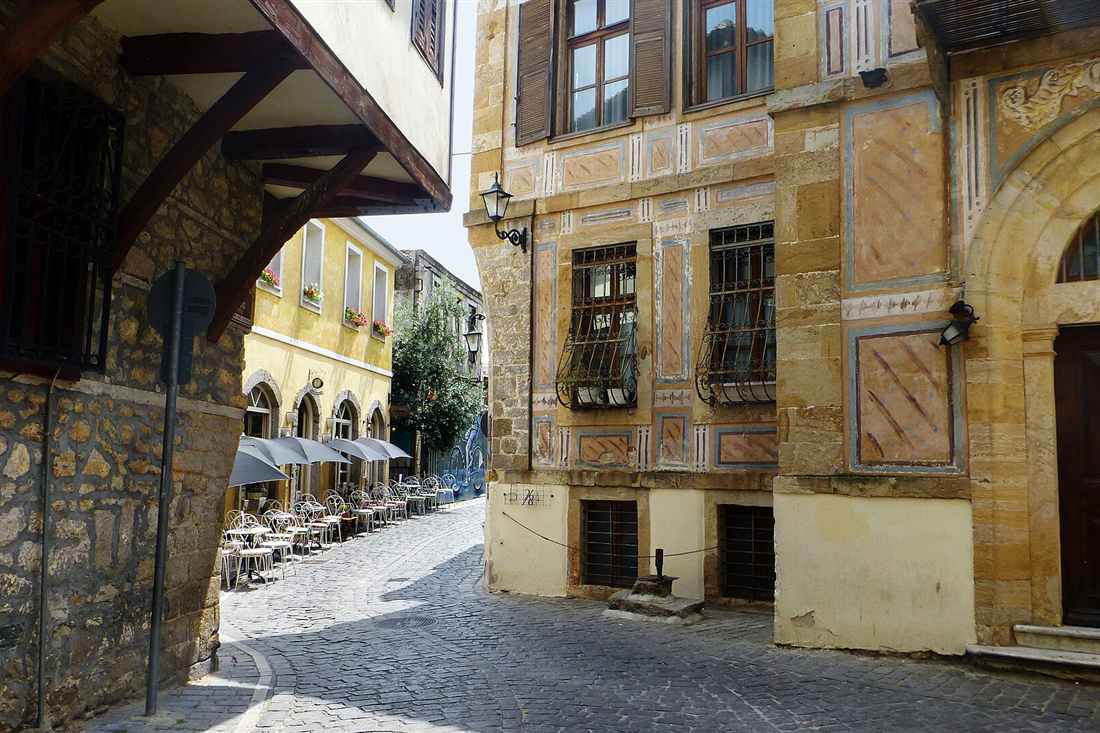
Xanthi tours in the old town see the tobacco merchants’ mansions of the 19th century, the Folklore and Historical Museum in the Kougioumtzoglou houses, the cobbled lanes climbing to the monasteries of Panagia Kalamou and Taxiarches, and the Saturday bazaar that fills the central square.
Tobacco made the town. Xanthi leaf was among the finest in the Ottoman Empire, and the merchants who traded it to Europe built mansions with painted ceilings, carved wood and walled gardens on the slope above the market; about 400 of the houses survive and the quarter is protected.
The Folklore Museum occupies two joined mansions built for the Kougioumtzoglou brothers in 1860, with the rooms kept as they were and the painted ceilings intact, and the Tobacco Museum in a converted warehouse explains the trade that paid for all of it.
- Merchants’ mansions – about 400 houses of the tobacco era on the hillside.
- Folklore and Historical Museum – the Kougioumtzoglou mansions of 1860.
- Tobacco warehouses – the brick depots of the trade, some converted to museums.
- Panagia Kalamou – the monastery above the old town with the view over the plain.
- The Saturday bazaar – the weekly market that brings the villages into town.
- The clock tower square – the heart of the town, with the cafes and the pastry shops.
The old town is walked in two hours from the central square up to the monasteries and back. Xanthi tours on a Saturday arrive early for the bazaar, when the Pomak and plain villages sell their produce.
What do Xanthi tours see in the Nestos gorge?
Xanthi tours in the Nestos gorge walk the path between Toxotes and Stavroupoli along the river’s meanders, see the famous loop from the viewpoint at Livera, cross the old railway bridges, and paddle the river by kayak or canoe in spring and summer.
The Nestos cuts through the Rhodope in a gorge about 20 km long, with sheer walls, plane and oak forest on the slopes, and the Drama to Xanthi railway running along the bank through tunnels. The river bends back on itself so tightly at Livera that the loop has become the region’s best-known picture.
The walking path follows the river from Galani near Toxotes for about 6 km, marked and partly along the old mule track, and the kayak and canoe operators at Toxotes run the calmer lower section from April to October.
- Livera viewpoint – the loop of the Nestos seen from the road above.
- Nestos gorge path – about 6 km along the river from Galani.
- Railway bridges and tunnels – the line from Drama to Xanthi through the gorge.
- Kayaking and canoeing – the lower river from Toxotes, April to October.
- Stavroupoli – the village at the head of the gorge, with the old houses.
- Nestos delta forest – the riverine woodland and lagoons towards the sea.
The gorge is 25 km from Xanthi town. Xanthi tours give it half a day, with the walk in the morning and the river in the afternoon.
What do Xanthi tours see in the Pomak villages?
Xanthi tours in the Pomak villages see Echinos, the largest of them, Glafki and Kentavros in the Rhodope valleys, stone houses with slate roofs, mosques and minarets among the orchards, tobacco hung to dry on the balconies, and the mountain roads toward the Bulgarian border.
The Pomaks are Muslim Slavic-speaking highlanders who have farmed the Rhodope for centuries, and about 30 of their villages lie in the mountains north of Xanthi. Access was restricted by a military control zone until 1995, which kept the villages unchanged and still makes them one of the least visited parts of Greece.
Echinos, 30 km from the town, is the centre: a village of about 3,000 with a market, a mosque with a stone minaret and a square where the villages gather. The road beyond it climbs to Kentavros and Glafki, with chestnut and walnut orchards and tobacco terraces on the slopes.
- Echinos – the largest Pomak village, with the market and the mosque.
- Glafki – the village of stone houses in the valley above Xanthi.
- Kentavros – the high village on the road toward the border.
- Tobacco terraces – the leaf hung to dry on the balconies in late summer.
- Stone bridges – the Ottoman arches over the Kompsatos and its tributaries.
- Chestnut and walnut orchards – the autumn harvest of the mountain slopes.
The villages are working communities rather than tourist stops, and a respectful visit keeps to the squares and the roads. Xanthi tours take Echinos and one higher village in half a day from the town.
What do Xanthi tours see at Porto Lagos and Lake Vistonida?
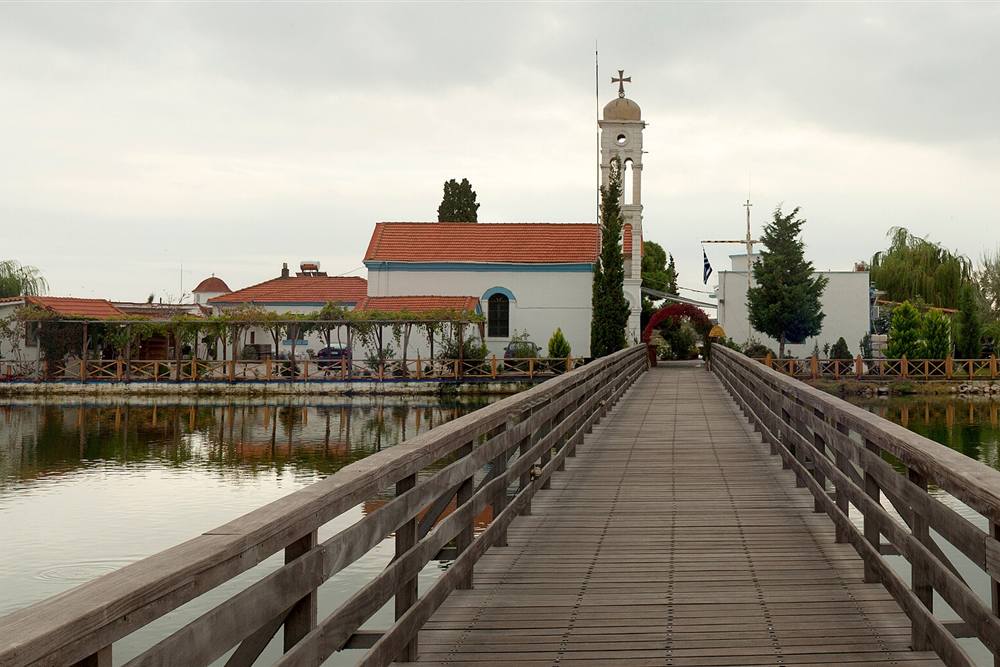
Xanthi tours at Porto Lagos see the white monastery of Agios Nikolaos on its islet in Lake Vistonida, reached by a wooden footbridge, the lagoons and salt flats with flamingos and pelicans, the fishing harbour of Porto Lagos and the Nestos-Vistonida national park around them.
The monastery is the image of the unit. A small church and cells stand on two islets in the lake linked to the shore by wooden walkways, a dependency of the Vatopedi monastery on Mount Athos, with the water and the reed beds all round it.
Vistonida is a brackish lake of about 45 square kilometres joined to the sea at Porto Lagos, part of a national park that takes in the Nestos delta and the lagoons along the coast. Flamingos, Dalmatian pelicans, herons and pygmy cormorants use it through the year.
- Agios Nikolaos monastery – the white church on its islet, reached by footbridge.
- Lake Vistonida – the brackish lake of about 45 square kilometres.
- Porto Lagos – the fishing harbour at the lake’s mouth.
- Flamingos and pelicans – the birds of the lagoons and salt flats.
- Lafri and Lafrouda lagoons – the coastal wetlands east of the harbour.
- Information centre – the national park centre with the bird hides.
The monastery closes in the early afternoon and asks for covered shoulders and knees. Xanthi tours take it with Abdera on the coastal day, since the two sit 20 km apart.
What do Xanthi tours see at Abdera?
Xanthi tours at Abdera see the ancient city founded by settlers from Teos about 544 BC, the birthplace of Democritus and Protagoras, its walls, theatre and harbour on the coast, and the archaeological museum in the modern village of Avdira with the finds of the site.
Abdera was one of the richest cities of the northern Aegean in the classical period, and its philosophers gave it a place in intellectual history out of proportion to its size: Democritus proposed that everything is made of atoms, and Protagoras that man is the measure of all things.
- The ancient city – walls, houses and the harbour on the headland.
- The theatre – the excavated theatre on the city’s slope.
- Archaeological museum of Avdira – the coins, sculpture and grave goods.
- Democritus and Protagoras – the two philosophers born in the city.
- Avdira beach – the sand beside the ancient harbour.
- Mandra – the coastal village and beach to the east.
The site is open, quiet and lies directly on the shore. Xanthi tours pair it with a swim, since the beach runs beside the ancient harbour.
What do Xanthi tours eat and drink?
Xanthi tours eat the syrup sweets of the town, kaltsounia and the Pomak pies of the mountains, fish and mussels from Porto Lagos and the Nestos delta, lamb from the Rhodope villages, beans and peppers from the plain, and drink tsipouro and the wines of the Thracian estates.
Xanthi is known across Greece for its sweets. The pastry shops round the clock tower square make syrup cakes, kariokes and sokolatina in a tradition brought by the refugees from Asia Minor and Constantinople, and the town’s sweets are a gift carried home by every visitor.
- Xanthi sweets – kariokes, sokolatina and the syrup cakes of the town.
- Pomak pies – the hand-rolled pies with cheese, leek and greens.
- Porto Lagos fish – mullet, eel and mussels from the lagoons.
- Rhodope lamb – grilled and roasted in the mountain tavernas.
- Tsipouro – distilled on the plain and drunk with meze.
- Thracian wine – the estates of the plain and the Ismaros slopes to the east.
The old town tavernas cook the mixed Thracian kitchen of Greek, Turkish and Pomak dishes. Xanthi tours finish the town walk with sweets at the square.
Which beaches do Xanthi tours use?
Xanthi tours use the long sand beaches of the Thracian Sea at Avdira, Mandra, Myrodato and Porto Lagos, the dunes at the Nestos mouth, and the shallow warm water that runs along the whole coast between the delta and Lake Vistonida.
The coast is flat and open, with dunes, pine and tamarisk behind the sand and few buildings along most of it. The water is shallow for a long way out, which makes it the family shore of Thrace, and the beaches stay quiet outside the Greek holiday weeks of August.
- Avdira – the sand beside the ancient harbour of Abdera.
- Mandra – the village beach east of Avdira, with the tavernas.
- Myrodato – the long quiet strand towards the Nestos.
- Porto Lagos – the beach at the lake mouth, near the monastery.
- Nestos mouth dunes – the wild sand at the edge of the delta.
- Erasmio – the western beach on the delta side.
The coast is 25 km from the town. Xanthi tours swim in the afternoon after the morning at Abdera or Porto Lagos.
Which festivals do Xanthi tours meet?
Xanthi tours meet the Xanthi carnival, one of the largest in Greece, in the weeks before Lent, the Old Town festival in early September, the tobacco and chestnut feasts of the villages, the Pomak weddings of the summer, and the religious feasts of both communities.
The carnival is the town’s largest event. Running for about two weeks, it brings parades of floats, the burning of the carnival king and the Thracian folk groups into the streets, and it draws visitors from across northern Greece every year.
- Xanthi carnival – the parades and the Thracian folk groups before Lent.
- Old Town festival – concerts and exhibitions in the lanes in early September.
- Tobacco harvest – the late-summer picking and stringing in the villages.
- Chestnut feast – the autumn harvest festival in the Rhodope villages.
- Pomak weddings – the summer celebrations of the mountain communities.
- Religious feasts – the Orthodox and Muslim holidays of the two communities.
Rooms in the old town fill for the carnival and the Old Town festival. Xanthi tours in those weeks book two months ahead.
Which trips combine with Xanthi tours, and how do visitors reach the unit?
Xanthi tours combine with Kavala and its old town an hour west, Thassos by ferry from Keramoti, the Nestos delta on the way, Komotini and Maroneia an hour east, and Alexandroupoli two hours east. Visitors reach Xanthi by the Egnatia motorway or by air to Kavala.
Kavala airport, 40 km west at Chrysoupoli, is the nearest and takes seasonal flights, and the Egnatia motorway puts Thessaloniki two hours and a quarter away. Trains on the Thessaloniki to Alexandroupoli line stop at Xanthi station south of the town.
- Thessaloniki to Xanthi – 210 km, about two and a quarter hours.
- Kavala to Xanthi – 55 km, about 45 minutes.
- Xanthi to the Nestos gorge – 25 km, about 30 minutes.
- Xanthi to Porto Lagos – 25 km, about 25 minutes.
- Keramoti to Thassos – the ferry across in about 40 minutes.
- Where to stay – the old town for the mansions, the coast for the beaches.
Our North Aegean islands tours page covers Thassos across the water. Xanthi tours built over three days drive about 250 km in total.
Which visitors do Xanthi tours suit, and what does a three-day route cover?
Xanthi tours suit visitors after a multicultural town that few foreigners know, walkers and kayakers in the Nestos gorge, birdwatchers at Vistonida, readers of the Greek philosophers at Abdera, and travellers crossing Thrace. Three days take the town, the gorge and the coast in turn.
The unit is quiet by Greek standards, with prices to match. It lacks a resort coast of the island kind, but its old town, gorge and wetlands give a trip no other part of Greece offers in the same combination.
- Day 1 – the old town, the Folklore Museum and the Saturday bazaar.
- Day 2 morning – the Nestos gorge walk from Galani and the Livera viewpoint.
- Day 2 afternoon – kayaking on the lower Nestos or the delta forest.
- Day 3 morning – Porto Lagos, the monastery and Lake Vistonida.
- Day 3 afternoon – Abdera, the museum and a swim at Avdira.
- Extra day – the Pomak villages of Echinos and Glafki in the Rhodope.
Two days cut the coast; four add the Rhodope villages. Xanthi tours keep the driving under 100 km a day.
Frequently Asked Questions
Where is Xanthi?
In western Thrace, between the Nestos river on the Macedonian border and Lake Vistonida, with the Rhodope mountains to the north and the Thracian Sea to the south.
What is the old town of Xanthi?
The hillside quarter where the 19th-century tobacco merchants built about 400 mansions with painted ceilings and walled gardens, now a protected settlement with museums and the Saturday bazaar below.
What is the Nestos gorge?
The 20 km canyon where the Nestos cuts through the Rhodope, with the famous loop seen from Livera, a 6 km riverside path from Galani and kayaking from Toxotes.
Who are the Pomaks?
Muslim Slavic-speaking highlanders who farm the Rhodope villages north of Xanthi, such as Echinos and Glafki. The area was a restricted military zone until 1995.
What is at Porto Lagos?
The monastery of Agios Nikolaos on two islets in Lake Vistonida, reached by wooden footbridges, with flamingos and pelicans in the lagoons around it.
What is Abdera?
The ancient city on the coast founded about 544 BC, birthplace of the philosophers Democritus and Protagoras, with walls, a theatre, a harbour and a museum in the village of Avdira.
How far is Xanthi from Kavala?
55 km, about 45 minutes on the Egnatia motorway, with Kavala airport 40 km west of the town.
When is the best time for Xanthi tours?
Spring and autumn for the gorge and the villages, the weeks before Lent for the carnival, early September for the Old Town festival, and summer for the beaches.