
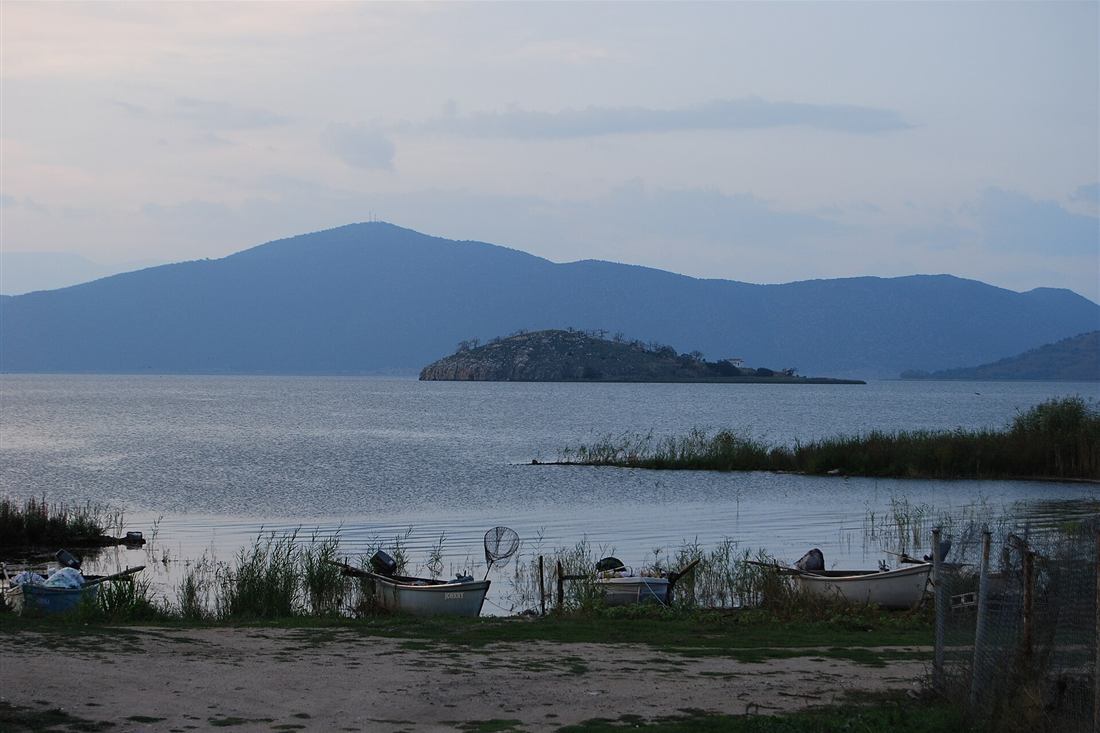
Florina tours cover the north-western corner of Greek Macedonia: the Prespa lakes shared with Albania and North Macedonia, the island of Agios Achilleios with Tsar Samuel’s basilica, the hermitages painted into the cliffs above Megali Prespa, the Vlach village of Nymfaio with its brown-bear sanctuary, Florina town on the Sakoulevas and the Xinomavro vineyards of Amyntaio. Plan the rest of the trip with Greece Tours.
This page covers the Florina tours you can arrange from Florina, Psarades and Nymfaio, what the lakes, the mountains and the town hold, the peppers, beans and wine, the history from Samuel to 1949, and how the passes, the border and the seasons shape the route.
What do Florina tours cover?
Florina tours cover the Prespa lakes shared with Albania and North Macedonia, the island of Agios Achilleios with its Byzantine basilica, the hermitages painted into the cliffs of Megali Prespa, the stone village of Nymfaio and its bear sanctuary, Florina town on the Sakoulevas, and the Vigla ski centre on Varnountas.
Florina is the north-western corner of Greek Macedonia, a unit of high basins and forested ranges on the borders with North Macedonia and Albania. Its town stands at 690 m on a river lined with neoclassical houses, and its most remarkable landscape, the Prespa basin, lies at 850 m behind a mountain wall to the west.
- Prespa lakes – Mikri and Megali Prespa, a national park with pelicans and island churches.
- Agios Achilleios – the island reached by a floating bridge, with the 10th-century basilica.
- Nymfaio – the stone village at 1,350 m and the Arcturos brown-bear sanctuary.
- Florina town – the Sakoulevas riverside, the neoclassical mansions and the museums.
- Vigla ski centre – the slopes at 1,650 m above Pisoderi.
- Lakes Vegoritida and Petron – the eastern lakes on the border with Pella.
Our Macedonia tours page covers the wider region and the Kastoria tours page the lake town to the south. Florina tours work as two or three days from Florina or Psarades, with a car.
Where is Florina, and what is in each part of it?
Florina runs from the Prespa basin in the west, over the Varnountas and Vitsi ranges, down to Florina town and the Amyntaio plain in the east, with Lakes Vegoritida, Petron and Zazari on the eastern border and North Macedonia along the whole northern edge.
The unit is high everywhere. The Prespa basin lies at about 850 m, the town at 690 m, the mountain passes above 1,500 m, and snow closes the Pisoderi road to Prespa for a few days each winter; only the Amyntaio plain in the east drops below 600 m.
The plain around Amyntaio grows apples, beans and the Xinomavro grapes of the Amyntaio appellation, the highest red-wine zone in Greece, and the lignite mines and power stations south of it supply much of the country’s electricity, which marks the landscape between the lakes.
- Prespa basin – the lakes, Psarades, Agios Germanos and the national park.
- Varnountas and Pisoderi – the pass, the ski centre and the fir forest.
- Florina town – the capital on the Sakoulevas river.
- Vitsi and Nymfaio – the mountain village and the bear sanctuary.
- Amyntaio plain – the vineyards, the apples and the eastern lakes.
- Lakes Vegoritida, Petron and Zazari – the waters on the Pella border.
The unit covers about 1,924 square kilometres and holds roughly 50,000 people. Florina tours drive 40 to 60 km between the main stops on slow mountain roads.
What do Florina tours see at the Prespa lakes?
Florina tours at Prespa see Mikri Prespa with its reed beds and the largest breeding colony of Dalmatian pelicans in the world, Megali Prespa shared by three countries, the fishing village of Psarades, and the national park of about 327 square kilometres around them.
The two lakes are joined by a narrow isthmus at Koula. Mikri Prespa is shallow, reed-fringed and almost all Greek, with the pelican colonies in its reeds; Megali Prespa is deep, clear and divided between Greece, Albania and North Macedonia, with the border running through the water.
The pelicans are the reason ornithologists come. About 1,400 pairs of Dalmatian pelicans and about 3,000 pairs of great white pelicans nest in the reeds from March, and the observation towers at Agios Achilleios and Vrondero put them in view without disturbing them.
- Mikri Prespa – the shallow lake of reeds and pelican colonies.
- Megali Prespa – the deep lake shared by Greece, Albania and North Macedonia.
- Dalmatian pelicans – the world’s largest breeding colony, nesting from March.
- Psarades – the fishing village on Megali Prespa with the boat trips.
- Koula isthmus – the sand strip between the lakes, with the beach.
- Observation towers – the hides at Agios Achilleios and Vrondero.
The park information centre at Agios Germanos explains the ecology and the border history. Florina tours reach the basin in 50 minutes from the town over the Pisoderi pass.
What do Florina tours see at Agios Achilleios and the painted hermitages?
Florina tours at Agios Achilleios cross a floating footbridge of about 600 m to the island in Mikri Prespa, see the ruined basilica built about 986 by Tsar Samuel of Bulgaria, and take a boat from Psarades to the hermitages painted into the cliffs of Megali Prespa.
Samuel made Prespa the capital of his empire at the end of the 10th century and built the basilica on the island to hold the relics of Saint Achilleios, brought from Larissa. The roofless nave, the columns and the apse still stand, with a village of a few families beside them.
The hermitages are reached only by water. From Psarades, fishing boats run along the western cliffs to Panagia Eleousa, Metamorfosi and Mikri Analipsi, small chapels built into caves in the rock and painted with frescoes from the 14th to the 16th century, some with icons painted directly onto the cliff face above the water.
- Floating bridge – the 600 m footbridge across the reeds to the island.
- Basilica of Agios Achilleios – Tsar Samuel’s church of about 986.
- Panagia Eleousa – the cave hermitage with its 15th-century frescoes.
- Metamorfosi – the cliff chapel reached by boat from Psarades.
- Rock icons – the images painted straight onto the cliffs above the lake.
- Agios Germanos – the 11th-century church in the village of the same name.
The boat trip from Psarades takes about an hour and a half and runs from spring to autumn. Florina tours take the island and the hermitages in one day at the lakes.
What do Florina tours see at Pisoderi and on the Varnountas pass?
Florina tours on the Pisoderi road climb from the town to the Varnountas pass at about 1,500 m through fir and beech forest, pass the monastery of Agia Triada, the ski centre at Vigla, and descend to the Prespa basin with the lakes opening below the road.
Pisoderi, at 1,420 m, is the highest village on the road and the base for the ski centre 3 km above it. The monastery of Agia Triada stands beside the village, rebuilt after the wars, and the forest round it carries the marked paths up to the border ridge.
The descent on the western side is the reveal of the unit: the road drops round a shoulder of the mountain and Mikri Prespa appears below, with the island of Agios Achilleios and the reed beds laid out in one view.
- Pisoderi – the highest village on the road, at 1,420 m.
- Agia Triada monastery – the house beside the village in the forest.
- Vigla ski centre – the slopes 3 km above Pisoderi.
- Varnountas pass – the crossing at about 1,500 m to the Prespa basin.
- The Prespa viewpoint – the first view of the lakes on the western descent.
- Antartiko – the border village above Prespa, with its chestnut forest.
The pass road is the only link between the town and the lakes and is cleared through the winter. Florina tours take it slowly for the views and stop at Pisoderi on the way back.
Which museums and churches do Florina tours visit?
Florina tours visit the Archaeological Museum of Florina, the Museum of Contemporary Art, the Folklore Museum, the Prespa information centre at Agios Germanos, the 11th-century churches of Agios Germanos and Agios Athanasios, and the cliff hermitages of Megali Prespa.
The unit keeps a dense run of Byzantine and post-Byzantine painting for its size. The churches of the Prespa basin were built and painted from the 10th century onward under Samuel and his successors, and the hermitages on the lake cliffs carry frescoes from the 14th to the 16th century.
- Archaeological Museum of Florina – the Hellenistic city and the Prespa finds.
- Museum of Contemporary Art – the painting of the town’s workshops.
- Folklore Museum – the dress, looms and crafts of the unit.
- Agios Germanos church – the 11th-century church and its frescoes.
- Prespa information centre – the ecology and history of the national park.
- Nymfaio Folklore Museum – the Vlach merchants’ trade and houses.
Most of the churches stay locked and the key is held in the village. Florina tours ask at the square or the park centre, which is how the basin has always worked.
What do Florina tours see at Nymfaio?
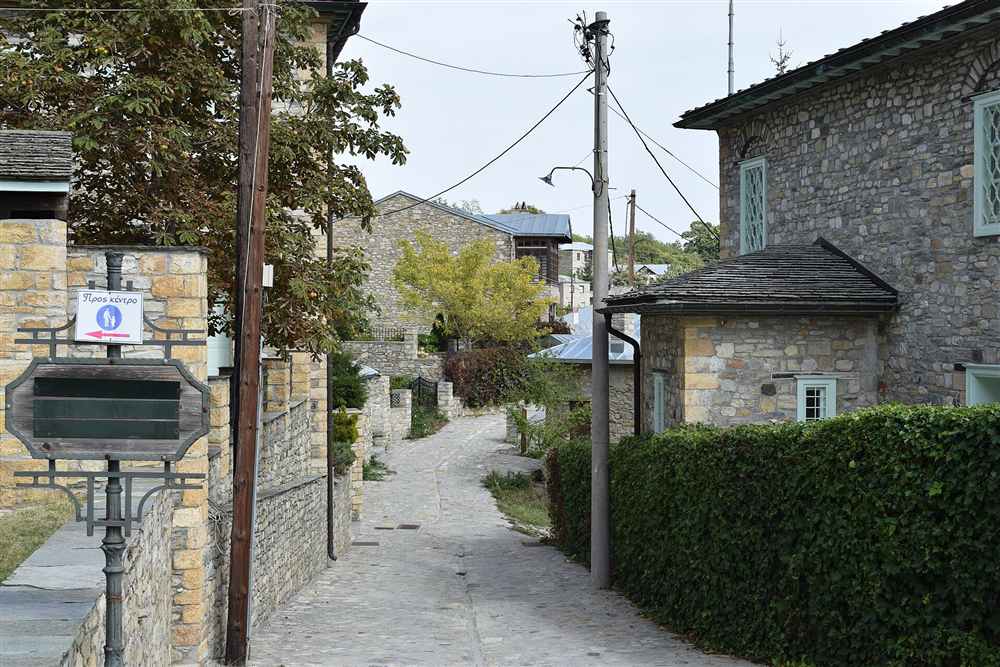
Florina tours at Nymfaio see a village of stone mansions at 1,350 m on Mount Vitsi, the Arcturos sanctuary where rescued brown bears live in a forest enclosure, the Nikeios school, the church of Agios Nikolaos, and the beech forest that surrounds the village.
Nymfaio was built by Vlach merchants and silversmiths who traded across the Balkans and Egypt in the 19th century, and their three-storey stone houses with timber balconies line a cobbled centre closed to cars. The village emptied through the 20th century and was restored from the 1990s as a protected settlement.
Arcturos, 7 km away at Agios Nikolaos, is the bear sanctuary: brown bears taken from dancing-bear owners and from captivity live in 50,000 square metres of beech forest, and visitors walk a path round the enclosure. A second Arcturos centre near Aetos keeps rescued wolves.
- Stone mansions – the Vlach merchants’ houses of the 19th century.
- Arcturos bear sanctuary – brown bears in a forest enclosure near Agios Nikolaos.
- Nikeios school – the village school built by an emigrant merchant.
- Agios Nikolaos church – the stone church on the square.
- Beech forest – the walks and trails round the village.
- Arcturos wolf centre – the wolf enclosure at Agios Panteleimonas near Aetos.
The village is closed to cars and visitors park at the entrance. Florina tours reach Nymfaio in 50 minutes from the town and stay the night in its guesthouses, which are among the most restored in northern Greece.
What do Florina tours see in Florina town?
Florina tours in the town see the Sakoulevas river lined with neoclassical mansions, the Archaeological Museum with finds from the Hellenistic city on Agios Panteleimonas hill, the Museum of Contemporary Art, the old railway station and the Christmas bonfires of 23 December.
The town grew on the trade route between Thessaloniki and Bitola, and the merchants who ran it built the neoclassical houses along the river in the early 20th century. The river walk runs between them with bridges every few hundred metres, and the old station keeps the line that once ran to Bitola.
The Hellenistic city on the hill above the town was excavated in the 1930s and again from the 1990s, and the museum shows its houses, pottery and coins alongside finds from Prespa and the Amyntaio plain. The contemporary art museum holds a collection built around the town’s painting workshops.
- Sakoulevas riverside – the neoclassical mansions and the footbridges.
- Archaeological Museum – the Hellenistic city, Prespa and the Amyntaio finds.
- Museum of Contemporary Art – the collection of the town’s painters.
- Agios Panteleimonas hill – the excavated Hellenistic city above the town.
- The old station – the terminus of the line north to Bitola.
- Christmas fires – the bonfires lit in every neighbourhood on 23 December.
The bonfires of 23 December are the town’s best-known custom, with towers of logs burned in the streets and music until morning. Florina tours in that week book rooms months ahead.
What do Florina tours eat and drink?
Florina tours eat the giant beans of Prespa, the red peppers of Florina, trout and carp from the lakes, cheese and pies from the mountain villages, apples from the Amyntaio plain, and drink the Xinomavro reds and rosés of the Amyntaio appellation.
The peppers are the export. Florina peppers, long, sweet and deep red, are roasted, peeled and preserved in oil across the country and carry a protected designation; the harvest from September fills the town with the smell of roasting.
The beans come from Prespa. The giant white gigantes and elephant beans grow on the fields round the lakes, irrigated from the water, and carry their own designation; the Psarades tavernas serve them baked with the lake fish.
- Florina peppers – the protected red peppers, roasted and preserved in oil.
- Prespa beans – the giant and elephant beans with their own designation.
- Lake fish – trout and carp from Prespa and Vegoritida.
- Amyntaio wine – Xinomavro reds and rosés from the highest red-wine zone in Greece.
- Apples – the orchards of the Amyntaio plain.
- Mountain cheese and pies – the Nymfaio and Pisoderi kitchens.
The Amyntaio estates sit between 570 and 750 m and take visitors for tasting. Florina tours pair a cellar with Lake Vegoritida on the way east to Edessa.
Which outdoor trips run in Florina?
Florina tours ski at Vigla above Pisoderi, walk the Prespa trails and the beech forest of Nymfaio, watch pelicans from the Prespa hides, kayak on Mikri Prespa and Vegoritida, and hike the Varnountas ridge on the border with its views over three countries.
The ski centre at Vigla works from December to March with slopes between 1,650 and 2,000 m, 17 km from the town on the Prespa road; in summer the same road carries walkers to the Varnountas ridge, where the border path looks down on both the Prespa basin and the Florina plain.
- Vigla ski centre – slopes at 1,650 to 2,000 m above Pisoderi.
- Prespa trails – the marked routes round the lakes and the villages.
- Birdwatching – the pelican colonies from the observation towers.
- Kayaking – on Mikri Prespa and Lake Vegoritida.
- Varnountas ridge – the border walk with views into Albania and North Macedonia.
- Nymfaio forest – the beech woods round the village and the bear sanctuary.
The walking season runs from May to October and the pelican season from March to July. Florina tours in winter combine the ski centre with the Christmas fires in the town.
What do Florina tours see at Psarades and the Prespa villages?
Florina tours at Psarades see a fishing village of stone houses on Megali Prespa, the harbour where the hermitage boats leave, and in the basin around it the villages of Agios Germanos, Laimos, Karyes and Pyli, each with its churches and its fields of Prespa beans.
Psarades stands at the end of the road on the Greek shore of Megali Prespa, a few hundred metres from the Albanian border line in the water. Its houses are built of stone with wooden balconies, many restored as guesthouses, and its tavernas cook the lake fish on the quay.
Agios Germanos, on the eastern slope of the basin, keeps an 11th-century church with frescoes and the national park information centre, and Laimos, Karyes and Pyli sit among the bean fields and orchards that run down to Mikri Prespa.
- Psarades – the fishing village and boat harbour on Megali Prespa.
- Agios Germanos – the 11th-century church and the park information centre.
- Laimos – the largest village of the basin, with the services.
- Karyes and Pyli – the bean and orchard villages near the lake.
- Koula beach – the sand strip on the isthmus between the lakes.
- Vrondero – the village with the observation tower over the pelicans.
The basin holds about 1,500 residents in all. Florina tours stay the night in Psarades or Agios Germanos to see the lakes at dawn, when the pelicans fish.
What do Florina tours see at Lake Vegoritida and the Amyntaio plain?
Florina tours at Vegoritida see the largest lake of the eastern basin, at about 54 square kilometres, the villages of Agios Panteleimonas and Arnissa on its shore, Lake Petron and Lake Zazari beside it, and the vineyards of the Amyntaio appellation between them.
Vegoritida lies on the Pella border and has no surface outlet, so its level rises and falls with the rains and with the pumping for the power stations; Arnissa on its northern shore is the lake village, with the tavernas and the rowing club.
- Lake Vegoritida – the 54 square kilometre lake on the Pella border.
- Arnissa – the lake village with the tavernas and the boats.
- Agios Panteleimonas – the village of the Amyntaio wine estates.
- Lake Petron – the smaller lake beside it, a Natura wetland.
- Lake Zazari – the reed-fringed lake with the birdwatching path.
- Amyntaio vineyards – Xinomavro between 570 and 750 m.
The eastern lakes sit on the road to Edessa and take an hour with a winery. Florina tours use them as the link between the unit and Pella.
Which festivals do Florina tours meet?
Florina tours meet the Christmas fires of 23 December in the town, the Prespa Festival of music in the summer at Agios Achilleios, the pepper festival in September, the Nymfaio feast days in August and the Epiphany customs in the villages of the basin.
The fires are the unit’s signature. Every neighbourhood of Florina builds a tower of logs in the days before Christmas, lights it on the night of 23 December, and the town gathers round them with wine, music and food until the morning.
- Christmas fires, 23 December – the bonfires in every neighbourhood of the town.
- Prespa Festival – the summer concerts on the island of Agios Achilleios.
- Pepper festival – the September harvest feast of the Florina pepper.
- Nymfaio in August – the village feasts and the return of the families.
- Epiphany – the blessing of the waters at Psarades and the lake villages.
- Bean festival – the autumn feast of the Prespa giant bean.
The Prespa Festival stages concerts in front of the island basilica with the lake behind the stage. Florina tours in August book the island event and the Nymfaio rooms together.
What history do Florina tours tell?
Florina tours tell of the Hellenistic city above the town, of Tsar Samuel who ruled the Bulgarian empire from Prespa around 1000, of the Ottoman centuries on the Via Egnatia, of the Macedonian Struggle of 1904 to 1908, and of the Civil War battles on Vitsi and Grammos.
Samuel made Prespa the centre of an empire that ran from the Adriatic to the Black Sea until Basil II destroyed his army in 1014; the basilica on Agios Achilleios and the churches of Agios Germanos date from his reign or just after it.
The Macedonian Struggle, the armed contest between Greek, Bulgarian and Serbian bands for the Ottoman province before 1912, was fought through these villages, and Pavlos Melas, its best known Greek leader, was killed at Statista, now named Melas after him, in 1904.
The Civil War ended here. The Democratic Army held Vitsi and Grammos until the government offensive of August 1949 broke the last positions, and Prespa, on the border, saw the final withdrawal into Albania. Florina tours read the sequence from the island basilica to the war memorials on the passes.
Which trips combine with Florina tours?
Florina tours combine with Kastoria an hour south, Edessa and the waterfalls an hour and a quarter east, Kozani and Siatista an hour south-east, Bitola in North Macedonia 30 minutes north, and Ohrid across the border beyond it.
The unit sits at a border crossing point, which makes it the natural base for a western Macedonia loop that takes Kastoria, Prespa and Edessa in three or four days, or a cross-border route north to Bitola and Ohrid.
- Kastoria – the lake town with its Byzantine churches, an hour south.
- Edessa – the waterfalls and Loutra Pozar, an hour and a quarter east.
- Siatista – the merchant mansions and the Kozani vineyards to the south-east.
- Bitola – the city across the border at Niki, 30 minutes north.
- Ohrid – the lake and old town in North Macedonia, two hours north-west.
- Thessaloniki – 160 km east, about two hours on the Egnatia.
Our Pella tours page covers the unit to the east. Florina tours that cross the border take passports; the Niki crossing is open around the clock.
How do visitors reach Florina, where do they stay, and when do the tours run?
Visitors reach Florina by the Egnatia motorway and the Florina branch from Thessaloniki in two hours, from Kozani in an hour, and by train from Thessaloniki through Edessa and Amyntaio. The tours run all year, with the pelicans from March and the snow from December.
The nearest airports are Kozani and Kastoria, both with seasonal flights, and Thessaloniki with the full schedule. The town, Psarades and Nymfaio hold the rooms, and the Prespa villages keep guesthouses that fill at weekends from spring to autumn.
- Thessaloniki to Florina – 160 km, about two hours.
- Florina to Prespa – 45 km over the Pisoderi pass, about 50 minutes.
- Florina to Nymfaio – 50 km, about 50 minutes.
- Florina to Kastoria – 70 km, about an hour.
- Florina to Bitola – 35 km across the border, about 30 minutes.
- Where to stay – Psarades or Agios Germanos for the lakes, Nymfaio for the mountain, the town for the rest.
Spring brings the pelicans and the flooded reeds, summer the lake swimming at Koula, autumn the peppers and the forest colour, and winter the snow and the Christmas fires. Florina tours plan three days: the town, the lakes and the mountain.
Which visitors do Florina tours suit, and what does a three-day route cover?
Florina tours suit birdwatchers at Prespa, walkers on the border ridges, visitors after Byzantine hermitages, families at the bear sanctuary, skiers at Vigla and travellers crossing to North Macedonia. Three days take the lakes, the mountain village and the town in turn.
The unit is one of the least visited in Greece and its prices and crowds show it. What it lacks is a coast and easy roads, since every stop sits behind a pass or a border.
- Day 1 – Florina town, the Sakoulevas and the Archaeological Museum.
- Day 2 morning – Agios Achilleios, the floating bridge and the pelican towers.
- Day 2 afternoon – Psarades and the boat to the cliff hermitages.
- Day 3 morning – Nymfaio, its mansions and the Arcturos bear sanctuary.
- Day 3 afternoon – Lake Vegoritida and an Amyntaio wine estate.
- Extra day – Kastoria to the south, or Bitola across the border.
Two days cut the town and the vineyards. Florina tours built over three days drive about 250 km in total, much of it on mountain road.
Frequently Asked Questions
Where is Florina?
In western Macedonia, on the borders with North Macedonia and Albania, with the Prespa basin in the west, Florina town in the centre and the Amyntaio plain and its lakes in the east.
What are the Prespa lakes?
Mikri and Megali Prespa, two lakes at about 850 m joined by the Koula isthmus. Megali Prespa is shared by Greece, Albania and North Macedonia, and the Greek side is a national park.
Why are the Prespa pelicans famous?
Mikri Prespa holds the largest breeding colony of Dalmatian pelicans in the world, about 1,400 pairs, with great white pelicans nesting beside them from March.
What is Agios Achilleios?
An island in Mikri Prespa reached by a floating footbridge of about 600 m, with the ruined basilica Tsar Samuel of Bulgaria built about 986 to hold the relics of Saint Achilleios.
How do you reach the painted hermitages?
By boat from Psarades along the cliffs of Megali Prespa to the cave chapels of Panagia Eleousa and Metamorfosi, about an hour and a half there and back.
What is Arcturos?
A sanctuary near Nymfaio where brown bears rescued from dancing and captivity live in 50,000 square metres of beech forest, with a visitor path round the enclosure.
What is Florina known for?
The sweet red Florina pepper, the Christmas bonfires of 23 December, the neoclassical mansions on the Sakoulevas river and the Vigla ski centre above the town.
Can you cross into North Macedonia?
Yes. The Niki crossing, 17 km north of the town, is open around the clock and puts Bitola 30 minutes away and Ohrid about two hours.
When is the best time for Florina tours?
March to July for the pelicans, summer for the lakes and the Prespa Festival, September for the peppers and the colour, and December for the snow and the Christmas fires.