
Arta tours cover the southern unit of Epirus: the four-arched stone bridge of the ballad over the Arachthos, the Byzantine churches the Despots built at Parigoritissa and Agia Theodora, the castle on the acropolis of ancient Ambracia, the Tzoumerka mountains with the Plaka bridge and the cliff monastery of Kipina, and the Amvrakikos Gulf with its dolphins and pelicans at Koronisia. Plan the rest of the trip with Greece Tours.
This page covers the Arta tours you can arrange from the town, Ioannina and Preveza, what each part of the unit holds, the churches and the bridge, the gorge and the gulf, the citrus and the shrimp, the history from Pyrrhus to 1822, and how the motorway and the seasons shape the route.
What do Arta tours cover?
Arta tours cover the arched bridge of the ballad, the Byzantine churches of Panagia Parigoritissa and Agia Theodora, the castle above the Arachthos, the Tzoumerka mountains and their stone bridges, the Amvrakikos wetland, and the beaches at Koronisia and the gulf shore.
Arta is the southern unit of Epirus, between the Tzoumerka range and the Amvrakikos Gulf, with the Arachthos river running through the middle of it. The town was the capital of the Despotate of Epirus in the 13th century, which is why it holds the best Byzantine churches in western Greece.
- Bridge of Arta – the four-arched stone bridge of the ballad over the Arachthos.
- Parigoritissa – the 13th-century church of the Despots with its dome on brackets.
- Castle of Arta – the walls above the river on the ancient Ambracia site.
- Tzoumerka – the mountain range at 2,429 m, with gorges, bridges and villages.
- Amvrakikos Gulf – the wetland of dolphins, pelicans and lagoons.
- Koronisia – the island village in the gulf, reached by a causeway.
Our Epirus tours page covers the wider region. Arta tours run as a day from Ioannina or Preveza, or as two days with a night in the town or the Tzoumerka villages.
Where is Arta, and what is in each part of it?
Arta runs from the Amvrakikos Gulf in the south, through the citrus plain round the town, north along the Arachthos into the Tzoumerka mountains, with Preveza to the west, Aetolia-Acarnania across the gulf and Ioannina and Trikala beyond the ridge.
The unit is a river valley between a wetland and a mountain wall. The Arachthos comes down from the Pindus through gorges and reservoirs, crosses the plain at the town, and reaches the gulf in a delta of lagoons; the Tzoumerka rise to 2,429 m on the eastern boundary.
The plain grows citrus, and the kiwi and orange orchards run from the town to the shore. Behind them the foothills carry the villages of Kompoti and Peta, and the mountain road north climbs into the national park of Tzoumerka, Peristeri and the Arachthos gorge.
- Arta town – the bridge, the churches, the castle and the market.
- The citrus plain – the orange and kiwi orchards between town and gulf.
- Amvrakikos shore – the lagoons at Koronisia, Kalogiriko and Tsoukalio.
- Tzoumerka – the mountain villages of Pramanta, Melissourgoi and Theodoriana.
- Arachthos gorge – the river between the reservoirs and the old stone bridges.
- Peta and Kompoti – the foothill villages with the 1822 battlefield.
The unit covers about 1,662 square kilometres and holds roughly 65,000 people. Arta tours drive 30 to 80 km between stops, and the mountain roads are slow.
What do Arta tours see at the bridge and in the town?
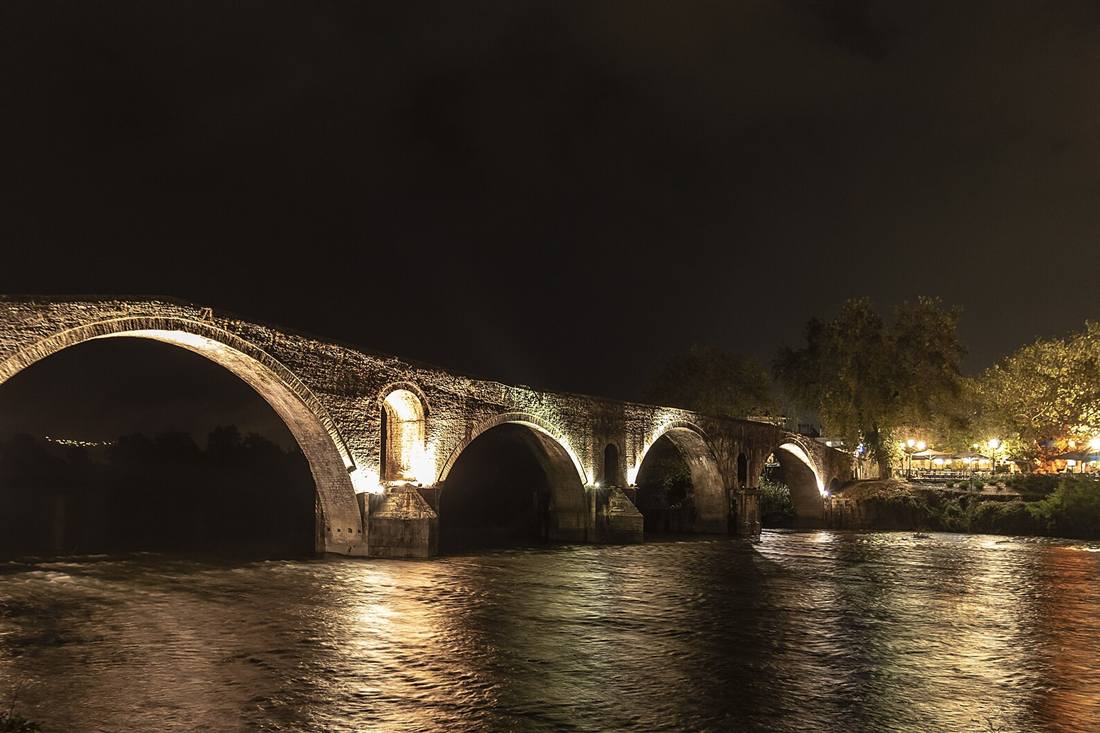
Arta tours see the bridge of four unequal arches over the Arachthos, rebuilt in 1602 on Roman foundations, the church of Panagia Parigoritissa with its dome carried on cantilevered columns, Agia Theodora with the tomb of the Despotate’s saint, and the castle above the river.
The bridge carries the best known folk ballad in Greece, in which the master builder’s wife is walled into the foundation so the span will stand. It is 145 m long, its arches are of different sizes because the river bed forced them, and it has been closed to traffic since the 1960s.
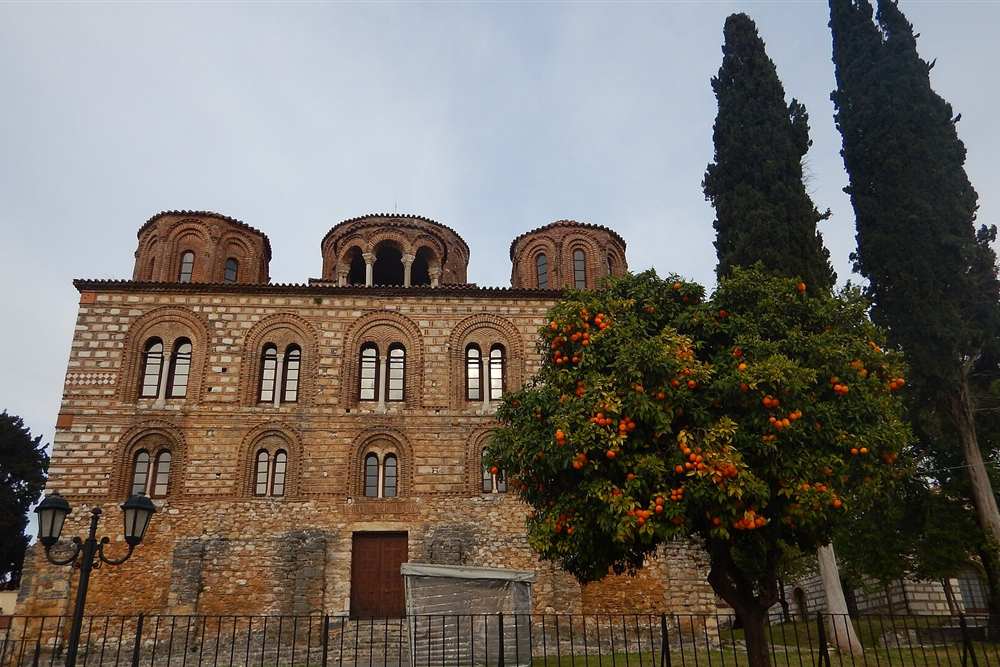
Parigoritissa is the strangest Byzantine church in the country. Built about 1290 by the Despot Nikephoros, it raises a dome on three tiers of ancient columns set on brackets, so the interior climbs in a way no other church of the period attempts, with mosaics of Christ Pantokrator above.
- Bridge of Arta – 145 m of stone in four unequal arches, rebuilt in 1602.
- Panagia Parigoritissa – the Despots’ church of about 1290 with its bracketed dome.
- Agia Theodora – the church holding the tomb of the Despotate’s saint and queen.
- Agios Vasileios – the small 13th-century church with its ceramic decoration.
- Castle of Arta – the walls on the ancient acropolis of Ambracia above the river.
- Archaeological Museum – the finds of Ambracia, Pyrrhus’s capital before Epirus moved.
Ambracia was the capital of Pyrrhus, the king whose victories gave the language a word. Arta tours cover the bridge, two churches and the castle on foot in half a day.
What do Arta tours see in the Tzoumerka mountains?
Arta tours in Tzoumerka see stone villages at 700 to 1,100 m, the arched bridges of Plaka and Politsa over the Arachthos, the gorge and waterfalls at Katarraktis, the Kipina monastery built into a cliff, and the national park that covers the range to 2,429 m.
The Plaka bridge is the landmark. Built in 1866 with a single span of 40 m, the largest stone arch in the Balkans, it collapsed in a flood in February 2015 and was rebuilt with its original stones five years later, and it carries the old road between Arta and Ioannina over the Arachthos.
Kipina, 20 km north, is a monastery wedged into a cliff face above the Kalarrytikos with a drawbridge to its door and a cave running back into the rock behind the church. The villages around it, Pramanta, Melissourgoi and Theodoriana, sit in fir forest with waterfalls above them.
- Plaka bridge – the 40 m single arch of 1866, rebuilt stone by stone after the flood.
- Kipina monastery – the cliff house with its drawbridge and cave.
- Katarraktis – the village with the waterfall and gorge path below it.
- Pramanta and Melissourgoi – the stone villages of the range at about 1,000 m.
- Theodoriana – the eastern village with the Souda waterfall above it.
- Tzoumerka national park – the protected area of the range and the Arachthos gorge.
The range is one of the least visited in Greece and the roads through it are narrow and slow. Snow closes the highest sections from December to March, and the villages keep a few dozen residents each through the winter, so fuel, food and rooms are found in Pramanta and Agnanta rather than in the smaller settlements above them. Arta tours take the Plaka bridge and two villages in a day of about 120 km.
What do Arta tours see on the Amvrakikos Gulf?
Arta tours on the Amvrakikos see a closed gulf of about 400 square kilometres holding the only resident bottlenose dolphins in a Greek gulf, Dalmatian pelicans, the lagoons of Tsoukalio and Rodia, the island village of Koronisia on its causeway, and the fish farms and shellfish beds.
The gulf is almost a lake. It opens to the Ionian through a channel 600 m wide at Preveza, which keeps its water brackish and still, and the delta of the Arachthos and Louros builds lagoons along the northern shore that carry pelicans, herons, terns and about 300 bird species.
Koronisia sits at the end of a 20 km causeway across the lagoons, a fishing village of 100 residents with a 10th-century church, fish tavernas on the water and a view over the whole gulf. Boat trips from it run out to the dolphins and the pelican colonies.
- Koronisia – the island village at the end of the causeway, with the fish tavernas.
- Tsoukalio and Rodia lagoons – the fishing lagoons and the pelican grounds.
- Bottlenose dolphins – the resident population of the gulf, seen on boat trips.
- Bird hides – the observation points on the northern shore.
- Salaora – the old salt works and the causeway start.
- Kommeno – the shore village with the memorial to the 1943 massacre.
The gulf is a Ramsar site shared with Preveza and Aetolia-Acarnania. Arta tours reach Koronisia in 40 minutes from the town and take the boat trip in the early morning.
What do Arta tours eat and drink?
Arta tours eat the oranges and kiwis of the plain, eel, shrimp and mullet from the Amvrakikos lagoons, the cheeses and pies of Tzoumerka, spit-roast lamb from the mountain villages, and drink the tsipouro distilled across the unit.
The gulf supplies the tables. Its shrimp are the best known catch, small and sweet, and the lagoons give eel, mullet and the bottarga made from its roe; the Koronisia and Salaora tavernas cook them within sight of the water they came from.
- Amvrakikos shrimp – the small gulf prawn, grilled or in saganaki.
- Lagoon eel and mullet – the catch of Tsoukalio and Rodia.
- Arta oranges and kiwis – the fruit of the plain, picked from November.
- Tzoumerka cheese and pies – the hard cheeses and hand-rolled pies of the villages.
- Spit-roast lamb – the mountain tavernas at Pramanta and Theodoriana.
- Tsipouro – distilled after the vintage across the plain and the hills.
The town market sells the citrus and the gulf catch every morning. Arta tours eat fish on the shore and meat in the mountains, which is how the unit divides its own cooking.
What history do Arta tours tell?
Arta tours tell of Ambracia, the capital of Pyrrhus in the 3rd century BC, of the Despotate of Epirus that ruled from the town after 1204 and built its churches, of the Ottoman centuries and the bridge of 1602, and of the battle of Peta in 1822.
Ambracia was a Corinthian colony that became the seat of Pyrrhus, the king whose costly victories over Rome gave the language the phrase. His city stood where the modern town does, and its walls, theatre and small temple sit among the streets with the museum holding the finds.
After the Fourth Crusade took Constantinople in 1204, Michael Komnenos Doukas set up the Despotate of Epirus and made Arta its capital. For a century and a half it was one of the Greek successor states, and the churches its despots built are the reason to come.
The Ottomans took the town in 1449. The revolution reached it in 1821, the battle of Peta in July 1822 killed most of the philhellene battalion fighting for the Greek side, and the unit passed to Greece only in 1881 with the rest of Thessaly and southern Epirus.
Arta tours read the sequence in the museum, the churches and the battlefield monument at Peta, all within 10 km of the bridge.
Which outdoor trips run in Arta?
Arta tours raft the Arachthos through its gorge, walk the Tzoumerka paths between the villages and the waterfalls, kayak on the Pournari reservoir, watch dolphins and pelicans on the Amvrakikos, and ride the forest roads of the range in summer.
The Arachthos carries the rafting. The run below the Plaka bridge takes about three hours through the gorge in spring and early summer when the snowmelt fills it, and the calmer sections above the Pournari dam suit kayaks and canoes through the season.
- Arachthos rafting – the gorge run below Plaka, from March to June.
- Tzoumerka walking – the paths between Pramanta, Melissourgoi and the waterfalls.
- Pournari reservoir – kayaking and canoeing on the lake above the town.
- Amvrakikos boat trips – the dolphin and pelican runs from Koronisia.
- Canyoning – the gorges above Katarraktis and Theodoriana.
- Mountain biking – the forest roads of the Tzoumerka national park.
The mountain season runs from April to November and the gulf works all year. Arta tours pair a river morning with an afternoon in the villages.
Which trips combine with Arta tours, and how do visitors reach the unit?
Arta tours combine with Preveza and Nikopolis 50 minutes west, Ioannina an hour north, the Tzoumerka villages of Ioannina over the ridge, Aetolia-Acarnania across the gulf and Meteora two hours east. Visitors reach the unit by the Ionia motorway.
The motorway from Igoumenitsa to Thessaloniki passes north of the town, and the one from Antirrio comes up the western side, which puts Arta within an hour of Ioannina and Preveza and two of Meteora. The nearest airport is Aktion, 50 minutes away by Preveza.
- Preveza and Nikopolis – 50 km west, with the Aktion airport beyond.
- Ioannina – 75 km north, about an hour on the motorway.
- Meteora – 140 km east, about two hours.
- Aetolia-Acarnania – Amfilochia and Vonitsa round the gulf.
- Athens – 370 km, about four hours by the Ionia and Olympia motorways.
- Where to stay – Arta town for the churches, the Tzoumerka villages for the mountain, Koronisia for the gulf.
Our Preveza tours page covers the unit to the west and the Ioannina tours page the one to the north. Arta tours take the town in half a day, the gulf in half a day and the mountains in a full one.
Which visitors do Arta tours suit, and what does a two-day route cover?
Arta tours suit visitors after Byzantine churches, walkers and rafters in Tzoumerka, birdwatchers on the Amvrakikos, families using the gulf beaches, and drivers crossing Epirus who want a stop with substance. Two days take the town and the gulf, then the mountains.
The unit gets a fraction of the visitors that Ioannina and Zagori take, which is why its churches are quiet and its mountain villages keep their prices low. Its weakness is the coast: the gulf is shallow and muddy, and the open-sea beaches are in Preveza next door.
- Day 1 morning – the bridge, Parigoritissa, Agia Theodora and the castle.
- Day 1 afternoon – the causeway to Koronisia and a boat trip on the gulf.
- Day 2 morning – the Plaka bridge and the Arachthos gorge.
- Day 2 afternoon – Pramanta, Kipina monastery and the Katarraktis waterfall.
- Extra day – Theodoriana, the Souda fall and the eastern Tzoumerka.
- Who it suits – church visitors, walkers, rafters, birdwatchers and road trips.
One day keeps the town and the bridge only. Arta tours built over two days drive about 200 km in total, most of it on the mountain road.
Which villages do Arta tours reach in the foothills?
Arta tours reach Peta with the philhellene memorial above the plain, Kompoti with its Byzantine tower, Vourgareli in the eastern hills with the Red Church, Athamanio and Agnanta on the Tzoumerka road, and the lakeside settlements above the Pournari dam.
Vourgareli is the one to plan for. The village sits at 750 m on the eastern side of the unit, and the Red Church, Kokkini Ekklisia, stands 3 km below it: a monastery church of 1281 built in brick and stone bands with the founder’s inscription naming the Despot of Epirus.
Peta, 8 km from the town, looks over the whole plain from its ridge. The monument on the hill marks the battle of 4 July 1822, when the philhellene battalion of German, Italian and Polish volunteers was destroyed by an Ottoman flanking attack, and the names are cut into the stone.
- Peta – the ridge village with the 1822 battlefield and the philhellene monument.
- Vourgareli and the Red Church – the 1281 monastery church in brick and stone.
- Kompoti – the Byzantine tower and the church of the Dormition.
- Agnanta – the balcony village on the Tzoumerka road, looking down the Arachthos.
- Athamanio – the stone village above the gorge, with the mountain paths.
- Pournari lake – the reservoir above the town, with the villages on its shore.
The foothill road links Peta, Kompoti and Vourgareli in about an hour and a half of driving. Arta tours take them on the way east towards Trikala or as a half day from the town.
Which festivals and seasons do Arta tours meet?
Arta tours meet the orange and kiwi harvest from November, the Tzoumerka village feasts in August, the Peta commemoration on 4 July, the Holy Week processions in the town churches, and the rafting season on the Arachthos from March to June.
The mountain villages fill for two weeks in August, when families return for the panigyria and the squares hold music until morning. The rest of the year they keep a few dozen residents each, and the guesthouses run on weekend visitors from Ioannina and Arta.
- August panigyria – the Tzoumerka village feasts, with music and roast lamb.
- 4 July, Peta – the commemoration of the philhellenes killed in 1822.
- Holy Week – the processions in the Byzantine churches of the town.
- Citrus harvest – the orange and kiwi picking on the plain from November.
- Rafting season – the Arachthos gorge from March to June.
- Bird season – the winter pelican and flamingo numbers on the Amvrakikos.
Spring gives the rivers and the flowers, autumn the harvest and the clear mountain light, and winter the gulf birds with the range under snow. Arta tours in August book the mountain rooms two months ahead.
Which museums and monasteries do Arta tours visit?
Arta tours visit the Archaeological Museum with the finds of Ambracia, the Folklore Museum in the old town, the monastery of Kato Panagia below the castle, Panagia Vlacherna with the Despots’ tombs, the Red Church at Vourgareli and Kipina in the Tzoumerka cliff.
The archaeological museum, opened in 2009 on the edge of the town, holds the record of Ambracia from the Corinthian foundation through the court of Pyrrhus to the Roman city: grave stelae, bronze helmets, the small temple finds and the mosaics lifted from the houses.
Vlacherna, 2 km from the centre, is the burial church of the Despotate. Michael II and his family lie in its marble sarcophagi, its floor keeps its original inlay, and its brick decoration matches the churches the same workshops built across Epirus in the 13th century.
- Archaeological Museum of Arta – the finds of Ambracia and the court of Pyrrhus.
- Panagia Vlacherna – the Despots’ burial church with its marble tombs.
- Kato Panagia – the 13th-century monastery under the castle hill.
- Red Church, Vourgareli – the 1281 church in banded brick and stone.
- Kipina – the cliff monastery with its drawbridge in the Tzoumerka.
- Folklore Museum – the dress, looms and trades of the plain and the mountains.
The Byzantine churches of the unit number more than twenty and most stand open in the morning. Arta tours take four of them in a day without leaving the plain.
Frequently Asked Questions
Where is Arta?
In southern Epirus, on the Arachthos river between the Tzoumerka mountains and the Amvrakikos Gulf, with Preveza to the west, Ioannina to the north and Aetolia-Acarnania across the water.
What is the bridge of Arta?
A stone bridge of four unequal arches, 145 m long, rebuilt in 1602 on older foundations and carrying the folk ballad in which the master builder walls his wife into the footing so the span will stand.
What is Panagia Parigoritissa?
The church of the Despots of Epirus, built about 1290, which raises its dome on three tiers of ancient columns set on brackets and keeps mosaics of Christ Pantokrator in the crown.
What was Ambracia?
The Corinthian colony under the modern town that became the capital of Pyrrhus in the 3rd century BC. Its walls, theatre and small temple stand among the streets and its finds fill the museum.
What is the Plaka bridge?
A single stone arch of 40 m over the Arachthos, built in 1866 and the largest in the Balkans, which collapsed in a flood in February 2015 and was rebuilt with its original stones five years later.
What is Kipina monastery?
A monastery wedged into a cliff above the Kalarrytikos in the Tzoumerka, reached by a drawbridge, with a cave running back into the rock behind the church.
Are there dolphins in the Amvrakikos Gulf?
Yes. The gulf holds the only resident bottlenose dolphin population in a Greek gulf, along with Dalmatian pelicans and about 300 recorded bird species in its lagoons.
What is Koronisia?
An island village of about 100 residents at the end of a 20 km causeway across the lagoons, with a 10th-century church, fish tavernas and boat trips onto the gulf.
How do you reach Arta?
By the Ionia motorway, an hour from Ioannina, 50 minutes from Preveza and its Aktion airport, two hours from Meteora and about four hours from Athens.
When is the best time for Arta tours?
March to June for the rivers and the rafting, September and October for the mountain light and the harvest, winter for the gulf birds, and August for the village feasts with rooms booked ahead.