
Kos fishing trips run out of Kos Town, Kardamena, Mastichari and Kefalos on licensed local boats with rods, bait and tackle supplied, working the reefs and drop-offs for bream, bass, amberjack and squid on a half day or a full day. Plan the rest of the island with Greece Tours.
This guide covers the whole day: the harbours the boats leave from, what the water holds and how it is fished, the prices for a shared seat and a private charter, the timings, what is included, the licence question, what happens to the catch, the wind, and the months that fish best.
What does a Kos fishing trip involve?
A half or full day aboard a licensed local boat with rods, bait and tackle supplied, working the reefs and drop-offs off the island for bream, bass, amberjack and squid, with the catch cooked aboard or bagged to take away.
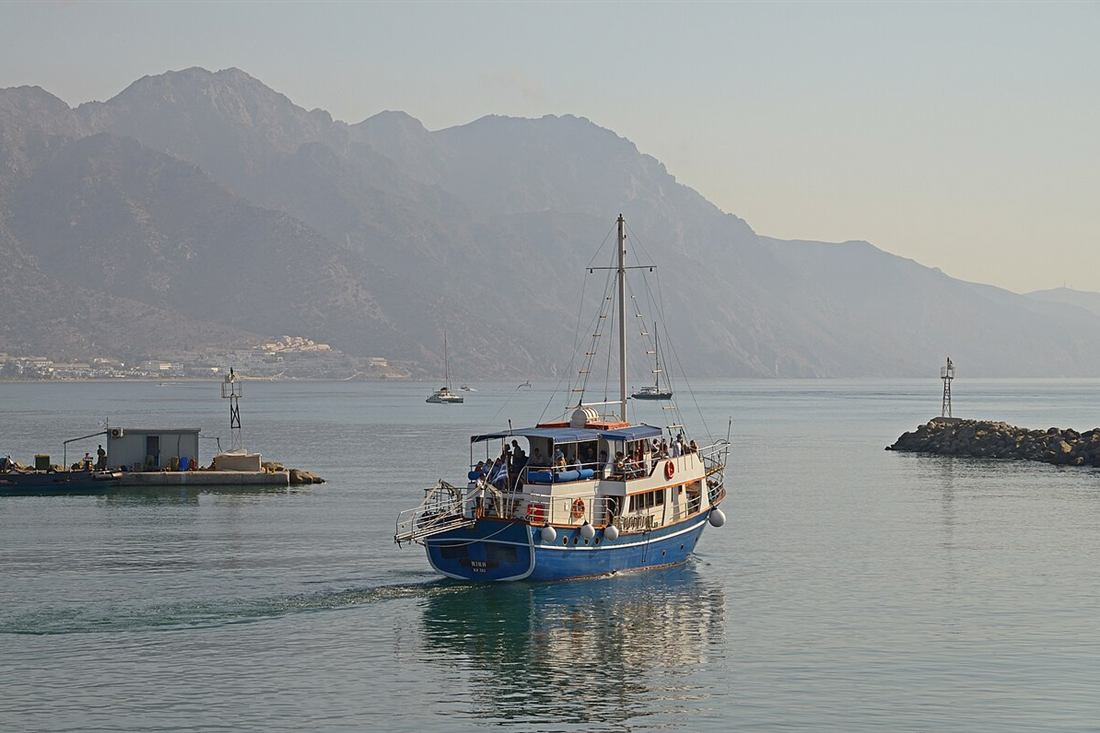
Kos fishing trips leave the town marina before the wind builds. The boats are working craft rather than sport cruisers: eight to fourteen metres, a wheelhouse, a shaded stern and a deck cleared for lines. The skipper is the fisherman, the crew is one or two, and the party is capped at six to ten people so everyone has water to fish. Kardamena sends its Kos fishing trips to the south-coast reefs.
Full-day Kos fishing trips run seven to eight hours from seven. The pattern of the day is fixed. Out to the first mark at slow speed, anchor or drift, bottom fishing while the sun climbs, a move to a second mark, then a swim stop and lunch before the run home. The trolling lines go out on both legs. A private charter puts the marks of the Kos fishing trips in your hands.
Where do the boats leave from?
Kos Town marina and the old harbour for the eastern grounds, Kardamena on the south coast, Mastichari on the north for the Pserimos channel, and Kefalos in the west for the deeper water off the headland.
Kardamena sends its Kos fishing trips to the south-coast reefs. Kos Town is the busiest base and the one with hotel pickup built into the price. The boats lie on the inner quay below the castle with their gear stacked on deck, and the morning departures leave between seven and eight while the water is flat. Mastichari works the Pserimos channel on its Kos fishing trips.
A private charter puts the marks of the Kos fishing trips in your hands. The village harbours are smaller and closer to the fishing. Kardamena runs the south-coast reefs and the drop to deep water, and Mastichari sits on the channel between Kos and Pserimos where the current concentrates the fish. Detail on that harbour sits at Mastichari. The crew cleans and bags the catch on the run home.
What do you catch in these waters?
Sea bream and sea bass on the bottom, amberjack and bonito on the troll, grouper and dentex over the rocky marks, and squid and octopus on the evening trips through autumn.
Mastichari works the Pserimos channel on its Kos fishing trips. Bottom fishing over reef and sand takes the bream family: sargos, melanouri and the larger fangri when the mark is right. The lines run heavy because the ground is rough and the tackle gets tested. Small hooks and patience take the most fish on a flat day. Kefalos puts Kos fishing trips over the deeper western water.
The crew cleans and bags the catch on the run home. Trolling on the passage between marks is where the fast fish come. Amberjack hunt the drop-offs through summer and the bonito run in autumn, and both take a lure at four or five knots. The skipper reads the birds and the surface rather than a chart plotter alone. Harbour tavernas grill what comes back from Kos fishing trips.
What does a Kos fishing trip cost?
From about 60 to 90 euros per person for a half day of four to five hours, and from about 110 to 160 euros for a full day of seven to eight. A private charter of the boat runs from about 450 euros for the half day.
Kefalos puts Kos fishing trips over the deeper western water. The shared price covers the boat, the crew, rods, bait, tackle and the licence cover the operator holds. Food and drink are included on the full-day trips and offered on the half day. Hotel pickup is bundled into the Kos Town departures and charged at five to ten euros elsewhere. Bream and bass come off the bottom on Kos fishing trips.
Harbour tavernas grill what comes back from Kos fishing trips. The private charter is the version that pays for a family or a group of four. It sets the departure hour, the marks and the length of the swim stop, and it keeps the deck to your party. Bare boat hire without a skipper is a different product entirely, covered in Kos boat rental without license. The meltemi shuts the northern grounds on the strongest days.
How long are the trips and when do they leave?
Half days run four to five hours leaving at seven or eight in the morning, full days run seven to eight hours from seven, and the evening squid trips run three to four hours from about five in the afternoon.
Bream and bass come off the bottom on Kos fishing trips. The morning departure is not a formality. The water is flattest before ten, the fish feed at first light, and the meltemi builds through the afternoon in July and August. A boat that leaves at seven fishes two productive hours that a nine o’clock departure never sees. Amberjack and bonito take a lure on the troll between marks.
The meltemi shuts the northern grounds on the strongest days. Autumn changes the timetable. The squid and cuttlefish trips run at dusk from September, the water is warm and the wind drops, and the boats work closer to shore. Those trips suit travellers who want the fishing without the early alarm. Polarised sunglasses show the ground under the boat.
What is included, and what do you bring?
Rods, reels, bait, tackle, ice and the operator’s licence are supplied. You bring a hat, high-factor sun cream, sunglasses, a light layer, deck shoes with grip, water and a seasickness tablet taken before boarding.
Amberjack and bonito take a lure on the troll between marks. The deck is open and the reflection off the water doubles the sun. Long sleeves in a light fabric beat bare arms by the fourth hour. Polarised sunglasses are the one piece of gear worth carrying yourself, because they show the fish and the ground under the boat. Grouper and dentex hold over the rocky ground these boats work.
Polarised sunglasses show the ground under the boat. Bring cash for the crew and for a taverna afterwards. Anglers who fish at home are welcome to bring a favourite rod, and the crews are relaxed about it, but the boat gear is matched to the ground and the bait is what the fish here take. Six to ten anglers is the cap on shared Kos fishing trips.
Do you need a fishing licence?
No. Recreational sea angling from a licensed passenger boat in Greece is covered by the operator’s professional licence, and guests fish under it. Independent anglers fishing from their own hired boat register with the port authority instead.
Grouper and dentex hold over the rocky ground these boats work. The rules that bind are about method and species rather than paperwork for a guest. Spearfishing with air tanks is prohibited, undersized fish go back, and the protected species are known to every skipper. Nothing on a booked trip asks the visitor to check any of it. Squid and octopus fill the autumn evening Kos fishing trips.
Six to ten anglers is the cap on shared Kos fishing trips. The licence question matters on a self-drive boat. Anyone taking a licence-free rental out with rods aboard is fishing under the recreational rules and is expected to keep to the sizes and the closed seasons, which the rental desk explains at the briefing. May, June, September and October fish better than August.
What happens to the fish you catch?
The catch is yours. Most boats clean it on the way in and bag it on ice, and part of the fleet cooks it aboard for lunch on the full-day trips. Tavernas along the harbour will cook what you carry in for a plate charge.
Squid and octopus fill the autumn evening Kos fishing trips. Cooking aboard is the memorable version: the crew grills what came over the side an hour before, with bread, salad and a bottle of wine on the stern. Nothing bought ashore matches it, and the price is inside the fare on the boats that do it. Rods, bait and tackle come with every Kos fishing trip aboard.
May, June, September and October fish better than August. Taking it in works too. Harbourside kitchens at Kos Town, Kardamena and Mastichari charge a few euros a head to grill a guest’s fish, and the practice is normal rather than a favour. The wider island table is covered in Kos restaurants. Hotel pickup is bundled into the Kos fishing trips from town.
How do the wind and the sea affect the day?
The meltemi blows from the north through July and August and shuts the northern grounds on the strongest days. Boats move to the lee of the island, shorten the trip or postpone rather than fish an uncomfortable sea.
Rods, bait and tackle come with every Kos fishing trip aboard. Travellers prone to seasickness take a tablet an hour before boarding, sit low and midships, watch the horizon and eat something dry beforehand. The trips that stay inshore in the lee of Kefalos are the calmest option on a blowing day. The operator’s professional licence covers guests on Kos fishing trips.
Hotel pickup is bundled into the Kos fishing trips from town. Cancellations are decided at the quay by seven in the morning and refunded in full. Operators call or message the booking the evening before when the forecast is already clear, which is a courtesy worth noting when choosing between two boats. Children over six take to the bottom fishing and the swim stop.
Who does a Kos fishing trip suit?
Families with children over six who want a boat day with something to do, couples who want a small boat instead of a party cruise, and anglers who want ground they do not know worked by someone who does.
The operator’s professional licence covers guests on Kos fishing trips. Children take to it when the fishing is bottom fishing with a rod they can hold and a swim stop in the middle. The full-day trolling trips are long for them. The crews are used to it and rig the light gear without being asked. Half-day Kos fishing trips run four to five hours from the quay.
Children over six take to the bottom fishing and the swim stop. Serious anglers get more from a private charter with the marks discussed in advance. The skippers here fish commercially out of season and the knowledge is real; the difference between a shared morning and a chartered day is the freedom to work one mark properly. Weather cancellations on Kos fishing trips are refunded in full.
When is the season, and how far ahead do you book?
April to November, with the best fishing in May, June, September and October. Book two to three days ahead in high summer and on the day outside it, because the boats are small and fill fast.
Half-day Kos fishing trips run four to five hours from the quay. High summer is hot and the fish go deep in the middle of the day, which is why the shoulder months fish better. September and October give warm water, light wind, the bonito run and half the crowd of August. Full-day Kos fishing trips run seven to eight hours from seven.
Weather cancellations on Kos fishing trips are refunded in full. Winter trips run on request when the weather allows, mostly for local anglers. A traveller in the island’s quiet months finds a skipper willing to go out on a settled day, which is the cheapest fishing of the year. The island as a whole is covered at Kos, and the other boat day is the Kos sunset cruise. Kos fishing trips leave the town marina before the wind builds.
Frequently Asked Questions
What do Kos fishing trips cost?
From about 60 to 90 euros per person for a half day of four to five hours and 110 to 160 euros for a full day. A private charter of the boat runs from about 450 euros for the half day.
Do you need a fishing licence on Kos?
No. Recreational angling from a licensed passenger boat is covered by the operator’s professional licence, and guests fish under it. Independent anglers on a hired boat register with the port authority.
What do you catch on Kos fishing trips?
Sea bream and sea bass on the bottom, amberjack and bonito on the troll, grouper and dentex over rocky ground, and squid and octopus on the evening trips through autumn.