
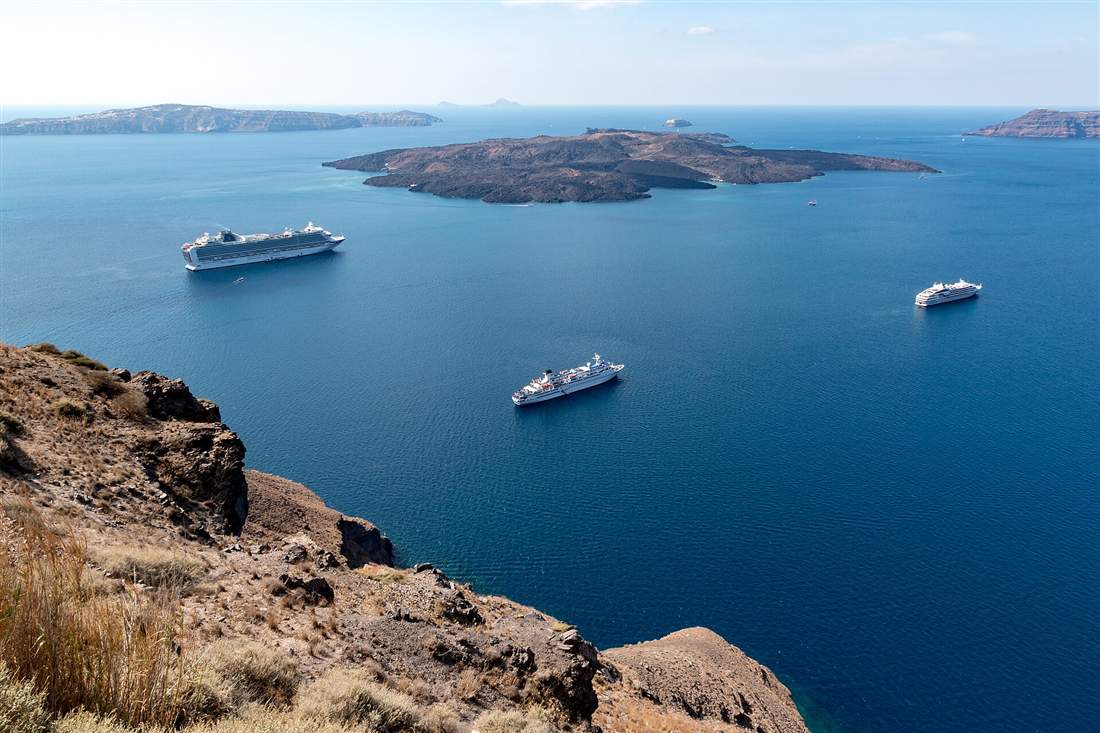
A Santorini shore excursion is the tour booked for the hours between the tender and the all-aboard, and it matters more here than at most ports, because the ship anchors in the caldera and every passenger faces three hundred metres of cliff before the day starts. Plan the rest of the island with Greece Tours.
This guide covers the whole call: the tender to Skala, the three ways up the cliff and what each costs in time, the cable car queue on a busy day, the boat-transfer tour that avoids it, the small-group and Oia excursions, what fits in four hours and in a full day, the return queue, and the prices.
What is a Santorini shore excursion, and why does this port demand one more than most?
A Santorini shore excursion is a pre-booked tour that fills the hours between the tender landing and the all-aboard call. The island demands one because the ship anchors offshore, the towns stand 220 metres above the water, and unplanned transport swallows the day.
Queues at the cable car eat the hours of a Santorini shore excursion. Most Mediterranean calls put the gangway on a quay inside the town, so a passenger walks off and starts sightseeing within five minutes. Santorini puts a tender at the base of a volcanic cliff. Between the water and the rim stands a wall of lava rock crossed by exactly three routes, and every one of them carries the entire day’s arrivals.
Fira and its museum sit at the top of the cable car. Perissa and Kamari lie further out than a short call reaches. Independent operators carry the timing risk that a ship tour does not. That geography turns transport into the governing constraint of a Santorini call. The distance from the pier at Skala to the centre of Fira measures under one kilometre in plan, yet the climb consumes anything from three minutes to ninety, depending on the queue. Sightseeing time is whatever survives the climb, and a passenger who improvises loses hours to lines rather than to views.
The small-group format of a Santorini shore excursion drives the caldera rim. A shore excursion converts that constraint into a fixed plan with a named driver, a reserved seat and a return commitment. The three products built for cruise passengers each solve the same problem from a different angle: one runs a small-group island circuit, one drives straight for Oia, and one removes the cliff from the day altogether by moving guests to a second harbour by boat.
Where does a cruise ship anchor at Santorini, and what does the tender to Skala involve?
Ships anchor in the flooded caldera off Fira, where the water runs 300 metres deep and holds no berth. Tenders cross roughly one nautical mile to Skala, the old port at the foot of the cliff, in ten to fifteen minutes.
The boat-transfer version of a Santorini shore excursion skips the cliff entirely. Four or five ships call on a peak day, which is what fills the cliff. Skala, the old port, is where a Santorini shore excursion steps ashore. The caldera is a drowned volcanic crater with near-vertical submarine walls, so a conventional quay is impossible along the west coast. Vessels hold position on a small number of mooring buoys and anchor points off Fira, and passengers reach land in the ship’s own tenders or in contracted local boats that berth along the concrete pier at Skala.
The all-aboard time governs every Santorini shore excursion on the island. The return tender queue is the part of the day passengers underestimate. The price of a Santorini shore excursion is set by the format and the group size. Tender tickets are issued by deck or by tour group, and passengers holding a booked excursion receive priority numbers that put them ashore in the first waves. That priority counts for more here than at a docked port: the gap between the first tender wave and the fifth runs to a full hour of shore time.
Oia is the destination that most passengers ask a Santorini shore excursion for. The Bronze Age excavation at Akrotiri is the indoor option on a hot call. A private car with a driver-guide is the flexible Santorini shore excursion. Everything about the anchorage itself — the tender tickets, the terminal building, the donkey stand and the ticket window — belongs to the Santorini cruise port guide. This page begins one step later, at the moment a guest stands on the Skala pier with a guide’s sign in view and a fixed number of hours to spend.
What are the three ways up the caldera cliff, and what does each one cost in time?
Three routes climb the 220-metre cliff. The cable car runs Skala to Fira in three minutes. The stepped donkey path covers 588 steps in twenty-five to thirty-five minutes on foot. The road from Athinios harbour reaches Fira by vehicle in twelve to fifteen minutes.
The small-group format of a Santorini shore excursion drives the caldera rim. The cable car is the fastest of the three ways up from the old port. The cable car is the default. Six cabins of six seats run on a system funded by the Nomikos foundation, and the ride climbs the cliff face in a straight line above the old port. The mechanical journey is short; the wait at either terminal is the single variable that decides the shape of the day.
A good operator builds a buffer into a Santorini shore excursion. The donkey path zigzags up the same face in broad stone switchbacks. A fit adult in proper shoes walks it downhill in twenty minutes, and it is hot, uneven and shared with animals on the way up. The surface is polished stone under a covering of grit and dung, and it punishes sandals and smooth soles.
Fira and its museum sit at the top of the cable car. Perissa and Kamari lie further out than a short call reaches. Independent operators carry the timing risk that a ship tour does not. The third route never touches the cliff at Skala at all. Athinios, the ferry harbour four kilometres to the south, sits at the foot of a switchback road that carries coaches and taxis to the rim. A boat transfer to Athinios plus a road climb delivers a group to the ridge in under half an hour with no queue, and that is the whole logic behind the skip-the-cable-car product.
How much of a cruise call does the cable car queue eat on a busy day?
The cable car carries thirty-six passengers a trip and moves up to 1,200 an hour. Four ships tendering together land 6,000 people at one pier, so the boarding line at Skala reaches sixty to ninety minutes at the morning peak and again on the afternoon return.
Oia is the destination that most passengers ask a Santorini shore excursion for. The Bronze Age excavation at Akrotiri is the indoor option on a hot call. A private car with a driver-guide is the flexible Santorini shore excursion. The donkey path and the road are the alternatives to the cable car. The arithmetic is unforgiving. A single 3,000-berth ship needs two and a half hours of uninterrupted cable car capacity to put its passengers on the rim, and that assumes the machine runs without a stop and nobody travels downhill. On a four-ship day the demand outruns the capacity by a wide margin before ten in the morning.
Four hours ashore fits Fira and Oia on a Santorini shore excursion. Four or five ships call on a peak day, which is what fills the cliff. Skala, the old port, is where a Santorini shore excursion steps ashore. The queue forms on the open quay with no shade and no seating. Passengers stand in direct sun on black rock that radiates heat, which is why the wait feels longer than the clock says and why a share of guests abandons the line for the donkey path halfway through. Running hours, ticket prices and the cabin schedule are set out on the Santorini cable car page.
The all-aboard time governs every Santorini shore excursion on the island. The return tender queue is the part of the day passengers underestimate. The price of a Santorini shore excursion is set by the format and the group size. Ninety minutes lost at the bottom and forty-five lost on the return strip more than two hours from a seven-hour call. That is the strongest single argument for booking an excursion that either lands guests early on a priority tender or bypasses the cliff route entirely by water.
How does the boat-transfer shore excursion skip the cable car entirely?
The SKIP CABLE CAR excursion collects guests at Skala by local boat and sails four kilometres south to Athinios, the ferry harbour. A minibus waits on the quay, climbs the switchback road, and the group stands on the caldera rim within twenty-five minutes of landing.
Fira and its museum sit at the top of the cable car. Perissa and Kamari lie further out than a short call reaches. Independent operators carry the timing risk that a ship tour does not. Queues at the cable car eat the hours of a Santorini shore excursion. The transfer boat runs along the inside wall of the caldera, which turns a piece of logistics into the scenic leg of the morning: the full stratigraphy of the eruption sits exposed above the waterline in red, black and white bands, with the villages forming a thin white rim along the top edge. The crossing takes fifteen to twenty minutes in calm water.
A full day ashore opens Akrotiri and a winery to a Santorini shore excursion. The cable car is the fastest of the three ways up from the old port. At Athinios the vehicle is pre-positioned and named, so there is no scramble for a taxi against 200 other arrivals. The road out of the harbour climbs eight hairpins in three kilometres and delivers the group to the ridge road that runs the length of the island. From that junction Fira lies ten minutes north and Akrotiri fifteen minutes to the south-west.
A good operator builds a buffer into a Santorini shore excursion. The return follows the same pattern in reverse, and that is where the product earns its keep. The afternoon downward queue at the Fira cable car station reaches forty-five minutes when three ships recall passengers at once. A guest on the boat-transfer tour drives to Athinios instead, boards a waiting boat and steps onto the Skala pier with the tender lane almost empty.
What does the small-group shore tour for cruise ships cover in the hours ashore?
The small-group shore tour caps the vehicle at six to eight guests and runs a fixed circuit: a caldera viewpoint above Fira, the ridge villages, a village or winery stop, Oia for the lanes and the castle, then a direct return to the pier ahead of the all-aboard.
The all-aboard time governs every Santorini shore excursion on the island. The return tender queue is the part of the day passengers underestimate. The price of a Santorini shore excursion is set by the format and the group size. The boat-transfer version of a Santorini shore excursion skips the cliff entirely. Group size is the working feature of the product. A coach of fifty needs twelve minutes to load at each stop and parks wherever a bus bay exists, which on Santorini means the far edge of every village. A minibus of eight loads in ninety seconds and uses the near car parks at Imerovigli, Pyrgos and Oia, and that difference alone returns forty minutes of walking time across a day.
The Bronze Age excavation at Akrotiri is the indoor option on a hot call. A private car with a driver-guide is the flexible Santorini shore excursion. The donkey path and the road are the alternatives to the cable car. The circuit itself is built around the ridge road. Fira, Firostefani and Imerovigli sit in one continuous white line along the rim, each with a different angle on the volcanic islets of Nea Kameni and Palea Kameni. Pyrgos, inland and higher, holds the only viewpoint that takes in both coasts and the summit of Profitis Ilias at once.
Four hours ashore fits Fira and Oia on a Santorini shore excursion. Four or five ships call on a peak day, which is what fills the cliff. Skala, the old port, is where a Santorini shore excursion steps ashore. A guide travelling with eight people answers questions in a normal voice rather than through a headset, and reorders the stops when a village fills with coaches. That flexibility is the reason the small-group format survives on an island where the ridge road jams solid between eleven and one.
What does the shore excursion to Oia include, from the rim drive to the lanes?
The Oia shore excursion drives the rim road eleven kilometres north from Fira through Firostefani and Imerovigli in twenty-five to thirty minutes, then releases the group for sixty to ninety minutes on foot in Oia: the marble lane, the castle ruin and the steps above Ammoudi.
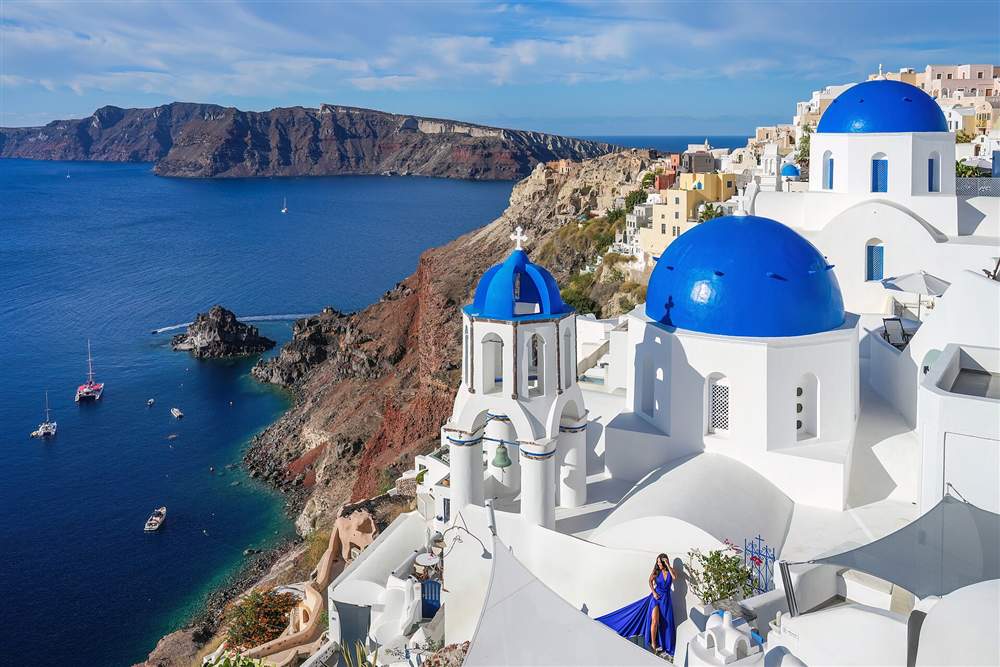
A good operator builds a buffer into a Santorini shore excursion. Oia occupies the northern tip of the crescent, where the caldera wall turns and the island narrows to a few hundred metres. The village is built on the outer edge of that wall in cave houses cut into pumice, with blue-domed churches stacked below the footpath and the sea 100 metres straight down. It is the image that sells the island.
Perissa and Kamari lie further out than a short call reaches. Independent operators carry the timing risk that a ship tour does not. Queues at the cable car eat the hours of a Santorini shore excursion. The walkable core is a single marble-paved pedestrian street about 700 metres long, running from the bus square to the Byzantine castle ruin at the far end. Side stairs drop off it toward the caldera every thirty metres or so. An unhurried walk out and back, with stops for photographs, takes fifty minutes; the shopping lanes absorb as much time as a guest hands them.
A full day ashore opens Akrotiri and a winery to a Santorini shore excursion. The cable car is the fastest of the three ways up from the old port. The castle ruin at the western tip is where the crowd concentrates, and a morning cruise call carries the enormous advantage of reaching it long before the sunset crush. The 300 steps down to Ammoudi Bay repay the effort in the downhill direction alone, and no cruise schedule leaves room for the climb back up in the heat.
How does the all-aboard time govern the plan, and what buffer does a good operator build?
The all-aboard time falls thirty to sixty minutes before sailing and forms the hard edge of the whole day. A competent operator ends the touring ninety minutes before it: thirty minutes for the descent, thirty for the tender queue and thirty as pure margin.
Four hours ashore fits Fira and Oia on a Santorini shore excursion. Four or five ships call on a peak day, which is what fills the cliff. Skala, the old port, is where a Santorini shore excursion steps ashore. Oia is the destination that most passengers ask a Santorini shore excursion for. Work the plan backwards from that number rather than forwards from the landing. A call from seven in the morning to four in the afternoon with an all-aboard at half past three yields eight and a half hours on paper. Subtract the tender wave, the climb and the return buffer, and the genuine touring window measures five and a half hours.
The return tender queue is the part of the day passengers underestimate. The price of a Santorini shore excursion is set by the format and the group size. The boat-transfer version of a Santorini shore excursion skips the cliff entirely. Operators who build no margin sell the extra hour as content and hand the risk to the guest. The failure mode is predictable: a traffic stall on the single ridge road at Imerovigli, a wedding closing the Oia bus square, or a swell that slows the tender cycle to a crawl. Each of those events costs twenty to forty minutes, and a plan with zero slack turns each one into a missed ship.
The Bronze Age excavation at Akrotiri is the indoor option on a hot call. A private car with a driver-guide is the flexible Santorini shore excursion. The donkey path and the road are the alternatives to the cable car. Ask the operator for the return time in writing before booking, and measure it against the ship’s all-aboard rather than against the sailing time. A tour that promises to have guests at the pier fifteen minutes before all-aboard is selling a coin flip. Ninety minutes of margin is the working standard on this island.
Is a ship excursion or an independent operator the safer choice if the tour runs late?
A ship-sold excursion transfers the risk to the cruise line, which holds the vessel or repatriates guests at its own cost. An independent operator carries no such power, so the protection comes instead from the return buffer, the group size and a guarantee written into the booking.
A full day ashore opens Akrotiri and a winery to a Santorini shore excursion. The cable car is the fastest of the three ways up from the old port. Fira and its museum sit at the top of the cable car. The cruise line’s guarantee is genuine, and it is the entire reason ship tours command a premium of thirty to sixty percent. The trade is scale: fifty-seat coaches, headsets, staged photo stops and a schedule set by the slowest passenger aboard. On Santorini’s narrow ridge road that scale costs more time than the guarantee protects.
Cash, water and proper shoes are what to carry on a Santorini shore excursion. A reputable independent operator answers with structure rather than with promises. Six to eight guests per vehicle, a driver-guide who tracks the tender cycle by radio, a first departure timed to the priority tender, and a written commitment to return guests before the all-aboard. Read the cancellation terms and the late-return clause before paying, because that is where the real policy sits.
Perissa and Kamari lie further out than a short call reaches. Independent operators carry the timing risk that a ship tour does not. Queues at the cable car eat the hours of a Santorini shore excursion. Guests who want the tightest control over the clock take a vehicle to themselves. A private Santorini tour with a local guide starts and ends when the guest says, reorders stops around the traffic, and cuts the day short at the first sign of trouble without negotiating with seven strangers.
What fits into four hours, six hours, and a full day ashore?
Four hours ashore hold two stops: Oia plus one viewpoint, or Akrotiri plus a winery. Six hours hold four stops with lunch. A nine-hour call holds the complete circuit — Oia, Fira, Akrotiri, a winery and a beach — with time to walk each one properly.
The Bronze Age excavation at Akrotiri is the indoor option on a hot call. A private car with a driver-guide is the flexible Santorini shore excursion. The donkey path and the road are the alternatives to the cable car. The all-aboard time governs every Santorini shore excursion on the island. Four hours is the most common real window on a short call, and the mistake is treating it as four hours of sightseeing. Deduct the climb and the return buffer and 150 usable minutes remain. Two stops with thirty minutes of driving between them fit that window; three stops do not, and the third becomes a photograph taken through a moving window.
Four or five ships call on a peak day, which is what fills the cliff. Skala, the old port, is where a Santorini shore excursion steps ashore. Oia is the destination that most passengers ask a Santorini shore excursion for. Six hours changes the shape of the day rather than merely extending it. A driver adds Pyrgos or Megalochori, a sit-down lunch of ninety minutes becomes possible, and the schedule absorbs one traffic delay without collapsing. This is the window in which a Santorini half-day private tour covers the island’s spine end to end.
The return tender queue is the part of the day passengers underestimate. The price of a Santorini shore excursion is set by the format and the group size. The boat-transfer version of a Santorini shore excursion skips the cliff entirely. A nine-hour call with an evening departure is the only shape that supports a beach. Perissa and Kamari lie on the far side of the island, twenty-five to thirty minutes from the rim, and a swim with changing time costs two hours from vehicle to vehicle. Fit that in only when the all-aboard falls after six in the evening.
Is Akrotiri worth a slot on a cruise call?
Akrotiri earns its slot on any call over five hours. The Bronze Age town stands under a bioclimatic roof, so the visit works in rain and in forty-degree heat alike, and a guided walk of the excavation takes forty-five to sixty minutes on level walkways.
Perissa and Kamari lie further out than a short call reaches. Independent operators carry the timing risk that a ship tour does not. Queues at the cable car eat the hours of a Santorini shore excursion. A good operator builds a buffer into a Santorini shore excursion. The settlement was buried by the Minoan eruption and preserved under metres of pumice: two-storey houses with intact staircases, milled drainage channels, storage jars still in position and street frontages standing to first-floor height. The wall paintings themselves sit in the Museum of Prehistoric Thera in Fira and in Athens, and a guide connects the two halves in the telling.
Limited mobility changes which Santorini shore excursion works. The cable car is the fastest of the three ways up from the old port. Fira and its museum sit at the top of the cable car. The practical case is the roof. Santorini in the middle of the day offers no shade on the rim, and an excursion that keeps a group outdoors from eleven until two exhausts people. An hour under cover in the middle of the circuit resets the day, and the raised walkways are flat, wide and passable with a wheelchair throughout.
Cash, water and proper shoes are what to carry on a Santorini shore excursion. The site sits fifteen minutes from Athinios harbour and twenty from Fira, which places it neatly on the boat-transfer routing. The full context, the opening hours and the layout of the dig are set out on the Akrotiri archaeological site guide.
Can a winery visit and a tasting fit inside a shore excursion?
A winery stop fits any call over five hours. A standard tasting of four to six wines with a vineyard explanation runs forty-five minutes, and the estates on the Pyrgos ridge sit ten to fifteen minutes off the caldera road, so the detour costs an hour in total.
The return tender queue is the part of the day passengers underestimate. The price of a Santorini shore excursion is set by the format and the group size. The boat-transfer version of a Santorini shore excursion skips the cliff entirely. Four hours ashore fits Fira and Oia on a Santorini shore excursion. Santorini’s viticulture resembles nothing else in the Mediterranean. Vines are trained into a low basket called a kouloura that lies on the ground, shielding the fruit from wind and collecting dew in a place with almost no summer rain. The vines grow ungrafted in volcanic ash, phylloxera never took hold, and root systems on the island run to eighty years and beyond.
A private car with a driver-guide is the flexible Santorini shore excursion. The donkey path and the road are the alternatives to the cable car. The all-aboard time governs every Santorini shore excursion on the island. The wine that carries the island is Assyrtiko: bone-dry, high in acid and mineral, fermented in steel or in oak. Vinsanto is the sweet counterpart, made from sun-dried grapes and aged for years in barrel. A flight of both, with a plate of tomatokeftedes and fava, hands a cruise guest the island’s agriculture in one sitting.
Four or five ships call on a peak day, which is what fills the cliff. Skala, the old port, is where a Santorini shore excursion steps ashore. Oia is the destination that most passengers ask a Santorini shore excursion for. The estates that handle cruise groups efficiently include the co-operative above Pyrgos with its caldera terrace and the cliff-cut winery on the Athinios road. A booked tasting costs €20 to €45 a head depending on the flight, and the operator reserves the slot in advance so a group of eight is not queued behind a coach of fifty.


Are the beaches at Perissa and Kamari worth the drive from the port?
Perissa and Kamari repay the drive only on a call of eight hours or more. Both lie twenty-five to thirty minutes from the caldera rim on the south-east coast, and a swim with changing and a drink consumes two hours of the day ashore.
Cash, water and proper shoes are what to carry on a Santorini shore excursion. The two beaches sit on opposite sides of the Mesa Vouno headland, joined by a mountain road and separated by the ruins of ancient Thera on the ridge above them. The sand is black volcanic grit that holds heat fiercely, which is why the sunbed rows exist and why walking barefoot at midday is not an option.
Independent operators carry the timing risk that a ship tour does not. Queues at the cable car eat the hours of a Santorini shore excursion. A good operator builds a buffer into a Santorini shore excursion. Kamari is the tidier of the pair, with a paved promenade, a long line of tavernas and organised beach clubs charging €15 to €30 for two beds and an umbrella. Perissa runs longer and looser, with a younger crowd, cheaper beds and open water that shelves steeply within a few metres of the shore.
Limited mobility changes which Santorini shore excursion works. The cable car is the fastest of the three ways up from the old port. Fira and its museum sit at the top of the cable car. The honest verdict for a cruise passenger is that the caldera rim is the reason the ship called here, and these beaches rate as ordinary by Greek standards. Guests who saw Oia on a previous call are the ones who trade the rim for the water.
What does Fira hold, and what is the walk to Firostefani like?
Fira holds the cable car terminal, the Museum of Prehistoric Thera, the Orthodox and Catholic cathedrals and the caldera promenade. The walk north to Firostefani follows a paved rim path for 1.2 kilometres and takes fifteen to twenty minutes, with a modest climb.
Four or five ships call on a peak day, which is what fills the cliff. Skala, the old port, is where a Santorini shore excursion steps ashore. Oia is the destination that most passengers ask a Santorini shore excursion for. The Bronze Age excavation at Akrotiri is the indoor option on a hot call. The Museum of Prehistoric Thera stands two minutes from the main square and holds the finds from Akrotiri: the gold ibex figurine, the Spring Fresco with its swallows and lilies, marble figurines and painted pottery. Forty minutes covers it, and it makes the excavation legible to anyone who takes in both sites in one day.
The price of a Santorini shore excursion is set by the format and the group size. The caldera promenade is the walk that defines Fira. It runs along the cliff edge past the cathedral, the cable car head, the terraces of the old canava wine cellars and the Catholic quarter, with the volcanic islets in view along its whole length. Cruise crowds concentrate on the first 300 metres and thin sharply after that.
A private car with a driver-guide is the flexible Santorini shore excursion. The donkey path and the road are the alternatives to the cable car. The all-aboard time governs every Santorini shore excursion on the island. Firostefani is the quieter continuation of the same white ribbon, one village north and slightly higher, with the small church of Agios Gerasimos on a terrace that gives the postcard view back over Fira. The path is paved and stepped in places, and it is the best free hour on the island for a guest whose excursion drops them in the centre.
What does a Santorini shore excursion demand from a passenger with limited mobility?
The island demands standing tolerance and step tolerance rather than distance. The cable car boards level but its queue is long and unshaded, the Oia lane is marble with intermittent steps, and the donkey path defeats anyone with a mobility limitation.
Limited mobility changes which Santorini shore excursion works. The cable car is the fastest of the three ways up from the old port. Fira and its museum sit at the top of the cable car. Perissa and Kamari lie further out than a short call reaches. The cable car cabins take a folding wheelchair with assistance, and the terminals at both ends have level access. The obstacle is the wait: sixty minutes standing on an exposed quay defeats a passenger who walks well but stands poorly, and no seating exists in the boarding line. Priority handling at the terminal is arranged on request through a tour operator.
A Santorini shore excursion starts with the tender from the anchored ship. Once on the rim the surfaces vary sharply. The Fira promenade is smooth and level along its first stretch. Oia’s main lane is broadly flat marble with three short flights of steps and a heavy camber near the castle. Imerovigli and the upper village of Pyrgos are built on stairs, and neither one works for a walking frame or a chair.
Independent operators carry the timing risk that a ship tour does not. Queues at the cable car eat the hours of a Santorini shore excursion. A good operator builds a buffer into a Santorini shore excursion. The boat-transfer routing is the strongest answer here. It removes the queue and the cliff at a stroke, puts the guest into a vehicle at a level quay and unloads at flat car parks. Combined with Akrotiri’s raised walkways and a winery terrace, it builds a full day ashore with almost no stairs in it.
When does the return to the ship start, and what does the tender queue look like?
The return starts ninety minutes before the all-aboard. The downward cable car queue at Fira reaches thirty to forty-five minutes when three ships recall at once, and the tender line on the Skala pier adds a further fifteen to thirty minutes on top.
A private car with a driver-guide is the flexible Santorini shore excursion. The donkey path and the road are the alternatives to the cable car. The all-aboard time governs every Santorini shore excursion on the island. The return tender queue is the part of the day passengers underestimate. The afternoon bottleneck mirrors the morning one with a sharper peak. Passengers from every ship head down within the same forty-minute window, and the Fira upper station has one boarding hall with a fixed footprint. The line spills into the square above and stays invisible from inside the station, so an eyeballed estimate of the wait is worthless.
Skala, the old port, is where a Santorini shore excursion steps ashore. The Bronze Age excavation at Akrotiri is the indoor option on a hot call. At the bottom, tenders cycle every ten to fifteen minutes per vessel and each carries 100 to 150 passengers. Boats from four ships share one pier, so guests wait in a marked lane for their own ship’s tender rather than boarding the first boat that arrives. Confusion at that point costs a full cycle of fifteen minutes.
The price of a Santorini shore excursion is set by the format and the group size. The rule that keeps guests calm is plain: be on the pier, not on the rim, at the ninety-minute mark. An operator who returns a group at that point puts them aboard with time in hand.
What goes ashore in the bag — cash, water and shoes?
Carry closed shoes with grip, one and a half litres of water per person, €60 to €100 in cash, sun protection and a hat. Card payment works across Fira and Oia, and cash settles cable car tickets, small tavernas and village kiosks faster than a terminal.
Independent operators carry the timing risk that a ship tour does not. Queues at the cable car eat the hours of a Santorini shore excursion. A good operator builds a buffer into a Santorini shore excursion. Cash, water and proper shoes are what to carry on a Santorini shore excursion. Footwear decides comfort on this island more than anything else in the bag. Every village surface is polished marble, cobble or volcanic stone, all three of them slick underfoot, and the lanes tilt. Flat closed shoes with a rubber sole carry a guest through nine hours; new sandals produce blisters inside the first village.
The cable car is the fastest of the three ways up from the old port. Fira and its museum sit at the top of the cable car. Perissa and Kamari lie further out than a short call reaches. Water counts because the rim has no shade and the black rock radiates heat from mid-morning onward. Refill points exist at tavernas and shops, and bottled water costs €0.50 to €1.50 at a village kiosk against €3 or more on a caldera-edge terrace. Two bottles per person on a summer call is the working quantity.
A Santorini shore excursion starts with the tender from the anchored ship. Round out the bag with a light layer against the meltemi wind, which drives hard across the rim from the north through the summer months, and a portable charger, since a phone used for photographs and maps drains before mid-afternoon. Keep the ship’s tender card and a photograph of the all-aboard time in an outside pocket.
What is the capacity of the anchorage on a peak day, and how does the season change it?
Santorini takes up to five or six ships at once at the height of the season, and the authorities have moved to cap cruise arrivals at 8,000 passengers a day. The season runs from April to October, with the heaviest calls falling in July, August and September.
The price of a Santorini shore excursion is set by the format and the group size. Four or five ships call on a peak day, which is what fills the cliff. A peak-season Tuesday brings a mix of a 4,000-berth mega-ship, two mid-size vessels and a small expedition ship, all tendering into one pier between seven and ten in the morning. That is the pattern that produces ninety-minute cable car queues, and it is entirely predictable from the port’s published call list before the cruise begins.
The donkey path and the road are the alternatives to the cable car. The all-aboard time governs every Santorini shore excursion on the island. The return tender queue is the part of the day passengers underestimate. Early and late in the season the whole calculation changes. In April, and again through the second half of October, one or two ships call on a given day, the queue disappears, the ridge road moves freely and the temperature sits in the low twenties rather than the mid thirties. The same excursion covers more ground in the same hours.
Skala, the old port, is where a Santorini shore excursion steps ashore. The Bronze Age excavation at Akrotiri is the indoor option on a hot call. Wind is the other seasonal variable. The meltemi blows hardest in July and August and has forced ships to suspend tender operations and skip the call outright. An excursion booked with free cancellation up to twenty-four hours ahead protects a guest against that outcome.
What suits children on a Santorini shore excursion?
Children handle the boat transfer, the volcano views, the excavated streets at Akrotiri and a black-sand beach well. Long village walking in the heat and a sixty-minute cable car queue defeat them, so the successful family plan is short stops with vehicle time between them.
A Santorini shore excursion starts with the tender from the anchored ship. The boat leg is the strongest card in the pack. A twenty-minute sail along the caldera wall with the eruption layers exposed above the waterline reads as an adventure rather than as transport, and it removes the two worst experiences of the day — the queue and the climb — from a child’s afternoon.
Queues at the cable car eat the hours of a Santorini shore excursion. Akrotiri works for children old enough to read a plan. Two-storey houses with staircases and doorways standing after 3,600 years turn abstract history into a physical street, and the raised walkways run above the ruins so a family crosses the town at first-floor height. Forty-five minutes is the attention limit.
The cable car is the fastest of the three ways up from the old port. Fira and its museum sit at the top of the cable car. Perissa and Kamari lie further out than a short call reaches. Kamari suits families on a long call: shallow entry at the northern end, organised beds, a paved promenade and tavernas that serve at any hour. A private vehicle rather than a shared minibus pays for itself with young children, since departure times bend around a nap and a stop is cut short without a group vote.
What do the three shore excursions cost in euros?
The small-group shore tour runs €90 to €150 a person, the Oia shore excursion €55 to €110, and the boat-transfer tour that skips the cable car €110 to €170. A private vehicle with a guide runs €350 to €650 for a half day.
Oia is the destination that most passengers ask a Santorini shore excursion for. The Bronze Age excavation at Akrotiri is the indoor option on a hot call. A private car with a driver-guide is the flexible Santorini shore excursion. Price moves with group size, vehicle standard and inclusions. A tour that carries entry to Akrotiri, a winery tasting and lunch sits at the top of its range, and one that is pure transport with commentary sits at the bottom. Cable car tickets are a separate €6 to €8 a person each way wherever the routing uses them.
The boat-transfer version of a Santorini shore excursion skips the cliff entirely. Four or five ships call on a peak day, which is what fills the cliff. Measure those numbers against the ship’s own equivalent before booking. Cruise-line excursions to Oia and the villages price at thirty to sixty percent above the independent equivalent for a larger group and a fixed schedule, and that premium buys the line’s guarantee to hold the vessel rather than a better tour.
The donkey path and the road are the alternatives to the cable car. The all-aboard time governs every Santorini shore excursion on the island. The return tender queue is the part of the day passengers underestimate. Check three things in the listing before paying: the return time against the all-aboard, the group cap in writing, and the cancellation window. Free cancellation up to twenty-four hours before the call protects the booking against a wind-cancelled tender operation, and a group cap in writing is the difference between a minibus of eight and a coach of forty-five.
Frequently Asked Questions
What suits a short call best?
The small-group tour that collects at the old port and drives the rim to Oia. It covers Fira, the caldera villages and Oia inside four to five hours and returns with a buffer against the all-aboard time.
How do you avoid the cable car queue?
Book the excursion that meets the tender and moves passengers by boat to another port, then drives up by road. The cliff and its queue are bypassed, which saves an hour on a busy call.
What does a Santorini shore excursion cost?
The small-group shore tour runs from about 90 to 160 euros per person. The Oia excursion runs from about 70 to 130 euros, and a private car with a driver-guide from about 350 euros for the group.