
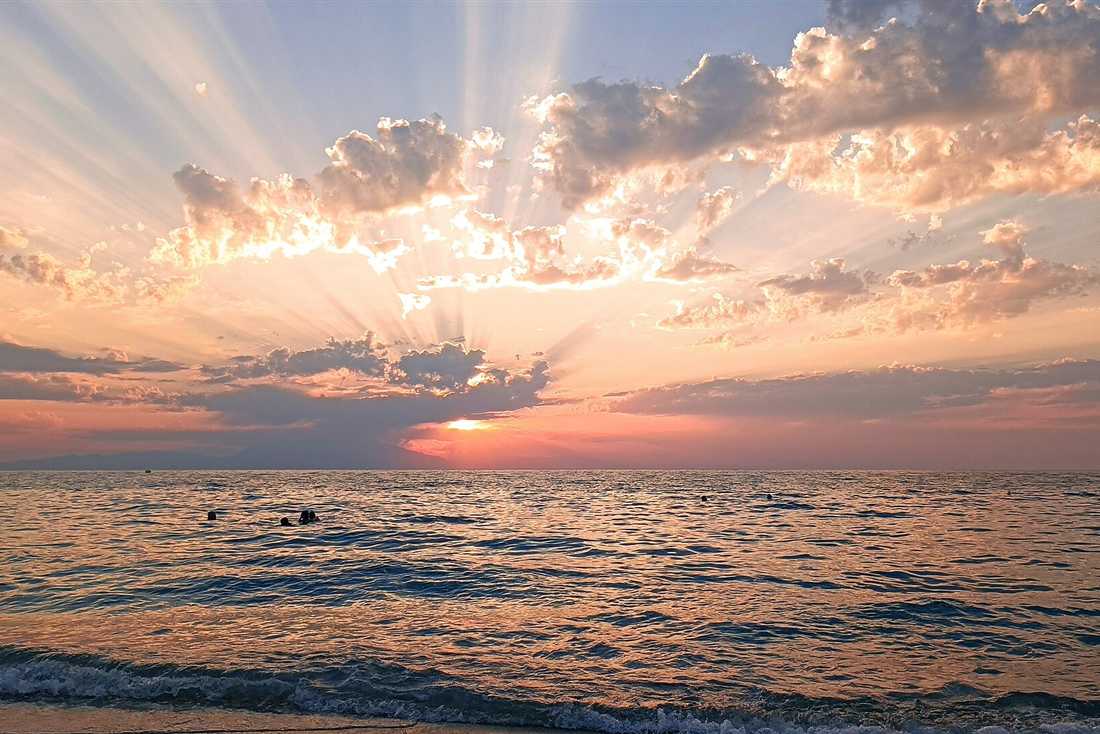
Kassandra is the western of the three Halkidiki peninsulas, a fifty-kilometre finger cut from the mainland by the canal at Nea Potidea, holding the stone village of Afytos, the resort strip at Kallithea, the sand spit at Possidi and a coastline of shallow bays an hour and a half from Thessaloniki. Plan the rest of the trip with Greece Tours.
This guide runs the peninsula end to end: the villages and what stands in each, the beaches on both coasts, the Petralona cave and the skull found in it, the thermal springs at Loutra, the jeep safari over the inland ridge, the boat tour out of Kallithea, the food, where to stay, the season and the roads. A Halkidiki jeep safari also crosses Sithonia on a private route.
What is Kassandra, and where does it sit within Halkidiki?
Kassandra is the westernmost of the three fingers of Halkidiki, a peninsula fifty kilometres long and fourteen kilometres across at its widest, running south from the Macedonian mainland with the Thermaic Gulf on its west coast and the Toroneos Gulf on its east.
Kassandra Halkidiki is the western of the three peninsulas that reach into the Aegean. The three fingers hang in parallel below the mainland. Kassandra is the first and the closest to Thessaloniki, Sithonia is the middle one, and the Athos peninsula is the eastern arm that ends at the monastic republic. That order matters to a traveller, because it fixes the driving time: the first finger is reached in under ninety minutes, while the third demands a long day of road.
Kassandra Halkidiki is the western of the three peninsulas that reach into the Aegean. The ancient name of the land was Pallene, and the classical geography still shows on the ground. Potidaea guarded the narrow neck, Mende and Skione held the southern shores, and the Macedonian king Cassander refounded the region under his own name after the classical cities fell. The modern peninsula carries that name into every road sign, every bus timetable and every hotel address.
Kassandra Halkidiki is the western of the three peninsulas that reach into the Aegean. Physically, Kassandra is a low spine of hills covered in pine and olive, with a coastal shelf on both flanks where the resorts sit. The interior rises to a ridge of about three hundred metres, enough to give sweeping views over both gulfs from a single viewpoint. The coastline alternates between long open sand and small rocky coves cut into soft sandstone cliffs. Anyone tracing kassandra halkidiki on a map sees a narrow leaf of land, no more than fifteen minutes wide by car at its middle point.
Kassandra Halkidiki is the western of the three peninsulas that reach into the Aegean. Administratively the peninsula forms the municipality of Kassandra, with the inland market town of Kassandreia as its seat. Roughly seventeen thousand permanent residents live here through winter, and the population multiplies through the warm months as hotels, campsites and rented apartments fill. That seasonal rhythm shapes everything from restaurant opening dates to the frequency of the buses.
How long is the drive from Thessaloniki, and what is the best way to get around the peninsula?
The drive from Thessaloniki to the canal at Nea Potidea covers about sixty-five kilometres and takes seventy minutes; Kallithea sits ninety kilometres out, roughly ninety minutes by car. Makedonia Airport lies on the same road and cuts twenty minutes from the journey.
The canal at Nea Potidea cuts Kassandra Halkidiki from the mainland. The route leaves Thessaloniki and its waterfront on the eastern ring road, passes the airport at Thermi, then follows the national road towards Nea Moudania. Traffic thins once the city is behind, and the last stretch is a fast two-lane highway through farmland. Friday evenings and Sunday returns in high season load this road with weekend traffic from the city, adding half an hour.
The canal at Nea Potidea cuts Kassandra Halkidiki from the mainland. KTEL Halkidiki runs scheduled coaches from its Thessaloniki terminal to every resort on the peninsula. Departures thicken through the warm months, with services down the east coast to Pefkochori and Paliouri and separate runs down the west coast through Nea Fokea, Afytos and Kallithea. Fares sit in the range of eight to twelve euros one way, and the coaches are air-conditioned.
The canal at Nea Potidea cuts Kassandra Halkidiki from the mainland. Car hire is the practical choice for anyone who wants Possidi at sunset and Afytos for dinner on the same day. Agencies operate at the airport and in the larger resorts, with small hatchbacks in the range of thirty-five to sixty euros a day in the peak weeks and considerably less in spring. The peninsula road network is a simple loop, so navigation stays easy.
The canal at Nea Potidea cuts Kassandra Halkidiki from the mainland. Inside the peninsula the roads are asphalt and well graded, with a coastal road on each flank and connecting spurs across the ridge. Parking is the real constraint: the beach roads at Kallithea and Chaniotis fill by eleven in the morning through the peak weeks. Taxis operate from every resort, and a Kallithea to Afytos hop runs in the range of ten to fifteen euros. Petrol stations line the main road at Kassandreia, Chaniotis and Nea Potidea, and the last one before the southern tip stands at Paliouri.
Why does a canal cut the peninsula at Nea Potidea?
A canal one thousand two hundred metres long slices the narrow isthmus at Nea Potidea, joining the Thermaic Gulf to the Toroneos Gulf and turning Kassandra into an island crossed by a single bridge. Its line follows a defensive ditch first dug in antiquity.
Afytos holds the stone houses that draw visitors across Kassandra Halkidiki. The neck of land here narrows to little more than a kilometre, and whoever held it controlled the whole peninsula. Corinthian colonists founded Potidaea on this pinch point, and the city walled the isthmus from gulf to gulf. The revolt of Potidaea against Athens, and the siege that followed, opened the chain of events that led into the Peloponnesian War.
Afytos holds the stone houses that draw visitors across Kassandra Halkidiki. Cassander refounded the settlement as Cassandreia, and later rulers cut and recut the ditch across the neck. The Byzantine and Ottoman periods left their own defensive lines on the same ground. The waterway visitors cross today was dug out and opened for navigation in the twentieth century, giving fishing boats a short cut between the two gulfs instead of the long haul around Cape Possidi.
Afytos holds the stone houses that draw visitors across Kassandra Halkidiki. The canal is worth a stop rather than a passing glance. A walkway runs along the northern bank, small craft moor against the stone quay, and the water changes colour where the two gulfs meet. Cafes and fish tavernas line the village side, and the bridge parapet gives the classic photograph of the cut with the sea at both ends.
Afytos holds the stone houses that draw visitors across Kassandra Halkidiki. Nea Potidea itself is a compact village with a long sandy beach on the Thermaic side and mussel rafts visible offshore. It works as the first stop of a driving day, since every road onto Kassandra crosses this bridge. The archaeological remains of the ancient walls lie beside the modern cut, marked and open to walk around. Cyclists use the flat coastal strip north of the bridge, and the village rents bicycles by the day for the run along the Thermaic shore.
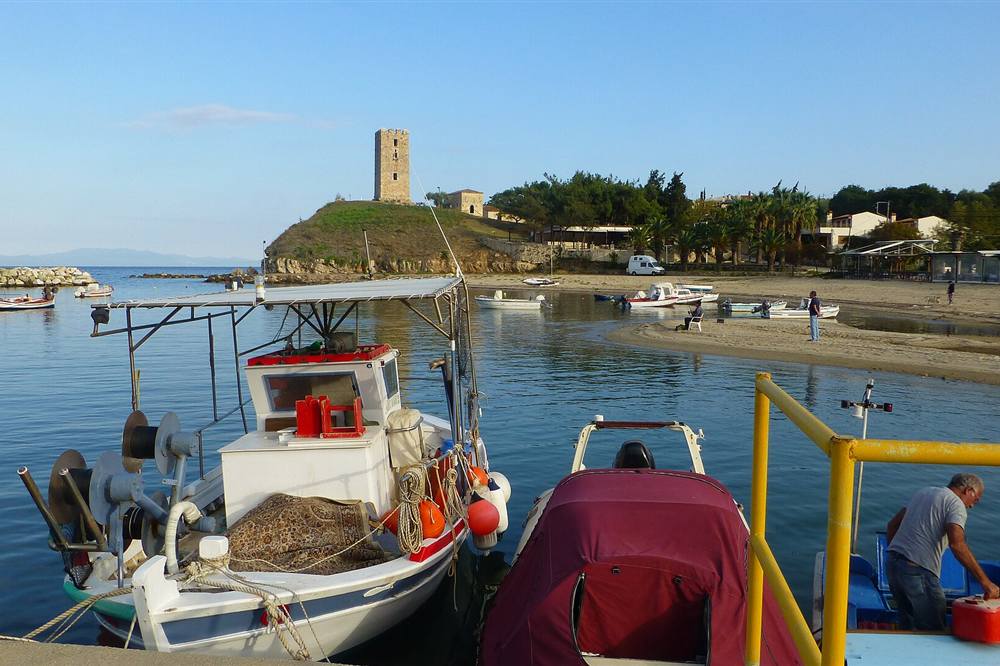
What makes Afytos and its stone houses the finest village on Kassandra?
Afytos stands on a sandstone terrace thirty metres above the Toroneos Gulf, built entirely in honey-coloured local stone under a preservation order. Its lanes, arcaded houses, cliff-edge squares and the church of Agios Dimitrios make it the architectural set piece of the peninsula.
Kallithea is the resort centre of Kassandra Halkidiki and its nightlife strip. The stone comes from the cliff the village sits on, quarried from the same terrace and cut into blocks that weather to a warm gold. A protection order forbids concrete facades and flat roofs, so the whole settlement keeps one material and one scale. Wooden balconies, arched doorways and slate paving finish the effect, and the older mansions carry carved lintels above their doors.
Kallithea is the resort centre of Kassandra Halkidiki and its nightlife strip. The village square opens straight onto the cliff edge, with a view across the gulf to the wooded flank of Sithonia. Cafes put their tables along the parapet, and the sunset light on the water pulls a crowd every evening. The church of Agios Dimitrios anchors the square, built in stone with a free-standing bell tower and a paved forecourt shaded by plane trees.
Kallithea is the resort centre of Kassandra Halkidiki and its nightlife strip. Below the terrace, a stepped path and a narrow road drop to Ai-Giannis beach, a strip of coarse sand and clear water backed by the cliff. Swimmers use the beach through the day and climb back for dinner. The Folklore Museum of Afytos, housed in a restored stone building, collects tools, textiles and household objects from the farming and fishing centuries.
Kallithea is the resort centre of Kassandra Halkidiki and its nightlife strip. Afytos is also the eating village of Kassandra. Tavernas along the cliff serve grilled fish, wild greens and local cheese, and the newer wine bars pour Macedonian bottles from Naoussa and Goumenissa. Dinner for two with wine lands in the range of forty to seventy euros. Evening parking is scarce, so the village rewards an early arrival on foot. The lower car park below the houses removes the problem entirely, and a paved ramp climbs from it to the main square in six minutes.
Why is Kallithea the resort centre of the peninsula?
Kallithea concentrates the peninsula’s hotels, bars, boat moorings and shops into one coastal grid on the eastern shore, twenty-two kilometres past the canal. It functions as the transport hub, the nightlife capital and the departure point for the private boat tours along the Kassandra coast.
Nea Fokea and its Byzantine tower stand at the north of Kassandra Halkidiki. The resort grew from a small settlement around the ancient sanctuary terrace into the densest tourist centre on the peninsula. Two parallel streets carry the shops, tavernas, bakeries, pharmacies and rental agencies, and the beach road behind them lines up sunbed operators one after another. Every service a visitor needs sits within a ten-minute walk of the main junction.
Nea Fokea and its Byzantine tower stand at the north of Kassandra Halkidiki. The beach runs for more than a kilometre in soft sand with a shallow entry, broken by rocky outcrops at the northern end. Organised sections rent two sunbeds and an umbrella in the range of ten to twenty euros a day, and free stretches survive at both ends. Water sports operators run jet skis, banana rides, paddle boards and parasailing from platforms on the sand.
Nea Fokea and its Byzantine tower stand at the north of Kassandra Halkidiki. Kallithea is the natural base for a first visit because the coach network converges here and taxis wait at the square through the night. Afytos lies eight kilometres north, Kryopigi four kilometres south, and the cross-peninsula road to the Thermaic side starts at the top of the village. A visitor without a car reaches most of Kassandra from this one point.
Nea Fokea and its Byzantine tower stand at the north of Kassandra Halkidiki. The harbour front at the southern edge holds the small craft that run coastal excursions and private charters. Fishing boats unload in the early morning at the same quay, and the fish tavernas beside it cook what comes off them. That mix of working port and resort strip gives Kallithea a rougher, livelier edge than the polished village squares further north. Supermarkets, a health point, bank machines and a petrol station keep the resort self-sufficient, which matters to families staying two weeks without a car.
What survives of the Sanctuary of Ammon Zeus?
The archaeological terrace at Kallithea preserves the foundations of a Doric temple of Ammon Zeus, an adjoining sanctuary of Dionysos with a spring cave, altars, retaining walls and a Hellenistic stoa, laid out on a seafront platform above the beach and open to visitors.
The sand spit at Possidi runs out from the west coast of Kassandra Halkidiki. Worship on this terrace began with a local cult of Dionysos beside a fresh-water spring in a rock cavity, and votive offerings from the archaic period were recovered around it. The Egyptian-Libyan god Ammon reached the site through trade with Cyrene and the oracle at Siwa, and the Greeks merged him with Zeus. The result is a temple to Zeus with a ram’s horns.
The sand spit at Possidi runs out from the west coast of Kassandra Halkidiki. The Doric temple itself was raised in the fourth century before the common era on a stone platform measuring roughly thirty by seventeen metres. Excavation exposed the stylobate, column drums, sections of the entablature and the sacrificial altar in front of the east face. Marble architectural fragments and inscriptions from the site are held in the archaeological collections of Polygyros and Thessaloniki.
The sand spit at Possidi runs out from the west coast of Kassandra Halkidiki. The whole complex sits inside a fenced archaeological park with raised walkways, interpretive panels in Greek and English, and a route that ends at the cliff edge above the sea. Admission runs in the range of two to six euros, and the visit takes forty minutes at a slow pace. Morning light suits the photographs, and shade on the terrace is thin.
The sand spit at Possidi runs out from the west coast of Kassandra Halkidiki. What makes the place unusual is its position inside a modern resort. The temple platform stands two hundred metres from the beach bars, so a visitor swims, walks up a lane and stands on a fourth-century sanctuary floor within a quarter of an hour. Guided tours of the peninsula build the stop into the middle of a beach day. Ram-horned coin types and votive offerings from the cult travelled across the Aegean, and the pairing of an Egyptian oracle god with a Macedonian beach resort is the detail visitors remember.
What stands at Nea Fokea beyond its Byzantine tower?
Nea Fokea keeps a fifteenth-century stone tower on the headland above its fishing harbour, built by the Athonite monastery of Agios Pavlos, and beneath it the rock-cut crypt and holy spring associated with the apostle Paul’s passage through Kassandra.
Sani and its marina sit among the pine forest of Kassandra Halkidiki. The tower rises seventeen metres in four storeys of rough masonry, with a vaulted ground floor and a restored timber gallery near the crown. Monastic estates across Halkidiki were fortified this way against pirate raids: grain, oil and wine went into the base, and the community climbed inside when sails appeared. Restoration opened the interior and the roof terrace for the view.
Sani and its marina sit among the pine forest of Kassandra Halkidiki. The crypt below is reached by a stepped tunnel cut into the sandstone, ending in a small chamber with a spring. Tradition holds that Paul preached at Kassandreia and hid here from pursuers before crossing to Sithonia. Pilgrims fill bottles at the spring through the year, and the chapel above it holds services on the apostle’s feast day.
Sani and its marina sit among the pine forest of Kassandra Halkidiki. The village itself is a working fishing port with a compact harbour, a short beach on each side and a line of tavernas facing the water. Caiques land octopus, sardines and gilt-head bream in the early hours, and grilled fish plates run in the range of twelve to twenty-two euros. The pace stays slower than Kallithea even in the busiest weeks.
Sani and its marina sit among the pine forest of Kassandra Halkidiki. Nea Fokea sits eight kilometres past the canal on the west coast road, which makes it the first proper stop after the bridge. The headland lawn around the tower is a picnic spot with a clear view north across the Thermaic Gulf towards Mount Olympus, visible in profile on clear days across seventy kilometres of open water. Caiques from the harbour run short dawn fishing trips, and the village keeps its festival on the feast of the apostle, with the tower floodlit above the water.
What does Sani hold behind its marina and pine forest?
Sani combines a full-service marina, a protected wetland, a pine and olive forest, a Byzantine watchtower on the cape, and a stretch of white sand that reaches seven kilometres, all on the western shore where Kassandra meets the Thermaic Gulf.
Pefkochori and Chaniotis line the east coast of Kassandra Halkidiki. The marina holds more than two hundred berths with pontoons for craft up to forty metres, fuel, water, power and a customs point. Its quayside gallery of boutiques and restaurants runs late through the warm months, and the sunset view across the water to Olympus is the reason the tables are booked out. A Halkidiki yacht charter starts from these pontoons for crews heading down to Sithonia.
Pefkochori and Chaniotis line the east coast of Kassandra Halkidiki. Behind the beach lies the Sani wetland, a shallow lagoon and reed system that is a registered stopover on the migration corridor between Africa and central Europe. Flamingos, herons, egrets and terns feed in the brackish water, and a boardwalk with hides lets walkers watch without disturbing the birds. The surrounding forest of stone pine covers about a thousand hectares.
Pefkochori and Chaniotis line the east coast of Kassandra Halkidiki. Sani Cape carries a ruined Byzantine tower on a low bluff above the sea, the same monastic fortification pattern found at Nea Fokea. Paths from the marina reach it in twenty minutes on foot through the pines. The Sani Festival stages concerts on the hill through July and August, with the stage set against the water and the tower lit behind the performers.
Pefkochori and Chaniotis line the east coast of Kassandra Halkidiki. The beaches here are the widest on the peninsula, with fine pale sand shelving gently into calm water. Bousoulas and Sani Beach carry organised sections attached to the resort hotels, while the northern end towards the wetland stays open and quiet. Sunbed and umbrella sets in the organised zones run in the range of fifteen to thirty euros a day. Runners and cyclists use the forest tracks behind the dunes at first light, and the pine canopy holds the temperature down until late morning.
Which resorts fit which traveller, and where do visitors stay across Kassandra?
Pefkochori suits nightlife and long sand, Chaniotis suits families with its shallow bay and pedestrian centre, Polychrono suits budget travellers, Kryopigi suits hillside views, Sani suits luxury, and Afytos suits couples who want stone lanes and dinner over the water.
The Petralona cave lies on the neck of land above Kassandra Halkidiki. Pefkochori anchors the southern end of the east coast with a two-kilometre beach, a dense bar strip and the largest concentration of apartments on the peninsula. Rooms run in the range of forty to ninety euros a night in the quieter weeks and climb steeply through August. Ferries and excursion boats leave from its small harbour for coastal trips.
The Petralona cave lies on the neck of land above Kassandra Halkidiki. Chaniotis, five kilometres north, is the family choice: a broad sheltered bay with a gradual sand shelf, a pedestrianised main street of shops and creperies, and a promenade that runs the length of the beach. Polychrono, between the two, keeps prices lower with studios and campsites set back from a sand-and-shingle beach and a small freshwater lake behind it.
The Petralona cave lies on the neck of land above Kassandra Halkidiki. On the higher ground, Kryopigi holds an old village core on the slope above its beach, with tavernas looking down the coast towards Sithonia. Nea Skioni and Kalandra on the western shore stay quiet and rural, with fishing harbours and small hotels. Paliouri sits at the southern tip, close to Glarokavos and Chrousso, and draws returning visitors rather than first-timers.
The Petralona cave lies on the neck of land above Kassandra Halkidiki. Accommodation across the peninsula splits into three bands. Five-star resorts at Sani, Kallithea and Paliouri run all-inclusive plans in the range of two hundred and fifty to eight hundred euros a night for two. Mid-range hotels sit at eighty to one hundred and sixty euros. Studios and apartments in the resorts start near thirty-five euros outside the peak fortnight. Campsites at Polychrono, Paliouri and Nea Potidea complete the range, with pitches under the pines charged by tent and vehicle rather than by head.
What is the sand spit and lighthouse at Possidi?
Cape Possidi ends in a natural sand spit that reaches almost a kilometre into the Thermaic Gulf, a strip of pale sand with shallow water on both flanks and a working lighthouse at its landward base, marking the western tip of Kassandra.
Thermal springs at Loutra bubble on the western shore of Kassandra Halkidiki. The spit is built by currents that meet at the cape and drop their load of sand in a long tongue. Walkers follow it out until the land narrows to a few metres, with the sea on the left and the sea on the right, then swim off either side into water that stays waist-deep for a long way. The formation shifts shape after winter storms.
Thermal springs at Loutra bubble on the western shore of Kassandra Halkidiki. The lighthouse dates from the late nineteenth century and still guides shipping into the Thermaic Gulf towards Thessaloniki. It stands white and squat on the low headland, surrounded by scrub and a gravel track, with an outbuilding once used by the keeper. The setting is bare and open, which is precisely why photographers arrive at the end of the afternoon.
Thermal springs at Loutra bubble on the western shore of Kassandra Halkidiki. Ancient Mende, one of the classical cities of Pallene and the source of a wine praised across the Greek world, lay just north of the cape near Kalandra. Excavated cemeteries and the acropolis site sit near the shoreline, marked but undeveloped. The wine of Mende travelled in stamped amphorae, examples of which are displayed in the archaeological museums of the region.
Thermal springs at Loutra bubble on the western shore of Kassandra Halkidiki. Practically, Possidi is a thirty-minute drive across the peninsula from Kallithea on the road through Kassandreia and Kalandra. A car park sits behind the beach, a canteen sells cold drinks, and sunbeds occupy the central section while both ends stay free. Sunset here faces Mount Olympus across the gulf, and the light show lasts a full hour. Wind out of the north builds across the open gulf in the afternoon, which turns the western flank of the spit into a kitesurfing strip while the eastern flank stays flat.
Which beaches run the strip from Kallithea down to Kryopigi?
The eastern shore between Kallithea and Kryopigi strings together five swimmable stretches in eight kilometres: Kallithea main beach, the rocky coves below the sanctuary, Kanistro, Kryopigi beach and the pocket bays at Vergia, all facing the Toroneos Gulf and Sithonia.
A jeep safari crosses the inland ridge and the olive country of Kassandra Halkidiki. Kallithea main beach opens the run with a wide band of soft sand and the fullest set of services on the peninsula: showers, changing cabins, beach bars with music from midday, and water-sports platforms. The seabed shelves slowly for thirty metres, which suits weak swimmers. Crowds thicken from eleven onwards, and the far southern end holds the calmest ground.
A jeep safari crosses the inland ridge and the olive country of Kassandra Halkidiki. South of the sanctuary terrace the coast breaks into low sandstone shelves and small coves reached by steps from the coast road. Snorkelling is better here than on the open sand, with rock ledges, sea grass and small fish close in. Divers head for the deeper reefs and wrecks along this coast, and operators offering scuba diving in Halkidiki run boats from the harbours.
A jeep safari crosses the inland ridge and the olive country of Kassandra Halkidiki. Kanistro and the beaches immediately north of Kryopigi carry organised sections attached to hillside hotels, with sun loungers on terraced platforms and a shallow entry over firm sand. Kryopigi beach itself runs long and straight below the village, with a paved promenade, a run of tavernas and enough width to keep the towels apart even in the peak fortnight.
A jeep safari crosses the inland ridge and the olive country of Kassandra Halkidiki. Water quality along this whole stretch holds blue-flag standard, and the Toroneos Gulf stays warmer and calmer than the Thermaic side because the shore faces away from the prevailing summer wind. The sea reaches twenty-four degrees by mid-June and holds twenty-five to twenty-seven degrees through August and into the first half of September. Blue-flag boards at the entrances carry the water-quality results, and lifeguard towers work the organised sections at Kallithea and Kryopigi through July and August.
What do families find in the shallow bays and at the Glarokavos lagoon?
Glarokavos is a shallow lagoon near Paliouri, joined to the sea by a narrow channel, with warm knee-deep water inside the sandbar, a small marina and a beach that suits toddlers. Chaniotis, Sani and Nea Potidea offer the same gradual entry on open sand.
A private boat out of Kallithea shows the coast of Kassandra Halkidiki from the water. The lagoon works because the sandbar shelters it from swell entirely. Inside the bar the water warms faster than the open gulf and stays flat through the afternoon breeze, so small children paddle without waves. Outside the bar the beach faces the Toroneos Gulf with clean sand and deeper water for adults, which puts both needs within thirty metres of each other.
A private boat out of Kallithea shows the coast of Kassandra Halkidiki from the water. A marina occupies the inner end of the lagoon, with pontoons for small craft, a fuel point and a taverna over the water. Boats leave the channel in single file, which is a spectacle in itself for children. Pedal boats and canoes are rented on the beach in the range of ten to twenty euros an hour.
A private boat out of Kallithea shows the coast of Kassandra Halkidiki from the water. Chaniotis remains the family capital of the peninsula. Its bay curves inward, the shelf stays waist-deep for forty metres, lifeguards work the central section, and the pedestrian main street sits one block behind the sand so an evening walk needs no road crossing. Playgrounds, pharmacies and supermarkets are within the same grid, and rooms with kitchens are standard.
A private boat out of Kallithea shows the coast of Kassandra Halkidiki from the water. Beyond the beaches, families use the water park near Nea Potidea, the mini-golf courses at Pefkochori and Chaniotis, and the horse-riding centres inland at Kassandreia. Boat trips that stay inside the gulf run one to three hours and take pushchairs aboard. Restaurants keep highchairs, and kitchens serve dinner from seven, earlier than in most Greek resorts. Pharmacies stock baby supplies, supermarkets carry formula and nappies, and the health centre at Kassandreia sits within twenty-five minutes of every east-coast resort.
Where are the thermal springs at Loutra, and what water rises there?
Loutra sits on the western coast near Agia Paraskevi, thirty-five kilometres from the canal, where sulphur-bearing thermal water rises at close to forty degrees. A spa complex channels it into baths and pools, and the village keeps a small harbour and beach beside it.
Thessaloniki sits an hour and a half by road from Kassandra Halkidiki. The springs surface at the foot of a low bluff a short walk from the sea. Water emerges hot, mineral-heavy and carrying the characteristic sulphur smell, and analyses register calcium, magnesium, chloride and sulphate compounds. The flow is constant through the year, and the temperature at source holds steady regardless of season, which allows the baths to run from spring into late autumn.
Thessaloniki sits an hour and a half by road from Kassandra Halkidiki. The thermal centre of Agia Paraskevi organises the flow into individual bath chambers, a hydrotherapy hall and an outdoor pool. Treatment courses are prescribed for rheumatic complaints, arthritic joints, skin conditions and gynaecological therapy, and a resident doctor supervises admissions. A single bath session runs in the range of six to fifteen euros, with course packages priced lower per visit.
Thessaloniki sits an hour and a half by road from Kassandra Halkidiki. Below the spa, the coast at Loutra holds a pebble beach, a small fishing harbour and a handful of tavernas that cook what the boats bring in. Bathers alternate between the hot water of the baths and the cold water of the gulf, which is the traditional pattern here. The setting is unpolished and rural compared with the east-coast resorts.
Thessaloniki sits an hour and a half by road from Kassandra Halkidiki. The road to Loutra runs through the inland villages of Kassandreia and Agia Paraskevi, past olive terraces and beehives, and the drive from Kallithea takes forty minutes. Visitors staying on the east coast pair the springs with Possidi and Nea Skioni in one western loop, returning across the ridge in the evening light. Bathers reserve a session by telephone through July and August, when residents from Thessaloniki fill the treatment slots alongside visitors from the coastal resorts.
What makes Petralona Cave and its archaic skull a landmark of prehistory?
Petralona Cave, on the slope of Mount Katsika above Petralona village in northern Halkidiki, produced a fossilised hominid skull embedded in the cave wall, the oldest human fossil found in Greece, alongside stalactite chambers extending over a kilometre underground.
Where to buy entry, who enters free and which day trips include the guided cave visit are set out on the Petralona Cave tickets page.
Shallow bays make Kassandra Halkidiki an easy coast for families. Villagers searching for a spring broke into the cave in the twentieth century and found chambers hung with stalactites, stalagmites, columns and curtains of calcite in red, ochre and cream. Excavation followed, and the fossil-bearing deposits gave animal bones by the thousand: cave bears, hyenas, lions, rhinoceros, deer and rodents, mapping the fauna of a Europe with a different climate.
Shallow bays make Kassandra Halkidiki an easy coast for families. The skull itself was found cemented into the cave wall, coated in calcite. Researchers classified it as Homo heidelbergensis, with the Greek literature using the name Archanthropus europaeus petraloniensis. Dating estimates run between two hundred thousand and seven hundred thousand years before the present, and the disagreement over that range is itself part of the site’s fame in palaeoanthropology.
Shallow bays make Kassandra Halkidiki an easy coast for families. Traces of fire, worked stone and butchered bone were recorded in the deposits, which is why the cave features in every argument about the earliest human presence in Europe. The original skull is held in Thessaloniki; a cast is displayed at the site. The anthropological museum beside the cave entrance sets out the finds, the stratigraphy and the reconstruction of the hominid.
Shallow bays make Kassandra Halkidiki an easy coast for families. A concreted walkway carries visitors through the illuminated chambers on a route of about two hundred metres, with the temperature holding near seventeen degrees all year and the air humid. Entry to the cave and museum runs in the range of eight to fifteen euros. The site lies fifty kilometres from Thessaloniki and forty from the Kassandra canal. Photography inside the chambers is restricted, the guided route follows a fixed timetable through the day, and the last admission falls an hour before closing.
What does the Petralona Cave, Afytos and Kassandra trip cover in a day?
The Chalkidiki Petralona Cave, Afytos and Kassandra trip pairs the prehistoric cave and its museum with the stone village of Afytos and the coast of Kassandra in one guided day, combining the region’s deepest history with its best-preserved architecture.
August fills every beach bar and taverna across Kassandra Halkidiki. The day starts inland at Petralona, where the guided walk through the illuminated chambers explains the calcite formations, the excavation layers and the position in which the skull was found. The museum visit follows with the fauna collection and the reconstruction. Sturdy shoes matter on the damp walkway, and a light layer is welcome in the cool underground air.
August fills every beach bar and taverna across Kassandra Halkidiki. The route then drops south across the isthmus, crossing the canal at Nea Potidea, and climbs the west-coast road to Afytos. Free time in the village covers the square, the cliff parapet, the church of Agios Dimitrios and the stone lanes, with a stop for coffee or lunch on a terrace above the Toroneos Gulf.
August fills every beach bar and taverna across Kassandra Halkidiki. The Kassandra portion of the itinerary adds a coastal drive with photo stops, and the beach time or sanctuary visit at Kallithea depending on the operator and the season. Groups that book the full-day version get a swim stop built into the afternoon, so a towel and swimwear belong in the bag alongside a hat and water.
August fills every beach bar and taverna across Kassandra Halkidiki. Pricing for the combined day sits in the range of seventy to one hundred and forty euros per person on a joining basis, with cave and museum admission charged separately in most listings. Hotel pickup is offered from Kassandra resorts and from Thessaloniki. The trip runs seven to nine hours door to door, and the guiding is in English. The pairing works because the cave answers the history question while kassandra halkidiki answers the beach one, so one day covers both halves of a Halkidiki holiday.
What does the Kassandra beaches private tour from Thessaloniki include?
The From Thessaloniki: Halkidiki Kassandra Beaches Private Tour is a chauffeured private day out of the city with a driver-guide, an air-conditioned vehicle and an itinerary of the peninsula’s best swimming stops, shaped around the group rather than a fixed coach route.
June and September give Kassandra Halkidiki warm water and space on the sand. Pickup is from a Thessaloniki hotel, apartment, cruise berth or the airport, and the vehicle runs south past Thermi to the canal. The guide sets the running order on the day: Sani and Possidi for wide pale sand and shallow water, Kallithea and Chaniotis for organised beaches with services, Afytos for the stone village and the cliff-top lunch.
June and September give Kassandra Halkidiki warm water and space on the sand. Because the vehicle is private, the stops flex. A family with small children stays longer at one shallow bay; a couple chasing photographs takes the cross-peninsula road for the ridge views and finishes at the Possidi spit for sunset. Swimming time is real time in the water, not a fifteen-minute coach halt, and the towels stay in the boot between stops.
June and September give Kassandra Halkidiki warm water and space on the sand. The format also solves the return. Nobody drives after a long lunch with wine, and the car handles the peak-season parking problem at Kallithea and Chaniotis by dropping passengers at the sand. Travellers comparing formats read the wider Halkidiki day trip from Thessaloniki options before choosing the private beach version.
June and September give Kassandra Halkidiki warm water and space on the sand. Private rates are quoted per vehicle rather than per head, in the range of three hundred and fifty to seven hundred euros for a car or minivan carrying up to seven passengers for a full day of eight to ten hours. Fuel, tolls and parking are included in the quoted rate; beach sunbeds, entrance fees and lunch are paid on the day. Booking ahead matters in July and August, when cruise arrivals in Thessaloniki absorb the private vehicles in the city on the same mornings.
What coast does the private boat tour out of Kallithea show?
The Transportation and Private Boat Tour in Kallithea puts a group on a private boat from the Kallithea moorings with hotel transfers included, cruising the eastern shore of Kassandra past the sanctuary cliffs, the sea caves and the coves between Kryopigi and Chaniotis with swim stops in open water.
Mussels, honey and olive oil are what the tables of Kassandra Halkidiki serve. The transfer element is the practical hook: the operator collects passengers from resorts along the peninsula and returns them afterwards, so nobody drives to the harbour or hunts for parking in Kallithea at the height of the season. Boarding is at the small quay at the southern edge of the resort, beside the fishing craft.
Mussels, honey and olive oil are what the tables of Kassandra Halkidiki serve. The route hugs a coastline that is invisible from the road. Sandstone cliffs run gold above the waterline, wind and waves have cut shallow caves and arches into the softer bands, and small beaches without any land access open between the headlands. The captain anchors off these for swimming and snorkelling, where the water runs eight to twelve metres deep and clear.
Mussels, honey and olive oil are what the tables of Kassandra Halkidiki serve. Private hire means the boat carries one group alone, so the timing bends around the passengers: a sunset run with the light on the cliffs, a morning cruise before the wind builds, or a long afternoon with three swim stops. Drinks and snorkelling gear come aboard, and a shaded section covers part of the deck.
Mussels, honey and olive oil are what the tables of Kassandra Halkidiki serve. Rates run in the range of three hundred to nine hundred euros for the boat, depending on duration, craft size and season, which divides well across a family or two couples. Longer cruises that cross the gulfs towards the Blue Lagoon, Ammouliani and the Athos coastline sit in a separate category of Halkidiki boat tours with their own itineraries. Life jackets are carried for every passenger, small children ride free on most listings, and the captain reschedules when the afternoon wind passes a set force.
Where does the 4×4 jeep safari run over the ridge and the olive country?
The Halkidiki Kassandra 4×4 Jeep Safari Off-Road Experience leaves the coast road for the dirt tracks over the central ridge, crossing pine forest, olive terraces and inland villages to reach viewpoints that show both gulfs at once, with a swim stop on a beach reached only by track.
Hire cars open the back roads and the small coves of Kassandra Halkidiki. The interior of Kassandra is unfamiliar ground to most visitors, who never leave the two coastal roads. The ridge behind Kallithea and Kryopigi carries a network of forestry and farm tracks through stone pine, kermes oak and olive groves. From the crest the land drops both ways, and the Thermaic Gulf and the Toroneos Gulf appear on either side of the same frame.
Hire cars open the back roads and the small coves of Kassandra Halkidiki. The route takes in working country rather than resort scenery: beehives stacked under the pines that make the region’s pine honey, olive terraces of the Halkidiki variety with its large green fruit, and hillside chapels at track junctions. Inland villages such as Kassandreia and Agia Paraskevi supply the coffee stop, where the tables belong to farmers rather than tourists.
Hire cars open the back roads and the small coves of Kassandra Halkidiki. Vehicles are open-top or soft-top four-wheel drives, driven by the guide in a convoy of two to five cars with a briefing before departure. Passengers sit high with clear sightlines, the tracks are dusty and stony, and the ride is deliberately bumpy on the descents. Sunglasses, a hat, closed shoes and a bandana for the dust are the sensible kit.
Hire cars open the back roads and the small coves of Kassandra Halkidiki. Half-day departures run four to five hours and full-day versions seven to eight, with the longer format adding a beach stop and a taverna lunch. Per-person rates sit in the range of sixty to one hundred and thirty euros, hotel pickup included from the Kassandra resorts. Children ride with an accompanying adult, and the convoy carries water aboard. Departures leave in the morning to keep the exposed ridge out of the afternoon heat, and the tracks stay driveable from April into October outside heavy rain.
On two wheels, a Halkidiki e-bike tour rides pedal-assist bikes along the forest tracks and coastal roads of Kassandra at sunset or in the south of the peninsula.
Where do the beach clubs and the nightlife strip run?
Kassandra’s nightlife concentrates in three places: the beach-club belt around Kallithea and Kryopigi, the bar strip of Pefkochori, and the late-night clubs of the Kalithea to Chaniotis coast road, with music running from afternoon sunbeds into the early hours.
The sanctuary of Ammon Zeus stands above the shore at Kallithea. The sanctuary of Ammon Zeus stands above the shore at Kallithea. Beach clubs on this coast run a full day rather than an evening. Sunbeds and day beds are laid out on the sand from morning, a kitchen serves through lunch, the music builds from mid-afternoon, and the sunset set turns the venue into a bar with the loungers still occupied. Minimum spend for a front-row bed sits in the range of twenty to sixty euros.
The sanctuary of Ammon Zeus stands above the shore at Kallithea. The sanctuary of Ammon Zeus stands above the shore at Kallithea. Kallithea holds the densest cluster: open-air bars on the beach road, cocktail terraces above the sand, and clubs that open at midnight and close at sunrise. Greek music venues and international dance floors sit within the same few streets, so groups split and regroup without a taxi. Cocktails run in the range of eight to fourteen euros.
The sanctuary of Ammon Zeus stands above the shore at Kallithea. The sanctuary of Ammon Zeus stands above the shore at Kallithea. Pefkochori runs a longer, looser strip along its main street and harbour front, with a stronger family presence early and a younger crowd after midnight. Chaniotis keeps its centre calm and pedestrian, with cafes and creperies rather than clubs, which is why families base themselves there and drive fifteen minutes north for a night out.
The sanctuary of Ammon Zeus stands above the shore at Kallithea. The season for the big venues is tight. The clubs open in June, run at full volume through July and August, and wind down through the first half of September. Outside those weeks, evenings on the peninsula belong to the tavernas and the cliff-top cafes of Afytos, which stay open into the autumn weekends. Taxis queue at the Kallithea square until dawn through the peak weeks, and the fare back to Chaniotis or Kryopigi sits in the range of twelve to twenty euros.
What food defines Kassandra — the mussels, the honey and the olive oil?
Four products define the table here: mussels farmed on ropes in the Thermaic Gulf, pine honey from the forests of the peninsula, the large green Halkidiki olive with its stone-milled oil, and the day boat fish landed at Nea Fokea, Possidi and Glarokavos.
Sunset at Possidi is the picture that closes a day on Kassandra Halkidiki. The mussel rafts off Nea Potidea and the inner Thermaic Gulf make this the largest producing area in the country. Kitchens serve them steamed with wine and garlic, baked with feta and peppers under the name saganaki, and fried in a light batter. A plate runs in the range of eight to fourteen euros and arrives with bread for the sauce.
Sunset at Possidi is the picture that closes a day on Kassandra Halkidiki. Halkidiki pine honey comes from the resin-feeding insects of the stone pine forest rather than from flowers, giving a dark, resinous, less sugary honey that keeps its liquid state. Producers sell it at roadside stalls and village shops in half-kilo and kilo jars, in the range of eight to eighteen euros, alongside thyme honey from the drier southern slopes.
Sunset at Possidi is the picture that closes a day on Kassandra Halkidiki. The Halkidiki olive is the large green table variety exported worldwide, and the groves inland from Kassandreia and Agia Paraskevi supply both the brine tables and the mills. Extra virgin oil from the local presses is grassy and peppery, sold in tins at eight to fifteen euros a litre direct from the producer.
Sunset at Possidi is the picture that closes a day on Kassandra Halkidiki. Beyond those staples, the tavernas hold a Macedonian rather than an island register: grilled sardines and anchovies in the fishing villages, gilt-head bream and sea bass by weight, wild greens with lemon, tomato fritters, aubergine dishes, and the smoked pork and peppers of the mainland kitchen. Wine lists lead with Naoussa xinomavro and the whites of Epanomi. Bakeries sell bougatsa and tsoureki from early morning, and the street markets at Kassandreia and Nea Moudania set out fruit, cheese, olives and honey once a week.
When does the season peak, and how quiet are the months on either side?
Kassandra fills from late June, peaks in the first three weeks of August when Greek holidaymakers arrive alongside international visitors, and empties fast after the first week of September. June and the second half of September deliver warm sea, open tavernas and thin crowds.
Sithonia lies east across the gulf from Kassandra Halkidiki. Sea temperature governs the calendar. The water reaches twenty-two degrees by early June, twenty-five to twenty-seven degrees through August, and holds near twenty-four degrees into early October. Air temperatures run to thirty-two or thirty-four degrees in the peak weeks, cooled on the east coast by an afternoon breeze off the Toroneos Gulf.
Sithonia lies east across the gulf from Kassandra Halkidiki. The middle fortnight of August is the compressed peak. Hotel rates double against June, beach parking fills before eleven, restaurant tables need booking, and the coast road between Kallithea and Pefkochori slows to a crawl at nine in the evening. Anyone who dislikes crowds avoids those two weeks and loses nothing in weather.
Sithonia lies east across the gulf from Kassandra Halkidiki. June rewards early travellers with hot sun, green hillsides that have not yet burned dry, full taverna service and beach prices at the lower end of every range. The second half of September repeats the trick from the other direction: the sea is at its warmest of the whole year, the clubs have closed, and hotel rates fall by a third.
Sithonia lies east across the gulf from Kassandra Halkidiki. Winter shuts the peninsula down. Resort hotels close from late October to April, most beach tavernas board up, and the villages return to their permanent residents. The exceptions are Kassandreia, Nea Potidea and Afytos, which keep cafes and kitchens open year-round for locals and for weekend traffic from Thessaloniki. Beach bars dismantle their decks in October, the sunbed lines vanish from the sand, and the coast returns to walkers, fishermen and the winter light on empty water.
How does Kassandra compare with Sithonia and the Athos side for a first visit?
Kassandra wins a first visit on access and services: it lies closest to Thessaloniki, carries the fullest hotel, restaurant and transport network, and reaches its own beaches on a simple loop road. Sithonia trades services for wilder coves; the Athos side trades both for pilgrimage and remoteness.
Resorts and rooms run the length of Kassandra Halkidiki on both coasts. Sithonia, the middle finger, has a jagged coast of pine-backed coves, the sailing centre of Porto Koufo and the resort of Neos Marmaras, but its perimeter road is longer, slower and more winding. Distances between beaches stretch, services thin outside the main villages, and a car becomes mandatory. It suits a second visit or a driving holiday.
Resorts and rooms run the length of Kassandra Halkidiki on both coasts. The Athos peninsula holds Ouranoupoli, Ammouliani island and the coastal boat routes below the monastic republic, where entry on land is restricted to male pilgrims holding a permit. The drive from Thessaloniki runs two and a half hours. That side rewards travellers interested in Byzantine architecture and boat cruises rather than in beach infrastructure.
Resorts and rooms run the length of Kassandra Halkidiki on both coasts. Practically, Kassandra concentrates the useful things: a hospital and clinics at Kassandreia, banks and pharmacies in every resort, coach connections to the city five times daily, car hire desks in the villages, and organised beaches with lifeguards and services. A traveller without a car functions here, which is not true of Sithonia’s southern coast.
Resorts and rooms run the length of Kassandra Halkidiki on both coasts. The sensible pattern for a first week is Kassandra as the base with a day out to the other fingers: the drive across to Sithonia for the viewpoints above Porto Koufo, or a boat day from Ormos Panagias along the Athos coast. That way the peninsula’s own villages, beaches, jeep tracks and the cave inland fill the week, and the neighbours are seen without moving hotels. That is the case for kassandra halkidiki as a first base: the shortest transfer from the airport, the widest choice of rooms, and every other corner of the region inside a day trip.
Frequently Asked Questions
How far is Kassandra from Thessaloniki?
The canal at Nea Potidea sits about eighty kilometres from the city, an hour and a quarter by road. Kallithea in the middle of the peninsula takes an hour and a half, and Possidi at the tip about two hours.
Which village on Kassandra suits a first visit?
Afytos for the stone houses and the cliff-top tavernas, Kallithea for the resorts and the nightlife, Sani for the marina and the forest, and Pefkochori for a quieter beach base on the east coast.
What is the Petralona cave?
A limestone cave on the neck of the peninsula where an archaic human skull was found embedded in the wall. The chambers hold stalactites and a walkway, and the site sits half an hour from the Kassandra coast.