
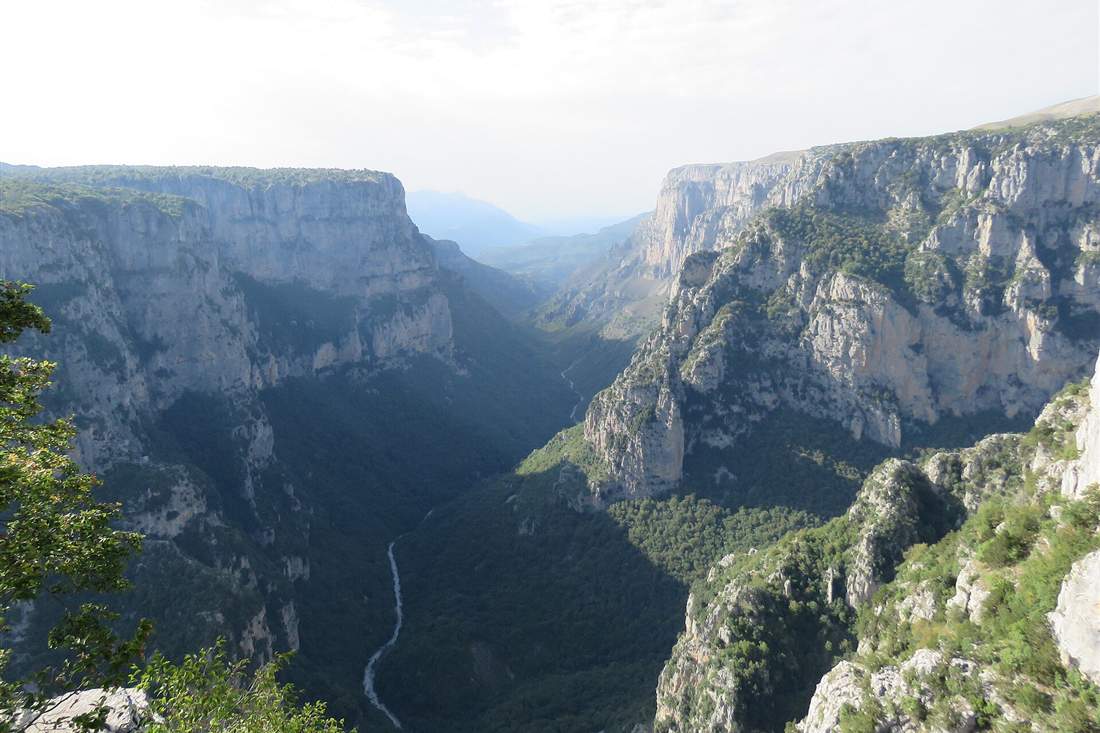
The Vikos gorge hike runs from Monodendri down to the springs at Vikos village, twelve kilometres through the deepest gorge in the world by depth-to-width ratio, a descent of seven hundred metres and a climb back out that takes six to seven hours. Plan the rest of the trip with Greece Tours.
This guide covers the whole walk: the classic traverse and the easier Kleidonia start, the trail surface and the river crossings, the Beloi and Oxya viewpoints on the rim, the Dragon Lake of Mount Tymfi above Papingo, the Astraka refuge, the stone bridges of Zagori, the villages to base in, the season, what to carry, and the guided prices.
What is the Vikos Gorge and what record does it hold?
The Vikos Gorge cuts through Mount Tymfi in Epirus, falling nine hundred metres from rim to riverbed while the walls close to four hundred metres apart. Guinness lists it as the deepest gorge on earth measured against its own width.
A Vikos gorge hike drops seven hundred metres to the riverbed in the first hour. The gorge runs twenty kilometres from Monodendri in the south to the village of Vikos in the north, carved by the Voidomatis river through limestone laid down under an ancient sea. The Vikos-Aoos National Park protects the whole basin, and the walls carry beech, black pine and Balkan maple in bands that change with altitude.
The O3 waymarks run the length of a Vikos gorge hike. Brown bears, wild boar and chamois live on the slopes above the path. Golden eagles and Egyptian vultures ride the thermals against the cliff faces through the middle of the day, and walkers on the floor hear the birds calling before they see them.
Dragon Lake on Mount Tymfi is the alpine alternative to a Vikos gorge hike. Forty-six villages sit on the plateau around the gorge, linked by mule paths, arched stone bridges and cobbled kalderimia built by masons from Konitsa. That surviving network is the reason a vikos gorge hike works as a walking holiday rather than as one isolated trail.
What does the classic Monodendri to Vikos village traverse involve?
The classic traverse runs twelve kilometres from Monodendri to Vikos village. The path drops five hundred metres to the gorge floor, follows the riverbed north for eight kilometres, then climbs four hundred metres out. Walking time runs six to seven hours.
The classic Vikos gorge hike covers twelve kilometres to the springs at Vikos village. The descent begins at the Monodendri car park below Agia Paraskevi, on a cobbled staircase that loses height fast in tight zigzags under beech shade. Knees take the punishment in the first forty minutes, and walking poles cut the load on this stretch more than on any other part of the route.
A guide reads the river crossings that slow an unguided Vikos gorge hike. The floor section is the long middle. Red and white O3 waymarks and stone cairns mark the line through boulder fields, scree fans and clearings of hazel. Water stands in pools through spring and dries to white stone by late summer, so the riverbed itself doubles as the path.
The Astraka refuge lets walkers break the Tymfi route over two days. Operators sell this leg as a full-day guided hike from Monodendri under the Zagori banner, with transfer from Ioannina, a picnic stop by the water and a vehicle waiting at Vikos village. Finishing in Vikos rather than doubling back is what makes a driver worth the money.
Is there an easier start at Kleidonia for families?
Kleidonia sits at the north end, where the gorge floor runs flat and the river holds water all year. Walkers start at the old bridge, follow the water upstream and turn back at will. Three hours covers a comfortable out-and-back with children.
Loose stone and boulder fields fill the middle of a Vikos gorge hike. The trekking day at Vikos Gorge for all leaves from Kleidonia for exactly this reason. No five-hundred-metre staircase waits at either end, the gradient stays gentle throughout, and the group turns around at the point that suits the slowest pair of legs in the party.
The Voidomatis surfaces at the north end where a Vikos gorge hike finishes. The route passes the Kleidonia bridge, the plane trees along the bank and the pools where the Voidomatis runs clear enough to read the stones on the bottom. Guides use the walk to name the plants – oregano, sage, mountain tea – and to point out trout holding station in the current.
The stone bridges of Zagori make the gentle walking day beside a Vikos gorge hike. Families with children under ten, walkers returning from injury and anyone unsure about six hours on rock take this option. It delivers the scenery of the full vikos gorge hike at a third of the effort and a third of the elapsed time.
What is the trail surface like and where are the river crossings?
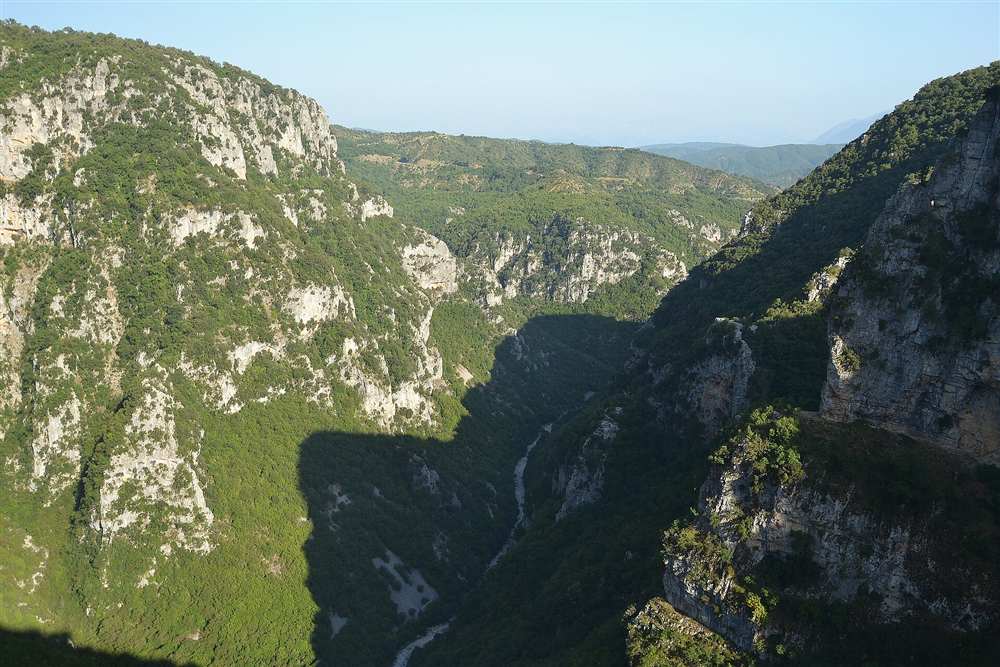
The route mixes cobbled kalderimi at both ends with raw limestone in the middle. Two thirds of the floor section crosses boulders the size of tables, and the path fords the streambed four times between Monodendri and the Voidomatis springs.
The climb out at Vikos village is the hardest hour of a Vikos gorge hike. Cobbles carry walkers down from Monodendri and back up to Vikos village. Between them the surface turns to loose scree, dry white slabs and rounded river rock that shifts underfoot. Ankle support matters more here than tread depth, and trail-running shoes leave feet exposed across the boulder fields.
Booking a Vikos gorge hike ahead secures the guide in the walking season. The crossings run dry in high summer and ankle-deep after rain. In spring the flow rises to knee height at the northern fords, and guides swap the line for a higher bypass along the east bank rather than putting a group into moving water on slick stone.
Monodendri, Papingo and Koukouli are the villages that base a Vikos gorge hike. Loose rock also comes from above. The safe habit is a spacing of ten metres on the scree fans and one walker at a time across them, a discipline the guided parties enforce as routine rather than as advice.
Where does the Voidomatis river appear at the northern end?
The Voidomatis rises from springs at the foot of the Vikos village climb, where water pushes out of the limestone at a steady four degrees. The dry riverbed ends and a full river begins within thirty metres of the source.
The Beloi viewpoint gives the rim view above the Vikos gorge hike. The springs mark the psychological end of the hard walking. Groups stop at the pool, refill bottles and sit on the flat rocks before the final climb. Watercress grows in the shallows, and the surface holds a blue-green cast that comes from the depth of the basin.
The gorge holds a world record for depth against width along a Vikos gorge hike. Downstream the river gathers pace through the Kleidonia narrows and out to the Aristi bridge, where the rafting boats put in. A half day on the water pairs well with the walk over a weekend, and the Voidomatis river rafting trips from Aristi cover the paddling side of the same water.
Snow closes the high routes above a Vikos gorge hike through the winter. The Voidomatis carries a reputation as one of the cleanest rivers in Europe. Its bed is white gravel, its banks are plane and willow, and its temperature stays cold enough through August to cut a swim down to one bracing minute.
Which rim viewpoints repay a short walk?
Oxya and Beloi both stand on the eastern rim with the full nine-hundred-metre drop under the railings. Oxya lies five kilometres by road from Monodendri. Beloi asks for a twenty-minute walk from the parking area above the village of Vradeto.
Oxya looks down on the same canyon that a Vikos gorge hike crosses from below. Oxya is the postcard. A short forest track from the car park reaches a fenced spur where the gorge opens in both directions and the houses of Vikos show white against the far slope. Late afternoon light fills the northern half and empties the southern half into shadow.
Families take the Kleidonia start rather than the full Vikos gorge hike. Beloi looks straight down the throat of the gorge towards Papingo and the Astraka towers. The approach crosses open meadow with no shade, so it goes early or late in the day. The Vradeto Steps, a switchback kalderimi of thirty-nine hairpins, climb to the same plateau from Kapesovo for walkers who want the historic line.
Autumn colour is the reason walkers time a Vikos gorge hike for October. A guided all-day tour to the Zagori area strings these viewpoints together with the villages and the bridges, which suits travellers who want the gorge without walking its floor.
What waits at the Agia Paraskevi monastery above Monodendri?
Agia Paraskevi stands on the cliff edge at the head of the gorge, a fifteenth-century foundation whose courtyard hangs over the drop. Beyond its wall a ledge path, cut a metre wide into the rock face, runs on to hermit caves.
The Agia Paraskevi monastery stands at the trailhead of a Vikos gorge hike. The monastery is five minutes on foot from the Monodendri square, along a flagged lane between grey stone houses. Entry costs nothing, the church keeps its frescoes, and the terrace gives the first full sight of the gorge to walkers about to descend into it.
The Vikos gorge hike starts at Monodendri on the eastern rim of the canyon. The ledge beyond is the memorable part. It clings to the wall with the floor three hundred metres below, protected in places by a low parapet and in others by nothing at all. It ends at the Megali Spilia cave, used as a refuge when raiders came through the valley.
Water and sturdy boots are the two things a Vikos gorge hike demands. Anyone with a fear of exposure turns back at the parapet without shame. The rest reach the cave in twenty minutes and return along the same line, which adds an hour to the day and no significant climbing.
What does the walk to the Dragon Lake of Mount Tymfi demand?
Drakolimni sits at two thousand and fifty metres on the shoulder of Tymfi above Mikro Papingo. The climb gains twelve hundred metres over eight kilometres and asks five to six hours upward and four back down, on rock and alpine grass.
Dragon Lake on Mount Tymfi is the alpine alternative to a Vikos gorge hike. The path leaves Mikro Papingo through box scrub, passes the Antalki spring and turns up the zigzags under the Astraka towers. The col at the refuge is the halfway marker, and the lake lies forty-five minutes further across a plateau of karst hollows and grazing sheep.
A Vikos gorge hike drops seven hundred metres to the riverbed in the first hour. Alpine newts live in the water, black-backed and orange-bellied, and the shepherds’ tale of dragons hurling rocks from lake to lake gave the place its name. The surface holds the reflection of the Aoos valley and the border ranges on a still morning.
Phone signal drops out inside the canyon on a Vikos gorge hike. Mikro Papingo operators run this as an alpine guided hike with lunch, and separate Dragon Lake guided trekking trips leave from Papingo on the parallel path. Both carry the group’s food and water, which strips the heaviest items out of a walker’s own pack.
Is a night at the Astraka refuge worth adding to the trek?
The Astraka refuge stands at nineteen hundred metres on the col below the towers, forty-five minutes short of the lake. It sleeps about fifty walkers in bunk rooms, serves hot meals, and splits one punishing day into two comfortable halves.
The Astraka refuge lets walkers break the Tymfi route over two days. Dragon Lake on Mount Tymfi is the alpine alternative to a Vikos gorge hike. Walkers who sleep at the refuge reach the lake at dawn, when the water lies like glass and the light comes in low across the plateau. Day visitors arrive at midday into wind and haze. That single difference carries the whole argument for the overnight stay.
A Vikos gorge hike drops seven hundred metres to the riverbed in the first hour. The refuge opens from late spring to the middle of autumn and takes bookings by phone and email. Blankets come with the bunk, a sleeping-bag liner does not, and the dormitory fills at weekends when Greek walking clubs drive up from Thessaloniki and Ioannina.
The O3 waymarks run the length of a Vikos gorge hike. The col also opens the traverse north towards Tsepelovo and the crossing down to the Aoos gorge, so the refuge works as the hinge of a three-day circuit rather than as one summit night bolted on to a day trip.
Which stone bridges of Zagori link into a single walking route?
Kipoi anchors the bridge walk. The three-arched Plakida bridge, the single-arched Kokkori bridge and the Misios bridge stand within four kilometres of each other on the Bagiotiko stream, joined by a cobbled path of two to three hours.
The stone bridges of Zagori make the gentle walking day beside a Vikos gorge hike. The Astraka refuge lets walkers break the Tymfi route over two days. Plakida, known locally as Kalogeriko, is the photograph everyone takes: three unequal arches stepping across the water like a caterpillar. Kokkori carries the widest single span in Zagori, and Misios sits lowest of the three, framed by plane trees with a green pool under the arch.
The classic Vikos gorge hike covers twelve kilometres to the springs at Vikos village. The Stone Bridges of Zagori walk starts from Kipoi and takes in all three along the old mule track. A second version starts from Koukouli and folds in the traditional villages, the Lazaridis bridge, the folklore museum and the cobbled lanes of Dilofo and Kapesovo.
A guide reads the river crossings that slow an unguided Vikos gorge hike. The masons who raised these structures worked without mortar in the arch faces, keying the stones so that the load pressed them tighter together. Each bridge was paid for by a village benefactor whose family name it still carries today.
Which villages work best as a base for the walking?
Monodendri suits the gorge traverse, Papingo and Mikro Papingo suit Tymfi and the lake, and Kipoi and Koukouli sit at the centre of the bridge walks. Ioannina, forty minutes by road, holds the airport and the widest choice of beds.
Monodendri, Papingo and Koukouli are the villages that base a Vikos gorge hike. Monodendri has guesthouses in restored stone mansions, two tavernas on the square and the trailhead within walking distance of every door. Papingo and Mikro Papingo look straight up at the Astraka towers and fill fast in summer, so rooms there go months ahead.
Loose stone and boulder fields fill the middle of a Vikos gorge hike. Kipoi and Koukouli are quieter, cheaper and greener, set among walnut groves rather than bare rock. They put the three bridges, the Vikos rim and the Vradeto Steps inside a twenty-minute drive of the front door.
The Voidomatis surfaces at the north end where a Vikos gorge hike finishes. Ioannina suits travellers who want a lake, a castle and restaurants at night. The day tours from Ioannina reach the island and the Perama cave, while Ioannina airport transfers put a driver at arrivals for the run up into Zagori.
Which season suits the gorge, and which one closes the high routes?
Snow shuts the Tymfi routes from November into the middle of June, and the Dragon Lake path holds ice into early summer. The gorge floor walks from April to November, with the river highest in spring and beech colour peaking in late October.
Snow closes the high routes above a Vikos gorge hike through the winter. Spring brings meltwater. The fords run deep, wildflowers cover the meadows above Vradeto, and the waterfalls on the western wall of the gorge pour for a handful of weeks before drying out. Guides watch the level and switch to the Kleidonia side when the crossings turn dangerous.
The climb out at Vikos village is the hardest hour of a Vikos gorge hike. Summer runs dry and hot on the rim and cool on the floor, where the walls hold shade until mid-morning. A start at seven o’clock puts the boulder section behind the group before the heat builds in the middle of the day.
Booking a Vikos gorge hike ahead secures the guide in the walking season. Autumn is the connoisseur’s season. Beech and maple turn copper through October, the air clears after the first rains, and the villages empty of crowds. Winter closes the high paths and leaves the bridges, the viewpoints and the stone villages open under snow.
What goes in the pack for a day in the gorge?
Two to three litres of water per walker, boots with ankle support and a hard sole, sun protection, a fleece for the shaded floor, food for the whole day and a paper map. No drinkable spring runs until the northern end.
Autumn colour is the reason walkers time a Vikos gorge hike for October. Phone signal disappears once the walls close in. Coverage returns on the Vikos village climb and along the rim, so a walking party agrees a turnaround time before the descent and holds to it rather than expecting a call to connect from the floor.
The Beloi viewpoint gives the rim view above the Vikos gorge hike. Footwear decides the day. The boulder field punishes soft soles, and wet limestone after rain turns slick as tile. Trekking poles save the knees on the Monodendri staircase and give a third point of contact at each of the fords.
The gorge holds a world record for depth against width along a Vikos gorge hike. A head torch belongs in the bag even for a morning start, because a slow group finishing the Vikos climb in October walks the last twenty minutes in dusk. Add a compact first-aid kit, tape for blisters and a whistle.
Does a guide change the day on the marked O3 trail?
The O3 waymarks run the length of the gorge, so navigation stays straightforward in clear weather. A guide changes the logistics instead: transfer at both ends, a judgement on the river level, the plants and the history, and a response if an ankle turns.
Water and sturdy boots are the two things a Vikos gorge hike demands. The trail is marked with red and white flashes on rock and tree, plus cairns across the open boulder ground. Fog, high water and a fresh rockfall each erase that clarity in an instant, and the floor of the gorge offers no phone signal for calling advice down.
Oxya looks down on the same canyon that a Vikos gorge hike crosses from below. Transport is the practical argument. A point-to-point walk from Monodendri to Vikos village leaves the car at the wrong end of twenty kilometres of mountain road. Guided parties are dropped and collected, which removes an hour of taxi hunting at the finish.
Families take the Kleidonia start rather than the full Vikos gorge hike. Guides also carry the knowledge that turns rock into story: the mule trade over these passes, the wool caravans that ran to central Europe, and the herb gatherers of Vikos whose reputation as healers reached Constantinople.
What do the guided walks in Zagori cost in euros?
Researched ranges put the full-day guided gorge hike at sixty to a hundred and ten euros per person, the Dragon Lake trek at seventy to a hundred and thirty, and the stone bridges walk at forty to seventy-five per person.
Phone signal drops out inside the canyon on a Vikos gorge hike. Price tracks group size and transfer distance. A shared departure out of Ioannina sits at the lower end of each band, and a private guide for two, collected from a guesthouse in Papingo, sits at the top. Lunch, entrance donations and equipment hire move the figure again.
The Agia Paraskevi monastery stands at the trailhead of a Vikos gorge hike. The Mikro Papingo alpine hike with lunch and the Papingo Dragon Lake departures include food and a vehicle to the trailhead, which explains the gap between them and the plain gorge day. An all-day Zagori tour by vehicle, covering viewpoints, bridges and villages, prices per car rather than per head.
The Vikos gorge hike starts at Monodendri on the eastern rim of the canyon. Travellers pairing Zagori with the monasteries of Meteora book the walking days first, because guide availability in Zagori is thinner than tour availability elsewhere in Greece and the weather window on Tymfi stays short.
Frequently Asked Questions
What is the length of the Vikos gorge hike?
Twelve kilometres from Monodendri to Vikos village, with a descent of about seven hundred metres at the start and a steep climb out at the end. Walkers cover it in six to seven hours.
Is the Vikos gorge hike difficult?
The distance is moderate and the terrain is hard. Loose stone, boulder fields and river crossings fill the middle section, and the climb out of the gorge at Vikos village is the steepest part of the day.
What does a guided Vikos gorge hike cost?
The guided full-day traverse runs from about 60 to 110 euros per person. The Dragon Lake trek runs from about 70 to 130 euros, and the stone bridges walk from about 40 euros.