
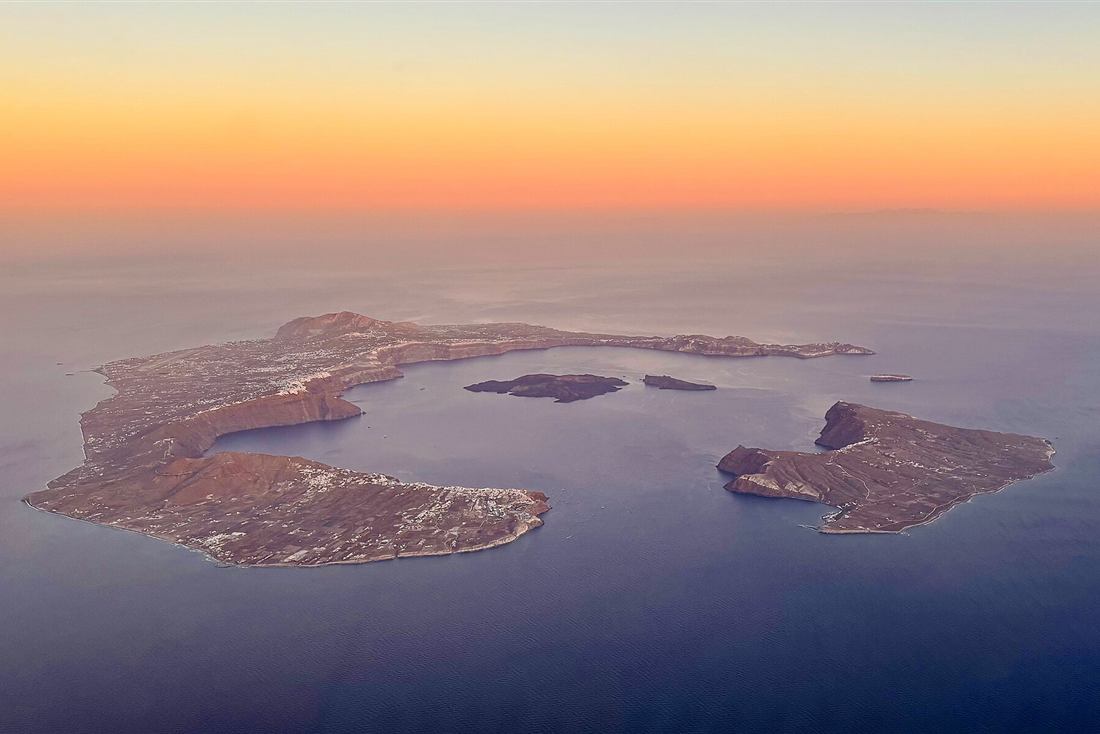
A Santorini helicopter tour is a fifteen to sixty minute sightseeing flight from the airport helipad over the caldera rim, the cliff towns of Fira and Oia, the Nea Kameni volcano crater and the Red and White beaches, flown in a light turbine or piston helicopter with three to five passenger seats. Plan the rest of the island with Greece Tours.
This guide sets out the whole picture: the aircraft in service, what each flight length reaches, the route over the caldera and the volcano, the price ranges for private charter and per-seat booking, the weight and luggage limits, the safety briefing, the wind and the light, the island-to-island transfer flights, and how far ahead to book.
What is a Santorini helicopter tour and what does the flight cover?
A Santorini helicopter tour is a private sightseeing flight that lifts off from the island airport, climbs over the caldera rim and circles the flooded volcanic basin, the cliff towns of Oia and Fira, the Nea Kameni crater and the south-coast beaches before landing on the same pad.
Photographers pick the window seat on a Santorini helicopter tour and shoot without glass glare. A Santorini helicopter tour lifts off from the helipad at the island’s national airport. The flight is chartered as a whole aircraft rather than sold by the seat on standard operations. One booking buys the machine, the pilot and the slot, so the group on board is the group that paid for it. The pilot agrees the route at the briefing and names each landmark as it passes under the nose.
A Santorini helicopter tour passes above Fira, Firostefani, Imerovigli and Oia on the rim. Booking a Santorini helicopter tour ahead secures the aircraft and the hour you want. Height and speed deliver what no other tour on the island delivers. From 1,500 to 2,000 feet the entire caldera fits inside one window: the crescent of Thera, the smaller island of Thirassia, the uninhabited rock of Aspronisi, the two dark lava islets at the centre and the white line of Oia along the northern cliff. The helicopter shows the shape of the collapsed volcano whole, in a single frame.
The aircraft on a Santorini helicopter tour seats three to five passengers beside the pilot. Operators run the route through the year, with the densest schedule from April to October. Reading the island geography before boarding sharpens every minute in the air, and the complete Santorini travel guide maps the towns, beaches and excavations that pass beneath the skids inside the first ten minutes of flight.
Which helicopter models fly over Santorini, and what does each cabin seat?
Three airframes dominate Greek island charter work: the Robinson R44 Raven II with three passenger seats, the Airbus H125 with five, and the twin-engine Agusta AW109 or Airbus H145 with six to seven. Bell 407 and Airbus H130 cabins also appear on Cycladic routes.
A Santorini helicopter tour is rescheduled rather than flown when the cloud base drops. The twenty minute Santorini helicopter tour circles the caldera and the Nea Kameni crater. The Robinson R44 is the entry aircraft for sightseeing. It is a single-engine piston helicopter with one pilot seat, one front passenger seat and a two-seat rear bench, giving three passengers per flight. Every seat is a window seat, and the front-left position beside the pilot opens the chin-bubble view straight down onto the caldera water.
The volcano leg of a Santorini helicopter tour crosses Nea Kameni and Palea Kameni. A Santorini helicopter tour reaches the Red Beach and the White Beach in a single pass. The Airbus H125, still called the Écureuil by crews, is the workhorse turbine machine. It carries five passengers, climbs faster, handles wind on the caldera rim with more margin and runs quieter inside the cabin. Its rear bench seats three across, and the two forward seats behind the pilot open the view on both sides.
A private Santorini helicopter tour is chartered whole, so the cabin belongs to your party. Twin-engine cabins — the AW109, the H145, the Bell 429 — carry six or seven passengers and hold the certification required for extended overwater legs. Families of five and small wedding parties book the turbine machines, because splitting a group across two R44 flights doubles the charter cost.
How long does a Santorini helicopter tour last, and what does each duration reach?
Published sightseeing durations run 15, 20, 30, 45 and 60 minutes of airborne time. Fifteen minutes covers the caldera rim and Oia. Thirty adds Nea Kameni and the coloured beaches. Sixty circles Thirassia, Akrotiri, Ancient Thera and the full coastline.
Luggage on a Santorini helicopter tour is limited by weight and by the size of the hold. A thirty minute Santorini helicopter tour adds Thirassia and the beaches of the south coast. The 15-minute flight is the proposal and cruise-call option. It lifts from the apron, tracks north-west across Pyrgos and Imerovigli, turns over Oia at cliff height and returns down the eastern shore. That single pass captures the caldera wall, the blue domes of the northern villages and Skaros Rock inside a shore excursion window.
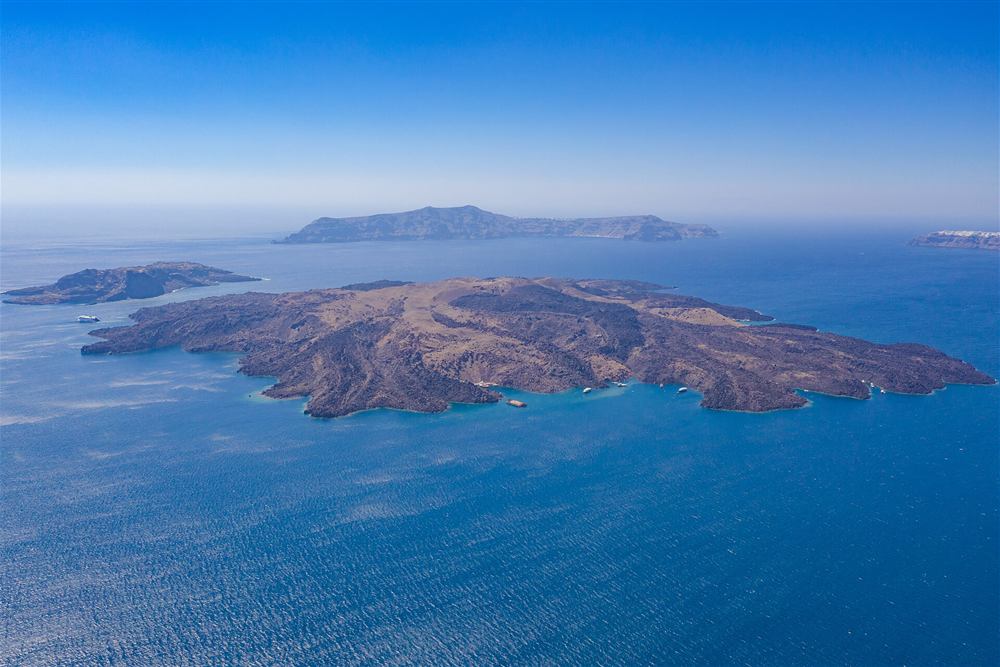
Couples book a Santorini helicopter tour for proposals and for honeymoon flights at sunset. Cruise passengers fit a Santorini helicopter tour inside a short call at the port. The 20 and 30-minute options open the centre of the basin. The aircraft crosses the water to the lava islets, orbits the crater field of Nea Kameni, passes the hot springs of Palea Kameni and turns south over the Red Beach and the White Beach at Akrotiri before rejoining the eastern coast at Vlychada.
The price of a Santorini helicopter tour tracks the aircraft type and the minutes in the air. The 45 and 60-minute flights add the western half of the ring. Thirassia’s terraced fields, the abandoned village of Manolas, the ridge of Profitis Ilias, the ruins of Ancient Thera on Mesa Vouno and the long dark beaches of Perissa and Perivolos all enter the route.
What does the flight path over the caldera, Oia and Fira show?
The northbound leg runs the whole cliff line at rim height: Fira stacked above the cruise anchorage, Firostefani and Imerovigli spilling over the ridge, Skaros Rock jutting into the basin, and Oia’s windmills and cave houses folded into the northern tip of the island.
A Santorini helicopter tour shows the caldera ring whole, which no boat or road can do. Every Santorini helicopter tour carries a pilot briefing and headsets before the doors close. The Santorini caldera reads as one structure only from the air. The sea-filled basin measures around twelve kilometres north to south and seven across, and the inner cliffs rise 250 to 300 metres in vertical bands of red scoria, black lava and white pumice laid down by successive eruptions. From the cockpit they read as the cross-section of a mountain that lost its centre.
A Santorini helicopter tour is weighed at check-in, since the total load sets the fuel. The transfer version of a Santorini helicopter tour flies on to Mykonos, Paros or Crete. Oia repays the pass more than any other stop. The village occupies the narrow spine where the caldera meets the open Aegean, so the aircraft frames whitewashed roofs against two different blues at once. Ammoudi Bay, its red cliff and the fishing tavernas along the waterline sit directly below the turn.
Morning air gives a Santorini helicopter tour the steadiest ride and the cleanest light. Fira, Firostefani and Imerovigli form a continuous three-kilometre ribbon along the rim. The flight reveals what walking the caldera path hides: the depth of the terraces, the cave houses cut back into the cliff, and the cruise tenders drawing white lines across the water 300 metres below.
Which volcanic and coastal landmarks does the aircraft pass on the wider loop?
The wider loop crosses Nea Kameni’s crater field, the sulphur-stained bay of Palea Kameni, the Red Beach and White Beach cliffs at Akrotiri, the black sand of Vlychada and Perissa, Thirassia’s terraces and the Bronze Age excavation at Akrotiri.
The sunset slot on a Santorini helicopter tour fills first through the summer weeks. The aircraft on a Santorini helicopter tour seats three to five passengers beside the pilot. Nea Kameni is the geological centre of the flight. The islet is raw basaltic andesite with no soil and no trees, and the aircraft orbits its summit craters low enough to show the fumarole vents and the ochre and grey staining around them. Details of the eruption history and the walking route to the summit sit in the guide to the Nea Kameni volcano.
The meltemi wind moves a Santorini helicopter tour to a calmer slot in the day. Photographers pick the window seat on a Santorini helicopter tour and shoot without glass glare. South of the caldera the coast turns to colour. The Red Beach sits under an oxidised cliff of iron-rich scoria that glows against the water. The White Beach, reachable on foot by nobody and by boat only, hides beneath pale pumice walls a few hundred metres further west. Between them the Akrotiri peninsula carries the lighthouse at Cape Akrotiri and the roofed excavation of the Minoan town buried by the eruption.
A Santorini helicopter tour passes above Fira, Firostefani, Imerovigli and Oia on the rim. The eastern and southern shores close the circuit. Vlychada’s wind-carved pumice cliffs, the black expanse of Perivolos and Perissa, the pyramid of Mesa Vouno with Ancient Thera along its ridge all pass before the final approach.
Where is the helipad, and how does it relate to Santorini National Airport?
Sightseeing flights and island transfers operate from the helicopter apron inside Santorini National Airport at Monolithos, on the island’s east coast beside Kamari. There is no separate commercial helipad on Santorini; passengers check in at the general aviation terminal.
A Santorini helicopter tour lifts off from the helipad at the island’s national airport. A private Santorini helicopter tour is chartered whole, so the cabin belongs to your party. The airport sits four kilometres from Fira and shares its single runway with scheduled airline traffic, so helicopter slots are coordinated with tower movements. Passengers arrive 30 minutes before the booked time, present identity documents, complete the security check and walk to the aircraft with the pilot. Practical detail on terminals, parking and arrival procedure is collected in the guide to Santorini National Airport.
Booking a Santorini helicopter tour ahead secures the aircraft and the hour you want. A Santorini helicopter tour is rescheduled rather than flown when the cloud base drops. The apron position dictates the shape of every route. Departures track west or north-west from Monolithos, cross the island’s interior over Pyrgos, Megalochori or Vothonas, and reach the caldera rim within three minutes of lift-off. That short transit is the reason a 15-minute flight still reaches Oia.
The volcano leg of a Santorini helicopter tour crosses Nea Kameni and Palea Kameni. Private villa landings are not available on Santorini. Greek regulation restricts off-airport landings to permitted sites, so every flight begins and ends on the airport apron. Ground transport to and from the terminal is arranged separately, and reliable options are listed under Santorini airport transfers.
How does a helicopter transfer between islands differ from a sightseeing flight?
A transfer moves passengers point to point between airports — Santorini to Mykonos, Paros, Naxos, Milos, Crete or Athens — on a direct routing. A sightseeing flight returns to its departure pad. Transfers carry luggage, cross open water and are priced per leg.
The twenty minute Santorini helicopter tour circles the caldera and the Nea Kameni crater. The price of a Santorini helicopter tour tracks the aircraft type and the minutes in the air. Flight times set the appeal. Santorini to Mykonos runs 30 to 35 minutes against a ferry crossing of two to three hours. Santorini to Paros or Naxos runs 25 to 30 minutes. Santorini to Heraklion on Crete takes about 30 minutes, and Santorini to Athens International runs 55 to 70 minutes.
A Santorini helicopter tour reaches the Red Beach and the White Beach in a single pass. Luggage on a Santorini helicopter tour is limited by weight and by the size of the hold. Overwater routing changes the equipment and the rules. Legs beyond gliding distance of land are flown with life jackets issued and demonstrated to every passenger, and twin-engine machines hold the advantage on the longer Athens and Crete sectors.
Couples book a Santorini helicopter tour for proposals and for honeymoon flights at sunset. Transfers absorb sightseeing at no extra flight time. A Santorini to Mykonos leg routes over Ios, Sikinos, Folegandros or Naxos, and pilots adjust the track on request so the departure climbs across the caldera before turning north. That combination converts a connection into a scenic flight and removes a ferry day from the itinerary.
What does a Santorini helicopter tour cost in euros?
Charter rates quoted by Greek operators fall in these ranges: 15 minutes at 900 to 1,400 euros for the aircraft, 20 minutes at 1,200 to 1,700, 30 minutes at 1,800 to 2,500 and 60 minutes at 3,500 to 4,800. Per-seat sightseeing sits at 300 to 600 euros.
A thirty minute Santorini helicopter tour adds Thirassia and the beaches of the south coast. Morning air gives a Santorini helicopter tour the steadiest ride and the cleanest light. Charter pricing is per aircraft per flight hour, prorated to the booked duration. Dividing a 30-minute R44 charter across three passengers lands each seat near the price of a per-seat ticket. Group size is the single strongest lever on cost per head.
Cruise passengers fit a Santorini helicopter tour inside a short call at the port. A Santorini helicopter tour shows the caldera ring whole, which no boat or road can do. Aircraft type is the second lever. A piston R44 costs less per hour to operate than a turbine H125, and a twin-engine AW109 costs more than both. The quoted total includes fuel, pilot, insurance and Greek VAT, with airport handling and landing fees itemised on transfers.
A Santorini helicopter tour is weighed at check-in, since the total load sets the fuel. Island transfers price by sector rather than by minute. Santorini to Mykonos quotes land between 2,300 and 4,000 euros for the aircraft, Santorini to Athens between 4,500 and 7,500. Empty-leg repositioning flights, sold when an aircraft returns without passengers, cut those figures sharply for travellers with flexible timing. Confirm every figure with the operator at booking.
What weight, passenger and luggage limits apply on board?
Every passenger declares an accurate body weight at booking. A Robinson R44 accepts three passengers within a combined limit near 250 kilograms. An Airbus H125 accepts five within roughly 500 kilograms. Luggage on transfers is limited to one soft bag of 10 to 15 kilograms per person.
Every Santorini helicopter tour carries a pilot briefing and headsets before the doors close. A Santorini helicopter tour passes above Fira, Firostefani, Imerovigli and Oia on the rim. Weight and balance is a legal calculation, not a formality. The pilot loads fuel against payload and assigns seats to keep the centre of gravity inside limits, which is why the seating plan arrives at the briefing rather than at booking. Understating a weight forces a reload on the apron, delays the slot or cancels the flight outright.
The transfer version of a Santorini helicopter tour flies on to Mykonos, Paros or Crete. The sunset slot on a Santorini helicopter tour fills first through the summer weeks. Individual passenger caps apply on the smaller airframes. A single passenger above 110 to 120 kilograms is placed in a specific seat or moved to a turbine aircraft. Heavier groups are quoted directly for the H125 or a twin-engine cabin.
The meltemi wind moves a Santorini helicopter tour to a calmer slot in the day. Luggage rules are stricter than on an airliner. Hard-shell suitcases do not fit the baggage compartments on an R44 or an H125, so transfers require soft duffels that compress into the hold. Excess bags travel on a following ferry, forwarded by the operator when declared in advance. Sightseeing flights carry no luggage at all — bags stay in a locker at the terminal.
How is the flight regulated, and what does the pilot briefing cover?
Greek commercial helicopter operators hold an Air Operator Certificate issued by the Hellenic Civil Aviation Authority under EASA rules. Pilots fly on a commercial licence with a type rating and recurrent checks. Aircraft follow mandatory maintenance intervals and carry current airworthiness certificates.
The aircraft on a Santorini helicopter tour seats three to five passengers beside the pilot. The volcano leg of a Santorini helicopter tour crosses Nea Kameni and Palea Kameni. The chain is verifiable before booking. An AOC number, the operator’s registered name and the aircraft registration marks are public, and a legitimate operator supplies all three on request. Flights sold without an AOC behind them are illegal charter, uninsured for the passenger and worth refusing.
Photographers pick the window seat on a Santorini helicopter tour and shoot without glass glare. A Santorini helicopter tour lifts off from the helipad at the island’s national airport. The briefing happens on the apron before boarding and runs five to ten minutes. It covers the approach path to the aircraft from the front-left, staying clear of the tail rotor, seat belt operation, headset and intercom use, door handles that stay untouched in flight, and the emergency exit procedure.
Booking a Santorini helicopter tour ahead secures the aircraft and the hour you want. Authority in the air rests with the pilot in command. Route changes, orbit height, cancellation for weather and the decision to turn back are the pilot’s alone, and Greek regulation binds the operator to that decision. Children fly with a dedicated seat and belt.
What is the best time of day to fly, and how does the meltemi wind change the plan?
The first two hours after sunrise give the calmest air and the sharpest visibility. The 90 minutes before sunset give the strongest colour on the caldera cliffs and Oia. The meltemi, a dry north wind, strengthens through midday in high summer and pushes flights to the early slots.
A private Santorini helicopter tour is chartered whole, so the cabin belongs to your party. Couples book a Santorini helicopter tour for proposals and for honeymoon flights at sunset. Morning air over the Cyclades is stable: thermal activity has not started, and the aircraft flies smooth at rim height with the sun behind it on the northbound leg. Photographers chasing detail in the white villages take the earliest slot.
A Santorini helicopter tour is rescheduled rather than flown when the cloud base drops. The twenty minute Santorini helicopter tour circles the caldera and the Nea Kameni crater. Golden hour reverses the geometry. Late light strikes the caldera wall head-on, the red and black strata separate, and Oia glows against the dark water. This is the slot booked for proposals and honeymoon flights, and it sells out first through July and August.
A Santorini helicopter tour reaches the Red Beach and the White Beach in a single pass. The meltemi governs the summer schedule. It blows from the north and north-east between June and September, builds through the afternoon and reaches 5 to 7 on the Beaufort scale on strong days. Rotor turbulence forms in the lee of the caldera rim in those conditions, so pilots raise the orbit height, reroute away from the cliff face or move the flight to dawn. Booking the earliest slot in a meltemi week removes most cancellation risk.
How far ahead do you book, and what happens when weather closes the window?
Reserve two to four weeks ahead from June to September and three to five days in the shoulder season. Sunset slots and proposal flights go earliest. Weather cancellations by the operator carry a full refund or a free reschedule to the next flyable slot.
The price of a Santorini helicopter tour tracks the aircraft type and the minutes in the air. A Santorini helicopter tour is weighed at check-in, since the total load sets the fuel. High-season demand is concentrated. A handful of aircraft cover the whole island, transfers compete with sightseeing for the same airframes, and cruise-call mornings absorb the early slots. Booking a specific date and hour four weeks out secures the light you came for.
Luggage on a Santorini helicopter tour is limited by weight and by the size of the hold. A thirty minute Santorini helicopter tour adds Thirassia and the beaches of the south coast. Cancellation terms follow a standard shape. Free cancellation runs to 48 or 72 hours before departure depending on operator, inside that window a deposit is retained, and a no-show forfeits the charter. Charter terms run stricter than tour terms, so read the wording before paying.
Cruise passengers fit a Santorini helicopter tour inside a short call at the port. Weather decisions belong to the operator and land on the morning of the flight. Low cloud on the caldera rim, visibility under the operating minimum, or wind above the aircraft limit closes the slot. The operator offers a later slot or the money back in full. Travellers on a tight schedule book the flight on the first full day of the trip, keeping the remaining days as reserve.
Who suits a helicopter flight, who is better served by a boat or a car tour, and what do you bring on board?
The flight suits proposals, honeymoons, photographers, cruise passengers with a five-hour call and travellers converting a ferry day into 30 minutes. A caldera boat or a private car tour serves anyone who wants to swim, walk the sites, taste wine or travel on a modest budget.
Morning air gives a Santorini helicopter tour the steadiest ride and the cleanest light. The meltemi wind moves a Santorini helicopter tour to a calmer slot in the day. Proposals dominate the sunset slots. A private charter puts two people, a pilot and a headset intercom in the same cabin above Oia, and operators coordinate a photographer on board. Honeymoon couples take the 20 or 30-minute loop for the same reason: privacy and a view that a crowded terrace on the rim cannot match.
Every Santorini helicopter tour carries a pilot briefing and headsets before the doors close. The alternatives win on different ground. A catamaran cruise anchors at the hot springs, stops at the Red Beach for swimming and serves dinner at sea. A private car tour reaches Ancient Thera, the Akrotiri excavation, Pyrgos and three wineries in a day. The helicopter delivers scale and speed; the boat and the car deliver contact with the island.
The transfer version of a Santorini helicopter tour flies on to Mykonos, Paros or Crete. Packing is minimal. Bring sunglasses, a light jacket for the turbine cabin airflow, a phone or camera with a wrist strap, and a lens hood if shooting through the window. Leave hats, loose scarves and drones behind — drone flight near the airport is prohibited. Shoot with the lens close to the glass to kill reflections, and keep the belt fastened until the engine stops.
Frequently Asked Questions
How long is a Santorini helicopter tour?
Fifteen to sixty minutes in the air. The twenty minute flight circles the caldera and the volcano. The thirty minute flight adds Thirassia and the southern beaches. Longer flights reach the neighbouring islands.
What does a Santorini helicopter tour cost?
Private charter runs from about 700 to 1,600 euros for the aircraft on a twenty to thirty minute flight, with per-seat pricing from about 250 to 450 euros per passenger. The aircraft type and the flight length set the figure.
Where does a Santorini helicopter tour take off from?
From the helipad at Santorini National Airport on the east side of the island, a short drive from Fira and Kamari. Passengers check in at the operator desk and walk to the aircraft after the safety briefing.