
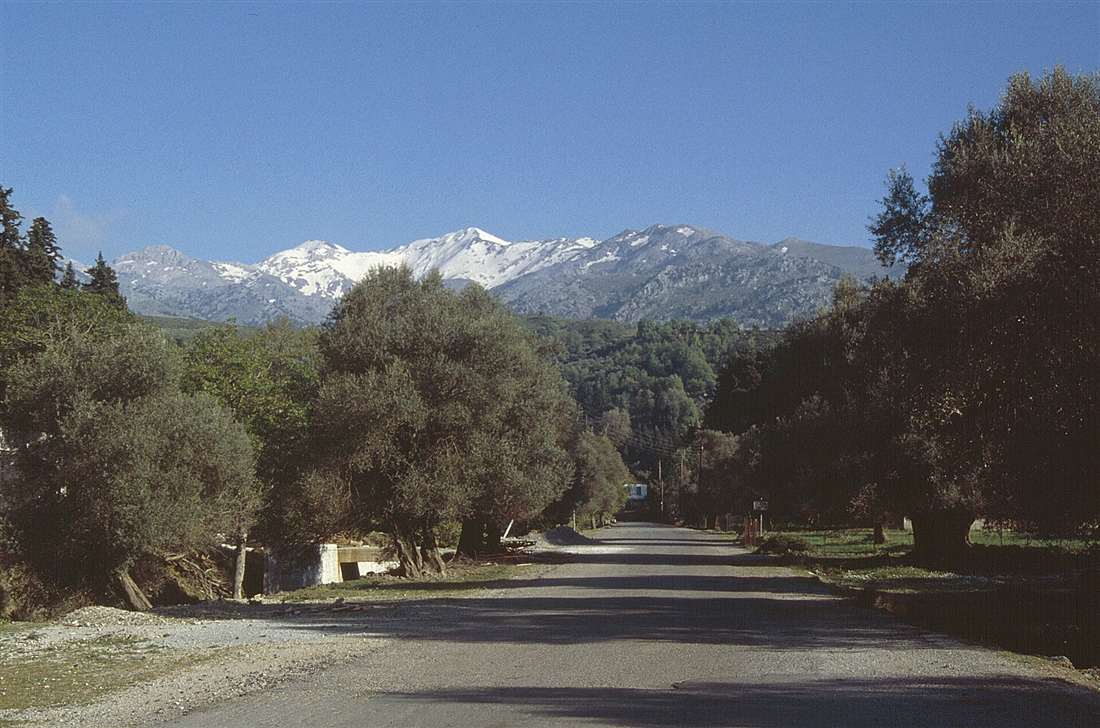
To get from Chania to Therisso, drive south through the village of Perivolia and into the Therisso gorge, a 6-kilometre canyon of sheer rock walls that the road threads through, then up to the village, about 16 kilometres in 25 to 30 minutes, reaching the mountain village at the foot of the White Mountains. Plan the whole trip with Greece Tours.
This guide covers the trip from Chania to Therisso in full: where it is, how to drive it through the gorge, the limited bus service, the canyon of grey limestone and plane trees, the village and its bond with Eleftherios Venizelos and the Therisso revolt, the Cretan mountain food, the White Mountains above, and whether this short trip is worth it.
Where is Therisso and how far is it from Chania?
Therisso is a mountain village 16 kilometres south of Chania in the Chania regional unit of west Crete. It sits at the southern end of the Therisso gorge, at the foot of the White Mountains, at an altitude of 580 metres above sea level.
The village stands directly below the northern wall of the Lefka Ori, the White Mountains that dominate western Crete. From the coast the land climbs fast: the port and old town of Chania sit at sea level, and in 16 kilometres the road lifts you to 580 metres, so the change in altitude is felt as a change in air, temperature and light. The heat of the harbour gives way to the cool of the mountain, and the built density of the city gives way to olive groves, stone walls and grazing land.
Therisso belongs to the Keramia district, a cluster of small farming settlements on the southern slopes above Chania. The village is the last real settlement before the mountain proper, which makes it both an endpoint and a gateway: the tarmac road stops climbing here, and the footpaths into the high massif begin. Its position at the head of a 6-kilometre canyon gives it a natural front door \u2014 you enter the village only after passing through the gorge that carries its name.
Because the distance is short and the elevation gain is sharp, Therisso reads as a compact half-day trip from the city rather than a long expedition. Travellers based in Chania reach the village, walk the gorge floor, eat a mountain lunch and return to the coast inside a single afternoon, with the drive itself counting as one of the highlights.
How do you drive from Chania to Therisso through the gorge?
Drive south out of Chania through the village of Perivolia, follow the signposted Therisso road into the canyon, and thread the 6-kilometre gorge to the village. The full route covers 16 kilometres and takes 25 to 30 minutes at an easy pace.
The road leaves the southern edge of the city and runs through Perivolia, a settlement of citrus and olive groves on the flat land below the mountains. Past the last houses the tarmac narrows and begins to climb toward the mouth of the canyon. The transition is abrupt: open farmland on one side, and ahead the grey limestone walls of the gorge closing in to form a natural corridor. The road then drops onto the canyon floor and follows it for 6 kilometres.
Inside the gorge the driving is slow and deliberate. The lane threads between sheer rock faces, the surface twists with the bends of the streambed, and the walls rise straight up on both sides. Blind corners force a light touch on the accelerator, and passing places are the way two vehicles meet on the tightest stretches. The reward for the care is the scene through the windscreen \u2014 walls of pale stone, plane trees leaning over the road, and the seasonal stream running beside the tarmac.
Beyond the canyon the road climbs the final stretch up to the village at 580 metres, where the gorge opens into a green upland bowl. A rental car is the practical vehicle for the whole route, and drivers combine it with other day trips from Chania into the western interior. The 25 to 30 minute timing holds for a relaxed drive; the slow gorge section is the part that sets the pace, not the distance.
Is there a bus to Therisso?
A limited KTEL bus service runs from Chania to Therisso on set days of the week, not on a frequent daily timetable. A rental car is the practical way to reach the village, and the drive through the gorge is part of the appeal rather than a chore to skip.
The public route from the KTEL station in Chania to Therisso exists, but it operates on a thin schedule tied to specific days, built for residents of the mountain villages rather than for visitors moving to their own plan. The gaps between departures are long, and a traveller who relies on the bus is locked to its hours for both the outward and the return leg. For a trip whose whole point is the gorge and a slow mountain lunch, that rigidity works against the experience.
A hired car removes the constraint. It lets you stop inside the canyon to look up at the walls, pull over at the plane trees, linger over food in the village and leave when the light is right rather than when a timetable dictates. The freedom to set your own pace is the main argument for driving, and the cost of a day’s rental buys exactly that flexibility across the 16-kilometre route.
Travellers without a car reach Therisso by taxi from Chania or on an organised excursion that folds the village into a wider tour of the Keramia district and the White Mountains foothills. A taxi covers the distance in the same 25 to 30 minutes as a private car and waits at the village for the return, which suits a group splitting the fare. The gorge drive stays the centrepiece whichever vehicle carries you through it.
What is the Therisso gorge like?
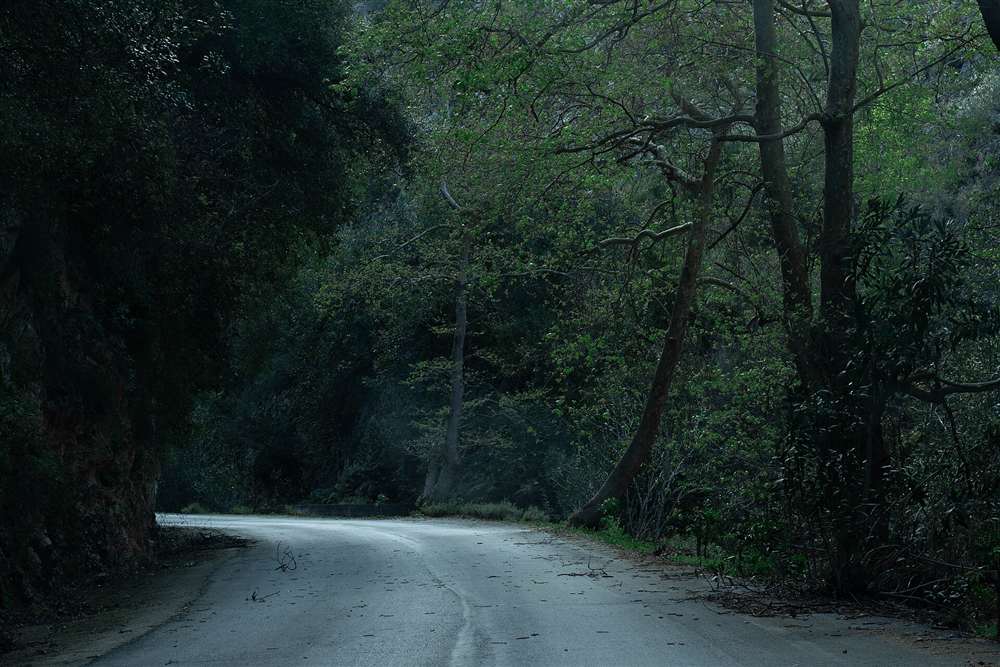
The Therisso gorge is a narrow 6-kilometre canyon of tall grey limestone walls, plane trees and a seasonal stream. The road runs along the canyon floor, wild flowers cover the slopes in spring, birds of prey circle the ridgelines, and short walking paths lead off the tarmac into the rock.
The gorge is the passage that carries the road from the farmland below Chania up to the village. Its walls are pale grey limestone, worn smooth in places and split into ledges in others, rising sheer on both flanks so that the sky narrows to a strip overhead. Plane trees root along the streambed, their canopies throwing shade across the tarmac, and in the cool of the shadow the air stays fresh even when the coast bakes. The seasonal stream runs strong after winter rain and thins to a trickle in the dry heat of high summer.
Spring turns the canyon into a garden. Wild flowers spread across the lower slopes and the crevices of the rock, the plane trees leaf out in bright green, and the stream feeds the growth along the floor. Overhead, birds of prey ride the thermals against the limestone, hunting the open ground above the gorge. The combination of flowering slopes, running water and circling raptors makes the drive an event in its own right, not a stretch of road to hurry through.
The canyon rewards travellers who stop as well as those who drive. Short walking paths branch off the road and lead a little way into the rock, close enough for a break of 20 to 30 minutes on foot without committing to a full hike. The scale of the walls is best felt from the ground, standing at the base and looking straight up the stone, with the plane trees and the stream at your feet and the ridgeline far above.
What is the story of Therisso village, Venizelos and the revolt?
Therisso is bound to Eleftherios Venizelos, the Cretan statesman and later Greek prime minister, whose mother came from the village. It was the seat of the Therisso revolt, the armed uprising he led against the autocratic rule of the island’s High Commissioner, an insurrection that pushed Crete toward union with Greece.
The village name carries far beyond its size because of its link to Venizelos. His mother’s family belonged to Therisso, and the mountain settlement gave him both a stronghold and a symbol when he broke with the ruling authority of the island. The revolt he headed here was an armed stand against the autocratic government of the High Commissioner, and its aim was the union of Crete with the Greek state. From this remote village, protected by the gorge below and the mountains above, the movement drew its name and its base.
The natural defences of the site explain the choice. An uprising planted at the head of a narrow canyon, with the White Mountains at its back, held a position that was hard to reach and easy to hold. The gorge that visitors now drive for pleasure served the rebels as a barrier, and the height of the village put its leaders above the reach of the coastal administration. The revolt turned Therisso from a farming hamlet into a name in the island’s fight for self-rule.
The house that served as the headquarters of the revolt still stands in the village, and it is now a small museum. Inside, the rooms preserve the memory of the uprising and of Venizelos, whose career carried him from this mountain seat to the leadership of Greece. A visit to Therisso is as much a visit to that history as to the gorge \u2014 the museum, the family story and the setting together explain why so small a place holds so large a place in the record of Crete.
What is there to do and eat at Therisso, and what lies nearby in the White Mountains?
At Therisso you tour the revolt headquarters museum, eat Cretan mountain food in the village tavernas \u2014 grilled meat, gamopilafo wedding rice, snails and raki \u2014 and set out on the White Mountains trailheads that begin above the village. The Venizelos family history and the villages of the Keramia region fill out the trip.
The tavernas are the heart of a village visit. They serve the food of the Cretan mountains, cooked plain and rich: grilled meat straight off the coals, gamopilafo \u2014 the wedding rice simmered in meat broth until it is thick and glossy \u2014 snails prepared in the island manner, and raki poured to close the meal. The cooking is unhurried and generous, matched to the pace of a mountain afternoon, and eating here is one of the two reasons travellers make the drive, the gorge being the other.
Above the village the tarmac ends and the mountain begins. Trailheads into the Lefka Ori, the White Mountains, start from the upland ground beyond the houses, opening the high massif to walkers who want more than the gorge floor. These paths climb into the harshest and highest country of western Crete, and the village at 580 metres is the last supply point before the ascent. Walkers who want only a taste turn back at a ridge for the view; those set on the peaks use Therisso as their launch.
Between meals and mountains sits the history. The revolt headquarters museum, the story of the Venizelos family whose roots lie here, and the small stone-built village itself reward an hour of slow walking. Beyond Therisso the wider Keramia region spreads its own farming villages across the southern slopes above Chania, and a driver with an afternoon to spare threads between them, adding the neighbouring settlements to the day. The city of Chania waits below for the evening.
Is the trip to Therisso worth it, and when to go?
The trip to Therisso is worth it for the gorge drive, the mountain food and the Venizelos history packed into a 16-kilometre half-day from Chania. Spring brings the flowering canyon and the full stream; autumn brings clear cool air. Both seasons beat the fierce heat of high summer.
The value of the trip rests on how much it delivers for how little distance. In 16 kilometres and 25 to 30 minutes you pass from the coast to a 6-kilometre canyon of grey rock and plane trees, arrive at a village bound to the founding history of modern Crete, eat mountain food that the coast rarely serves, and stand at the foot of the highest range in western Crete. That density of reward over so short a route is the argument for going: no other outing from the city concentrates gorge, food and history so tightly.
Season shapes the experience. Spring is the peak \u2014 wild flowers cover the gorge slopes, the plane trees turn green, the stream runs full, and birds of prey work the thermals above the walls. The upland air is cool while the coast warms. Autumn offers clear, settled weather and comfortable temperatures for both the drive and the trailhead walks, with the summer crowds gone. High summer bakes the interior, thins the stream and pushes the heat up even at 580 metres, so an early start beats the midday sun for anyone travelling in the hottest weeks.
The practical plan is simple: drive south from Chania through Perivolia in the morning, take the gorge slowly, reach the village by late morning, tour the museum, eat a long mountain lunch, and return to the coast in the afternoon. A rental car makes the whole trip yours to time, the gorge doubles as the scenic highlight of the drive, and the village at the head of the canyon rewards the climb with food, history and the front wall of the White Mountains. For a half-day out of Chania, Therisso earns its place.
Frequently Asked Questions
How do you get from Chania to Therisso?
From Chania to Therisso, drive south through Perivolia and into the Therisso gorge, a 6-kilometre canyon the road threads through, then up to the village, 16 kilometres in 25 to 30 minutes. A limited KTEL bus runs on set days; a rental car is the practical way, and the gorge drive is part of the appeal.
How far is Therisso from Chania?
Therisso lies 16 kilometres south of Chania in the Chania regional unit, at the southern end of the Therisso gorge at the foot of the White Mountains, at 580 metres altitude. The drive through the canyon takes 25 to 30 minutes.
Is the trip from Chania to Therisso worth it?
The trip from Chania to Therisso rewards visitors with a dramatic gorge drive of sheer rock walls, a mountain village bound to Eleftherios Venizelos and the revolt that pushed Crete toward union with Greece, and hearty Cretan food, 25 minutes from the city. The short distance makes it an easy half-day.