
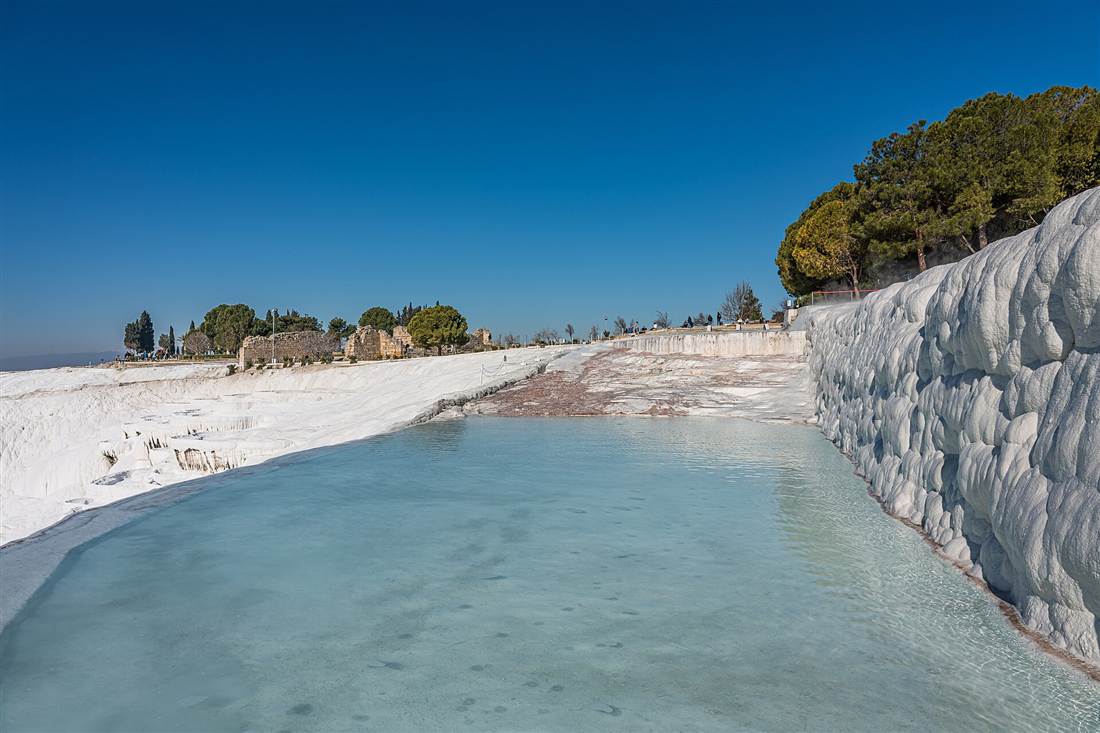
Pamukkale lies about 230 kilometres north-west of Antalya, a three-and-a-half to four-hour drive over the Taurus mountains. A guided day tour with hotel pickup is the direct way to reach the travertines and Hierapolis, with the intercity bus and self-drive as the independent routes. Plan the whole trip with Greece Tours.
This guide covers getting to Pamukkale from Antalya in full: the distance and journey time over the mountains, the guided day tour, the bus, self-drive and the airport transfer, whether the day trip is worth the long day, what a tour includes, the day-trip versus overnight choice, combining Pamukkale with Salda Lake, the cost, and the best time to travel.
How do you get from Antalya to Pamukkale?
Three routes connect Antalya to Pamukkale across roughly 230 kilometres of the Taurus mountains: a guided day tour with hotel pickup, an intercity coach to Denizli then a shuttle, or a self-drive hire car. Each covers the distance in about 3.5 to 4 hours.
The guided day tour is the route most Antalya visitors take. A coach collects you from your hotel along the Antalya, Belek and Side coast at dawn, a licensed guide travels with the group, and the price folds in the entrance fee to the Pamukkale-Hierapolis site plus a lunch stop near the travertines. The full day runs about 13 to 14 hours door to door, and the driving is handled for you across the mountain passes.
The intercity bus suits independent travellers on a budget. Coaches leave the Antalya otogar through the day for the Denizli otogar, a journey of about 4 hours, and a free servis minibus links Denizli to Pamukkale village at the foot of the white terraces. The self-drive option gives the most freedom: a hire car crosses the Taurus at your own pace, with stops for photographs on the winding climb, and parking sits a short walk from the south gate of the site.
The choice comes down to control against convenience. The tour removes every logistical decision and delivers a guide who explains the Roman ruins of Hierapolis; the bus costs the least but demands two changes; the hire car trades a higher day rate for the freedom to linger at the calcium pools until the light turns gold. All three arrive at the same terraces above the Curuksu valley.
Timing anchors every route. Pamukkale sits a long half-day from the coast, so a same-day return from Antalya starts before sunrise and ends after dark whichever method you pick. Travellers who resist the pre-dawn alarm split the journey with a night in Pamukkale village or in Denizli, walk the terraces in the soft early light before the coach convoys arrive, and treat the mountain crossing as a leg of the holiday rather than a chore. The distance dictates the shape of the day more than the transport does.
What is the distance and journey time from Antalya to Pamukkale?
Antalya to Pamukkale measures about 230 to 250 kilometres by road, covered in roughly 3.5 to 4 hours of driving. The mountain route runs far longer than the straight-line map distance because the road climbs and folds through the Taurus range.
Two main road corridors link the coast to the terraces. The shorter line threads inland from Antalya through Korkuteli, a direct mountain road that crosses high plateaus and pine forest before dropping toward Denizli. The alternative swings north-east on the Burdur motorway, a faster surfaced dual carriageway that adds kilometres but trims the twisting single-lane sections, and drivers who prize a smooth journey favour it despite the extra distance.
The straight-line distance between Antalya and Pamukkale sits near 160 kilometres, yet no road follows that line. The Taurus mountains stand directly between the two, so every route detours around ridges and through valleys, stretching the real driving distance to 230 kilometres and beyond. This gap between map distance and road distance catches out first-time visitors who budget too little time for the crossing.
Journey time shifts with the season and the traffic on the Antalya ring road. A clear run over the Korkuteli road lands near 3.5 hours; the Burdur motorway route, with its higher speed limits, holds a similar total despite the longer path. Summer coach convoys and roadworks on the mountain sections push the figure toward 4 hours, and a coffee halt at a mountain rest stop adds a further 20 to 30 minutes to the door-to-door total.
Pickup point widens the range. A tour that gathers guests from Kemer, Side or a far Belek resort adds 40 to 60 minutes of coastal driving before the coach even turns inland, which stretches the effective travel time beyond the raw Antalya-to-Pamukkale figure. Guests measuring the day plan around door-to-door hours, not the road-atlas distance, and factor the collection run into the total.
The elevation profile explains the pace. The road climbs from sea level on the Antalya coast to mountain passes above 1,000 metres before descending into the Denizli basin, and the gradient holds coaches and cars to steady speeds on the ascent. This vertical climb, invisible on a flat map, is the reason a 230-kilometre road journey demands the better part of four hours rather than the two a motorway of that length promises.
How do you take a guided day tour from Antalya to Pamukkale?
A guided Pamukkale day tour starts with a dawn hotel pickup along the Antalya, Belek, Lara and Side coast, travels by air-conditioned coach with a licensed guide, and includes the site entrance and a buffet lunch. The travertines and Hierapolis fill the middle of a 13 to 14 hour day.
The pickup window opens early because the drive eats the first slice of the day. A minibus gathers guests from scattered resorts and transfers them to a larger coach at a meeting point, and the convoy sets off north across the Taurus. The guide uses the road time to outline the geology of the calcium-laden springs and the history of the Roman spa city that grew above them, so passengers arrive primed rather than cold.
On site the group walks the white travertine terraces barefoot, as the site rules require, then crosses into the ruins of Hierapolis. The itinerary takes in the vast necropolis, the colonnaded main street, the restored Roman theatre carved into the hillside, and the edge of the sacred Antique Pool where broken marble columns lie on the pool floor. Lunch falls at a restaurant near the lower village, and the price of the tour absorbs the site entry fee that independent travellers pay at the gate.
The return coach rolls out in late afternoon and retraces the mountain road to the coast, dropping guests back at their hotels after dark. Booking ahead secures the pickup and locks the guide and entrance into one price, which removes the queue at the ticket window and the guesswork of the bus timetable. The single long day covers what a self-guided trip splits across a night in Denizli.
Tour formats split into two clear tiers. The standard group coach tour holds the lowest price and fills a full-size vehicle with guests drawn from across the coast, while a private tour puts a car, a driver and a dedicated guide at the disposal of one party, sets its own pace, and skips the multi-hotel pickup crawl. The private format costs more per head but suits families with small children who struggle with a 14-hour group schedule.
What the price includes decides the value. A complete Pamukkale day tour bundles the round-trip coach, the licensed guide, the site entrance fee and a buffet lunch into one figure paid at booking; the Antique Pool swim, where visitors bathe among sunken Roman columns in warm mineral water, carries a separate ticket paid on site. Reading the inclusions before booking prevents surprise charges at the gate and clarifies which extras fall outside the headline price.
How do you get from Antalya to Pamukkale by bus?
Take an intercity coach from the Antalya otogar to the Denizli otogar, a ride of about 4 hours across the mountains, then board the free servis minibus that carries ticket holders the final 20 kilometres to Pamukkale village at the foot of the terraces.
The Antalya otogar sits on the northern edge of the city, reached by the Antray tram or a short taxi from the centre. Rival coach firms run the Denizli line through the day from early morning, and a one-way ticket falls in a modest price range that undercuts every other route. The coaches carry air conditioning, a steward with tea and water, and a rest halt at a mountain services roughly halfway.
Denizli is the transport hub for the whole Pamukkale region; the terraces themselves have no long-distance coach station. On arrival at the Denizli otogar, the same company that sold the ticket runs a servis, a free connecting minibus, out to Pamukkale village. The servis waits on the lower level of the terminal, and the driver checks the coach ticket before the 30-minute run out to the village streets below the white cliff.
The bus route rewards planning. Check the last return servis from Pamukkale to Denizli and the last evening coach from Denizli to Antalya before committing to a day trip, because a missed connection strands travellers overnight. Independent bus travellers who want the terraces at sunset stay a night in Pamukkale village, where small guesthouses cluster within a walk of the south gate, and ride the morning coach back to the coast.
The maths of the bus day is tight. A 4-hour coach out and a 4-hour coach back leave a narrow window on the terraces once the two servis transfers and the ticket queue are counted, so a same-day bus round trip from Antalya delivers a rushed few hours at the site. Travellers who value the low fare accept the pace; those who want to walk the full length of Hierapolis add the overnight stay and turn the trip into two unhurried half-days.
Tickets sell at the otogar counters and through the coach firms’ own apps. Buying a day ahead secures a seat on the morning departure in peak weeks, when demand for the Denizli line runs high, and fixes the fare before the counter prices climb. The seat comes reserved and numbered, and the same booking reference clears the free servis at the Denizli end, so one purchase carries the traveller from the Antalya terminal to the village streets below the white cliff.
What does driving from Antalya to Pamukkale involve?
A hire car from Antalya reaches Pamukkale in about 3.5 to 4 hours over the Taurus mountains, following either the Korkuteli mountain road or the faster Burdur motorway, with car parks a short walk from the south gate of the travertine site.
Car hire desks fill the arrivals hall of Antalya Airport and line the resort strips of Lara, Belek and Side. The drive north climbs quickly out of the coastal plain into pine-clad highlands, and the Korkuteli road delivers the scenery: high plateaus, mountain villages, and long views back toward the Mediterranean on the descent toward Denizli. Drivers who prefer speed over switchbacks take the Burdur motorway, a modern dual carriageway with steady speed limits.
The road surface holds up across both routes, though the mountain sections narrow to single lanes with tight bends that demand attention on the climb and descent. Fuel stations and mountain rest stops punctuate the route at regular intervals, so a tank filled in Antalya covers the round trip with margin to spare. Winter brings snow to the higher passes, and the motorway route stays clearer than the exposed Korkuteli road in cold weather.
Turkish road rules run to the European pattern: drive on the right, headlights on the mountain tunnels, and speed cameras on the motorway sections toward Denizli. An international driving permit alongside the home licence satisfies the hire desk, and the toll on the Burdur motorway settles through the vehicle’s fitted transponder, which the rental firm bills after the return. Parking in Pamukkale village and at the site car parks charges a flat daily rate paid on arrival.
Parking sits close to the terraces. The main pay-and-display car park serves the south gate, the higher entrance that opens onto the ruins of Hierapolis and the walk down across the white terraces, while a second car park serves the lower north gate beside Pamukkale village. Arriving under your own power means beating the coach convoys to the terraces at opening time and staying past their departure for the low evening light on the calcium pools.
The south gate suits a driving visit best. Entering from the top, above the ruins, lets you walk down through Hierapolis and finish the day descending the barefoot travertine path toward the village, rather than climbing it in the heat. Leaving the car at the south car park and collecting it after the walk turns the site into a one-way route downhill, and the entrance ticket covers both gates so a driver picks the direction that fits the day.
Self-drive opens the wider region beyond the terraces. A hire car reaches the ancient city of Laodicea a short distance toward Denizli, the ruins of Aphrodisias further west, and the highland lakes north of Burdur, none of which a fixed coach tour visits. Drivers who build a two-day loop from Antalya string these sites together around a night in Pamukkale village and return over the mountains with the terraces as one stop among others.
How do you get from Antalya Airport to Pamukkale?
From Antalya Airport, a pre-booked private transfer or a hire car reaches Pamukkale in about 4 hours across the Taurus mountains. The airport sits on the eastern edge of Antalya, a short hop from the ring road that feeds both the Korkuteli and Burdur routes north.
Antalya Airport is the main gateway for the entire Turkish Riviera, with two international terminals and a domestic terminal handling holiday traffic from across Europe. A private transfer booked before arrival waits in the meeting hall with a name board and drives straight to Pamukkale village, which suits families and groups who want the door-to-door run without changing vehicles. The transfer price scales with the size of the car and the party.
Hiring a car at the airport puts the whole route under your control from the moment you land. The desks stand in the arrivals area of each terminal, and the airport slip road joins the Antalya ring road within minutes, from where signs point north toward Burdur and Denizli. The 230-kilometre run to the terraces takes about 3.5 to 4 hours depending on the route and the rest stops.
Travellers who land late and want the terraces the next morning stay a first night in Pamukkale village rather than driving tired over mountain roads after dark. A morning departure from the airport, by contrast, delivers arrival at the white cliff by early afternoon with time to walk the terraces and the ruins of Hierapolis before the return leg. Booking the transfer or the car in advance of the flight secures the vehicle in peak holiday weeks when airport demand runs high.
A private transfer runs on your flight, not a timetable. The driver tracks the arrival, waits through a delay at no extra charge on most bookings, and loads luggage straight into the car, which removes the tram, the otogar and the two bus changes that the public route demands. Families landing with children and cases value the direct run north over the effort of hauling bags through the Antalya terminal to a coach.
Denizli’s own airport sits far closer to the terraces than Antalya’s for travellers arriving by domestic flight. A hop from Istanbul or Ankara into Denizli lands within about an hour’s drive of Pamukkale, which skips the Taurus crossing entirely. Visitors already based on the Antalya coast, though, cross the mountains by road whichever way they cut it, and the airport-to-terraces run holds near the 4-hour mark from the Antalya side.
How do cruise and resort guests reach Pamukkale from the Antalya coast?
Booked day tours collect resort and cruise guests from Belek, Side, Kemer and Lara, cross the Taurus to the travertines and Hierapolis, and return the same evening. The full day runs 13 to 14 hours because the coast-to-terraces distance nears 250 kilometres.
Pickup reaches the length of the Antalya coast. Guests staying in the golf resorts of Belek, the beach hotels of Lara, the harbour town of Side, or the pine-backed bays of Kemer all fall inside the tour pickup network, though the exact departure time shifts with the distance from the mountain road. Kemer and Side guests, further from the route north, leave earliest, while Antalya-city hotels board last before the coach turns inland.
Cruise passengers docking at the Antalya port face the same arithmetic. The terraces stand a full 230 to 250 kilometres inland over mountain roads, so a Pamukkale excursion consumes the entire port day and demands a ship return time that clears a 14-hour round trip. A booked shore excursion, timed to the vessel’s schedule, removes the risk of a missed sailing that dogs an independent bus attempt.
The long day is the trade for reaching one of Turkey’s signature sights from the coast. The booked tour flattens the logistics: one fixed price covers the coach across the Taurus, the licensed guide through the ruins of Hierapolis, the entrance to the calcium terraces, and the lunch stop near the white cliff. Resort and cruise guests who want the travertines without a night away from the coast take the booked day tour and return to their hotel or ship by night.
Comfort on the road shapes the choice for coast-based guests. The distance means five to six hours in a vehicle across the two legs, so the coach quality, the air conditioning, the leg room and the rest-stop schedule carry real weight. A well-run tour breaks the outbound drive with a mid-morning halt for refreshments and the return with an early-evening stop, which keeps the mountain crossing bearable for guests unused to long transfers.
The alternative to the day trip is a coastal excursion closer to home. Guests who baulk at the 14-hour Pamukkale run trade the terraces for the ruins of Perge and Aspendos, the waterfalls at Duden and Kursunlu, or a boat day off the Antalya shore, all within a short drive of the resorts. Pamukkale rewards the guests who commit the whole day to it; the terraces and the Roman city justify the long crossing for those who make the journey the centre of their day out from the coast.
Is a Pamukkale day trip from Antalya worth it?
A Pamukkale day trip from Antalya rewards a long day on the road with two of Turkey’s headline sights in one visit: the white travertine terraces and the ruined Roman city of Hierapolis. The early start pays for itself.
The distance from Antalya to Pamukkale runs 230 to 250 kilometres each way, and the coach climbs from sea level over the Taurus range to a plateau at roughly 350 metres. Departure lands between 03:30 and 06:00 depending on your resort, and the return drops you back in Antalya between 19:00 and 21:00. That framing tells the honest story: this is a 13 to 15 hour commitment built around three to four hours on the site itself.
The payoff justifies the mileage for a first-time visitor to Turkey’s interior. The travertines form a cascade of chalk-white basins stepped down a hillside, filled with mineral water at 35 degrees Celsius, and the sight has no rival on the Mediterranean coast. Above the terraces spreads Hierapolis, a spa city of the ancient world with a theatre seating 12,000, a colonnaded main street, a necropolis of more than 1,200 tombs, and the thermal spring where Cleopatra’s Pool now lets bathers swim among fallen marble columns. One drive delivers a geological wonder and a UNESCO World Heritage archaeological zone side by side.
The verdict turns on stamina and time budget. A traveller with a single free day and an appetite for the interior gets full value. A traveller who tires on long transfers, or who prioritises beach hours, weighs the 26 to 30 hours of return travel against the site time and plans an overnight instead. For the planning detail on the destination itself, the Pamukkale travel guide sets out the terraces and the Hierapolis ruins in full.
Pace the day to protect the payoff. Sleep on the outbound coach through the dark mountain hours, save energy for the barefoot walk down the terraces, and keep the phone charged for the theatre and the necropolis shots. The thermal water underfoot stays at bath warmth year-round, so the terrace walk works even on a cool plateau morning. A visitor who treats the drive as rest rather than dead time steps off the coach ready for the site, and the long day reads as one great excursion rather than a slog.
What does a Pamukkale tour from Antalya include?
A standard Pamukkale tour from Antalya includes hotel pickup and drop-off, an air-conditioned coach, a licensed guide, the Hierapolis-Pamukkale entrance ticket, and a buffet lunch. The travertine terraces and the Roman ruins fill the on-site programme, with Cleopatra’s Pool as a paid extra.
Pickup covers hotels across Antalya centre, Lara, Konyaaltı, Belek, Side and Kemer, with the pickup window set earliest for the resorts furthest from the motorway. The coach carries a rest stop each way, roughly two hours into the drive, for tea, toilets and a stretch. Water is provided on board on most operators; confirm at booking rather than assume.
On arrival the guide walks the group through Hierapolis first: the theatre, the main colonnaded street, the Temple of Apollo and the Plutonium, the sacred pool area, and the necropolis. The route then descends to the travertines, where visitors walk barefoot down the terraces as footwear is banned to protect the calcite surface. Lunch is a buffet at a restaurant near the site, included in the headline price. The entrance ticket to the archaeological zone is bundled in; Cleopatra’s Antique Pool charges a separate swim fee paid on the day, and a swimsuit and towel travel in your day bag if you plan to bathe.
Read the inclusions line by line before you book. Budget tours quote a low headline figure and then add lunch, the entrance ticket or Cleopatra’s Pool as extras, while all-inclusive quotes fold lunch and the entrance fee into one number. The Cleopatra’s Pool swim fee sits outside almost every package, so carry cash for it. Guide commentary runs in English on the main coach services, with German, Russian and other languages on scheduled departures from the larger operators.
Pack for the day the inclusions imply. The barefoot terrace walk demands a bag to carry your shoes, the Cleopatra’s Pool swim needs a swimsuit and a towel, and the exposed site calls for sun cream, a hat and a refillable water bottle. A private tour upgrades every included element: a car instead of a coach, a guide dedicated to your party, and pickup and departure times set to your schedule rather than the group’s. Weigh that flexibility against the higher price when the group timetable clashes with how you want to spend the day.
Is a Pamukkale day trip or an overnight from Antalya the better choice?
The day trip suits a tight itinerary and delivers the terraces and Hierapolis in one 13 to 15 hour push. An overnight in Pamukkale village earns sunrise on the travertines, a quiet swim in Cleopatra’s Pool, and time for nearby Laodicea, at the cost of a second travel day.
The day-trip case is simple arithmetic. One departure, one return, three to four hours on the ground, and you sleep in your own Antalya bed. It fits a coastal holiday where the beach is the anchor and Pamukkale is the one inland excursion. The trade-off is the compression: you arrive with the midday crowds, the terraces sit under the hardest light, and the coach clock caps your museum and pool time.
The overnight case is about the hours the day trip cannot buy. Sleeping in Pamukkale village, a five-minute walk from the lower gate, puts you on the terraces at opening before the tour coaches arrive from the coast, and back at Cleopatra’s Pool in the calm of early morning. A second morning frees time for Laodicea, the ruined city 10 kilometres north, and for the Hierapolis Archaeology Museum housed in the old Roman baths. Village guesthouses run modest room rates, so the extra night adds a small cost against a large gain in experience. A traveller who wants the photograph of empty white basins at dawn chooses the overnight without hesitation.
What is the best way to get from Antalya to Pamukkale?
The guided coach tour is the best way for most visitors: it removes the mountain drive, bundles the guide and tickets, and needs no planning. Self-drive suits travellers who want to set their own hours and stop at Salda Lake, and the intercity bus serves budget solo trips via Denizli.
The guided tour wins on the road itself. The route crosses the Taurus mountains on a climbing, curving highway, and handing that drive to a professional lets you watch the scenery instead of the switchbacks. The package price folds in the entrance ticket and lunch, the guide interprets Hierapolis, and pickup at your hotel door removes every logistics decision. This is the default choice for first-time visitors and for families.
Self-drive answers a different priority: freedom. A hire car lets you leave before dawn, detour to Salda Lake, linger at the terraces past the tour departure time, and drive back at your own pace. Reckon two hours 45 minutes to three hours 30 minutes each way, plus fuel and parking at the site. The intercity bus is the budget route: a coach from Antalya otogar to Denizli takes three to four hours, then a local dolmuş or municipal bus covers the final 20 kilometres to Pamukkale village. The verdict by traveller type: coach tour for convenience and interpretation, hire car for flexibility and the lake detour, intercity bus for the lowest fare.
Match the route to who is travelling. A couple on a first Turkey trip takes the guided coach and lets the operator handle the road, the tickets and the timing. An independent pair who value spontaneity hire a car and build the Salda detour into the plan. A solo backpacker counting every lira rides the Denizli bus and connects to the village dolmuş. A family with young children leans to the private tour, where the car seats and the flexible stops beat a 15-hour group schedule. The route decision follows the traveller, not the other way round.
What do you see on the drive from Antalya to Pamukkale?
The drive climbs from the Mediterranean coast through the Taurus mountains, past pine forest and mountain villages, onto the Anatolian plateau. The road runs near Lake Salda, crosses fertile farmland, and enters the city of Denizli before the final approach to Pamukkale.
The first hour leaves the Antalya plain and gains height fast. The highway threads gorges and forested slopes of the Taurus, with roadside stalls selling honey, pine nuts and fresh fruit at the higher passes. The engineering of the climb is part of the journey: long ascents, tight bends, and views back down toward the coast on the clearest mornings.
Beyond the summit the land opens into the plateau. The Burdur and Denizli plains carry orchards, cotton fields and grazing land, and the pale outline of Lake Salda appears off the route near Yeşilova, its white shoreline visible from the road. Denizli, a textile and industrial city of half a million people, marks the last leg; from its edge the travertine hillside of Pamukkale shows as a white scar on the green slope 20 kilometres out. The contrast of dark mountain forest at the start and bright chalk terraces at the finish frames the whole drive.
Does a combined tour pair Pamukkale with Salda Lake from Antalya?
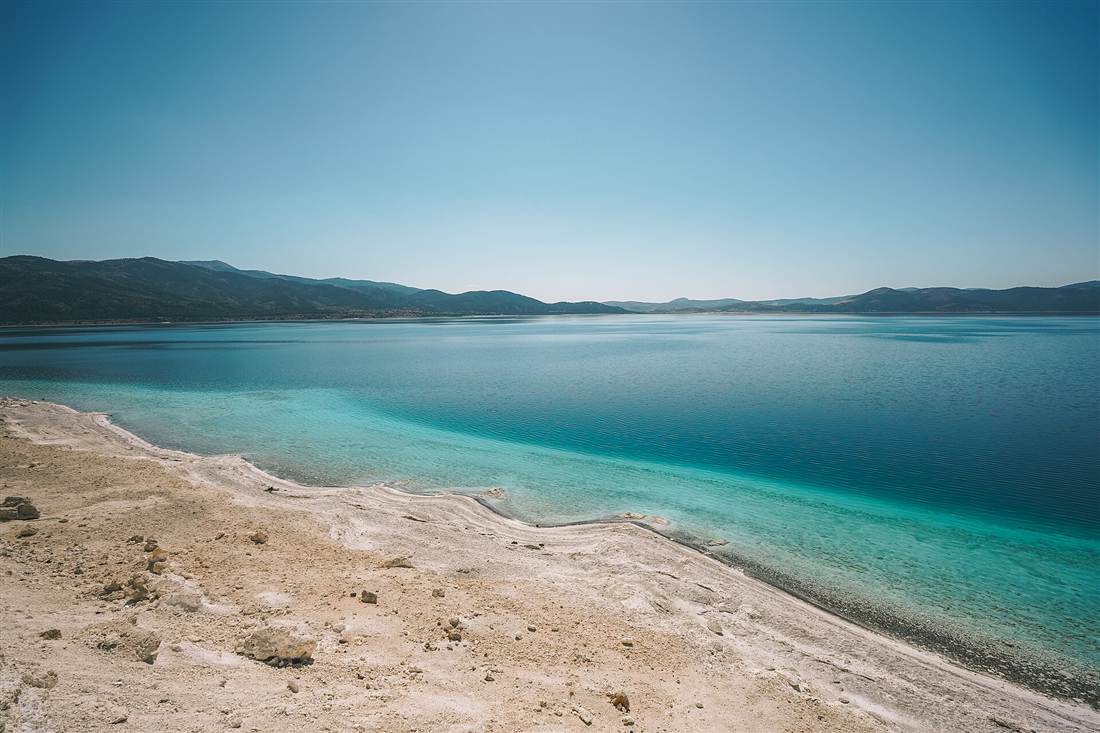
Yes. Salda Lake sits near the Antalya-to-Pamukkale road, and combined day tours pair the two: a morning stop at the white-sand, turquoise crater lake dubbed the “Turkish Maldives”, then the travertines and Hierapolis. The combined tour runs longer than the Pamukkale-only day.
Salda Lake lies near Yeşilova in Burdur province, about 155 kilometres from Antalya and directly on the inland route, which makes the pairing geographically clean rather than a backtrack. The lake is a deep crater basin ringed with brilliant white beaches of hydromagnesite sand, and its mineral-rich water shifts from turquoise in the shallows to deep blue over the depths. The white sand and clear water earned it the “Turkish Maldives” tag, and its geology drew NASA study for its resemblance to sediments on Mars.
The combined tour front-loads the lake in the morning, allowing a walk on the white beaches and a swim in the shallow bays, then continues to Pamukkale for the terraces, Hierapolis and lunch. The full day stretches to 15 to 16 hours given the two sites, so it demands more stamina than the single-site trip. A self-driver builds the same route without a fixed timetable, stopping at the lake for as long as the day allows before pressing on to the terraces. Bring a swimsuit for both the lake and Cleopatra’s Pool.
Guard the lake’s fragile edge. Salda’s white shore is a protected natural area, and access to the most brilliant beach sections is restricted to protect the hydromagnesite sediment, so the swimming and walking zones concentrate at designated bays. The mineral sand doubles as a natural skin treatment, and visitors coat themselves in the white clay along the water’s edge. Pair the lake’s cool freshwater swim in the morning with the warm thermal soak at Cleopatra’s Pool in the afternoon, and the combined day delivers two contrasting waters in a single loop from Antalya.
When is the best time to travel from Antalya to Pamukkale?
Spring and autumn — April to June and September to October — are the best times, with mild plateau temperatures for walking the terraces and comfortable coach travel. The early departure beats the midday crowds and the summer heat, when coastal Antalya climbs past 40 degrees Celsius.
Temperature drives the timing. The travertines offer no shade, and the walk down the terraces and around Hierapolis exposes you to the full sun. In high summer the plateau hits the mid-30s and the coast tops 40 degrees, so a July or August visit means an even earlier start and a mid-morning finish on the terraces before the heat peaks. Spring brings green hillsides and wildflowers across the plateau; autumn brings settled skies and warm-but-bearable days.
Timing within the day matters as much as the season. The first coaches from the coast reach the site around 10:30 to 11:00, so an early independent arrival, or an overnight in the village, buys a window of quieter terraces. Winter travel works for the site itself — the thermal water stays warm and the crowds thin — but the mountain road carries fog and the risk of ice on the high passes, and daylight for the drive shortens. For the balance of comfortable walking weather and reliable road conditions, the shoulder months lead.
How much does it cost to get from Antalya to Pamukkale?
A guided day tour from Antalya runs from a budget group rate to a mid-range all-inclusive figure per person, lunch and entrance ticket bundled. The intercity bus is the cheapest route at a low one-way fare via Denizli. A hire car costs a daily rental rate plus fuel for the 460 to 500 kilometre round trip.
Tour pricing splits by inclusion. A stripped budget group tour quotes the lowest headline number and lists lunch, the Hierapolis entrance ticket and Cleopatra’s Pool as separate add-ons. An all-inclusive group tour folds lunch and the site entrance into one price, and a private tour with a dedicated car and guide sits well above the group rate. Read the inclusions before comparing figures, because two tours at different prices sometimes cover different things once the extras are added.
Independent routes shift the maths. The intercity bus to Denizli plus the local connection to Pamukkale village is the lowest-cost option, though it trades money for a longer, self-navigated day. A hire car spreads a fixed daily rate across the group, so a family of four splits the rental and fuel into a competitive per-head figure while gaining flexibility. Fixed extras stay constant on every route: the Hierapolis-Pamukkale entrance ticket, and the separate Cleopatra’s Pool swim fee, both paid on the day. Budget cash for the pool, the rest stops and any souvenirs, as card acceptance thins at the smaller roadside points along the mountain highway.
Do multi-day routes link Pamukkale from Antalya to Cappadocia or the coast?
Yes. Pamukkale sits on the main inland circuit, so multi-day routes chain it with Cappadocia to the east or with the Aegean coast — Ephesus, Kuşadası and Bodrum — to the west. Operators run two- to five-day tours that start in Antalya and end at either destination.
The Cappadocia link runs east. A two- or three-day tour departs Antalya, takes in Pamukkale on day one, overnights in the village or in Konya, and drives on to the rock valleys, cave churches and hot-air balloon fields of Cappadocia. The Antalya-to-Cappadocia road covers roughly 550 kilometres, so the tour breaks the distance with the Pamukkale stop rather than driving it in one push. This route suits a traveller building a Turkey highlights loop from a coastal base.
The Aegean link runs west. Pamukkale pairs naturally with Ephesus, the best-preserved classical city on the Mediterranean, 190 kilometres further on toward the coast at Selçuk, and from there with Kuşadası and Bodrum for a beach finish. A two-day Pamukkale-and-Ephesus tour from Antalya covers both UNESCO sites with one overnight in between. For a traveller open to a one-way itinerary, ending at the Aegean coast rather than returning to Antalya turns the transfer time into progress across the country instead of a round-trip repeat.
Structure the multi-day trip around the overnight points. Denizli and Pamukkale village anchor the first night on both the eastern and western routes, which makes the terraces the natural pivot of any Turkey loop out of Antalya. From the pivot the road forks: east through Konya to Cappadocia’s balloon country, or west through Aphrodisias and Ephesus to the Aegean shore. A traveller with three to five days threads Pamukkale, one classical city and one landscape wonder into a single arc, and the Antalya start point works whether the trip ends back on the Turquoise Coast or hands off to a departure flight from İzmir or Kayseri.
Frequently Asked Questions
How far is Pamukkale from Antalya?
Pamukkale is about 230 kilometres from Antalya, a three-and-a-half to four-hour drive over the Taurus mountains. A guided day tour covers the round trip with pickup, entry and lunch in a long 13-to-14-hour day.
Is a Pamukkale day trip from Antalya worth it?
The Antalya to Pamukkale day trip rewards the mountain drive with the white travertine terraces, the ruins of Hierapolis and the white-sand Salda Lake on the way, best done on an early guided tour or as an overnight.
How do you get from Antalya to Pamukkale?
From Antalya reach Pamukkale by guided day tour with hotel pickup, by intercity coach to Denizli then a servis, or by hire car over the Taurus. The drive runs three-and-a-half to four hours each way.