
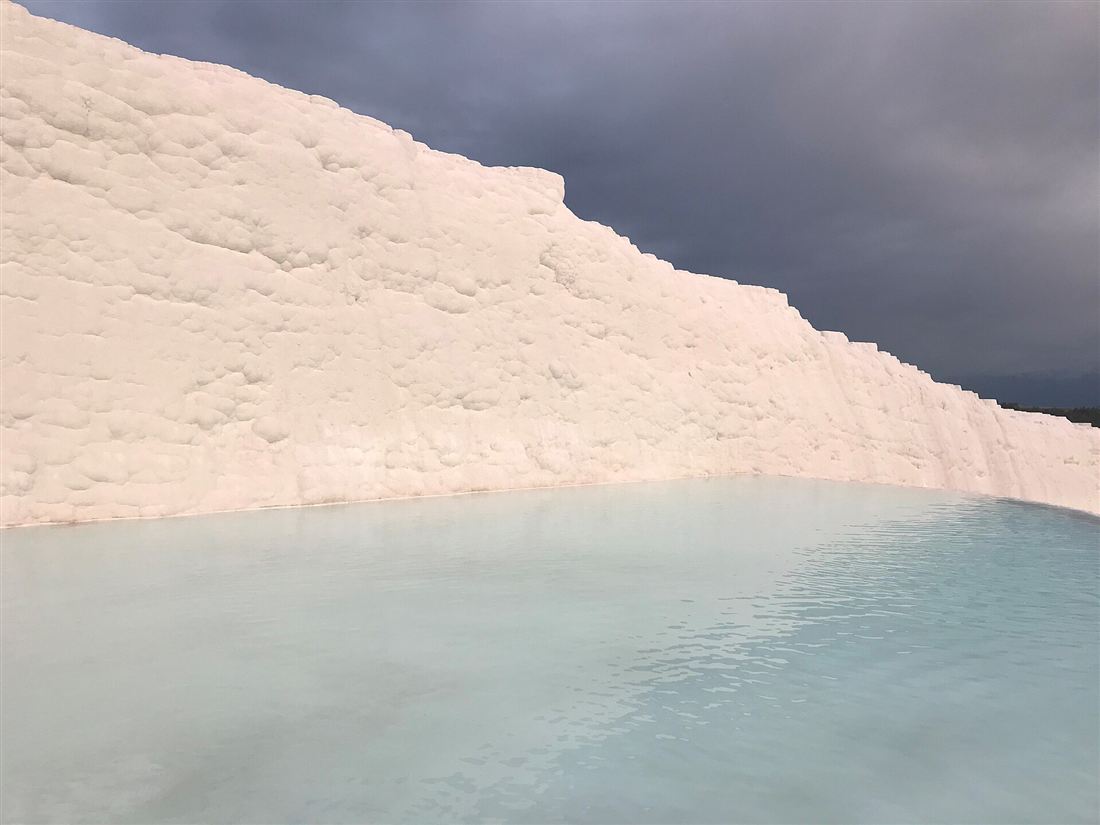
Pamukkale lies about 250 kilometres east of Izmir, a three-hour drive. A guided day tour with hotel pickup is the direct way to reach the travertines and Hierapolis, with the intercity bus, the train and self-drive as the independent alternatives. Plan the whole trip with Greece Tours.
This guide covers getting to Pamukkale from Izmir in full: the distance and journey time, the guided day tour, the bus, the train, self-drive and the airport transfer, whether the day trip is worth it, what a tour includes, the day-trip versus overnight choice, the cost, and how to combine Pamukkale with Ephesus.
How do you get from Izmir to Pamukkale?
Four routes connect Izmir to Pamukkale, a distance of roughly 250 km east: a guided day tour with hotel pickup, an intercity coach to Denizli then a shuttle, the TCDD regional train to Denizli, or a self-drive car hire, each taking about three hours by road.
The guided day tour delivers the fewest moving parts. A coach collects travellers from Izmir hotels in the early morning, a licensed guide narrates the drive, and the fare bundles the Hierapolis-Pamukkale entry ticket, lunch and the return. This route removes every transfer decision and returns to Izmir the same evening after an eleven to twelve hour day.
Independent travellers weigh three self-managed alternatives. The intercity coach runs from Izmir otogar to Denizli otogar in about three and a half to four hours, and a free servis minibus then covers the final 20 km to Pamukkale village. The TCDD train departs Izmir Basmane for Denizli across roughly five hours, connecting to a dolmus for the last leg. A hire car grants full control over timing and nearby stops, driving the motorway east through Aydin province.
The choice divides on priorities. Travellers who prize a stress-free single day book the guided tour. Travellers who prize a low fare and a flexible schedule take the coach or the train. Travellers who plan to link Pamukkale with Aphrodisias, Laodicea or a Denizli overnight hire a car and set their own pace across the 250 km corridor.
Every route shares one geographic fact: Denizli is the hub. The province capital sits 20 km short of the terraces, and its combined coach terminal and railway station feed the servis shuttles and dolmus minibuses that make the final climb to Pamukkale village. Coach passengers, rail passengers and connecting travellers all pass through Denizli, so the last 20 km stay identical whatever the long-haul mode. This makes the decision from Izmir a decision purely about the main leg east, with the village transfer a settled constant.
What is the distance and journey time from Izmir to Pamukkale?
Izmir sits roughly 250 km west of Pamukkale, and the drive runs about three hours on the modern road. The route heads south-east from Izmir through Aydin, tracks the Buyuk Menderes valley past Nazilli, and climbs to the Denizli plain where the white travertine terraces of Hierapolis-Pamukkale stand.
The road distance holds near 250 km whether a driver takes the Aydin motorway or the older parallel highway. The Otoyol motorway carries traffic swiftly south from Izmir toward Aydin, then a dual carriageway continues east along the fertile Menderes basin through Nazilli and Kuyucak. The final approach lifts onto the Denizli tableland, where Pamukkale village sits at the foot of the calcite cliffs. Total driving time settles between three hours and three hours twenty minutes without stops.
Journey time by public transport stretches the clock. The intercity coach adds otogar waiting, boarding and a servis connection, so the door-to-door total reaches four and a half to five hours. The TCDD regional train, threading a slower rail alignment through the valley, runs about five hours to Denizli station before the dolmus transfer to Pamukkale. Every route funnels through Denizli, the province capital 20 km short of the terraces, which serves as the natural gateway for coach, rail and shuttle traffic alike.
Distance from the specific pickup point shifts the figure slightly. Central Izmir hotels near Konak and Alsancak sit closest to the motorway on-ramp, while accommodation on the Cesme peninsula west of the city adds an hour before the eastbound run even begins. Travellers staying near Izmir Adnan Menderes Airport, south of the centre, save a short stretch because the airport already lies on the southern edge of the metropolitan area toward Aydin.
Traffic conditions bend the three-hour figure at the margins. The Izmir end congests during the morning and evening peaks, so a departure before 07:00 or after 09:30 clears the city fastest. The valley highway itself flows freely for most of the run, and the tolled motorway sections carry a steady pace. A driver planning a single stop at Nazilli or Kuyucak for fuel and refreshment adds twenty to thirty minutes without straining the day. The consistent 250 km road distance and three-hour core drive make Izmir one of the closest major cities to Pamukkale, ahead of Antalya, Bodrum and Marmaris.
How do you take a guided day tour from Izmir to Pamukkale?
A guided day tour starts with hotel pickup in Izmir around 06:00, a coach transfer east across roughly three hours, a licensed guide leading the Hierapolis-Pamukkale visit with entry and lunch included, and a return that lands back in Izmir by early evening after an eleven to twelve hour day.
The morning opens with a scheduled pickup from Izmir city-centre hotels, and the coach departs while the roads stay clear. A guide introduces the geology of the travertines and the history of the Roman spa city during the drive along the Menderes valley. Operators time the arrival at Pamukkale for late morning, ahead of the midday crowds that build at the terraces.
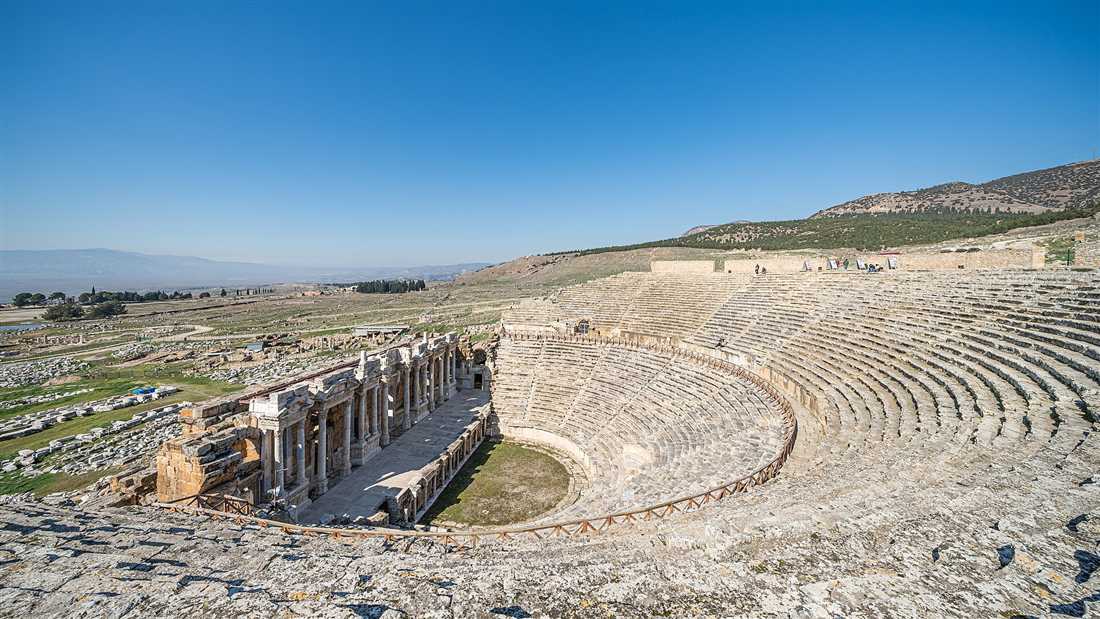
On site the guide walks the group across the white calcite pools, up to the ancient theatre of Hierapolis, past the Temple of Apollo and the vast necropolis, and to the Antique Pool where thermal spring water flows over submerged marble columns. The bundled ticket covers the archaeological site; the Antique Pool swim carries a separate fee paid on the day. A buffet lunch at a local restaurant sits inside the standard package.
The return coach leaves Pamukkale in mid-afternoon and retraces the 250 km west, dropping travellers at their Izmir hotels in the early evening. The full-day format suits visitors on a tight Izmir base who want the site interpreted and every transfer arranged. Group tours run daily in the high season and on fixed departure days off-season; private tours run to a requested schedule at a higher fare. Prices for a shared group tour range from roughly 40 to 90 euros per person depending on inclusions and season.
The guide adds context the site’s sparse signage leaves out. Interpretation covers the sacred spring that made Hierapolis a Greco-Roman healing centre, the mechanism by which calcium-rich thermal water deposits the white travertine over the cliff face, and the earthquake history that shaped the ruined city. A guide also steers the group to the strongest photo points on the terraces and paces the visit so the theatre, the necropolis and the pools all fit the on-site window.
Practical inclusions vary between operators, so a traveller checks the itinerary before booking. The base fare covers transport, guide and the site entry ticket; lunch appears in most packages as a buffet at a Pamukkale restaurant. The Antique Pool swim, sturdy footwear for the terrace boardwalk and a swimsuit for those planning to bathe are the traveller’s own responsibility. The white travertine is walked barefoot to protect the calcite, so shoes come off at the terraces and go back on for Hierapolis above.
How do you get from Izmir to Pamukkale by bus?
The bus route runs an intercity coach from Izmir otogar to Denizli otogar in about three and a half to four hours, then a free servis minibus from the coach company covers the final 20 km to Pamukkale village. Fares for the coach leg sit around 300 to 500 Turkish lira.
Izmir’s main intercity bus terminal, the otogar at Bornova, dispatches frequent departures east to Denizli through the day with operators such as Pamukkale, Metro Turizm and Kamil Koc. Coaches leave through the morning and afternoon, so a traveller matches a departure to an early start. The vehicles carry reclining seats, air conditioning and onboard refreshment service across the three-and-a-half to four-hour run down the Menderes valley.
At Denizli otogar the connection is the servis, a complimentary shuttle that Turkish coach companies operate from their arrival terminals to the town centre and onward destinations. Passengers show the coach ticket and board the servis marked for Pamukkale, which climbs the 20 km from Denizli to the village at the base of the terraces. Where a direct servis to Pamukkale is not timed to the arrival, a city dolmus from Denizli otogar to Pamukkale departs at short intervals for a small separate fare.
The bus route delivers a low cost and a dependable frequency, and it drops travellers inside Pamukkale village within walking distance of the site’s lower entrance. The trade-off is the transfer at Denizli and a total door-to-door time near five hours. Travellers who plan to stay overnight in Pamukkale, rather than return to Izmir the same day, favour the coach for its flexibility and its late departures back west.
Booking the coach is straightforward. Tickets sell at the operator counters inside Izmir otogar, through the company websites and via the aggregator platforms that list Turkish intercity routes with seat selection. Buying a day ahead secures a morning departure in peak season, while off-season travellers walk up and board the next service. The coach names to look for on the Izmir-Denizli corridor are Pamukkale, Metro Turizm, Kamil Koc and Pamukkale-branded regional carriers, all running modern fleets with assigned seating.
The return follows the same pattern in reverse. Denizli otogar dispatches coaches west to Izmir through the day and into the evening, so a Pamukkale visitor rides the servis or dolmus down from the village to Denizli, then boards a westbound coach. The late departures mean a traveller squeezes a full day at the terraces and still reaches Izmir the same night, which the fixed-time guided tour does not allow.
Is there a train from Izmir to Pamukkale?
A TCDD regional train runs from Izmir Basmane station to Denizli in about five hours, and a dolmus then covers the final 20 km from Denizli to Pamukkale village. No railway reaches Pamukkale directly, so Denizli station is the rail terminus for the terraces.
The state railway TCDD operates the Izmir-Denizli regional service from Basmane, the historic central station in Izmir. The train threads south-east through Aydin and along the Buyuk Menderes valley, calling at Nazilli, Kuyucak and Saraykoy before terminating at Denizli. The alignment follows the river plain closely, so the ride offers valley scenery across roughly five hours at a steady regional pace. Fares stay very low, well under the coach price, which draws budget travellers to the rail option.
From Denizli railway station the onward leg mirrors the bus route. A dolmus to Pamukkale departs from the station forecourt or the adjacent otogar at frequent intervals through the day, running the 20 km up to the village for a small fare paid to the driver. The transfer is straightforward and signposted, and Denizli’s train and coach terminals sit close together.
The train appeals to travellers who value the low fare and a relaxed valley journey over speed. Two to three departures run each day, so a rail traveller checks the TCDD timetable and books an early service to reach Pamukkale with the site’s full opening hours ahead. The longer five-hour duration rules the train out for a same-day return to Izmir, so it pairs naturally with a Pamukkale or Denizli overnight.
Basmane station itself sits in central Izmir, a short tram or metro ride from the Konak and Alsancak hotel districts, which makes the rail start convenient for city-centre travellers. The station is a functioning terminus with ticket windows and a waiting hall, and tickets sell on the day for the regional service. The carriages are basic regional stock rather than a high-speed set, so the appeal rests on scenery and price, not on transit time.
The valley run rewards the patient traveller. The line hugs the Buyuk Menderes as it winds east, passing cotton fields, olive groves and the small valley towns of Aydin province, a slower and more scenic passage than the parallel motorway offers a coach. For travellers building a two-day Pamukkale trip from Izmir, the outbound train and a coach return, or the reverse, combines the scenery of the rail with the speed of the road across the same 250 km corridor.
Can you drive from Izmir to Pamukkale?
A self-drive from Izmir to Pamukkale runs about three hours over 250 km on the Aydin motorway and the Menderes valley highway. Car hire desks operate at Izmir Adnan Menderes Airport and across the city centre, and free parking sits at both Pamukkale site entrances.
The drive leaves Izmir south on the Otoyol toward Aydin, a fast toll motorway that clears the metropolitan traffic quickly. Beyond Aydin the road becomes a dual-carriageway highway tracking the Buyuk Menderes river east through Nazilli, Kuyucak and Saraykoy, an easy well-surfaced route with fuel stations and rest stops along the way. The final stretch rises to the Denizli plain and turns north the last 20 km to Pamukkale village. Total time holds near three hours to three hours twenty minutes, and toll payment uses the electronic HGS sticker that hire cars carry pre-fitted.
Car hire multiplies the itinerary. A driver links Pamukkale with the marble city of Aphrodisias 80 km to the south-west, the ruins of Laodicea just outside Denizli, or a continuation east toward Lake Salda. Parking at the northern and southern gates of the Hierapolis-Pamukkale site is free, and both entrances place travellers at a short walk from the travertines. Petrol for the round trip runs a modest sum on top of the daily hire rate, which starts from roughly 25 to 45 euros per day for a compact car.
Driving grants the fullest control over timing, letting a traveller reach the terraces at opening to photograph the white pools before the tour coaches arrive, then linger for the golden light of late afternoon. The route demands nothing beyond a valid licence and confidence on Turkish dual carriageways, and satellite navigation guides the whole run without difficulty.
Two site entrances shape the parking decision. The northern gate sits above Hierapolis and lets a driver descend through the ruined city to the terraces, while the southern gate places visitors nearer the village and the lower travertines. Both have free car parks, so a driver picks the gate that matches the intended walking route. Leaving the car at the north gate and exiting at the south, or the reverse, works for a group willing to walk the site one way.
Fuel and tolls are the running costs to budget. Petrol stations line the valley highway at regular intervals through Aydin province, and the HGS electronic toll sticker pre-fitted to hire cars debits the motorway charges automatically. A driver confirms the HGS account is topped up with the rental desk at pickup to avoid a fine. For a two-centre trip pairing Izmir and Pamukkale with the ancient sites of the Menderes valley, the hire car turns a single-destination day into a flexible multi-stop itinerary.
How do you get from Izmir Airport to Pamukkale?
Izmir Adnan Menderes Airport lies on the southern edge of the city toward Aydin, roughly three hours and 240 km from Pamukkale. Travellers pick up a hire car at the airport desks, book a private transfer, or ride into central Izmir for the coach or train to Denizli.
The airport’s position works in a Pamukkale traveller’s favour. Adnan Menderes sits south of central Izmir on the road toward Aydin, so a driver leaving the terminal joins the eastbound motorway without crossing the city. Car hire counters from the international operators line the arrivals hall, and a self-drive from the airport to the terraces runs about three hours over 240 km on the same Aydin motorway and Menderes valley highway that carries the city-centre route.
Travellers without a hire car book a private transfer direct from the airport to Pamukkale, a door-to-door car or minibus arranged in advance that runs the full distance in about three hours for a fixed fare. The private transfer suits arriving flight passengers who want to reach Pamukkale the same day without returning into Izmir first, and it drops travellers at their village hotel.
The public-transport path routes through the city. The Izban commuter rail and the Havas airport shuttle connect Adnan Menderes with central Izmir, from where the intercity coach at the Bornova otogar or the TCDD train at Basmane continues to Denizli and the servis or dolmus climbs the final 20 km to Pamukkale. This chain costs the least but adds transfers and time, so flight arrivals aiming for a same-day Pamukkale visit favour the hire car or the private transfer over the coach relay.
Timing the flight against the onward journey matters. A morning landing at Adnan Menderes leaves a full day to reach Pamukkale and see the site, whether by hire car in three hours or by the public chain in five. An afternoon or evening arrival points a traveller toward an overnight in Izmir or Denizli, with the eastbound run the next morning. The airport’s twenty-four-hour car hire desks and pre-booked transfers accommodate late flights, so an arrival hour drives the choice more than the mode.
Adnan Menderes serves domestic and international flights, so travellers connecting from Istanbul, other Turkish cities or overseas gateways land at the same terminal and pick up the same three-hour route east. The airport’s location on the Aydin side of Izmir shortens the drive against a start from the northern city districts, making a fly-in, drive-to-Pamukkale plan one of the fastest ways to stand on the travertines within hours of touching down.
Is a Pamukkale day trip from Izmir worth it?
A Pamukkale day trip from Izmir rewards the long day in full. The white travertine terraces and the ruined city of Hierapolis sit 250-270km southeast, a 3 to 3.5-hour drive, and one dawn departure buys both wonders inside a single unbroken visit.
The day runs long by design. Pickup lands between 06:30 and 07:30, and the coach returns to Izmir near 20:00, a 12 to 13-hour round trip. That span covers roughly 500-540km of driving plus four hours on the site itself, so the hours on the road buy the reward at the far end rather than draining it.
The reward justifies the distance. The travertines pour down the hillside in bright calcium-carbonate basins fed by warm mineral springs at a constant 35-38°C, and Hierapolis crowns the ridge above them with a Roman theatre seating 12,000, a necropolis of over 1,200 tombs, and a colonnaded marble main street a kilometre long. Walking barefoot across the warm white shelves and then stepping straight into an ancient Roman city delivers two distinct experiences on one ticket.
The early start is the mechanism that makes it work. Leaving Izmir at first light puts you on the terraces before the midday coach convoys arrive from the coastal resorts, so the first hour on the white travertines stays quiet and the light stays soft. The full guide to the site sits at Pamukkale.
The verdict favours the traveller who commits to the full day. Anyone treating the outing as a relaxed half-day loses the reward, because the drive alone consumes six hours return. Book the trip on a day with no competing plans, accept the 06:30 alarm, and the 250-270km each way converts into a landmark seen properly rather than glimpsed in a rush.
What does a Pamukkale tour from Izmir include?
A standard Pamukkale tour from Izmir includes hotel pickup, an air-conditioned coach, a licensed English-speaking guide, the Hierapolis-Pamukkale entrance ticket, and a buffet lunch. The itinerary covers the travertine terraces and the ruins of Hierapolis, with the Cleopatra Pool as a paid add-on.
The transport and guiding form the core. A modern coach with reclining seats and air conditioning collects you from central Izmir hotels, and a licensed guide narrates the drive and leads the walk across the site. The single entrance ticket to the combined Hierapolis-Pamukkale archaeological zone is prepaid inside the tour price, so no queue forms at the gate on arrival.
The on-site programme fills the middle of the day. You walk the travertine terraces barefoot along the marked route, tour the theatre and colonnaded street of Hierapolis, and pass the necropolis and the Roman baths. A buffet lunch at a restaurant near the site breaks the visit, and the guide points out the mineral springs that build the white shelves.
The four-hour on-site window sets the pace. Rules require shoes off across the travertine basins to protect the calcium surface, so the walk down the terraces runs barefoot through shallow warm water. The guide allocates time for the museum housed in the Roman baths, the theatre carved into the ridge, and the photo stops along the upper pools before the coach reboards for Izmir.
The Cleopatra Antique Pool sits apart from the main ticket. Swimming among the submerged Roman columns in the warm 36°C spring water carries a separate charge of 300-500 Turkish lira, paid at the poolside gate, and towels and lockers cost extra. The guide flags the entrance and the timing so a swim fits the on-site window.
The inclusions vary by operator, so the fine print settles the value. Standard coach tours cover the buffet lunch and the gate ticket; premium small-group versions add a licensed archaeologist and a wider route through the necropolis. Drinks, the Cleopatra Pool swim, and personal spending fall outside every package, so pack Turkish lira in small notes for the on-site extras.
What is the best way to get from Izmir to Pamukkale?
The guided coach tour is the best way for most travellers, folding transport, ticket, guide, and lunch into one fixed price. A self-drive hire car suits independent visitors who want their own schedule, while the public bus serves budget travellers content to organise the site themselves.
The guided tour removes the logistics. One booking handles the 250-270km each way, the early start, the entrance ticket, and the meal, and the guide supplies the history of Hierapolis on the spot. This route wins for first-time visitors, for anyone without a driving licence, and for travellers who prefer to watch the Menderes valley pass rather than steer through it.
Self-drive wins on freedom. A hire car from Izmir costs 1,200-2,500 Turkish lira per day plus fuel, and the motorway route via the O-31 and the D320 runs 3 to 3.5 hours. Driving yourself lets you leave before the tour coaches, linger past their departure, and detour to Laodicea or Aphrodisias on the same axis.
The public bus fills the budget slot. Frequent departures from Izmir’s Otogar reach Denizli in 3.5 to 4 hours, and a local dolmus covers the final 20km to the village. This route asks the traveller to buy the entrance ticket, arrange lunch, and time the return alone, so it trades the tour’s convenience for a lower fare and full independence on site.
The verdict splits by traveller type. Independent drivers and small groups splitting a car take the wheel; solo travellers, couples wanting the history narrated, and anyone nervous about Turkish motorway traffic take the coach; backpackers on the tightest budget take the intercity bus to Denizli and the connecting shuttle up to the village.
Does the Izmir to Pamukkale trip combine with Ephesus?
Yes. Ephesus sits near Selcuk, 80km south of Izmir and directly on the road toward Pamukkale, so a two-day tour pairs the ancient city with the travertines. Day one covers Ephesus and an overnight in Pamukkale village; day two covers the terraces and Hierapolis before the return.
The geography makes the pairing natural. The route south from Izmir passes Selcuk first, where Ephesus preserves the Library of Celsus, the Great Theatre, and the marble main streets of a Roman provincial capital. Continuing another 180km inland reaches Denizli and the Pamukkale ridge, so the two sites string along one line rather than pulling in opposite directions.
The two-day format solves the timetable. A single day cannot hold both the terraces and a full Ephesus walk without cutting each short, so the overnight version gives Ephesus a proper morning, a night in Pamukkale for a rested start, and the white shelves at dawn. The full Ephesus guide sits at Ephesus.
The combined trip concentrates the region’s headline sights. One booking from Izmir delivers a marble Roman city and a natural terrace of mineral pools, the two most photographed landmarks of western Turkey, without doubling back to the coast between them. Travellers with two free days extract far more from the same drive than a single-site dash allows.
A one-day combined dash exists but strains the schedule. Pairing Ephesus and Pamukkale inside twelve hours forces a fast pass through each, trims the Hierapolis walk, and reaches the terraces near the midday crowd rather than at dawn. Travellers set on both sites in a single day accept the compression; those wanting each done justice take the two-day format and the Pamukkale overnight between them.
Is Pamukkale a day trip or an overnight stay from Izmir?
A day trip suits travellers on a tight timetable who want the terraces and Hierapolis in one outing. An overnight in Pamukkale village suits those chasing sunrise on the empty travertines, an unhurried Cleopatra Pool swim, and the theatre lit at golden hour without the return-drive clock ticking.
The day trip is the efficient choice. It packs the full site into 12-13 hours from Izmir, costs less than a night’s accommodation added on top, and returns you to the city the same evening. For a two or three-night Izmir stay, the single-day format keeps the itinerary tight and leaves the other days free for Ephesus or the coast.
The overnight rewards patience. Staying in Pamukkale village, a short walk below the terraces, puts you at the gate for the 08:00 opening before the coaches arrive, and again at dusk when the light turns the white shelves gold. Village guesthouses charge 800-2,000 Turkish lira a night, and a thermal-pool hotel stretches the mineral-water theme into the evening.
The overnight also unlocks the wider valley. A second morning frees time for Laodicea, an ancient city 10km from Denizli, or the marble ruins of Aphrodisias an hour further, both bypassed by the single-day rush. Staying the night converts a there-and-back errand into a two-site regional loop worked into the same Izmir road.
The decision tracks the traveller’s priority. Time-pressed visitors and those anchored to an Izmir base take the day trip; photographers, slow travellers, and anyone wanting the terraces to themselves at first light take the overnight and treat the drive back as a separate leisurely leg.
When is the best time to travel from Izmir to Pamukkale?
Spring and autumn, from April to June and September to October, deliver the best conditions: mild 20-28°C days, thinner crowds, and comfortable walking on the exposed white terraces. A midweek visit with an early departure from Izmir clears the site before the peak-summer coach convoys arrive.
The shoulder seasons balance heat and crowds. Midsummer pushes the Denizli plain past 38°C, and the reflective white travertines throw the glare back at midday, so April, May, September, and October keep the walk pleasant. These months also thin the visitor numbers that peak in July and August, so the terraces and the Hierapolis theatre stay open rather than packed.
The day of the week shifts the density. Weekends draw domestic visitors from Denizli and Izmir alongside the international coaches, so a Tuesday, Wednesday, or Thursday visit meets fewer people on the same terraces. Booking the trip for midweek trims the queue at the Cleopatra Pool and the photo spots along the upper basins.
Winter shifts the calculus rather than closing it. December to February brings cool 8-14°C days and a chance of rain on the Denizli plain, yet the warm 35-38°C springs still feed the terraces and the crowds fall to their thinnest. A clear winter morning delivers the white shelves almost empty, so the season trades warmth for solitude.
The departure hour decides the first impression. A 06:30 to 07:30 pickup from Izmir reaches the gate near opening, so the first hour on the travertines runs before the resort coaches roll in from Kusadasi and Marmaris around midday. Beating that wave is the single strongest lever on the quality of the visit, in every season.
How much does it cost to get from Izmir to Pamukkale?
An organised day tour from Izmir costs 1,500-3,000 Turkish lira per person including transport, guide, ticket, and lunch. The intercity bus to Denizli runs 300-600 lira each way, the train fare lands lower where it operates, and a hire car costs 1,200-2,500 lira a day plus fuel.
The tour price bundles the whole day. The 1,500-3,000 lira range reflects group size and inclusions: a shared large-coach trip sits at the lower end, while a small-group or private car with a dedicated guide climbs higher. The site entrance ticket, priced around 700-1,100 lira on its own gate, is already inside that figure, so the tour absorbs the single biggest fixed cost.
Independent transport costs less up front and more in effort. The intercity bus from Izmir’s Otogar to Denizli takes 3.5 to 4 hours at 300-600 lira, then a local dolmus shuttle covers the final 20km to the village for a modest fare. Rail links run into Denizli where the service operates, and the entrance ticket, any Cleopatra Pool swim, and meals are then paid separately at the site.
Self-drive spreads the cost across the car. Hire runs 1,200-2,500 lira a day, fuel for the 500-540km round trip adds a further sum, and motorway tolls apply on the O-31 section. Split among three or four people, the per-head figure undercuts the tour, though the driver forgoes the narrated history and organises the ticket and lunch alone.
The cheapest total belongs to the self-organised bus traveller. Round-trip coach fare to Denizli, the dolmus shuttle, and the gate ticket bought on the day add up to less than a guided tour, and skipping the Cleopatra Pool and a restaurant lunch trims the figure further. This route costs the most in time and planning, so it rewards the budget traveller and penalises the time-pressed one.
What do you see on the drive from Izmir to Pamukkale?
The drive from Izmir to Pamukkale threads the Menderes river valley southeast through orchard and cotton country. The route passes Aydin’s olive groves and fig plantations, follows the broad farmland of the Buyuk Menderes plain, and climbs to Denizli before the white terraces rise on the ridge above.
The valley sets the scene early. After leaving the Izmir sprawl, the motorway drops into the Menderes basin, where the meandering river that gave English the word “meander” waters a wide agricultural plain. Rows of fig and olive trees around Aydin, cotton fields, and vineyards roll past the coach window through the middle stretch of the 250-270km run.
The landscape signals the approach. Nazilli and the farming towns of the plain give way to the higher ground around Denizli, a textile city of half a million that serves as the gateway to the site. As the road bends toward the village, the Pamukkale ridge appears across the valley, its white travertine face bright against the brown hillside from kilometres out.
The roadside towns punctuate the run with working Anatolia. Aydin trades in figs and olives, Nazilli in textiles and cotton, and Denizli in the woven towels and cloth that made its name, so the drive reads as a tour of the region’s produce as much as its scenery. Roadside stalls sell dried figs, olives, and local honey along the D-roads for travellers who stop.
The scenery frames the destination rather than competing with it. The three-hour drive builds anticipation as farmland yields to the mineral cliff, and the first glimpse of the white shelves from the valley floor marks the transition from journey to arrival. By the time the coach reaches the gate, the terraces have already announced themselves across the plain.
Can cruise passengers visit Pamukkale from the Izmir port?
Cruise passengers reach Pamukkale on a booked shore excursion. The Izmir cruise terminal at Alsancak sits 250 km from Hierapolis, a three-hour drive each way, so a guaranteed return itinerary protects the ship departure and the six hours on the road.
Ships dock at the Alsancak cruise terminal in central Izmir, and a second stream of Aegean cruises calls at Kusadasi to the south, which trims the road distance to Pamukkale by 40 minutes. From either quay the travertine terraces and the ruins of Hierapolis lie inland, past Aydin and the Buyuk Menderes valley, on a route that climbs from sea level to the calcium-white plateau above Denizli.
The six hours of driving swallow the bulk of a port call, and independent taxis and public coaches carry no obligation to the vessel’s schedule. A shore excursion sold through the cruise line or a licensed local operator commits the driver to the all-aboard time, holds the ship for a delayed group, and builds the return buffer into the plan. That single guarantee is the reason cruise travellers book the transfer rather than improvise the 500 km round trip.
How early do you leave Izmir for a Pamukkale day trip?
Day trips depart Izmir between 06:00 and 07:00. The pre-dawn start delivers travellers to Pamukkale by mid-morning, ahead of the mid-day tour coaches and before the plateau heat builds over the exposed white terraces and the open ruins of Hierapolis.
Hotel pickups in the Alsancak, Konak and Kordon districts begin in darkness, and the minibus clears the Izmir ring road while the motorway to Aydin stays empty. The three-hour transfer down the O-31 and the Denizli highway puts the first arrivals at the lower gate around 09:30, when the pools reflect the morning light and the terrace walkways stand near empty.
The early departure earns two rewards. Coaches from Kusadasi, Marmaris and Bodrum converge on Pamukkale near midday, so a mid-morning arrival buys clear photographs and an unhurried barefoot walk across the calcium shelves. The plateau also bakes under the Aegean summer sun, and shade is scarce among the travertines and the ruined streets, so the cooler hours before noon carry the comfortable part of the visit. Groups that leave at 06:00 finish the terraces, the Antique Pool and the Hierapolis theatre before the crowds and the heat arrive together.
What do the Izmir to Pamukkale tour options and operators offer?
Operators run small-group and private day trips. Small-group tours seat 12 to 16 travellers with a licensed guide and cost 45 to 80 euros; private tours carry one party in a dedicated car from 150 euros, both with hotel pickup and site entry.
Small-group departures pool travellers from central Izmir hotels into an air-conditioned minibus, follow a fixed itinerary through the travertine terraces, the Antique Pool and the Hierapolis necropolis, and return to the pickup point by early evening. The price band covers the round-trip transport, the licensed English-speaking guide and the Pamukkale entrance fee, while lunch at a Karahayit restaurant and the swim in the thermal Antique Pool sit as paid extras.
Private tours replace the shared minibus with a car or van for one booking, add hotel pickup across a wider zone that reaches Cesme and the northern suburbs, and hand the party control of the pace and the stops. Group size drops to the travellers who book together, the guide attends one party through Hierapolis, and the itinerary bends to add Laodicea or the Kaklik cave. The 150-euro floor rises with the vehicle class and the passenger count, and the inclusions match the small-group set: transport, guide and the Pamukkale ticket, with meals and the pool billed on site.
Booking channels split the two formats along a clear line. Small-group seats sell online per traveller with a fixed pickup window, and the operator confirms the exact hotel time the evening before. Private bookings run through a direct quote that names the vehicle, the guide language and the extra stops, and the deposit locks the car for the party. Both formats end the day at the Izmir pickup point, delivering travellers back to Alsancak in the early evening after the 500 km round trip through the Menderes valley.
Frequently Asked Questions
How far is Pamukkale from Izmir?
Pamukkale is about 250 kilometres east of Izmir, a three-hour drive via Aydin. A guided day tour covers the round trip with pickup, entry and lunch in an 11-to-12-hour day; the bus to Denizli takes around four hours.
What is the best way to get from Izmir to Pamukkale?
A guided day tour is the easiest way from Izmir to Pamukkale, handling the three-hour drive, entry and lunch. Self-drive suits travellers who want freedom, while the bus to Denizli and a servis is the budget route.
Is a Pamukkale day trip from Izmir worth it?
The Izmir to Pamukkale day trip rewards the long drive with the white travertine terraces, the ruins of Hierapolis and a swim option at Cleopatra”s Pool. An early guided tour makes the full day manageable.