
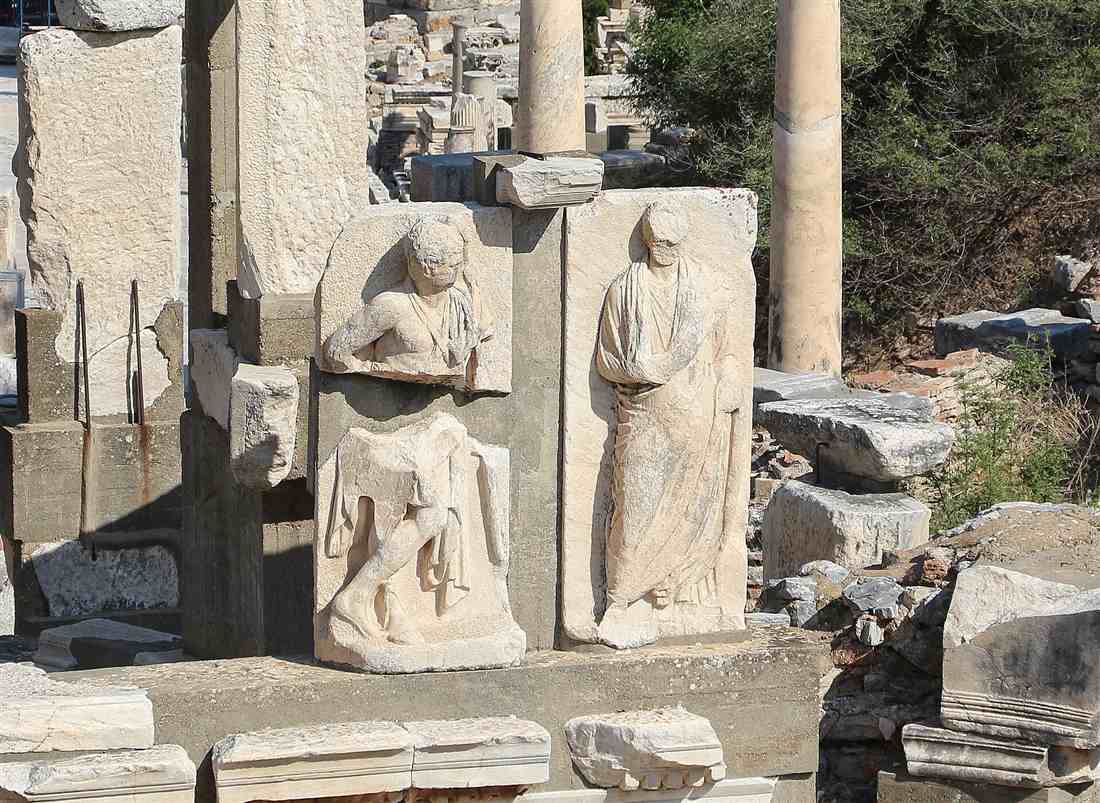
The Memmius Monument of Ephesus is the honorific monument on Domitian Square at the head of Curetes Street in Ephesus, raised in honour of Gaius Memmius, grandson of the Roman dictator Sulla, at the top of the upper city. Plan the whole trip with Greece Tours.
This guide covers the Memmius Monument in full: what it is and where it stands, who Gaius Memmius was, how the dictator Sulla connects to Ephesus, what the monument looked like and whom it honoured, the Hydreion fountain built beside it, and what is left to see at the head of Curetes Street today.
What is the Memmius Monument in Ephesus?
The Memmius Monument is a Roman honorific and funerary structure on Domitian Square at the top of Curetes Street in Ephesus, built in the first century BC to honour Gaius Memmius, grandson of the Roman dictator Sulla.
The monument stands as a tall square pier of marble blocks, dressed on its faces with figural reliefs and framed by engaged half-columns. It belongs to the family of public monuments the Romans raised across Asia Minor to mark their presence and to fix Roman names into the civic centre of a Greek city. Ephesus, capital of the Roman province of Asia, carried statements of this kind, and the Memmius Monument is the most prominent survivor at the head of the town’s main street.
The structure crowns the western edge of Ephesus where the ceremonial route bends downhill. Its re-erected blocks and carved figures give visitors their first close encounter with Roman-era sculpture on the walk, before the libraries, terraces and temples that follow along the paved descent.
Where is the Memmius Monument on the Ephesus site?
The Memmius Monument stands on Domitian Square, at the very top of Curetes Street, beside the Hercules Gate, the Pollio Fountain and the Temple of Domitian, marking the point where the marble street begins its slope down towards the Library of Celsus.
Domitian Square is the open plaza that gathers the western entrance traffic of the archaeological park. The Hercules Gate frames the head of the street a few steps away, narrowing the route so that wheeled traffic stops and the ceremonial descent begins on foot. To one side rises the terrace of the Temple of Domitian, and near the corner of the square stands the Pollio Fountain.
Visitors who enter from the upper Magnesia Gate reach the monument first, before Curetes Street opens below them. The Ephesus map places the structure at the north-west corner of the square, a fixed landmark for orientation the moment the walk starts.
Who was Gaius Memmius?
Gaius Memmius was a Roman noble of the first century BC, grandson of the dictator Lucius Cornelius Sulla through Sulla’s daughter, and the man whose family the Ephesus monument commemorates in the reordered city of the Augustan age.
The Memmii were a Roman senatorial family with ties into the eastern provinces. Gaius Memmius carried the blood of Sulla, and that descent is the reason his monument occupies a place of honour in the provincial capital rather than in Rome itself. The monument names three generations in stone: Memmius, his father Caius, and his grandfather Sulla, binding the son to the dictator through the male line of the inscription and the reliefs.
The choice of Ephesus for the memorial ties the family to the province of Asia, where Sulla’s earlier acts had left a hard mark. By the reign of Augustus the province was pacified and rebuilt, and the descendants of the men who had once fought over it were memorialised in its marble streets.
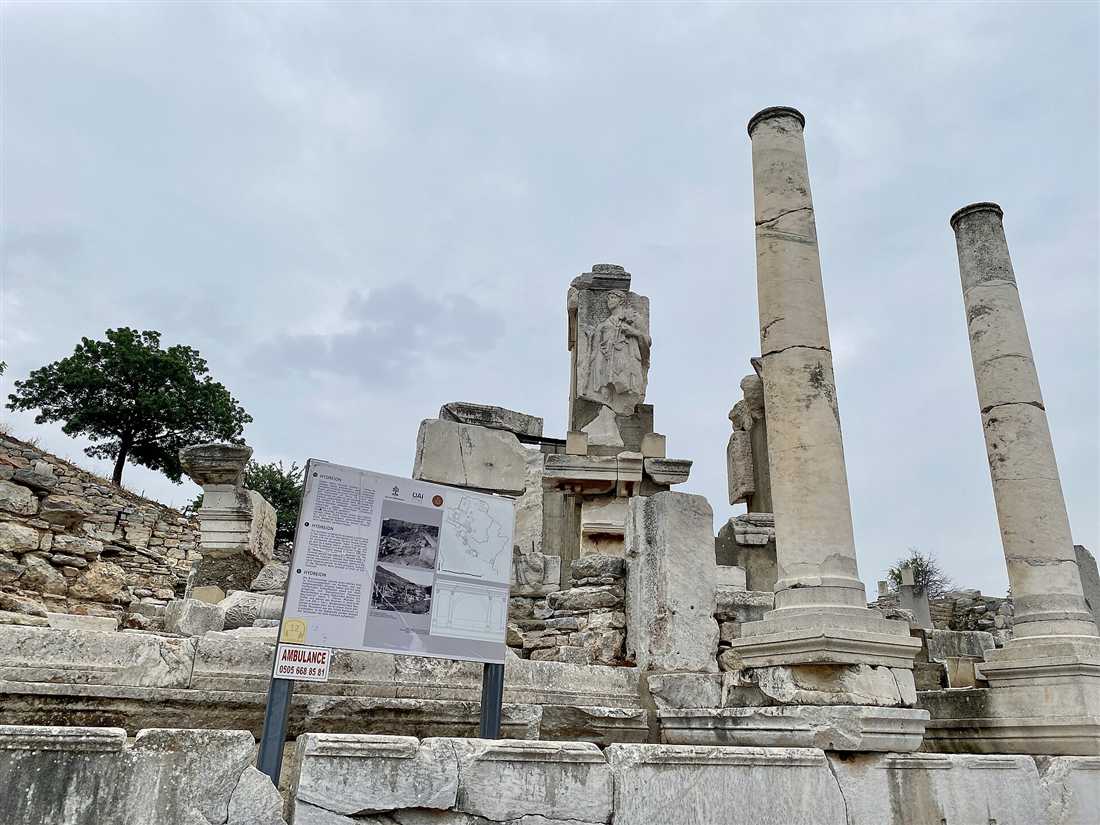
Who was Sulla and how does he connect to Ephesus?
Lucius Cornelius Sulla was the Roman dictator who marched east in the first century BC, defeated Mithridates VI of Pontus, and punished Ephesus and the other cities of Asia that had joined the Asiatic Vespers, the massacre of tens of thousands of Romans and Italians across the province.
The Asiatic Vespers was a coordinated killing ordered by Mithridates, in which the Greek cities of Asia turned on the Roman and Italian residents living among them. Ephesus took part, dragging Romans from the sanctuary of the Artemision to their deaths. When Sulla won the war, he stripped the rebel cities of privileges, imposed a vast indemnity, and quartered troops upon them.
The monument to Sulla’s grandson on Ephesian ground turns that memory into a statement of reconciliation and dominance at once. The city that once rose against Rome now honoured the dictator’s descendant at the head of its finest street, a public sign that Roman and Ephesian futures were bound together.
What did the Memmius Monument look like?
The Memmius Monument rose as a square marble pier on a stepped base, with engaged columns at its corners and relief panels carrying standing figures of Gaius Memmius, his father Caius, and his grandfather Sulla, cut in high relief against the block faces.
The three named figures stood in Roman dress within the framing architecture, their identities fixed by the inscription that ran across the structure. Between and around them the builders set decorative caryatid-like figures and carved friezes, so that the monument read as a small architectural stage of family portraiture rather than a plain inscribed block.
The upper structure carried an entablature and a crowning storey now lost, leaving the surviving pier and its reliefs as the core of what stands today. The workmanship follows Roman honorific taste of the first century BC, the standing togate figure set into a columnar frame, a form repeated on triumphal and funerary monuments across the empire.
What was the monument for?
The Memmius Monument served as a public honorific memorial to the Memmius family, raised during the Augustan restoration of Ephesus to fix a Roman lineage descended from Sulla into the ceremonial heart of the provincial capital.
Honorific monuments of this kind carried a civic purpose beyond family pride. They marked loyalty, patronage and the flow of Roman authority through the city, and they claimed the most visible ground for the names carved on them. Placing the Memmii at the top of Curetes Street set their memory in the path of every procession, magistrate and visitor who entered the town from the upper gate.
The Augustan age rebuilt Ephesus after the wars of the late Republic, and monuments like this one belong to that reordering. The city that Sulla had punished became, under Augustus, a stage for celebrating the very Roman families whose ancestors had subdued it, turning conquest into a shared civic identity in stone.
What is the Hydreion beside it?
The Hydreion is a small fountain built in late antiquity directly beside the Memmius Monument, constructed from reused marble blocks taken from the older structure and from other dismantled buildings on Domitian Square.
By the time the Hydreion was raised, the Memmius Monument had lost part of its fabric, and its dressed blocks became ready building material. The fountain drew water to the top of Curetes Street, serving the crowds who gathered at the square before descending, and it reused spolia in the practical manner of the later Roman and early Byzantine city.
The pairing of the two structures records the long life of the site: a first-century-BC honorific pier and a later utilitarian fountain sharing the same corner, the newer work quarrying the older. Their juxtaposition on the square shows how Ephesus rebuilt itself out of its own past across the centuries.
What is there to see at the Memmius Monument today?
Today visitors see the re-erected marble pier of the monument on Domitian Square, its surviving relief figures and engaged columns anastylosed into position, standing at the head of Curetes Street beside the Hydreion fountain and the Hercules Gate.
Archaeological anastylosis reassembled the scattered blocks into a legible upright structure, so the pier reads again as architecture rather than a heap of stone. The relief faces preserve the framed standing figures, weathered but recognisable, and the corner columns carry their capitals where the fabric survived.
From the monument the eye follows the marble slope of Curetes Street downhill towards the terraced houses and the Library of Celsus. The structure works as the opening set piece of the walk, the first monument the visitor studies at close range and a fixed marker for the route that unfolds below.
How does the monument fit an Ephesus visit?
The Memmius Monument opens the standard Ephesus walk, standing at the top of Curetes Street where visitors entering from the upper Magnesia Gate begin the downhill descent past the Pollio Fountain, the Temple of Domitian and on towards the Library of Celsus and the Great Theatre.
Most guided routes start at the upper gate and move downhill, so the monument is the first major stop after the Hercules Gate. Reaching it early sets the chronology of the walk, a Roman-era honorific piece framing the entrance to the ceremonial street that carries the visitor through the civic and commercial heart of the ruined city.
Pairing the monument with its neighbours on Domitian Square gives a compact opening cluster before the longer descent. From here the paved street runs down past terraced houses, fountains and gates to the Library of Celsus, making the Memmius Monument the natural threshold of the whole Ephesus route.
Frequently Asked Questions
What is the Memmius Monument in Ephesus?
The Memmius Monument is an honorific monument on Domitian Square at the top of Curetes Street in Ephesus, raised for Gaius Memmius, grandson of the dictator Sulla. Its square structure carried figures of Memmius, his father and Sulla.
Who was Gaius Memmius?
Gaius Memmius was the grandson of the Roman dictator Sulla. The monument on Domitian Square honours his family, a mark of the restored bond between Ephesus and Rome in the Augustan age.
Where is the Memmius Monument on the Ephesus map?
The Memmius Monument stands on Domitian Square at the top of Curetes Street, near the Hercules Gate, the Pollio Fountain and the Temple of Domitian, where the downhill walk through the city begins.