
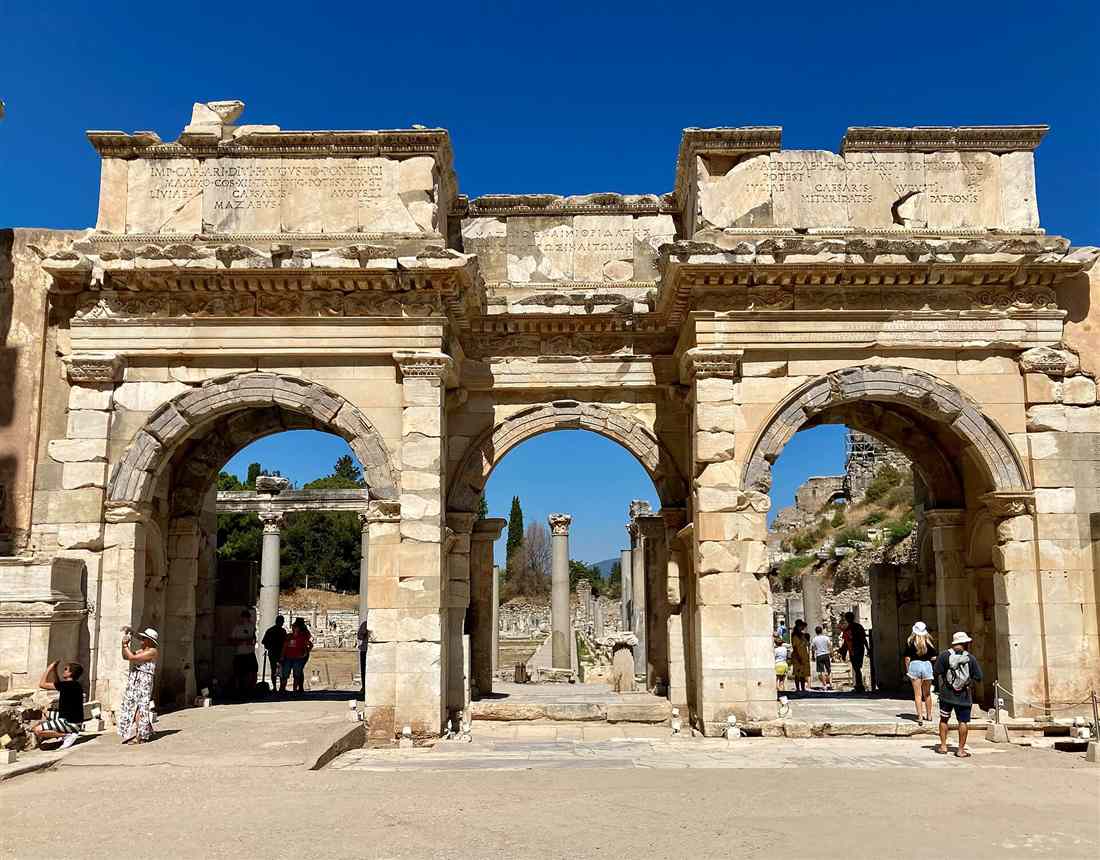
The Gate of Mazeus and Mithridates is the triple-arched marble gate into the Commercial Agora beside the Library of Celsus in Ephesus, built by two freedmen for the emperor Augustus and his family and also called the Gate of Augustus. Plan the whole trip with Greece Tours.
This guide covers the Gate of Mazeus and Mithridates in full: what the gate is and where it stands, who Mazeus and Mithridates were, who the gate honoured, what its inscription says, what the arches looked like, what the gate was used for, how it ties to the Library of Celsus, and what is left to see at the corner of the Commercial Agora today.
What is the Gate of Mazeus and Mithridates?
The Gate of Mazeus and Mithridates is a triple-arched marble gateway in Ephesus, built in the first century BC as the monumental south entrance into the Commercial Agora, standing directly beside the Library of Celsus.
The monument carries a second name, the Gate of Augustus, because two freedmen dedicated it to the emperor Augustus and his family. Its three passageways cut through a solid marble screen, the widest arch in the centre flanked by two narrower arches, all crowned by a tall attic band that carried the dedicatory inscription in Latin and Greek.
The gate belongs to the imperial reconstruction of the city, when Ephesus served as the capital of the Roman province of Asia. Builders faced the structure in white marble, matched its proportions to the neighbouring civic buildings, and set it as the formal threshold between the paved public street and the enclosed market square. The structure survives today as one of the best-preserved Roman gateways on the site.
Archaeologists group the gate with the great building programme that reshaped the lower city under the first emperors. Marble replaced earlier stone, colonnades framed the streets, and monumental gates marked the entrances to public squares. The Gate of Mazeus and Mithridates fixes the date of the Commercial Agora rebuild to the reign of Augustus and ties the market directly to the imperial capital of the province of Asia.
Where is the gate on the Ephesus site?
The gate stands at the south-east corner of the Commercial Agora, immediately west of the Library of Celsus, at the foot of Marble Street. It marks the point where the paved processional street meets the market square.
Visitors reach the gate on the standard walking route that descends Curetes Street to the Library of Celsus. The Library facade rises on the left of the small plaza, and the triple arch opens on the right, so the two monuments share a single dramatic corner. Passing through the arches leads directly into the open rectangle of the Commercial Agora, the trading heart of Roman Ephesus.
North of the gate, Marble Street runs toward the Great Theatre and the Arcadian Way to the ancient harbour. The Ephesus map places the gate at the pivot of the lower city, linking the library district, the market and the theatre approach in one connected sequence of paved public space.
Who were Mazaeus and Mithridates?
Mazaeus and Mithridates were two freed slaves, one a former slave of the emperor Augustus and the other of his general and son-in-law Marcus Agrippa. After gaining their liberty, the two men paid for the gate to honour their former masters and patrons.
Their names reveal eastern origins, and their new status as Roman freedmen gave them the wealth and standing to fund a public monument in a provincial capital. Erecting a marble gate dedicated to the ruling dynasty announced their loyalty, repaid the patronage that raised them, and fixed their own names permanently in the civic centre of the city.
The act reflects a wider Roman practice in which prosperous freedmen financed public buildings to display gratitude and secure prestige. By placing their gift at the entrance of the Commercial Agora, Mazaeus and Mithridates ensured that every merchant and citizen entering the market read their names beside those of the imperial family.
Who was the gate dedicated to?
The gate honours the emperor Augustus, his wife Livia, his daughter Julia and his son-in-law Marcus Agrippa. The four members of the imperial family stand named in the inscription across the attic, presented as the patrons of the two freedmen who built the monument.
The dedication ties the gate to the founding generation of the Roman imperial house. Augustus ruled as the first emperor, Livia held the position of empress, Agrippa commanded the armies and fleets that secured the empire, and Julia linked the two men as daughter of Augustus and wife of Agrippa. Naming all four bound the monument to the dynastic order that governed the province of Asia.
The dedication served a clear civic purpose. It broadcast imperial loyalty at the busiest threshold in the lower city, aligned the local market with the authority of Rome, and marked Ephesus as a city that celebrated the ruling family in stone and marble at the entrance to its commercial life.
What does the inscription on the gate say?
The inscription runs in both Latin and Greek across the attic of the gate. It names Augustus, Livia, Julia and Agrippa as the honoured patrons, then records that Mazaeus and Mithridates, the freedmen who built the gate, dedicated it to their masters and to the people of Ephesus.
The bilingual text matched the population of the city, where Latin marked the official language of Roman power and Greek remained the everyday speech of the province. Cutting the dedication in both scripts addressed the administration and the citizens together, and let every reader identify the ruling family and the two donors at a glance.
The letters stood in large bronze forms fixed into the marble, so the words caught the light above the arches. The inscription places the freedmen’s names in permanent partnership with the imperial house, turning the gate into a public statement of gratitude, status and civic gift for all who crossed the threshold.
The wording follows the standard formula of Roman dedicatory texts, opening with the names and titles of the honoured family, then recording the donors and the act of dedication. This structure let a reader grasp the hierarchy at once: the imperial house came first, the freedmen and the people of Ephesus followed. The inscription thus doubles as a record of who paid, who ruled, and who benefited from the gift.
What did the gate look like?
The gate presents three arched passageways in a broad marble screen, the central arch taller and wider than the two side arches. A deep attic block crowns the arches, faced with the bilingual inscription, and the whole facade rises in white marble that answers the neighbouring library front.
Engaged columns and pilasters frame the openings, dividing the wall into a rhythm of solid piers and open arches. The design belongs to the type of Roman monumental gateway that treats an entrance as a triumphal screen rather than a plain doorway, so the structure reads as an ornament and a threshold at the same time.
The proportions of the gate deliberately echo the two-storey facade of the Library of Celsus a few metres away. The two monuments share cornice lines, marble colour and a matched sense of scale, so the corner they define reads as a single composed architectural set piece framing the entrance to the market.
What was the gate used for?
The gate served as the monumental south entrance from Marble Street into the Commercial Agora, the great market square of Roman Ephesus. Merchants, shoppers and citizens passed through its three arches to reach the trading colonnades, shops and open selling floor of the agora.
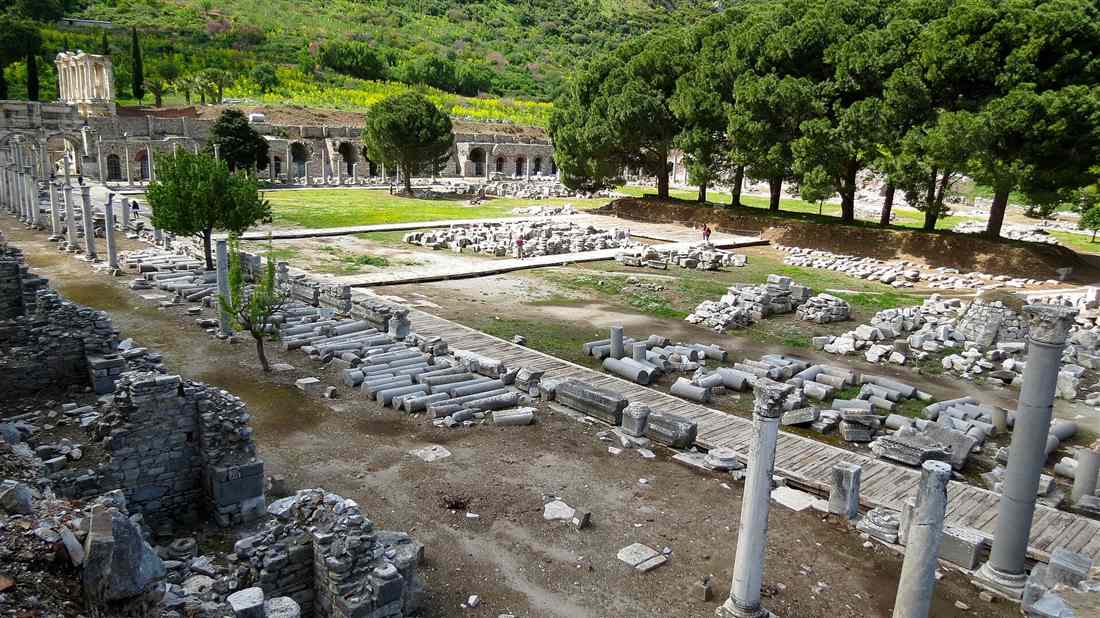
The Commercial Agora measured roughly a hundred and ten metres on each side, a vast square ringed by two-storey colonnades that sheltered shops and stalls. As the busiest commercial space in the lower city, it drew a constant flow of people, and the triple gate channelled that traffic through a single controlled and dignified threshold.
The three passageways split the crowd into ordered lanes, the wide central arch carrying the main flow and the side arches easing the press. Positioned at the meeting of the market and the processional street, the gate marked the transition from public civic space to the enclosed world of trade, and framed that passage as a celebrated architectural event.
How is the gate linked to the Library of Celsus?
The gate and the Library of Celsus share the same paved corner of the lower city, and their marble facades were designed to harmonise. The two monuments stand a few metres apart, matched in scale, colour and cornice line, so they read as one composed architectural group.
The Library rose as a grand two-storey facade honouring the Roman senator Tiberius Julius Celsus Polemaeanus, and the gate answered it across the small plaza with its triple arch and inscribed attic. Walking the site, a visitor takes in both fronts in a single view, then passes through the gate to enter the market directly behind the library corner.
The pairing creates one of the most photographed spaces in Ephesus. The library facade closes the plaza on one side, the gate opens it on the other, and the route between them carries the walker from the civic monument of learning straight into the commercial life of the agora, uniting the two functions in one connected marble stage.
What is there to see at the gate today?
Visitors see the restored triple arch standing in white marble, the tall attic that carried the bilingual inscription, and the open expanse of the Commercial Agora stretching behind the passageways. The gate anchors the celebrated corner beside the Library of Celsus.
Restoration work re-erected the three arches and the piers between them, so the gate stands close to its original height and preserves the shape of its central and side openings. The marble screen frames a clear view into the agora, letting a visitor read the monument as both an entrance and a backdrop to the market square beyond.
The gate rewards a slow pause on the plaza it shares with the Library of Celsus, at the foot of Marble Street. From this point a walk continues north toward the Great Theatre, and the connected sights of the lower city sit together on the Ephesus map, making the corner a natural centre of any visit to Ephesus.
Frequently Asked Questions
What is the Gate of Mazeus and Mithridates?
The Gate of Mazeus and Mithridates is the triple-arched marble gate into the Commercial Agora of Ephesus, beside the Library of Celsus. Two freedmen, Mazeus and Mithridates, built it to honour the emperor Augustus and his family.
Who built the Gate of Mazeus and Mithridates?
Mazeus and Mithridates, two freed slaves of the emperor Augustus and his son-in-law Agrippa, paid for the gate. Its inscription names them as the builders and dedicates the gate to their imperial patrons.
Where is the gate on the Ephesus map?
The gate stands at the south-east corner of the Commercial Agora, right beside the Library of Celsus at the foot of Marble Street, where the walking route turns toward the Great Theatre.